
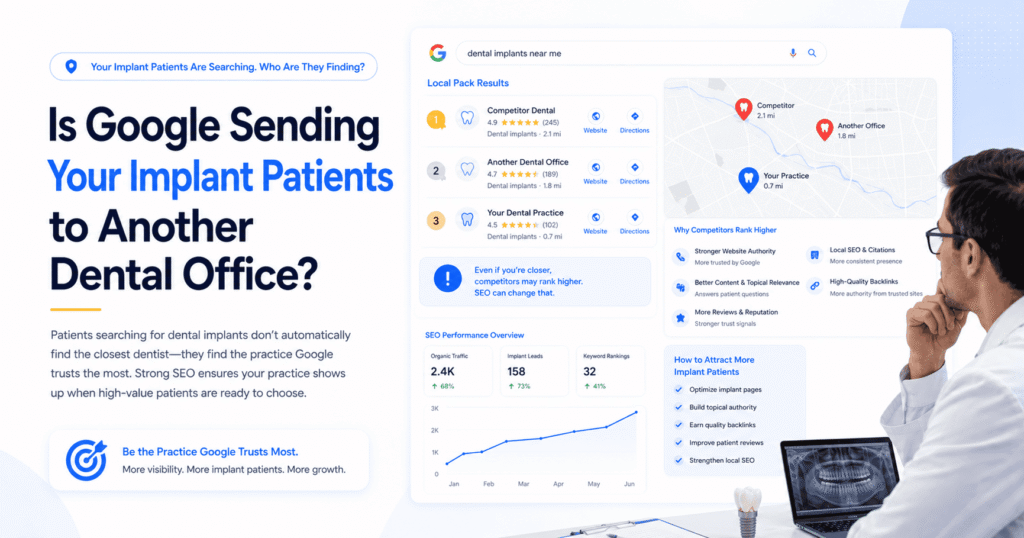
Somewhere in your city right now, a patient with three missing teeth is typing “dental implants near me” into their phone. They’re not going to call the closest practice. They’re not going to call the practice with the most years in business, or the one with the nicest office. They’re going to call whichever practice Google decides to show them first, and if that isn’t your practice, that patient and the $3,000 to $8,000+ case attached to them just became someone else’s new patient.
This isn’t a hypothetical. Implant cases are some of the highest-value, highest-intent searches in dentistry, and the practices winning them aren’t necessarily the best implant providers in the area. They’re the practices that have told Google, clearly and repeatedly, exactly what they do and why they should be trusted to do it.
If your implant case volume feels disconnected from your clinical reputation, this is usually why.
What “Winning” an Implant Search Actually Requires
Google’s local ranking system evaluates every dental practice on three factors: relevance, distance, and prominence. Distance is the only one you can’t influence, and here’s the part most practice owners get wrong: distance is frequently the weakest of the three. A practice a mile further away with stronger relevance and prominence signals will regularly outrank the closer, quieter competitor.
One geo-grid analysis found exactly this pattern with a dental clinic: a competitor located 0.8 miles further away still ranked two spots higher in the Map Pack. The reason wasn’t proximity. It was 190 reviews versus 60, a local news mention, and clean, complete business listing data. The closer clinic had none of that working in its favour.
That’s the uncomfortable truth behind the question in this article’s title. Google isn’t sending your implant patients to the closest office, or even necessarily the best one clinically. It’s sending them to whichever practice has built the strongest trust signature, and that signature is built well before the patient ever types a search.
The Signals Deciding Who Ranks for Implant Searches
Your Google Business Profile Category and Whether It Even Mentions Implants
Your primary Google Business Profile category is the single strongest relevance signal Google has for matching your listing to a search. A practice generating a meaningful share of revenue from implants but still listed simply as “Dentist” is leaving that signal on the table entirely. A more specific primary category, or a dedicated secondary category, tells Google directly that your listing is a legitimate answer to an implant-specific search.
Beyond the category, GBP allows individual service listings. Every high-value procedure should appear as its own named entry: “Dental Implants,” “All-on-4,” “Implant-Supported Dentures,” “Full Arch Restoration.” A generic “General Dentistry” bucket with no procedure-level detail tells Google nothing about implant relevance specifically. GBP signals alone are estimated to carry roughly a third of total local ranking weight, making this the single highest-leverage fix available to most practices.
Reviews That Actually Say “Implants”
Not all five-star reviews carry equal weight. A generic “great experience, friendly staff” review tells Google very little about what procedure happened. A review that specifically mentions “implants,” “All-on-4,” or “implant-supported dentures” is a direct relevance signal. It tells Google’s algorithm exactly what this practice provides, in the patient’s own words.
Practices in the top three Map Pack positions for competitive dental searches average 150+ reviews at a 4.5+ star rating. Volume matters, but specificity matters more for procedure-level rankings: a practice with 80 reviews that consistently name the treatment will often outperform a practice with 150 generic ones on implant-specific queries.
A Dedicated Implant Page, Not a Mention on Your Services List
A single line under “Services We Offer” does almost nothing for implant rankings. Implants need a standalone page: 1,000 to 1,800 words, a direct-answer opening paragraph addressing the most common patient question (“How much do dental implants cost in [city]?”), FAQ content, and your city or service area named in the title, H1, intro paragraph, and meta description.
This matters even more with AI-generated search results in the mix. Google’s AI Overviews now appear for a growing share of implant-related searches, including high-intent queries like “best dental implants in [city]” and “how much do dental implants cost.” Practices that show up in AI Overview results consistently share the same characteristics: structured FAQ content, named provider credentials, and direct-answer formatting that AI systems can extract and cite. A practice without a real implant page isn’t just losing traditional rankings. It’s invisible to the AI layer that’s increasingly answering these questions before the patient ever clicks a link.
Local Trust Signals Beyond Your Own Website
Google cross-references your practice against external sources to validate what you claim about yourself. High-authority listings such as Zocdoc, Healthgrades, the ADA Find-a-Dentist directory, and WebMD/Vitals carry real weight in this cross-referencing, particularly for a YMYL (Your Money or Your Life) category like healthcare, where Google’s quality bar is deliberately higher than for a typical local business.
Backlinks work the same way, but quality matters far more than quantity. A single link from a local news story or a chamber of commerce carries more ranking value than dozens of generic directory submissions. Google increasingly weights unstructured mentions (Reddit threads, “best of” lists, community discussion) alongside traditional backlinks as authority signals, on top of structured citations.
Want to find out if a competitor is outranking you for implant searches right now?
Why This Matters More for Implants Than Almost Any Other Procedure
Implant cases are disproportionately valuable, and disproportionately worth fighting for in search. Just two additional implant cases per month, even from modest marketing improvement, can represent $72,000 to $120,000 in additional annual revenue for a practice, and for practices placing and restoring in-house, margins on those cases typically exceed 60%.
The search behaviour backs up why this is a search-visibility problem specifically, not a word-of-mouth or reputation problem. The large majority of patients research potential providers online before booking, and trust what past patients say more than almost anything else in the decision. An implant patient isn’t asking their neighbour which practice to call. They’re searching, comparing what comes up, and reading reviews before they ever pick up the phone, which means the practices absent from that search results page are absent from consideration entirely, regardless of how strong their clinical reputation is offline.
Our dental SEO services are specifically built around this kind of procedure-level visibility, not generic rankings that don’t convert to high-value cases.
Common Mistakes Implant Providers Make
Burying implants inside a general services page. If implants don’t have a dedicated URL, Google has no dedicated page to rank for implant-specific searches. No amount of clinical excellence changes that.
Leaving GBP categories generic. “Dentist” alone competes with every general practice in the city for every search. A practice built around implant volume needs its GBP listing to say so explicitly, in the category field itself.
Treating reviews as a volume game only. 150 generic reviews are worth less for implant rankings than 80 reviews that specifically mention the procedure. Asking patients to name what treatment they had, when appropriate and HIPAA-compliant, is a small operational change with an outsized relevance impact.
Assuming reputation transfers automatically to search visibility. A decade of referrals and word-of-mouth trust means nothing to Google’s algorithm if it isn’t reflected in structured signals: category data, named services, specific reviews, dedicated content. Offline reputation and online relevance are two different systems, and only one of them is visible to a patient searching cold.
Ignoring AI Overviews as “not real traffic yet.” Structured, direct-answer content is what gets cited in AI-generated results for implant queries today, not a future consideration. Practices building this now are positioning ahead of a channel that’s only going to carry more search volume from here.
Are any of these mistakes costing your practice implant cases every month?
What to Actually Fix First
If implant cases feel like they’re going to competitors despite a strong clinical track record, this is the order that typically moves the needle fastest:
- Audit your GBP category and service listings first. This is the single highest-leverage, lowest-cost fix, and it can often be corrected in an afternoon.
- Build a real, dedicated implant page with direct-answer content addressing cost, process, and candidacy questions up front, not a paragraph on a general services page.
- Start asking satisfied implant patients to name the procedure in their review, in a HIPAA-compliant way that leaves the choice entirely to the patient.
- Pursue a small number of high-quality local links such as a chamber of commerce mention, a local news feature, or a genuine community partnership, rather than volume directory submissions that carry little weight on their own.
- Check whether your practice shows up when you search your own implant queries, including inside AI Overviews. If it doesn’t, that’s the exact gap costing you cases right now.
Not sure where your implant visibility gaps actually are? We can show you in a free audit.
The Bottom Line
Google doesn’t send implant patients to the closest practice, and it doesn’t send them to the practice with the strongest clinical reputation either. It sends them to the practice that has made its expertise legible to an algorithm: through category data, named services, specific reviews, and real content built around the procedure.
If a competitor with less clinical experience is consistently outranking you for implant searches, the gap almost never lives in the operatory. It lives in a handful of missing signals that are usually straightforward to fix once they’re actually identified. We don’t do everything. We only do Dental SEO. Rank. Be found. Grow.
Frequently Asked Questions
Why would a less experienced practice outrank mine for dental implant searches?
Because Google ranks based on relevance and prominence signals: GBP category, named services, review specificity, dedicated content, not years in practice or clinical reputation. A newer practice with stronger digital signals will regularly outrank a more established one.
Does proximity guarantee a top Map Pack ranking?
No. Distance is one of three ranking factors and is frequently outweighed by prominence signals like reviews, citations, and content strength. A practice further from the searcher can and often does outrank a closer one.
What is the single fastest fix for implant search visibility?
Auditing and correcting your Google Business Profile category and named service listings. It’s typically the highest-impact, lowest-effort change available, and can often be done in under a day.
Do reviews need to mention “implants” specifically to help rankings?
Specific procedure mentions in reviews are a stronger relevance signal than generic positive reviews. A practice can encourage this by inviting patients to share what treatment they had, while leaving that choice entirely to the patient.
Do AI Overviews affect implant search visibility?
Yes, increasingly. AI Overviews already appear for high-intent implant queries, and the practices being cited share structured FAQ content and direct-answer formatting. A practice without real implant content is losing visibility in AI-generated results, not just traditional search.
How much revenue is actually at stake in implant search visibility?
Two additional implant cases per month can represent $72,000 to $120,000 in additional annual revenue for a practice, with margins on in-house cases typically exceeding 60%, making implant search visibility one of the highest-ROI areas to fix.
Is a single “Implants” line on my services page enough?
No. Implants generally need a dedicated, standalone page with direct-answer content, FAQs, and geographic targeting to compete for procedure-specific searches. A general services page rarely ranks for anything beyond the broadest, least valuable queries.
Key Takeaways
- Google ranks for implant searches based on relevance, distance, and prominence. Distance is the weakest signal: a competitor further away with stronger signals will regularly outrank you.
- Your GBP primary category and named service listings carry roughly a third of total local ranking weight, and are often the highest-leverage fix available.
- Reviews mentioning the specific procedure (“implants,” “All-on-4”) are a stronger signal than generic positive reviews at the same volume.
- A single line on a services page does almost nothing. Implants need a dedicated page with direct-answer content, FAQ structure, and geographic targeting.
- AI Overviews are already appearing for high-intent implant queries. Practices without structured implant content are invisible to this layer, not just traditional search.
- Offline reputation and online relevance are two entirely separate systems. Clinical excellence does not automatically translate into search visibility.
- Two additional implant cases per month can represent over $100,000 in additional annual revenue, making this one of the highest-ROI improvements in dental marketing.
Implant patients are searching in your city right now. Are they finding you?
We don’t do everything. We only do Dental SEO. Our team audits implant search visibility every day and shows practices exactly which signals are missing. More patients, not just rankings.
Written by the Dental Master Media SEO team. We don’t do everything. We only do Dental SEO, for independent dental practices across the USA, UK, Canada, Australia, New Zealand, and Singapore.

Suraj Rana is the owner of Dental Master Media and a leading expert in SEO for dental practices. With a passion for dental marketing, he has successfully helped numerous dental clinics climb the search engine ranks. Suraj’s expertise makes him a go-to resource for effective, results-driven dental marketing.