
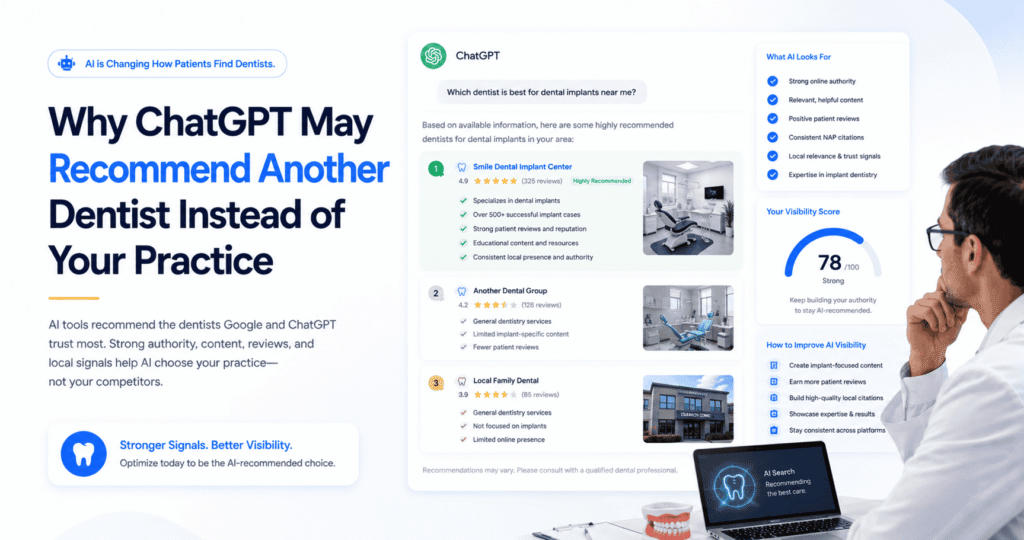
A patient wakes up at 2 a.m. with a throbbing jaw. She doesn’t open Google and scroll through ten blue links. She opens ChatGPT and types: “best dentist near me for emergency root canal.” In seconds, the AI names two or three practices, summarises what each offers, and tells her which one is taking new patients tonight.
If your practice isn’t one of those two or three names, you never existed in that conversation, and you’ll never know the patient, or the case, you lost.
This isn’t a future scenario. AI search platforms already influence a majority of dental patient research decisions, and the share is highest among exactly the patients most practices want more of: those under 40. If your online presence was built for Google’s ten blue links and nothing else, there’s a real chance a growing slice of your search traffic is quietly being redirected to a competitor without you ever seeing it happen.
Why This Is a Different Problem Than Traditional SEO
Traditional search still shows a list of results and lets the patient decide. AI search doesn’t. When a patient asks ChatGPT, Google AI Overviews, Gemini, or Perplexity for a dentist, they get a synthesised, direct answer, often naming just one to three practices, not a page to browse. You’re not competing for a ranking position anymore. You’re competing to be one of a small number of names that make it into the answer at all.
That distinction matters because ranking on page one of Google no longer guarantees inclusion in an AI answer, and appearing in an AI answer no longer requires ranking on page one. Research tracking the overlap between top Google results and AI-cited sources found that overlap has dropped from around 70% to below 20%, meaning the practice that dominates traditional search results in your city may be entirely absent from what ChatGPT tells a patient tonight, while a smaller competitor with cleaner AI signals gets named instead.
What AI Actually Looks At Before Recommending a Dentist
AI systems don’t read your website the way a person does. They’re scanning for specific, verifiable signals that tell them your practice is real, credible, locally relevant, and trusted, and they pull those signals from across the web, not just your homepage.
Structured, direct-answer content. AI tools favour content that answers a specific question clearly and immediately. A page that opens with “Root canal treatment typically costs $700 to $1,500 and takes 60 to 90 minutes” gives an AI something concrete to extract and cite. A page that opens with “Welcome to our practice, where your smile is our priority” gives it nothing usable.
Consistent, verifiable business data. AI systems cross-reference your Google Business Profile, healthcare directories (ADA Find-a-Dentist, Healthgrades, Zocdoc, Vitals), and your website against each other. Inconsistent hours, mismatched addresses, or an incomplete profile don’t just hurt Google Maps rankings. They actively undermine whether an AI can confidently verify your practice is a safe answer to recommend.
Reviews that mention specifics, not just star ratings. A generic five-star review tells an AI system almost nothing. A review that mentions “gentle with anxious patients,” “same-day emergency appointment,” or a named procedure gives the AI verifiable proof of a specific claim it can cite. One analysis of AI visibility testing found that a single review naming a specific strength is worth more to an AI recommendation than ten generic five-star ratings.
Unlinked mentions, not just backlinks. Traditional SEO cares about links pointing to your site. AI systems also track mentions that never link back at all: a local news story, a podcast appearance, a community sponsorship writeup, a mention in a local subreddit. These function as independent verification that your practice is real and locally trusted, even without a clickable link attached.
Freshness and recency. AI tools weigh how current your information is, not just how much of it exists. A review from six months ago carries more weight than one from three years ago, and content with visible, recent update dates is more likely to be treated as trustworthy than a page that hasn’t changed since earlier in the decade.
Want to find out whether ChatGPT or Google AI Overviews are recommending your practice right now?
Why This Matters More Than It Might Seem Right Now
It’s tempting to treat this as a future problem, but the volume is already real and growing fast. AI assistants now serve hundreds of millions of weekly active users, and a substantial share of what people ask these tools for is specifically recommendations. For healthcare specifically, roughly a third of patients now say they include an AI consultation somewhere in their provider search process, and that number is meaningfully higher among patients under 40, precisely the demographic building lifetime patient relationships that carry the most long-term value for a practice.
The traffic pattern is also easy to miss if you’re not looking for it. Because AI referrals often show up as direct traffic or unattributed phone calls rather than a clearly labelled channel, a practice can be losing a meaningful number of patients to AI-invisible competitors without any single metric flagging it. The first real signal most practices get is a new patient mentioning “ChatGPT” on an intake form, well after the pattern has already been happening for months.
Our dental SEO services include GEO (Generative Engine Optimisation) specifically so your practice builds visibility in AI-generated answers, not just traditional search results.
Common Mistakes That Make AI Recommend Someone Else
Treating your website as a brochure instead of an answer bank. Marketing language like “your smile is our priority” gives AI systems nothing to extract or cite. Every core page should answer a real question a patient would ask, directly and specifically, in the opening lines.
Letting directory listings drift out of sync. An outdated phone number on Healthgrades or an address mismatch between your website and Google Business Profile doesn’t just confuse patients. It actively signals to AI systems that your practice’s information can’t be verified, which is disqualifying for a recommendation engine built to avoid citing unreliable sources.
Chasing review volume without review specificity. A hundred generic five-star reviews are a weaker AI signal than twenty reviews that name specific strengths: sedation options, paediatric comfort, emergency availability, a particular procedure done well. Volume helps traditional SEO; specificity is what AI systems actually extract and cite.
Assuming AI visibility is a “later” problem. Practices waiting to see how the AI search shift plays out before investing in it are the ones most likely to discover the shift already happened, quietly, in a competitor’s favour, months before they noticed anything in their numbers.
Ignoring unlinked brand mentions entirely. A practice fixated only on backlinks is missing a growing category of trust signal. A local news mention, a sponsorship writeup, or a guest appearance on a dental podcast builds exactly the kind of independent verification AI systems are trained to weigh, with no link required.
Are any of these mistakes making your practice invisible to AI search right now?
What to Actually Do About It
If you want to know where you stand today, the fastest test costs nothing: open ChatGPT, Google AI Overviews, and Perplexity and ask the exact questions a patient would ask: “best emergency dentist near [your city],” “dentist who takes anxious kids in [your city].” Note whether your practice appears, and how it’s described if it does.
From there, the highest-leverage fixes are usually:
- Rewrite key service pages to open with a direct, specific answer to the question a patient is actually asking: cost, timeframe, what to expect, before any marketing language.
- Audit and correct your business listings across every directory where your practice appears, so an AI system cross-referencing your name, address, phone, and hours finds the same answer everywhere.
- Build a steady, ongoing flow of specific reviews, not just a high star rating. Reviews that name procedures, staff qualities, or specific patient experiences carry more AI weight than volume alone.
- Pursue a small number of genuine, unlinked local mentions such as a news feature, a podcast appearance, or a documented community event, as deliberately as you’d pursue a backlink.
- Keep content visibly current, with real update dates and refreshed information, since AI systems weigh recency as part of trustworthiness.
Ready to make your practice visible to the patients asking AI for a dentist?
The Bottom Line
The patient asking ChatGPT for a dentist tonight isn’t comparing a page of options. They’re getting handed two or three names and calling one of them. Whether your practice is one of those names has very little to do with how good your dentistry is, and everything to do with whether your online presence gives an AI system enough verifiable, specific, current information to trust you as the answer.
That’s a fixable problem, but only if it’s treated as its own discipline rather than an assumed side effect of good traditional SEO. We don’t do everything. We only do Dental SEO. Rank. Be found. Grow.
Frequently Asked Questions
Is ChatGPT actually recommending dentists to patients right now?
Yes. AI search platforms already influence a majority of dental patient research decisions, and usage is growing quickly, particularly among patients under 40.
Does ranking #1 on Google guarantee I’ll be recommended by ChatGPT?
No. The overlap between top Google results and AI-cited sources has dropped sharply, meaning strong traditional rankings do not guarantee AI visibility. The two are increasingly decided by different signals.
What is the fastest way to check my current AI visibility?
Open ChatGPT, Google AI Overviews, and Perplexity and ask the exact questions a patient would ask, such as “best emergency dentist near [your city].” Note whether your practice appears and how it’s described.
Do reviews need to be longer or more detailed to help AI visibility?
They need to be more specific, not necessarily longer. A review naming a particular strength, such as gentle with anxious patients or fast emergency scheduling, carries more weight with AI systems than a generic five-star rating.
Does my practice need backlinks to be recommended by AI?
Backlinks still help, but AI systems also weigh unlinked mentions such as local news coverage, podcast appearances, and community sponsorships as independent trust signals, even without a clickable link.
How is Generative Engine Optimisation (GEO) different from regular SEO?
SEO aims to rank your website in a list of search results. GEO aims to get your practice named directly inside an AI-generated answer, which depends more heavily on structured, verifiable, and consistent information than on traditional ranking factors alone.
How would I even know if I’m losing patients to AI-invisible competitors?
It’s easy to miss, since AI referrals often show up as direct traffic or unattributed calls rather than a labelled channel. Asking new patients how they found you, and testing your own AI visibility directly, are the most reliable ways to catch it early.
Key Takeaways
- AI search tools are already influencing dental patient decisions, particularly among patients under 40, and the share is growing.
- The overlap between top Google results and AI-cited practices has dropped below 20%, meaning traditional SEO no longer guarantees AI visibility.
- AI systems scan for direct-answer content, consistent business data, specific reviews, unlinked mentions, and freshness, not ranking position.
- A practice invisible to AI isn’t just missing some traffic. It’s being excluded from the entire conversation a patient is having before they ever pick up the phone.
- Specific reviews naming a procedure or a practice strength are worth more to an AI recommendation than ten generic five-star ratings.
- AI referrals frequently show up as direct traffic or unattributed calls, meaning the loss is invisible until you actively test for it.
- GEO (Generative Engine Optimisation) is a separate discipline from traditional SEO, and both are needed now.
A patient is asking ChatGPT for a dentist in your city right now. Are you being named?
We don’t do everything. We only do Dental SEO. Our team checks your AI and traditional search visibility and shows you exactly where the gaps are. More patients, not just rankings.
Written by the Dental Master Media SEO team. We don’t do everything. We only do Dental SEO, for independent dental practices across the USA, UK, Canada, Australia, New Zealand, and Singapore.

Suraj Rana is the owner of Dental Master Media and a leading expert in SEO for dental practices. With a passion for dental marketing, he has successfully helped numerous dental clinics climb the search engine ranks. Suraj’s expertise makes him a go-to resource for effective, results-driven dental marketing.