
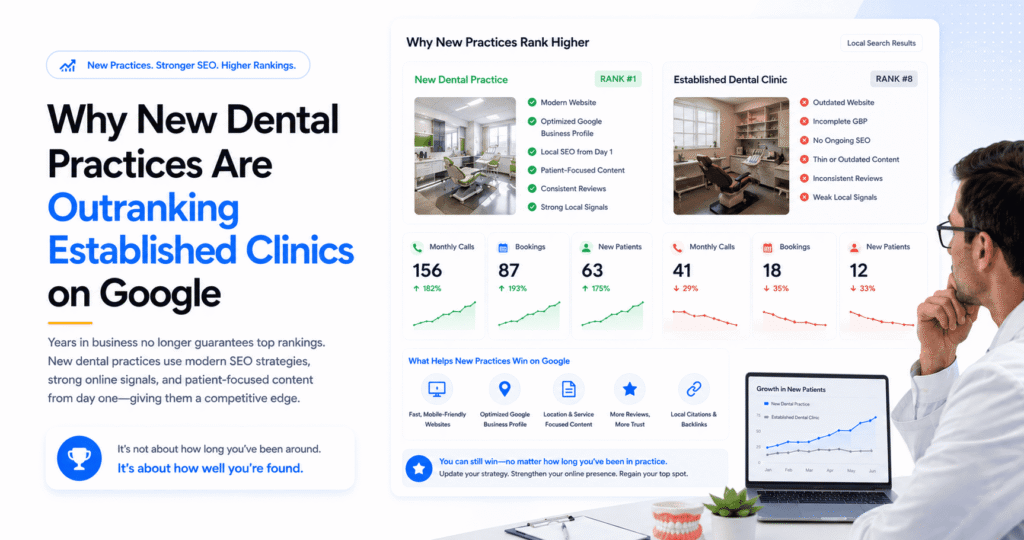
A practice that opened eighteen months ago is outranking the clinic down the street that’s been treating three generations of the same families for twenty years. The established practice has more patients, more reviews accumulated over decades, and a far deeper local reputation, and it’s nowhere to be found on page one for “dentist near me.”
This isn’t a glitch, and it isn’t unfair. Google has never ranked practices by how long they’ve existed. It ranks them by how clearly and consistently they demonstrate relevance, trust, and technical quality right now, and newer practices, built without two decades of accumulated technical debt, are frequently doing that better.
If a younger competitor is consistently beating a longer-established practice in search, the years in business were never the advantage they felt like. Here’s what actually was, and why it’s now missing.
The Myth That’s Costing Established Practices the Most
Domain age and years in business feel like they should matter to Google, and they don’t, not directly. Google’s own spokespeople have confirmed repeatedly that domain age itself is not a ranking factor, and the pattern SEOs observed for years (older sites tend to rank better) was always a correlation, not a cause. Older sites often rank well because they’ve had more time to accumulate backlinks, build out content, and earn trust signals, not because of the calendar date on their registration.
That distinction matters enormously for an established dental practice, because it means the advantage was always the accumulated signals, not the years themselves, and those signals decay if they aren’t actively maintained. A practice that built a strong website years ago and hasn’t meaningfully touched it since isn’t coasting on a decade of authority. It’s sitting on a decade of technical debt: broken redirects, outdated URL structures, orphaned pages, and content that was never refreshed to reflect what Google now expects.
What Newer Practices Are Actually Doing Right
New practices don’t win by accident, and they don’t win because Google favours them. They win because they’re building with a genuinely clean slate, and they usually do a handful of specific things established clinics have let slide.
They launch with zero technical debt. A new domain has no orphaned pages, no legacy URL structure, no years of accumulated broken redirect chains. A new practice’s website is fast and clean by default; an established practice’s site frequently isn’t, because nobody has gone back to fix what quietly broke over a decade of small edits, plugin updates, and platform migrations.
They treat their Google Business Profile as core infrastructure, not an afterthought. Newer practices tend to build a complete, fully categorised GBP from day one: every service listed individually, photos current, posts active. Many established practices set their GBP up years ago and haven’t meaningfully touched it since, leaving outdated hours, old photos, and a category field that hasn’t been revisited even as the practice’s actual services expanded.
Their content matches what Google rewards today, not five years ago. Google increasingly evaluates content for direct usefulness: does this page actually answer what a patient is asking? A newer practice writing “Root canal treatment typically takes 60 to 90 minutes and costs $700 to $1,500” is giving Google exactly what it wants to extract and rank. An older services page listing procedures in a bulleted list without real content underneath is not.
They’re mobile-fast because they were built that way, not retrofitted. Site speed and mobile experience are meaningful, direct ranking factors. A site built in the last two years is far more likely to load quickly and render cleanly on a phone by default. A site built a decade ago and never rebuilt is frequently carrying years of added scripts, unoptimised images, and legacy code that established practices have simply never had audited.
They’re publishing consistently, which signals activity Google can measure. Google’s freshness systems give a measurable boost to content that’s recently published or updated. A newer practice publishing two or three pieces of real content per week builds indexing momentum quickly. An established practice that published fifty pages once and hasn’t touched them since is sending the opposite signal, regardless of how long the domain has existed.
Is your established practice leaving these signals on the table for a newer competitor to claim?
Why This Gap Widens Instead of Closing on Its Own
The uncomfortable part of this pattern is that it doesn’t self-correct. An established practice that keeps doing nothing doesn’t just stay flat while newer competitors catch up. It actively falls further behind, because Google’s evaluation is relative and ongoing, not a one-time credential check.
Every core update reassesses content quality and technical health against current standards, not the standards that existed when a site was built. A site that hasn’t been actively maintained accumulates a growing gap between what it currently demonstrates and what newer, actively managed sites are demonstrating in the same local market, and every update is a fresh opportunity for that gap to show up in rankings.
Meanwhile, the accumulated technical debt itself compounds. A broken redirect from three years ago doesn’t fix itself. An outdated GBP category doesn’t update on its own. Reviews that stopped flowing in steadily don’t retroactively become recent. Every year of neglect is a year further behind a competitor that’s actively building, not a year of banked credibility waiting to be cashed in.
Our dental SEO services are specifically designed for practices in exactly this position: strong clinical reputation, strong local trust, but a digital presence that hasn’t kept pace with what Google now rewards.
Common Mistakes Established Practices Make
Assuming reputation and rankings are the same thing. A twenty-year local reputation built through referrals and word-of-mouth is real and valuable, but it lives in the community, not in Google’s index, unless it’s actively reflected in current reviews, structured content, and technical signals.
Treating the website as a one-time project instead of ongoing infrastructure. A site built well once and never revisited accumulates exactly the kind of technical debt that quietly costs rankings, page by page, year by year.
Letting the Google Business Profile go stale. Outdated hours, old photos, an unchanged category field, and a slowing pace of new reviews all signal declining activity to Google, the opposite of what an established, thriving practice should be projecting.
Confusing content volume with content quality. Fifty pages published years ago and never updated carry less current weight than a newer, smaller site publishing real, direct-answer content consistently today. Google increasingly rewards recency and usefulness over sheer page count.
Waiting for a full website rebuild before fixing anything. Practices often delay every improvement until a complete redesign is budgeted, which can take a year or more to greenlight, while a newer competitor keeps compounding smaller, consistent improvements in the meantime.
Are any of these patterns quietly costing your established practice its rankings?
What to Actually Do About It
If a newer competitor has pulled ahead, closing the gap doesn’t require starting over. It requires treating the existing site and profile as active infrastructure again, starting with the highest-leverage fixes:
- Run a technical audit for accumulated debt: broken redirects, orphaned pages, outdated URL structures, and slow-loading assets that have built up unnoticed over years.
- Fully rebuild the Google Business Profile categories and service listings to reflect what the practice actually offers today, not what it offered when the profile was first set up.
- Rewrite the oldest, highest-traffic service pages first, leading with direct, specific answers to real patient questions instead of legacy bulleted lists.
- Re-establish a steady, ongoing review flow, since recency matters as much as total volume to how Google and AI systems weigh review signals.
- Set a real publishing cadence going forward, even a modest one, rather than another one-time content push that goes stale again in a year.
Ready to close the gap between your clinical reputation and your search visibility?
The Bottom Line
Years in business build trust with patients. They don’t automatically build trust with Google, and they never did. What actually accumulates value in search is ongoing, active signal-building, which is exactly what many newer practices are doing more consistently than the established clinics they’re now outranking.
The good news is that this gap is entirely closeable. It doesn’t require erasing a competitor’s head start. It requires treating the practice’s digital presence with the same active, ongoing attention its clinical reputation has already earned. We don’t do everything. We only do Dental SEO. Rank. Be found. Grow.
Frequently Asked Questions
Does domain age or years in business directly affect Google rankings?
No. Google has confirmed that domain age itself is not a ranking factor. Older sites often rank well because of accumulated backlinks, content, and trust signals, not because of how long the domain has existed.
Why would a newer practice outrank an established one with more reviews?
Total review count matters less than recency and specificity. A newer practice with a steady flow of recent, detailed reviews can outweigh an established practice with many older reviews and a slowing pace of new ones.
Is a full website rebuild necessary to close the ranking gap?
Not usually as a first step. Technical audits, Google Business Profile updates, and rewriting key service pages typically produce faster results than waiting for a complete redesign.
How long does it take to recover rankings lost to newer competitors?
Most practices begin seeing measurable movement within three to six months of consistent, active work, though full recovery depends on how much technical debt and content staleness has accumulated.
Does publishing more content automatically help rankings?
Only if it’s genuinely useful and kept current. Fifty pages published years ago and never updated carry less weight than a smaller amount of recent, direct-answer content that matches what patients are actually asking.
Can an established practice’s reputation ever translate into SEO advantage?
Yes, but only when it’s actively reflected in current signals: recent reviews, updated content, accurate business listings, rather than assumed to carry weight on its own.
What is the single highest-leverage fix for a practice that’s fallen behind?
Usually the Google Business Profile: correcting categories, service listings, hours, and photos to reflect the practice as it exists today is typically the fastest, lowest-cost improvement available.
Key Takeaways
- Google ranks on current, active signals, not years in business or domain age. The advantage was always the accumulated signals, not the calendar.
- Newer practices win because they build with zero technical debt, a complete GBP from day one, and content that matches what Google rewards today.
- The gap between an established practice and a newer competitor doesn’t self-correct. It widens with every update as the relative signal gap grows.
- Technical debt compounds silently: broken redirects, stale GBP data, and outdated content don’t fix themselves and cost rankings every month they persist.
- A website built well once and never revisited is not an asset. It’s accumulating liability while newer competitors actively build.
- Closing the gap doesn’t require a complete rebuild. Technical audit, GBP refresh, and service page rewrites typically move rankings in three to six months.
- Offline clinical reputation and online search relevance are two entirely separate systems. Only one is visible to a patient searching cold.
Your twenty years of clinical excellence should be visible on page one. Right now, it might not be.
We don’t do everything. We only do Dental SEO. Our team identifies exactly where your established practice’s digital signals have fallen behind and fixes them in the right order.
Written by the Dental Master Media SEO team. We don’t do everything. We only do Dental SEO, for independent dental practices across the USA, UK, Canada, Australia, New Zealand, and Singapore.

Suraj Rana is the owner of Dental Master Media and a leading expert in SEO for dental practices. With a passion for dental marketing, he has successfully helped numerous dental clinics climb the search engine ranks. Suraj’s expertise makes him a go-to resource for effective, results-driven dental marketing.