
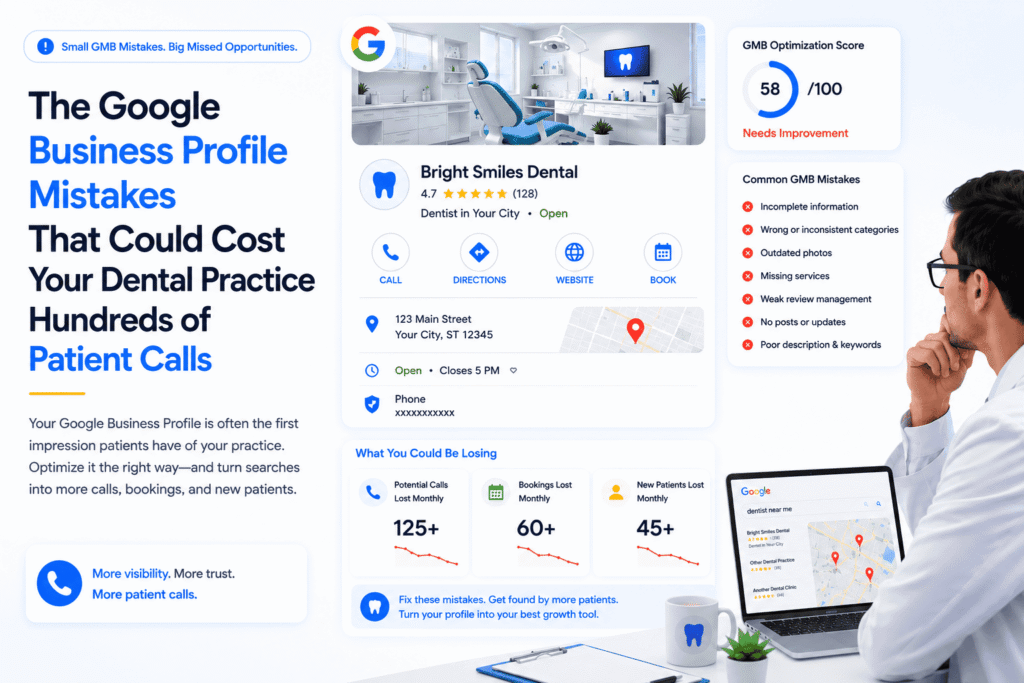
For most patients searching for a dentist, your Google Business Profile isn’t a supporting player in your marketing. It’s the entire decision. They see your name, star rating, hours, and a few photos, and in under thirty seconds they either tap “Call” or move to the next practice in the Map Pack. They never reach your website. They never read your About page. The decision happens inside that small panel, or it doesn’t happen at all.
That means every incomplete field, outdated photo, and unanswered review isn’t a cosmetic issue. It’s a piece of missing information that could have tipped a patient toward calling you instead of the practice next door. One analysis across 2,000 dental practice profiles found that neglected listings generated roughly 180 to 250 views per month, compared to 1,000 to 1,400 views for a properly maintained profile in the same market (BrightLocal, 2024). That’s not a small gap. It’s the difference between a full schedule and empty chairs.
Here are the mistakes actually driving that gap, and what fixes them.
Mistake 1: A Generic or Incomplete Category
Your primary category is the single strongest relevance signal in your entire profile. It tells Google what kind of searches you should appear in before anything else on the listing does. A general dentist who only ever selects “Dentist” and stops there is leaving real visibility on the table for every procedure-specific search a patient might run: implants, cosmetic dentistry, Invisalign, emergency care.
Google allows up to 10 categories per profile. Most practices use three or four and leave the rest blank. If your practice does meaningful volume in a specific service, that service should have its own secondary category, not just a mention buried in your description.
The fix: Choose a primary category that matches your actual patient volume and specialty focus, then add every genuinely applicable secondary category rather than leaving the field mostly empty.
Mistake 2: Inconsistent Business Information (NAP)
Google cross-references your name, address, and phone number against your website and every directory where your practice appears. Even a small mismatch, “Suite 100” on your website versus “Ste 100” on Yelp, or a phone number that connects to a disconnected line, creates confusion for both patients and Google’s matching algorithm, and it’s treated as a red flag rather than a minor typo.
The fix: Audit your NAP across your website, GBP, and every major directory (Healthgrades, Zocdoc, Vitals, Yelp, ADA Find-a-Dentist) and correct any inconsistency, however small it looks.
Mistake 3: Stale or Missing Photos
Profiles with no new photos added in months signal something specific to Google and to patients: a practice that isn’t actively managing its online presence. Patients want to see the actual office, the team, and the equipment before they ever walk in, particularly given how much anxiety is already baked into choosing a new dentist. Dark, blurry, or obviously generic stock photos actively work against you; they can be the difference between a click and a scroll past.
The fix: Upload real, current photos of your office, team, and technology on an ongoing basis, not as a one-time setup task, but as a recurring habit, the same way you’d update anything else that represents the practice publicly.
Mistake 4: Missing or Vague Service Listings
Many practices either skip the services section entirely or fill it with one-word labels that tell Google almost nothing. This section is one of the specific fields AI tools read when deciding what a practice is known for and whether to recommend it. A vague or empty services list isn’t just a missed SEO opportunity. It’s a missed AI visibility opportunity too.
The fix: List every service individually with a real, natural-language description. “We provide same-day dental crowns using CEREC technology” tells Google and a patient far more than a bare label like “Crowns.”
Want to find out which of these GBP gaps are costing your practice calls every month?
Mistake 5: An Inactive, Never-Updated Profile
A striking share of dental practices have never posted a single update on their profile. Meanwhile, practices ranking consistently in competitive local markets tend to post every 7 to 10 days. Regular posting isn’t a vanity metric. It’s a direct signal to Google that the practice is active, current, and worth showing to patients making a decision right now.
The fix: Set a simple, sustainable posting cadence: service highlights, patient education, seasonal offers, rather than treating the profile as a one-time setup task that never gets touched again.
Mistake 6: Weak Review Management
Reviews are one of the most powerful trust signals a patient sees before ever calling, and one of the strongest local ranking factors Google weighs. A meaningful share of consumers won’t consider a business with a rating under 4 stars, and a large share won’t consider one with fewer than roughly 20 reviews at all (BrightLocal Consumer Review Survey, 2025). Beyond the star rating itself, Google increasingly rewards a steady, ongoing flow of recent reviews over a large pile of old ones.
Just as important as collecting reviews is responding to them. A thoughtful, professional reply to both positive and negative reviews signals to prospective patients that the practice is engaged and mature. Response rate and speed function as their own trust signal, separate from the star rating itself.
The fix: Build a review request into the post-appointment workflow, a text or email sent within an hour or two of the visit with a direct one-click link, and respond to every review within a day or two, without ever discussing clinical details.
Mistake 7: Leaving Key Attributes Unconfigured
Google provides health-specific profile attributes most practices either configure incompletely or skip outright. “Accepts new patients” is arguably the single most important one for a practice actively trying to grow. When it’s missing or set incorrectly, practices either miss patients who assumed they weren’t accepting new registrations, or waste front-desk time on calls from patients who can’t actually be seen. Accessibility attributes, insurance details, and appointment booking links carry similar weight and are frequently left blank.
The fix: Go through every available attribute field and configure it deliberately. Treat each one as a small but real signal, not an optional extra.
What This Actually Costs
The maths is worth running for your own practice. A well-optimised Google Business Profile in a mid-sized market can generate roughly 1,000 to 1,400 views per month, converting to calls at somewhere around 30 to 35%. A neglected profile, the kind with stale photos, an incomplete service menu, and no recent posts, can fall to 180 to 250 views in the exact same market (BrightLocal, 2024).
That gap compounds every month it goes unaddressed, and it’s happening silently. There’s no alert that tells a practice owner “you lost forty calls this month to an incomplete profile.” The only way to see it is to actually compare a neglected profile’s numbers against what a fully optimised one in the same market is capable of.
Not sure how your GBP stacks up against the top-ranking practices in your area?
Common Mistakes That Compound the Problem
Treating the GBP as a one-time setup task. Every mistake above gets worse with time if nothing changes. The profile doesn’t just stay static while a competitor’s improves; the relative gap widens with every update Google rolls out.
Assuming the website carries the same weight as the profile. For most dental practices, the Google Business Profile generates more direct patient contact than the website does. A beautiful, expensive website doesn’t compensate for an incomplete GBP. Patients often never reach it.
Fixing fields once and never auditing again. Hours change for holidays, services expand, staff photos go stale. A quarterly review of every field catches drift before it costs calls.
Chasing review volume while ignoring recency. A practice with 150 reviews from three years ago and nothing recent sends a weaker signal than a practice with 40 reviews arriving steadily every month.
What to Actually Fix First
If your profile hasn’t been touched in a while, this is the order that typically produces the fastest visible improvement:
- Correct your primary and secondary categories to reflect your actual specialty focus and patient volume, not just the broadest default option.
- Audit NAP consistency across your website and every major directory where your practice appears.
- Upload a fresh batch of real photos and set a recurring reminder to add more on an ongoing basis.
- Fill out every service listing individually with a real description, not a one-word label.
- Set up an automated review request workflow timed to fire shortly after each appointment, and commit to responding to every review within a day or two.
Ready to turn your GBP into your practice’s best-performing marketing channel?
The Bottom Line
A Google Business Profile isn’t a listing you set up once and leave alone. It’s an active, ongoing extension of your front desk, and patients are making real decisions from it in under thirty seconds. The practices losing calls to competitors down the street usually aren’t losing them because of anything clinical. They’re losing them to a handful of specific, fixable gaps in a profile that hasn’t been revisited in months or years.
Every one of the mistakes above is straightforward to correct once it’s actually identified. We don’t do everything. We only do Dental SEO. Rank. Be found. Grow.
Frequently Asked Questions
What is the single most important field to fix first on a Google Business Profile?
Usually the primary and secondary categories. They’re the strongest relevance signal Google uses, and getting them wrong or leaving them incomplete limits which searches your profile can even appear in.
How often should a dental practice update its Google Business Profile?
Top-performing practices post updates roughly every 7 to 10 days and review the full profile quarterly to catch outdated hours, stale photos, or drifted information.
Does the number of reviews matter more than how recent they are?
Both matter, but recency is increasingly weighted alongside volume. A steady, ongoing flow of recent reviews signals an active practice more strongly than a large pile of older ones with nothing new arriving.
Can an incomplete Google Business Profile really cost hundreds of calls?
Yes. Analyses comparing neglected profiles to fully optimised ones in the same market have found view-count gaps of roughly 4 to 5 times, which translates directly into a proportional gap in calls and booked appointments (BrightLocal, 2024).
Should every dentist in a multi-dentist practice have their own Google Business Profile?
Generally no. Creating individual listings for associate dentists is a common mistake that can trigger duplicate-listing flags from Google. A single, fully optimised practice profile representing all practitioners is typically the safer, more effective approach.
Do AI search tools like ChatGPT and Google AI Overviews use Google Business Profile data?
Yes. AI tools reference profile completeness, services, and reviews when deciding whether and how to recommend a practice, meaning an incomplete GBP hurts both traditional local rankings and AI visibility at the same time.
What is the fastest way to know if my profile needs attention?
Compare your current view and call counts against what a fully optimised profile typically generates in a similar market, and check for the basics: are your categories specific, are your photos recent, and have you responded to your last several reviews?
Key Takeaways
- Your Google Business Profile is the entire decision for most patients: they never reach your website before calling or moving on.
- A neglected profile generates roughly 180 to 250 monthly views versus 1,000 to 1,400 for a fully optimised one in the same market.
- Primary and secondary categories are the strongest relevance signal in your profile. “Dentist” alone competes with everyone for everything.
- NAP inconsistencies across directories are treated as verification failures by both Google and AI search tools, not minor typos.
- Specific reviews naming a procedure or practice quality are stronger ranking and AI-recommendation signals than generic five-star volume.
- Regular posting (every 7 to 10 days) signals an active practice. A profile with no posts in 90 days signals inactivity regardless of how strong everything else is.
- Every GBP mistake above is fixable quickly once identified. The cost is in not identifying them.
How many patient calls is your Google Business Profile missing every month?
We don’t do everything. We only do Dental SEO. Our team audits GBP profiles every day and shows practices exactly which gaps are costing them calls, before the appointment is ever made.
Written by the Dental Master Media SEO team. We don’t do everything. We only do Dental SEO, for independent dental practices across the USA, UK, Canada, Australia, New Zealand, and Singapore.

Suraj Rana is the owner of Dental Master Media and a leading expert in SEO for dental practices. With a passion for dental marketing, he has successfully helped numerous dental clinics climb the search engine ranks. Suraj’s expertise makes him a go-to resource for effective, results-driven dental marketing.