
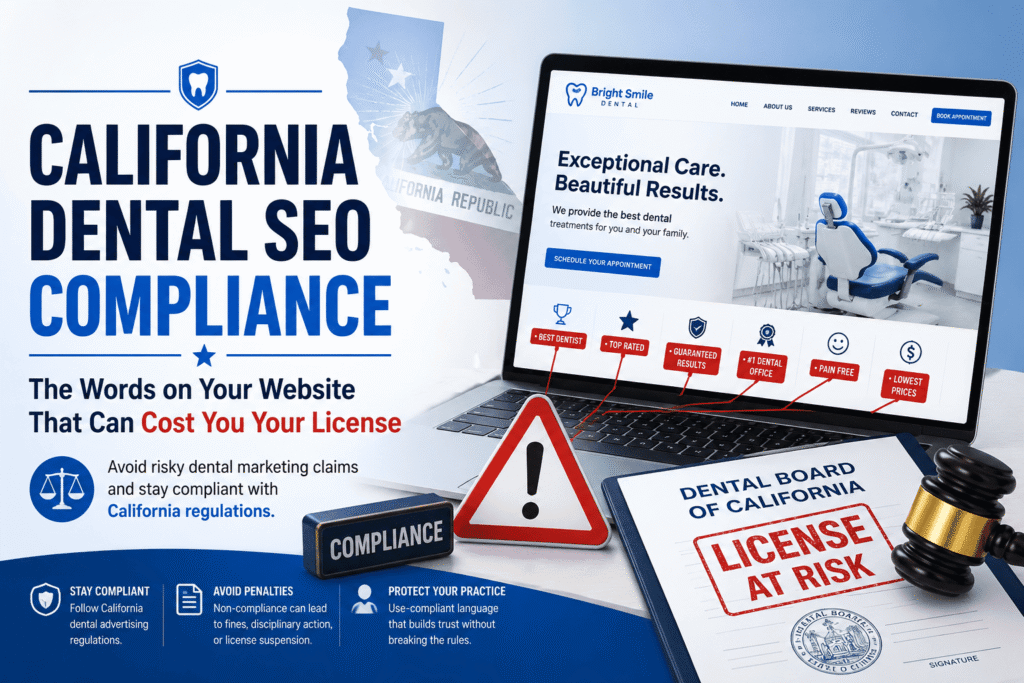
Picture this: you hired an SEO agency six months ago. Your dental website is ranking higher. New patient enquiries are up. You are finally getting some traction online. Then a formal complaint lands with the Dental Board of California — because the homepage your agency wrote calls you “the best cosmetic dentist in [City]”, and your implant service page promises “pain-free results, guaranteed.”
Both of those phrases are illegal in California dental advertising. And neither your web designer nor your SEO agency knew that when they wrote them.
This is not an isolated story. It is the norm. Most dental SEO content in California is written by people who have never read the California Dental Practice Act, never reviewed the American Dental Association’s Code of Professional Conduct, and never considered that a dental website sits at the intersection of state law, federal ethics guidelines, and Google’s own quality standards — all at the same time.
The wrong words on your website do not just risk your rankings. They risk your license. This guide covers exactly what your SEO content can and cannot say — with the specific laws, real penalties, and the Google ranking consequences that follow.
The Three Compliance Layers Every California Dentist Must Satisfy
California is the hardest state in America to market a dental practice. That is not an exaggeration — it is the reality of practicing in a state where your website answers to three separate authorities simultaneously. Most dentists know about HIPAA. Far fewer know that their SEO content must satisfy two additional frameworks before a single word goes live on their site.
Layer 1 — California Dental Practice Act (BPC 651 and 1680)
The Dental Practice Act is enforced by the Dental Board of California and governs every licensed dentist in the state. Section 1680 explicitly lists the acts that constitute unprofessional conduct — and advertising violations sit prominently on that list. Section 651 governs what constitutes a false, fraudulent, misleading, or deceptive advertising statement across all public communications, including websites, landing pages, and digital content of any kind.
There is no exemption for content written by a third-party marketing agency. If it appears on your website, you own the liability.
Layer 2 — ADA Principles of Ethics & Code of Professional Conduct (Section 5.F)
The American Dental Association’s ethics code states clearly that no dentist shall advertise or solicit patients in any form of communication in a manner that is false or misleading in any material respect. This is not a guideline for ADA members only — it represents the ethical standard to which all licensed dentists are held, and California’s Dental Practice Act directly mirrors its principles.
In 2025, the ADA updated its code to specifically address digital platforms. The new Advisory Opinion 5.F.7 extends the prohibition on false and misleading statements to website content, social media, and any other online channel a dentist uses to attract patients.
ADA Advisory Opinion 5.F.7 (2025 Update):
“Dentists have an obligation to present factual information to the public. The ethical requirement that advertising not be false or misleading in a material respect extends to all digital platforms, including websites and social media.”
Layer 3 — Google’s E-E-A-T and YMYL Standards
Dental websites fall into Google’s YMYL category — Your Money or Your Life. This means Google applies its strictest quality scrutiny to your content because dental decisions directly affect patient health. Google evaluates your site against E-E-A-T standards: Experience, Expertise, Authoritativeness, and Trustworthiness.
Unverifiable superlatives, outcome guarantees, and vague marketing claims are consistent markers of low-trust, low-E-E-A-T content. Non-compliant language does not just create legal risk — it actively suppresses your Google rankings.
The Exact SEO Phrases That Are Illegal on California Dental Websites
Check your website right now. The following phrases are found on the majority of California dental websites — and most were placed there by SEO agencies who had no knowledge of the Dental Practice Act. Each one represents a live compliance risk sitting on your site today.
2a. Professional Superiority Claims
Phrases like: “Best dentist in [City]” · “Top-rated dental practice” · “Superior dental care” · “Highest quality dentistry” · “Premier dental clinic”
Under California Business and Professions Code Section 1680(i), the advertising of professional superiority or the performance of professional services in a superior manner is explicitly listed as unprofessional conduct. The ADA Code mirrors this — advertising claims about the quality of services are not measurable or verifiable, and are therefore considered likely to be false or misleading, making them prohibited.
This includes meta titles. Many SEO agencies write “Best Dentist in [City] | [Practice Name]” directly into the page title tag — which is one of the most visible parts of your site in Google’s eyes, and one of the most direct BPC 1680(i) violations.
2b. Outcome Guarantees and Painless Claims
Phrases like: “Guaranteed results” · “We guarantee your smile” · “Pain-free dentistry guaranteed” · “Painless implants” · “No pain, no worry”
California BPC Section 1680(l) is unambiguous: advertising to guarantee any dental service, or to perform any dental operation painlessly, is prohibited unprofessional conduct. This is one of the most common phrases SEO agencies write into implant and cosmetic dentistry service pages, and it is one of the most direct violations on the books.
There is no softened version of this that is compliant. “We aim to minimise discomfort” is compliant. “Pain-free guaranteed” is not.
2c. Vague and Misleading Price Language
Phrases like: “Implants starting from $X” · “As low as $299 per tooth” · “Most affordable dentist in [City]” · “Lowest prices in [Area]” · “And up”
Any communication referring to the cost of dental services must be exact, without omissions, and must clearly identify each specific service — without using phrases such as “as low as,” “and up,” or “lowest prices.” This requirement comes directly from both CDA advertising guidelines and BPC 651, and it applies to every pricing reference on your website, including landing pages, service pages, and any paid ad copy.
If your pricing page uses “starting from” language, it is non-compliant. The fix is straightforward: state the exact cost for a specific, clearly identified service. Anything less is legally ambiguous and exposes you to a formal complaint.
2d. Specialty Claims Without Board Certification
Phrases like: “Implant specialist” · “Cosmetic dentistry specialist” · “Specialist in Invisalign” · “Expert cosmetic dentist” · “Orthodontic specialist”
California law and ADA guidelines prohibit dentists from claiming to be a specialist in, or specially qualified in, any branch of dentistry unless they hold a recognized board certification in that specialty. The recognized dental specialties in California include orthodontics, periodontics, oral surgery, endodontics, prosthodontics, pediatric dentistry, and oral medicine — each requiring formal board certification.
A general dentist who places implants, straightens teeth with aligners, or performs cosmetic procedures can describe those services. They cannot call themselves a specialist. SEO agencies regularly use the word “specialist” to target high-value keywords — and every instance on a non-certified dentist’s website is a direct violation.
2e. Unverified Comparison Claims
Phrases like: “More affordable than most clinics” · “Better outcomes than our competitors” · “Lower prices than corporate chains” · “Higher success rates than average”
Any advertisement using words of comparison — including “low fees,” “affordable,” or “better” — must be based on verifiable data that substantiates the comparison. The burden of proof sits entirely with the dentist making the claim. If you cannot produce documented data to support the statement, you cannot make it. Most comparative claims on dental websites exist without any supporting data whatsoever.
2f. Stock Before/After Photos Without Disclosure
California BPC 651 explicitly prohibits the use of any photograph or other image of a model — meaning anyone who is not an actual patient of the advertising dentist — without clearly stating in a prominent location in easily readable type that the image is of a model and not an actual patient.
Most dental SEO agencies use stock before/after photos sourced from treatment libraries or image banks. Without a clearly visible disclaimer on every such image, this constitutes a direct violation. Additionally, any before/after photo of a real patient requires documented written HIPAA-compliant consent — not just verbal agreement.
The Real Penalties — What Happens When the Dental Board Finds Your Website
This section is not hypothetical. These are the documented enforcement outcomes the Dental Board of California applies to advertising violations. Understanding the penalty tiers is important because they escalate — and because the Dental Board’s enforcement actions are published publicly, where patients and referring doctors can see them.
Penalty Tier 1: Administrative Citation and Fine
The Dental Board issues administrative citations in cases where violations are found. Citations include an order to correct the violations and an administrative fine under BPC 125.9. Citations are added to your public enforcement record on the DBC website — visible to every patient who searches your name before booking an appointment.
Penalty Tier 2: Misdemeanor Criminal Charge
Violations of BPC Section 651 on advertising can be charged as misdemeanors. A misdemeanor conviction is a criminal record. It appears in background checks, it is discoverable by patients, and it is reportable to your malpractice insurer. This is not a theoretical outcome — it is a stated enforcement pathway for advertising violations under California law.
Penalty Tier 3: License Probation, Public Reproval, or Suspension
If an investigation finds repeated acts of unprofessional conduct, the Dental Board can impose license probation, issue a public reproval, or suspend your license. Under BPC 1673, the Board can pursue a stipulated settlement that includes probation or public reproval — both of which are published permanently on the DBC’s public enforcement record.
Public reproval is particularly damaging from a practice growth perspective. It appears in every search of your license number and is visible in perpetuity. A dentist’s Google reputation can recover from negative reviews. A public reproval on the Dental Board’s record is permanent.
Penalty Tier 4: License Revocation
Under BPC 1670, a dentist’s license may be revoked if an investigation finds repeated acts of negligence, gross negligence, incompetence, or unprofessional conduct. Advertising violations that are repeated after a citation, or that are combined with other compliance failures, can escalate to revocation proceedings before an Administrative Law Judge.
Penalty Tier 5: Civil Penalties Under California’s False Advertising Law (BPC 17500)
Up to $2,500 per violation.
California’s False Advertising Law makes it unlawful for any business to disseminate any statement that is untrue or likely to mislead. Violations may result in civil penalties of up to $2,500 per violation — and in serious cases, exposure to individual and class action lawsuits under California’s Unfair Competition Law. With each non-compliant page of your website potentially constituting a separate violation, civil penalty exposure stacks quickly.
DMM Insight:
We have audited hundreds of dental websites across California. The majority have at least two BPC 651 violations sitting live on their website right now — written there by an SEO agency that never read the Dental Practice Act. The Dental Board processed over 3,776 complaints in a single year. Anyone — including a competitor down the street — can file one about your website, today.
How Non-Compliant SEO Content Also Hurts Your Google Rankings
Some dentists hear about advertising compliance and think: the Dental Board is busy, enforcement is rare, the risk is low. That logic ignores the second consequence entirely — because non-compliant SEO content does not just risk your license. It actively suppresses your Google rankings.
Google’s YMYL Classification and E-E-A-T Scrutiny
Google classifies dental websites as YMYL content — Your Money or Your Life. This category includes any content that could directly affect someone’s health, safety, or financial wellbeing. For YMYL pages, Google applies its most rigorous quality standards, evaluated through E-E-A-T: Experience, Expertise, Authoritativeness, and Trustworthiness.
When Google’s quality raters assess a dental website and find unverifiable superlatives (“best dentist”), outcome guarantees (“guaranteed results”), or vague price claims (“as low as”), they flag those as signals of low-trust, low-quality content. Low-E-E-A-T scores translate directly into suppressed rankings — particularly after Google’s core algorithm updates, which have consistently targeted healthcare content that does not meet its quality threshold.
The Double Damage from Non-Compliant Content
Consider what a phrase like “best cosmetic dentist in [City]” actually does to your website:
- From a legal standpoint: it violates BPC 1680(i) and ADA Code 5.F, exposing you to a Dental Board complaint, a misdemeanor charge, and civil penalties.
- From a Google standpoint: it is an unverifiable superlative on a YMYL page that signals low E-E-A-T — reducing your probability of ranking for the competitive dental terms that actually bring in patients.
You are taking the legal risk and the SEO penalty for the same phrase. Removing it eliminates both exposures simultaneously.
What Google Rewards Instead
Compliant content consistently outranks non-compliant content in dental SEO. The reason is straightforward: specific, factual, verifiable content is exactly what E-E-A-T rewards. Consider the difference:
| Non-Compliant (Legal Risk + Poor SEO) | Compliant (Legally Safe + Better SEO) |
| “Best implant dentist in Los Angeles” | “Dr. [Name] has placed 500+ dental implants in Los Angeles since 2011 using guided surgery technology” |
| “Pain-free dentistry guaranteed” | “We use local anaesthesia and conscious sedation to minimise discomfort throughout your visit” |
| “Implants starting from $999” | “Single dental implants from $2,500, including crown. Payment plans available through [named provider]” |
What Compliant Dental SEO Content Looks Like
Compliant content is not boring content. The most effective dental websites we have worked on — the ones ranking on page one in competitive California markets — are built entirely on factual, specific, verifiable language. Here is exactly what is permitted and what works:
- Years in practice and location: “Dr. [Name] has served patients in [City] since 2008.” ✓
- Specific technology: “We use CBCT cone beam imaging for precise implant placement.” ✓
- Documented procedure volume: “Over 600 Invisalign cases completed.” ✓ (must be accurate and documentable)
- Named certifications: “Fellow of the Academy of General Dentistry (FAGD).” ✓
- ADA membership and associations: “Member, California Dental Association and American Dental Association.” ✓
- Languages spoken: “We see patients in English, Spanish, and Mandarin.” ✓ (explicitly permitted under BPC 651(h))
- Payment and financing — with specifics: “0% financing for 18 months through CareCredit.” ✓
- Verified review ratings with attribution: “Rated 4.9/5 on Google based on 312 patient reviews.” ✓
- Educational procedure content: Detailed, factual descriptions of what a treatment involves, recovery timelines, and candidacy criteria. ✓
Notice that none of these require exaggeration or unverifiable claims. Specific facts build more patient trust than superlatives — and they rank better on Google. Specificity is the compliant marketer’s competitive advantage.
The 8-Point Dental Website SEO Compliance Checklist
Run this check on your live website today. If you find any of the following on your site, you have a live compliance issue that needs to be corrected before a complaint is filed.
- Homepage and about page: Remove all uses of “best,” “top,” “superior,” “highest quality,” and “premier” without objective, verifiable attribution to a named third-party source.
- Service pages: Remove all “guaranteed results,” “pain-free guaranteed,” “painless,” and any other outcome guarantee language from every service page, especially implants, cosmetic dentistry, and Invisalign.
- Pricing pages: Remove “as low as,” “starting from,” “and up,” and “lowest prices” from all cost references. Replace with exact pricing for specific, clearly identified services.
- Specialty language: Audit every page for “specialist” terminology. If the dentist does not hold board certification in that ADA-recognized specialty, remove or reframe as a service description.
- Before/after photos: Verify every before/after image is of an actual patient with documented written consent, or clearly labeled as a model in prominent, easily readable text.
- Comparison claims: Remove any “more affordable than competitors,” “lower prices than corporate chains,” or “better outcomes” language not backed by documented, verifiable comparative data.
- Meta titles and descriptions: Audit all SEO meta tags — title tags, meta descriptions, and H1 headings — for the same prohibited language. Violations in meta tags are still BPC 651 violations.
- Contact and booking forms: Ensure all patient-facing forms use encrypted data transmission and that any third-party tool handling patient data operates under a signed Business Associate Agreement.
Frequently Asked Questions
What words are illegal in California dental advertising?
Under BPC 651 and 1680, prohibited terms include: “best dentist,” “guaranteed results,” “painless dentistry guaranteed,” “superior care,” “lowest prices,” “as low as,” and any specialty claim (e.g. “implant specialist”) without board certification. These apply to all website content, meta tags, and any other digital communication used to attract patients.
Can a California dentist use the phrase “best dentist” on their website?
No. Under BPC 1680(i), advertising professional superiority is explicitly prohibited unprofessional conduct in California. “Best dentist” is an unverifiable quality claim that cannot be substantiated, making it a direct violation of both the Dental Practice Act and the ADA Code of Professional Conduct.
What is BPC Section 651 and what does it prohibit for dentists?
BPC 651 governs false, fraudulent, misleading, or deceptive advertising statements in California healthcare. For dentists, it prohibits: unverifiable quality claims, outcome guarantees, vague price language (“as low as”), model photos without disclosure, and any statement likely to mislead patients. Violations can be charged as misdemeanors.
What are the actual penalties for dental advertising violations in California?
Penalties escalate through five tiers: (1) administrative citation and fine under BPC 125.9; (2) misdemeanor criminal charge under BPC 651; (3) license probation or public reproval under BPC 1673; (4) license suspension or revocation under BPC 1670; and (5) civil penalties of up to $2,500 per violation under California’s False Advertising Law (BPC 17500), with potential class action exposure under the Unfair Competition Law.
Does the ADA Code of Ethics apply to my dental website?
Yes. Section 5.F of the ADA Principles of Ethics and Code of Professional Conduct states that dentists shall not advertise in any manner that is false or misleading in a material respect. The 2025 update (Advisory Opinion 5.F.7) explicitly extends this obligation to digital platforms including websites and social media.
Can I claim to be a dental specialist in California if I am not board certified?
No. Using the term “specialist” in any branch of dentistry — including cosmetic, implant, or aesthetic dentistry — without holding a recognized board certification in that ADA-designated specialty is a direct violation of both the Dental Practice Act and ADA ethics guidelines. General dentists can describe services they provide but cannot imply specialty-level credentials they do not hold.
How do fake claims on a dental website hurt Google rankings?
Dental websites are classified as YMYL (Your Money or Your Life) content by Google, meaning they face the strictest E-E-A-T scrutiny. Unverifiable superlatives, outcome guarantees, and vague claims are signals of low Trustworthiness — one of the four E-E-A-T pillars. Google’s core algorithm updates have consistently targeted low-trust healthcare content, and non-compliant SEO language suppresses rankings on both standard search and Google Maps results.
Conclusion: The Problem Is Not Your Dentistry — It Is What Your SEO Agency Wrote
The vast majority of California dentists running non-compliant websites did not make a deliberate choice to violate the Dental Practice Act. Their web designer used a dental website template. Their SEO agency applied standard marketing copy. Neither of them knew — or checked — California BPC 651, Section 1680, or the ADA’s Code of Professional Conduct.
The result is that thousands of California dental websites are sitting with live compliance violations right now. Some will never be flagged. Others will be the subject of a formal complaint filed by a patient, a competitor, or an automated compliance monitoring system. The Dental Board receives close to 4,000 complaints per year. The risk is not zero.
The good news: fixing this is straightforward when you know what to look for. Compliant language is not weaker language — it is more specific, more credible, and more effective at converting patients than vague superlatives. And it ranks better on Google.
Is Your California Dental Website Compliant?
Dental Master Media offers a Free Dental Website Audit for California dental practices.
We audit every page for BPC 651 violations · ADA ethics breaches · Fake claim language · SEO issues suppressing your rankings
It takes 48 hours. No obligation. Just clarity on where you stand.
Research Sources
This guide was developed after reviewing primary legal sources, official regulatory body websites, and authoritative dental compliance resources. Each section is grounded in the specific laws and guidelines cited below.
| # | Source / Title | Domain | Why We Used It |
| [1] | Dental Board of California — Enforcement & Discipline | dbc.ca.gov/consumers/enforcement.shtml | Primary source for DBC penalty tiers, complaint volume stats, and license enforcement procedures. |
| [2] | California BPC 651 — False Advertising in Healthcare | law.justia.com/codes/california/code-bpc | The core statutory text governing all dental advertising in California, including prohibited claim types and misdemeanor penalties. |
| [3] | California BPC 1680 — Unprofessional Conduct, Dentistry | law.justia.com/codes/california/code-bpc/division-2/chapter-4/article-4/section-1680/ | Statutory source for the specific advertising acts classified as unprofessional conduct, including superiority claims and outcome guarantees. |
| [4] | California Dental Practice Act Compliance Guide (CDA) | sfvds.org/docs/…guide_dpa_compliance.pdf | Official CDA compliance guide explaining BPC 651 advertising requirements and what constitutes a violation. |
| [5] | ADA Principles of Ethics & Code of Professional Conduct — 2025 Update | adanews.ada.org/ada-news/2025/february/ada-code-updates… | Source for the 2025 ADA Code update adding Advisory Opinion 5.F.7 on digital advertising and social media compliance. |
| [6] | ADA Marketing and Advertising Resource Guide | ada.org/resources/practice/legal-and-regulatory/marketing-and-advertising | ADA’s comprehensive guide to federal and state advertising rules applicable to dentists, including FTC standards. |
| [7] | Understanding the California Dental Practice Act (2024) | odgerslawgroup.com/california-dental-practice-act/ | Legal analysis of Section 1680 and its prohibition on false, misleading, or deceptive advertising in all public communications. |
| [8] | California Dental Association v. FTC — Case Law | caselaw.findlaw.com/court/us-9th-circuit/1401462.html | Key case law establishing that quality-of-service claims are unverifiable and therefore prohibited in California dental advertising. |
| [9] | California False Advertising Law — BPC 17500 Analysis | thelyonfirm.com/blog/california-false-advertising-law-attorney/ | Analysis of BPC 17500 and the civil penalty exposure (up to $2,500 per violation) that applies to misleading dental website content. |
| [10] | AB 2426 — California Digital Advertising Amendments (2025) | wsgr.com/en/insights/ab-2426-californias-new-law… | 2025 California law strengthening digital advertising compliance requirements, extending false advertising penalties to online content. |
| [11] | Dental Website Compliance — HIPAA, ADA, and Marketing Rules | accountablehq.com/post/dental-website-compliance… | Comprehensive guide to dental website compliance across HIPAA, ADA standards, and state dental board advertising rules. |
| [12] | DBC Disciplinary and Denial Guidelines | dbc.ca.gov/formspubs/pub_dgml.pdf | Official Dental Board of California document detailing how disciplinary penalties are applied to advertising and professional conduct violations. |

Dental Master Media is the world’s most focused Dental SEO agency, serving dental clinics across the USA, UK, Canada, Australia, and New Zealand. With 9+ years of dental SEO experience and 300+ dental clinics ranked across our served markets, we specialize exclusively in helping dental practices rank, be found, and grow. We don’t do everything. We only do Dental SEO — and we do it better than anyone else.