
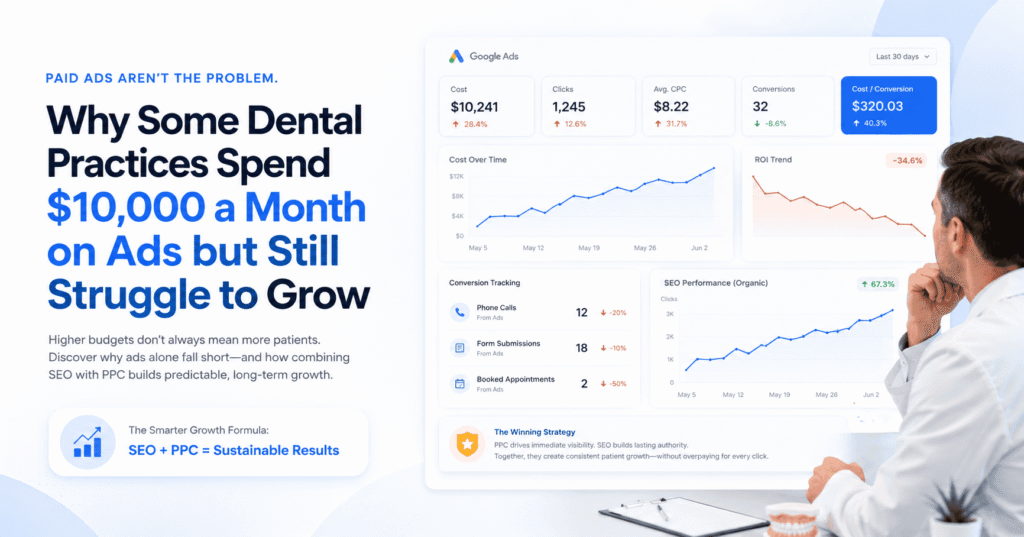
A dental practice owner sits down to review the month’s numbers. $10,000 went out the door to Google Ads. The phone rang. The website got clicks. But new patient numbers barely moved, and the chair count looks the same as it did three months ago.
If that sounds familiar, you’re not doing anything wrong by advertising. You’re running into a structural problem affecting dental practices across every major market right now: paid ads are getting more expensive and less efficient at the exact same time, and most practices are trying to fix that with more budget instead of a better system.
This isn’t an argument against Google Ads. It’s an explanation of why ad spend alone has a ceiling, and what separates practices that are stuck writing bigger cheques every quarter from practices that are actually growing.
The Math Has Changed: Why $10K/Month Buys Less Than It Used To
Three things are happening in the dental ad market right now, and all three are working against you.
Cost-per-click keeps climbing. Dentistry is already one of the most expensive verticals in Google Ads. Only attorneys and home improvement companies pay more per click on average. Implant and cosmetic keywords in competitive metro areas can run $12 to $25 per click, and even general dentistry terms have risen 10 to 15 per cent year-over-year in most markets.
AI Overviews are quietly stealing your clicks. When Google answers a search directly at the top of the page, fewer people scroll down to click anything. Industry data shows AI-generated results are cutting traditional click volume by 15 to 25 per cent across the board, with paid click-through rates collapsing from nearly 20 per cent down to around 6 per cent on searches where an AI Overview appears (Search Engine Journal, 2025). You can be paying the same cost-per-click and getting dramatically fewer clicks for it.
More advertisers are chasing the same auction. As AI tools make campaign setup easier, more small and mid-size practices are entering the same keyword auctions. Google’s Smart Bidding tools are structurally optimised to extract maximum value from every auction, not to save you money.
Put together, that’s a treadmill: rising costs, shrinking click volume, and more competitors. Spending more on ads used to guarantee more visibility. Now it just guarantees more spend.
Want to see where your ad budget is actually leaking?
Our dental SEO services are built to work alongside your paid campaigns, so you’re not 100 per cent dependent on an auction that’s increasingly stacked against you.
Where the $10,000 Actually Goes to Waste
1. The Landing Page Isn’t Built to Convert
Sending a paid click for “dental implants” to your homepage is one of the most common and most expensive mistakes a practice can make. A homepage is too broad, with links to blogs, team bios, and general services competing for attention instead of one clear next step.
The data backs this up. One general dentistry practice was spending $4,500/month on Google Ads, driving 450 visitors but converting only 18 appointments, a 4 per cent conversion rate and $250 cost per appointment. After fixing landing page design, trust signals, and calls-to-action, conversion climbed to 12 per cent within 90 days. Appointments tripled to 54 per month, and cost per appointment dropped to $83, on the exact same ad budget (WordStream Case Studies, 2024).
That’s not a new-ad-spend story. That’s a fixed-what-was-already-broken story.
2. Conversion Tracking Is Measuring the Wrong Thing
Google will happily count a form submission, a button click, or a landing on a “thank you” page as a “conversion.” But in dentistry, a real conversion is a booked appointment or a completed visit. Because most practice management systems don’t pass that data back into Google, the algorithm ends up optimising your entire campaign around incomplete signals.
That means your automated bidding could be actively steering budget toward the wrong kind of click, and you’d have no way of knowing without closed-loop tracking.
3. No Negative Keyword Management
A meaningful chunk of every dental ad budget disappears into searches that were never going to become patients. Regularly auditing search term reports to exclude irrelevant queries can immediately reduce wasted spend by 20 to 30 per cent (Google Ads Help, 2024). Skip that maintenance and the waste compounds every month, quietly, without ever showing up as a single line item you’d notice.
4. Zero Organic Foundation to Fall Back On
This is the one that actually explains the “$10K/month and still struggling” pattern. When every patient you see this month came from a click you paid for this month, your growth is entirely rented. The moment you pause spend, visibility disappears completely. There’s no residual asset left behind.
Curious what an organic SEO foundation looks like for your practice?
DMM Insight“We see this pattern constantly: a practice spends $8,000 to $12,000 a month on ads, gets reasonable click volume, but can’t explain why growth has plateaued. Almost every time, the root cause is the same. The ads are feeding a funnel with a structural leak: weak landing pages, no organic base, and conversion tracking that’s counting clicks instead of patients. Fixing the system produces faster results than scaling the spend.”
The Part Most Practices Miss: Paid Ads Have No Compounding Effect
Here’s the core structural difference between paid ads and dental SEO: every pound or dollar you put into Google Ads produces results only while that money is actively spent. The day you pause your campaign, your visibility drops to zero. There is no residual value. No asset created. The clicks stop and so does the patient pipeline.
SEO works the opposite way. A well-optimised service page, a strong Google Business Profile, and a growing local link profile all continue producing patients after the work is done. The value compounds month over month rather than resetting to zero each billing cycle.
That compounding effect is why practices with strong SEO foundations typically see their cost-per-acquisition from SEO fall over time, while their cost-per-acquisition from PPC either holds flat or rises. After 12 months, most mature dental SEO programmes show a 60 to 75 per cent lower cost-per-acquisition than paid search for the same procedure types (BrightEdge Research, 2024).
We don’t do everything. We only do Dental SEO. That focus means every recommendation we make is built around creating that compounding asset, not just filling this month’s chair.
The Real Fix: SEO and PPC Working Together, Not Ads Alone
The answer isn’t to cancel your ads. Paid ads usually create faster visibility in the short term, and SEO often produces stronger long-term patient acquisition at a lower cost over time. The practices that grow fastest use both deliberately, instead of treating it as a choice between the two.
In practice, that looks like this:
- PPC captures immediate, high-intent demand. Someone searching “emergency dentist near me” tonight needs a chair this week, not after your rankings mature. Paid ads are the right tool for that specific situation.
- SEO builds the compounding asset underneath. Service pages, location pages, and Google Business Profile authority that keep producing patients whether or not the ad budget runs that month.
- Each channel makes the other cheaper. PPC data reveals which keywords and offers actually convert, which sharpens SEO content strategy. Stronger organic rankings reduce how much total budget you need to hold visibility across the page.
- Fixed technical and conversion foundations make every paid click worth more. A dedicated, procedure-specific landing page with fast load times and clean call tracking turns the exact same $10,000/month into meaningfully more booked patients, before you spend a single additional dollar.
The practices spending $10K a month and still feeling stuck aren’t failing because paid ads don’t work. They’re stuck because 100 per cent of their marketing budget resets to zero every single month, with nothing being built underneath it. More patients, not just rankings: that’s the outcome a properly integrated strategy delivers.
Our dental website design and development services ensure your landing pages and site structure are built to convert the traffic you’re already paying for, so no click goes to waste.
Ready to combine SEO and paid ads into a strategy that compounds?
The Bottom Line
Ad spend gets you visibility for as long as you keep paying for it. SEO gets you an asset that keeps producing patients long after the invoice is paid, and reduces what every future ad dollar has to work so hard for. Practices that combine both, with clean conversion tracking and pages built to close the patient rather than just capture the click, are the ones whose growth curve doesn’t flatten out the moment the ad budget gets tight.
If your practice is spending real money every month and still can’t explain where the growth went, that’s usually not a budget problem. It’s a system problem, and it’s fixable. Rank. Be found. Grow.
Frequently Asked Questions
Why isn’t more Google Ads budget fixing my patient growth?
More budget buys more clicks, not necessarily more patients. If your landing pages, conversion tracking, or offer aren’t optimised, additional spend just scales the same waste.
Is SEO actually cheaper than Google Ads for dental practices?
Over time, yes. Most mature SEO programmes show 60 to 75 per cent lower cost-per-acquisition than paid search by month 12, though SEO requires upfront investment before it starts producing volume (BrightEdge Research, 2024).
Should I stop running Google Ads and switch entirely to SEO?
No. The strongest-performing practices run both. PPC for immediate visibility while SEO builds toward lower long-term acquisition costs.
How long does dental SEO take to start producing patients?
Most practices see meaningful traction between months three and six, with the strongest results typically appearing between months six and twelve as rankings and authority compound.
What’s the single biggest reason ad spend fails to convert into growth?
Landing pages that don’t match search intent. Sending a paid click for a specific procedure to a general homepage is consistently one of the largest sources of wasted ad budget in dentistry.
Does AI search actually affect dental practices yet?
Yes, and it’s accelerating. Health-related search categories have already seen significant ad and organic click declines as AI-generated answers satisfy searches directly on the results page.
How do I know if my current ad spend is being wasted?
Start with your Search Terms Report and your call tracking data. If you can’t tie ad spend directly to booked appointments, not just form fills or clicks, you don’t have enough visibility to know.
What should I fix first if I’m spending a lot and not growing?
Landing page conversion and closed-loop tracking, before adding budget. Fixing what’s broken in the funnel usually produces faster results than scaling spend into the same leak.
Key Takeaways
- Dental ad costs are rising while click volume is falling: the same $10K/month now buys less than it did 12 to 18 months ago.
- Most ad budget waste comes from weak landing pages, incomplete conversion tracking, and no negative keyword management.
- Paid ads have no compounding effect: the day you pause spend, visibility resets to zero.
- SEO builds an asset that keeps producing patients and reduces your long-term acquisition costs.
- The strongest-performing practices run PPC and SEO together, each making the other more efficient.
- Fixing your landing pages and conversion tracking produces faster results than scaling ad spend into the same structural leak.
- A properly integrated strategy shifts your growth curve from rented traffic to owned authority.
Ready to stop renting your patients and start owning them?
Our team audits dental practices every day and shows exactly where ad spend is leaking and how SEO closes the gap. We don’t do everything. We only do Dental SEO.
Written by the Dental Master Media SEO team. We don’t do everything. We only do Dental SEO, for independent dental practices across the USA, UK, Canada, Australia, New Zealand, and Singapore.

Suraj Rana is the owner of Dental Master Media and a leading expert in SEO for dental practices. With a passion for dental marketing, he has successfully helped numerous dental clinics climb the search engine ranks. Suraj’s expertise makes him a go-to resource for effective, results-driven dental marketing.