
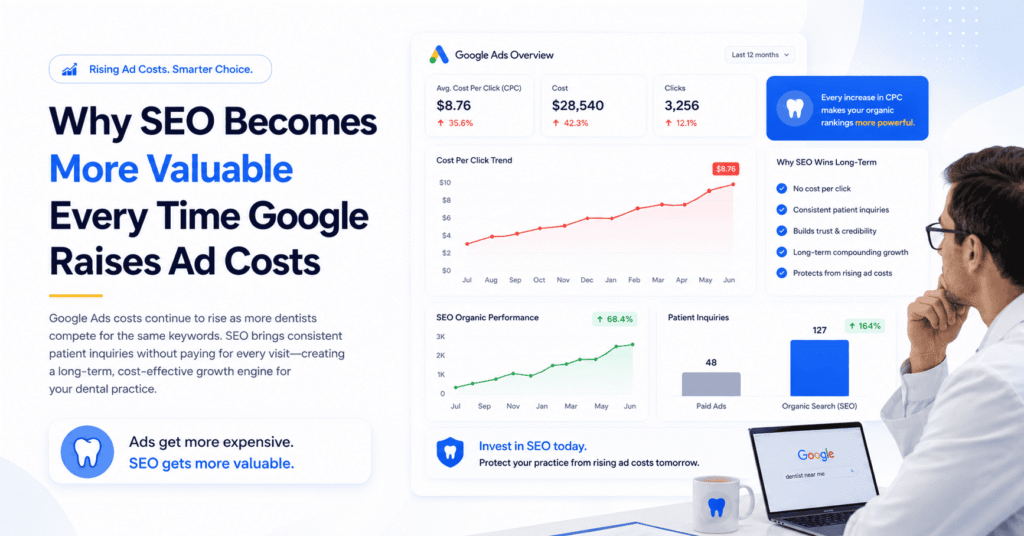
Every dental practice owner who runs Google Ads has felt it: the same campaign, the same keywords, the same location and yet the bill keeps creeping up. That’s not your imagination, and it’s not bad campaign management. It’s the market.
What most practices never stop to calculate is what that price increase is actually doing on the other side of the ledger. Every dollar Google adds to your cost per click is a dollar that makes your organic rankings worth more, not metaphorically, but in cold, calculable terms. SEO doesn’t get more expensive when Google raises ad prices. Your competitors’ cost of not having it just did.
This isn’t a reason to panic about your ad budget. It’s a reason to understand the one channel in dental marketing whose value moves in the opposite direction of rising costs, and to make sure you’re building it before the gap gets even wider.
The Numbers Behind the Squeeze
Dentistry has consistently ranked among the most expensive verticals in Google Ads, trailing only attorneys and a handful of other high-value categories. That’s not a temporary spike. It’s a structural feature of the platform, and current data shows the trend accelerating rather than levelling off.
The average Google Ads search CPC across all industries rose 12% year-over-year, the steepest annual increase since 2021, and industry forecasts point to another 8 to 10% increase before the year is out (WordStream, 2025). Dental-specific CPCs have moved even faster: in competitive metro markets, “dental implants [city]” now runs $20 to $45 per click, up 15 to 20% year-over-year since 2022, with general terms like “dentist near me” still commanding $4 to $12 per click even in less competitive areas.
Five forces are driving that number up simultaneously, and none of them are going away:
- AI Overviews are shrinking organic click supply, pushing more search volume and more advertiser demand into the paid auction.
- Performance Max and Smart Bidding are escalating auctions algorithmically, with every advertiser’s bidding system optimising toward the same efficient frontier.
- More practices are entering the same keyword auctions as AI tools make campaign setup easier for smaller operators.
- Privacy signal loss is forcing bidding algorithms to raise bids just to maintain the same conversion volume.
- Well-funded competitors in adjacent high-value verticals are pushing up the general cost floor across healthcare auctions.
None of this means dental SEO replaces ads entirely. It means the price of the exact same ad result keeps climbing, and it will keep climbing for the foreseeable future.
Want to know exactly what your current rankings are costing you in lost clicks?
The Part of This Equation Most Practices Never Run
Here’s the maths that changes how this should feel to a practice owner.
Imagine your Google Ads budget stays exactly flat at $3,000/month for three years while CPCs rise 15% annually, a conservative, current-market assumption. By year three, that same $3,000 is buying roughly a third fewer clicks than it did in year one. You’re not standing still. You’re losing ground every single month on a budget that hasn’t changed at all.
Now compare that to what a dollar spent on SEO does. A well-optimised service page published today doesn’t get more expensive to keep ranking next year. The content published in months one through three keeps generating traffic in months twelve, eighteen, and twenty-four, at effectively zero additional cost per visit. The authority signals built through Google Business Profile optimisation and local citations accumulate. They don’t decay, and they certainly don’t inflate with the auction.
That’s the actual mechanism behind the headline of this article. Every time Google raises the price of a click, the relative value of a ranking you already own goes up, because the alternative (buying that same visibility through ads) just got more expensive, while your organic position costs exactly what it cost yesterday.
Why This Isn’t an Argument to Cancel Your Ads
To be direct: this is not a case for abandoning Google Ads. Paid ads still deliver something SEO structurally cannot: visibility within hours, precise control over which searches trigger your ad, and immediate volume for a new practice or an empty afternoon on the schedule. For high-value procedures like implants and full-mouth reconstruction, a well-managed ad spending $300 to acquire a $4,000+ case is still an excellent trade.
The point is narrower and more specific. Rising CPCs change the relative maths of your marketing budget, and most practices never update their allocation to reflect it. A budget split that made sense in 2023, when a dental implant click cost $8 to $20, doesn’t make the same sense today, when that same click runs $20 to $45 in competitive markets. If your budget mix hasn’t moved in three years while CPCs have climbed 15 to 20% annually, you’re not maintaining your position. You’re quietly losing it while paying more to do so.
Common Mistakes Practices Make as Ad Costs Rise
Increasing ad budget instead of diversifying it. The instinctive response to falling click volume is to spend more to compensate. That works for exactly one more cycle before the same pressure returns. It treats the symptom, not the structural cause.
Treating SEO and PPC as a one-time either/or decision. The right allocation between the two channels isn’t fixed. It should shift as CPCs rise, and most practices set their marketing budget once and never revisit the ratio as the underlying economics change.
Ignoring the Map Pack because “the ads are already running.” Ranking organically in the local pack doesn’t cannibalize your ad performance. It captures a category of click that paid search cannot buy at any price, no matter how much budget is behind the campaign.
Underfunding SEO just enough that it never moves the needle. A modest dental SEO budget that never crosses the threshold to actually change rankings is money spent without the asset ever forming. In SEO specifically, spending too little is frequently worse than spending nothing, because it burns budget without ever producing the compounding effect that makes the channel valuable.
Are you making any of these mistakes with your current marketing budget?
What to Actually Do With This
If your Google Ads bill has grown faster than your new patient count over the past 12 to 24 months, that’s the clearest signal your channel mix needs to shift, not just your budget. In practice, that looks like this:
- Audit your current CPC trend against your patient volume trend for the same period. If cost is climbing faster than volume, the channel is quietly losing efficiency even if the dashboard still looks fine.
- Treat SEO investment as building equity, not renting attention. Budget it like a fixed asset with a payback period, not a monthly expense you can cut the first time cash flow tightens.
- Prioritise the Map Pack and service pages for your highest-value procedures first. Implants, cosmetic work, and orthodontics carry the CPC increases hardest, which means they’re also where organic rankings save you the most as ad prices climb.
- Keep paid ads running for immediate, high-intent demand. But treat every CPC increase as a prompt to shift a proportionally larger share of new budget toward the channel that isn’t inflating with the auction.
Not sure if your current budget mix still makes sense at today’s ad prices?
The Bottom Line
Rising ad costs aren’t a reason to spend more on ads. They’re a signal that the value of the traffic you already own, or could be building, just went up. Every year Google’s auction gets more expensive, the practices with a real organic foundation get a quiet, compounding advantage over the ones still trying to outbid their way to the same page.
The gap between those two groups doesn’t close on its own. It widens every time the CPC ticks up again, and right now it’s ticking up faster than most practices have adjusted for. If you don’t know whether your current budget mix is still the right one at today’s ad prices, that’s the exact question worth answering before your next renewal. We don’t do everything. We only do Dental SEO. Rank. Be found. Grow.
Frequently Asked Questions
Why does SEO become more valuable when Google Ads costs go up?
Because SEO’s cost to maintain a ranking stays roughly flat while the cost to buy the same visibility through ads keeps rising. The gap between what you’d pay for a click versus what you’re already paying for an organic ranking widens every time CPCs increase.
Should I stop running Google Ads if I invest more in SEO?
No. Paid ads still deliver immediate visibility and precise targeting that SEO can’t replicate on day one. The goal is shifting the ratio over time, not eliminating either channel.
How much have dental CPCs actually increased?
In competitive metro markets, procedure-specific keywords like “dental implants [city]” have risen 15 to 20% year-over-year since 2022, with some categories seeing costs effectively double over that period (WordStream, 2025).
Can I buy my way into the Google Map Pack with ads?
No. The top three organic local results, which receive the largest share of clicks on local dental searches, can only be earned through SEO and Google Business Profile optimisation, not purchased through standard search ads.
What happens to my visibility if I pause SEO the way I would pause ads?
Organic rankings typically persist for months after work stops, unlike paid visibility, which disappears immediately when spend stops. It’s not permanent, but it’s a meaningfully different risk profile than PPC.
Is it too late to start SEO if I’ve relied on ads for years?
No. Every month you wait is another month of rising CPCs with no organic asset offsetting them, but a properly resourced SEO programme still builds real equity starting from month one. It just takes three to six months to show meaningful movement.
How do I know if my ad spend is being outpaced by rising costs?
Compare your CPC trend to your patient volume trend over the past 12 to 24 months. If cost is climbing faster than volume, your channel mix needs to shift even if your total spend hasn’t changed.
Key Takeaways
- Dental CPCs are rising 15 to 20% annually in most competitive markets, and the trend is accelerating, not levelling off.
- Every CPC increase makes your existing organic rankings worth proportionally more, because buying the same visibility just got more expensive.
- The Google Map Pack, which captures the largest share of local dental clicks, cannot be bought through ads at any price.
- A flat ad budget buying fewer clicks every month means you are quietly losing ground, not holding steady.
- SEO builds an asset that persists and compounds; PPC creates visibility that resets to zero the moment spend stops.
- The right response to rising CPCs isn’t more ad spend. It’s shifting a larger share of new budget toward the channel that isn’t inflating with the auction.
- Underfunding SEO below the threshold needed to actually move rankings is worse than spending nothing. It burns budget without ever creating the asset.
Every month you wait is another month of rising CPCs with no organic asset offsetting them.
We don’t do everything. We only do Dental SEO. Let us show you exactly where your rankings are leaving money on the table.
Written by the Dental Master Media SEO team. We don’t do everything. We only do Dental SEO, for independent dental practices across the USA, UK, Canada, Australia, New Zealand, and Singapore.

Suraj Rana is the owner of Dental Master Media and a leading expert in SEO for dental practices. With a passion for dental marketing, he has successfully helped numerous dental clinics climb the search engine ranks. Suraj’s expertise makes him a go-to resource for effective, results-driven dental marketing.