
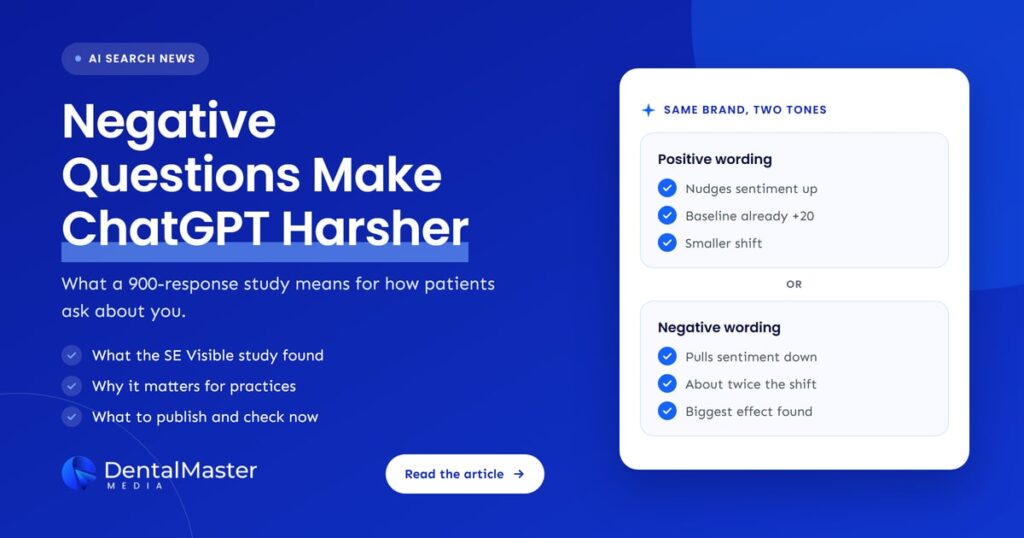
Quick answer: A new study of 900 ChatGPT answers found that negatively worded questions moved brand sentiment about twice as far as positively worded ones. The study tested TVs, weight-loss telehealth and airlines, not dentistry. Still, patients ask worried questions, so practices should answer common concerns clearly online and check how ChatGPT responds.
Key takeaways
- SE Visible, part of SE Ranking, ran 180 prompts five times each in ChatGPT and published the results on November 4, 2026.
- Negative prompts moved sentiment roughly twice as far from the neutral baseline as positive prompts. Neutral prompts averaged a mildly positive net sentiment of about +20.
- Answers were not stable: only 44% of prompts got the same sentiment in all five runs.
- No dental practices were tested. The study covered one AI model, three categories, and comes from a company that sells AI visibility tracking.
- The practical lesson for practices is to answer the worries patients actually have (pain, cost, emergencies, complaints) on your own pages and Google Business Profile, and to test worried questions, not just flattering ones.
What did the ChatGPT prompt sentiment study find?
SE Visible tested whether the tone of a question changes how ChatGPT talks about a brand. It found a clear link: across 180 prompts the correlation between prompt tone and answer tone was 0.66, and negative wording pulled answers down about twice as far as positive wording pushed them up.
The study, written by Celeste Gonzalez, built 60 positive, 60 neutral and 60 negative prompts. Each set was matched on the same brand and the same decision, so only the tone changed. Every prompt was run five times, giving 900 responses. Answers were scored on a net sentiment scale from -100 (fully negative) to +100 (fully positive).
| Finding | What SE Visible reported |
|---|---|
| Sample | 180 prompts (60 positive, 60 neutral, 60 negative), each run 5 times for 900 ChatGPT responses |
| Categories tested | Samsung vs Sony TVs, Hers vs Start Willow GLP-1 telehealth, Delta SkyMiles vs United MileagePlus |
| Link between prompt tone and answer tone | Spearman correlation of 0.66 |
| Neutral baseline | Neutral prompts averaged a net sentiment of about +20, so “neutral” answers leaned mildly positive |
| Negative vs positive wording | Negative prompts moved sentiment roughly twice as far from the baseline as positive prompts |
| Negative prompts by category | About -11 for TVs, -45 for airlines and -53 for GLP-1 telehealth |
| Consistency between runs | 44% of prompts got the same sentiment in all 5 runs; 96% had a majority (3 of 5) agreeing |
The author notes that part of the gap is a ceiling effect. If neutral answers already sit around +20, there is less room for a positive question to push them higher. The study says the imbalance remained after allowing for that.
Framing also had limits. When asked about Sony’s upscaling weaknesses, Sony still scored about +59. In a small mirrored test of five negative comparison pairs, the brand placed in the negative position lost between 20 and 180 points. The author describes framing as pressure on the answer rather than something that rewrites it.
What is prompt sentiment?
Prompt sentiment is the emotional tone of the question someone types into an AI assistant. “What do patients love about this practice?” is positive. “What is this practice like?” is neutral. “Are there complaints about this practice?” is negative. The study measured how much that tone carries over into the answer.
A negative question in this sense isn’t rude. It is any question framed around a doubt, a risk or a problem. In dentistry, many everyday questions are framed that way, because people often look up a dentist when they are worried about pain, cost or a bad past experience.
How much weight should practice owners give this study?
Treat it as a useful signal, not a rule. It tested one AI model, three non-dental categories and a modest number of prompts, and it was published by a company that sells AI visibility tracking. The author also stresses that a correlation shows a link, not proof that wording alone caused every change.
Here is what the study does and does not tell you:
- It does show that ChatGPT’s tone about a brand can shift with the wording of the question, and that negative wording had the bigger effect in these categories.
- It does show that a single answer is a weak measure. Net sentiment moved an average of 27 points between runs of the same prompt.
- It does not show how ChatGPT talks about dental practices. No dental prompts were tested.
- It does not show results for Google AI Overviews, Gemini, Perplexity or other assistants.
The closest category to healthcare was GLP-1 telehealth, which had the most negative average under negative wording, at about -53. That is one category in one study, so read it as a reason for care, not a forecast for dentistry.
Why does this matter for dental practices?
It matters because patients rarely ask about a dentist in a neutral way. They ask whether a treatment hurts, whether a practice overcharges, or whether anyone has complained. If worried wording pulls answers down, the questions patients ask most often may be the ones where your practice looks weakest, unless your information answers those worries.
ChatGPT can search the web and answer with links to sources, as OpenAI described when it launched ChatGPT search. That means what your website, your Google Business Profile, your reviews and other sites say about you is the material it can work from. The SE Visible author also suggests tracking sentiment over time, because changes in online information can shift how ChatGPT responds.
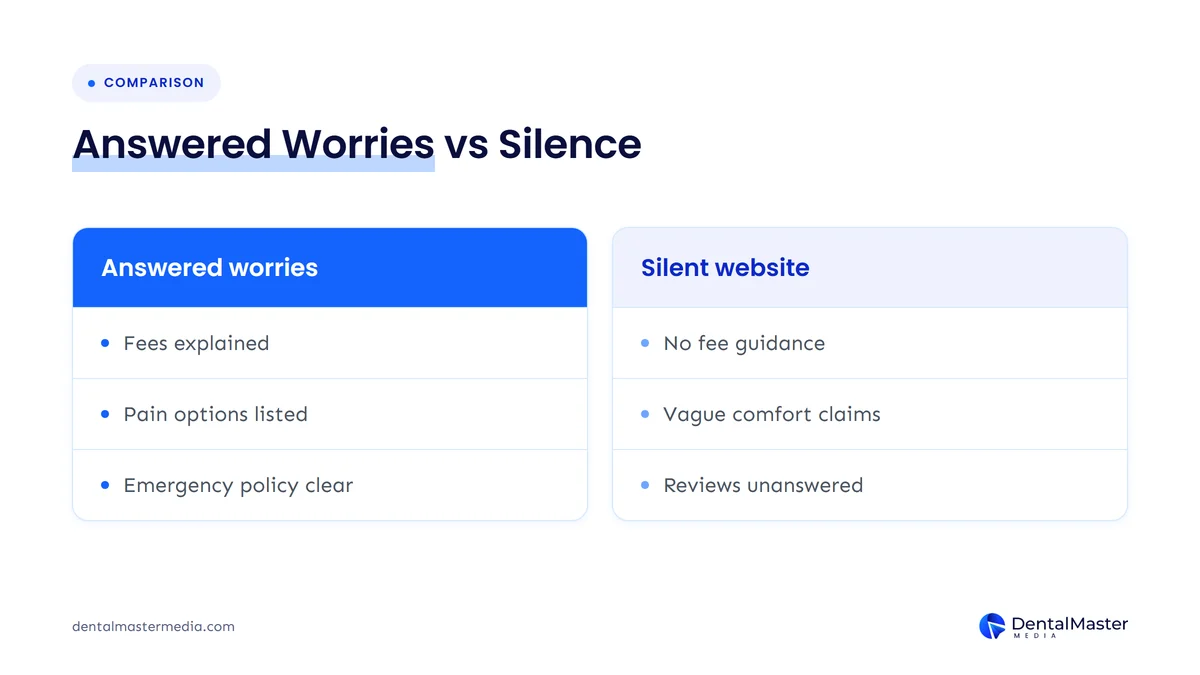
Typical worried questions a patient might type, with your practice name in place of “the practice”, include:
- “Is a root canal at the practice painful?”
- “Are there complaints about the practice?”
- “Is the practice too expensive for implants?”
- “Will the practice see me if I have a dental emergency at the weekend?”
These are examples of how people phrase concerns, not data from the study. For a wider look at why AI tools sometimes name a competitor instead, read why ChatGPT may recommend another dentist.
What should your practice do now?
Start by finding the worries patients have about your practice, then answer each one plainly on a page you control. Keep your Google Business Profile complete and accurate, reply to reviews, and check how ChatGPT answers worried questions about you several times, not once. None of this needs special AI tricks.
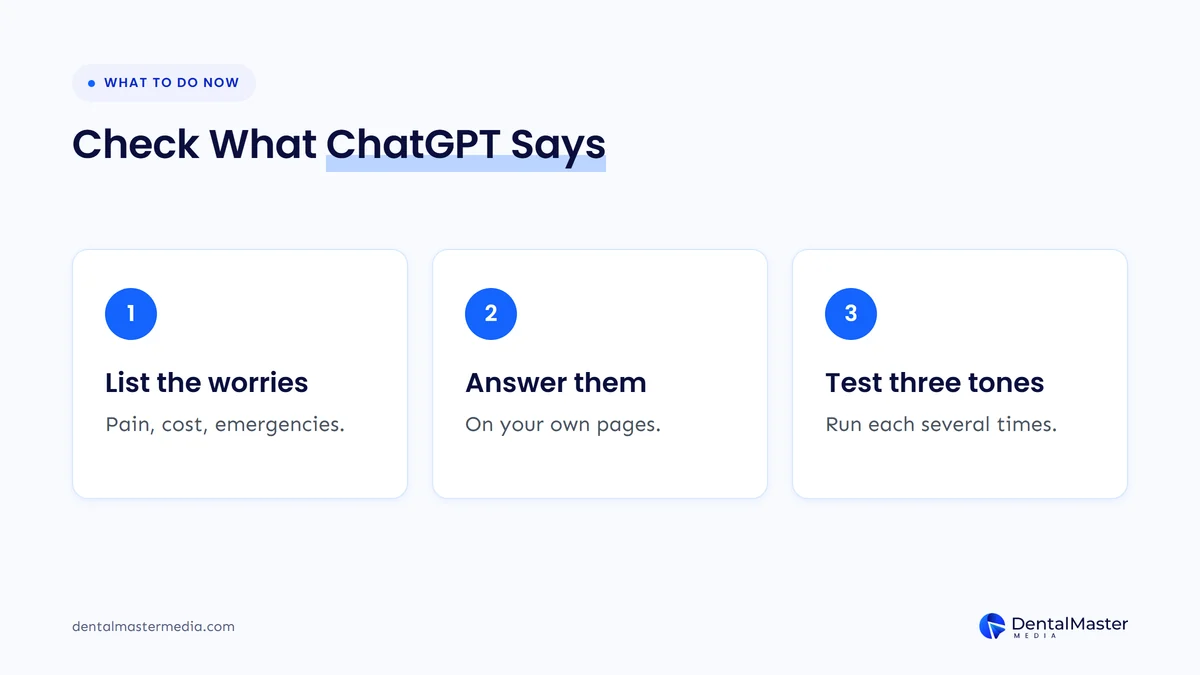
- List the worries. Ask your front desk which questions callers ask most before booking. Read your reviews, good and bad, for repeated themes such as waiting times, billing or pain.
- Answer each worry on your website. Give it a clear heading and a direct answer: how you manage pain and anxiety, how fees and payment plans work, and what happens in an emergency. The SE Visible author recommends addressing recurring concerns directly in FAQs and service pages.
- Keep your Google Business Profile complete. Google says businesses with complete and accurate information are more likely to show up in local results. Hours, services and emergency details should match your website.
- Reply to reviews, including critical ones. Google says replying shows you value feedback. A calm, factual reply also puts your side of a complaint on the record, without sharing any patient details.
- Keep your details consistent everywhere. Your name, address, phone, services and hours should agree across your site, your profile and directories. Our guide to cross-platform consistency for dental practices explains why this matters for AI search.
- Check ChatGPT regularly. Use the method in the next section and note any concern that keeps appearing.
Which pages answer the questions patients worry about?
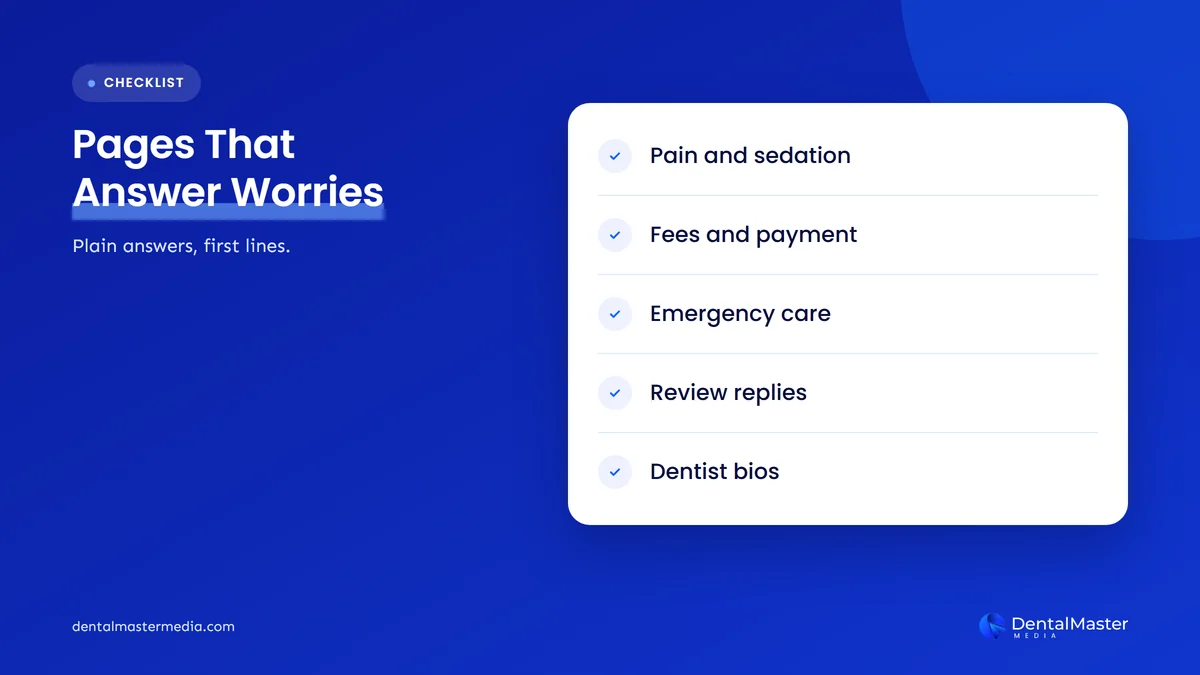
Most worried questions map to a small set of pages: a pain and sedation page, a fees and payment page, an emergency page, an FAQ and your Google Business Profile. Each should give a direct, factual answer in the first few lines, written for patients and in line with your local advertising rules.
| Patient worry | Example question | Where to answer it |
|---|---|---|
| Pain and anxiety | “Does a filling hurt there?” | A comfort, sedation or anxious patients page, plus treatment pages |
| Cost | “Is this practice expensive?” | A fees, insurance and payment plans page |
| Emergencies | “Can I be seen today?” | An emergency page and the hours on your Google Business Profile |
| Complaints | “Do people complain about them?” | Your replies to reviews, plus a clear contact and feedback route |
| Trust | “Is the dentist qualified?” | Dentist bio pages with credentials and memberships |
Reviews often carry the strongest negative signals, so it helps to understand how they affect patients too. Our guide on why negative reviews cost dental practices more than they think covers how to respond.
How do you check what ChatGPT says about your practice?
Write a short set of questions about your practice in three tones, positive, neutral and negative, and run each one several times. Record whether the answer is positive, neutral or negative and which concerns it raises. Repeat the check every month or two so you can see changes over time.
This copies the logic of the study at a small scale. Because answers vary between runs, one reply tells you little. Look for patterns instead:
- Pick five to ten questions covering booking, cost, pain, emergencies and trust.
- Write each in three tones. For example: “Why do patients like your practice?”, “What is your practice like?” and “What are the downsides of your practice?”
- Run each version several times, ideally in fresh chats, and note the tone and any concerns mentioned.
- Note the sources ChatGPT links to. If it cites an old directory listing or an outdated page, fix that information at the source.
- Turn repeated concerns into content. If the same worry keeps appearing, answer it on your site and in your profile.
If you would rather have this done for you, our post on what an AI search visibility audit reveals shows what we look at.
What’s likely next?
This section is our opinion. We expect more studies like this one, and more AI visibility tools that test worried questions as well as positive ones. For practices, we think the basics will matter more, not less: clear answers, honest replies to reviews and accurate details everywhere.
We would not chase tricks aimed at a single AI tool. Assistants change often, and the study itself shows how much answers vary. Content that answers real patient concerns helps in Google search, in Maps and on the phone, whatever happens with AI answers.
Frequently asked questions
Did the study test dental practices?
No. The study tested TVs, GLP-1 telehealth providers and airline loyalty programs. Nothing in it measured dental practices, so any lesson for dentistry is an inference. The useful takeaway is the pattern: worried wording pulled ChatGPT’s answers down more than positive wording pushed them up.
Can a practice stop ChatGPT from saying negative things?
No. A practice cannot control what ChatGPT says. What it can control is the information available about it: clear website pages, a complete Google Business Profile, accurate details on other sites and calm replies to reviews. That gives AI tools better material when patients ask worried questions.
Why does ChatGPT give different answers to the same question?
AI assistants generate each answer fresh, so wording and tone can change between runs. In the SE Visible study, only 44% of prompts got the same sentiment in all five runs, and net sentiment moved an average of 27 points between runs. That is why one check proves very little.
Should I ask patients to write positive reviews to offset negative questions?
You can ask patients for honest reviews, but follow Google’s rules and your local professional rules. Google’s Maps content policy says businesses must not offer incentives for reviews or selectively ask only happy patients. Replying to existing reviews, including critical ones, is something you can start this week.
How often should a practice check what ChatGPT says about it?
Every month or two is a sensible rhythm for most practices, and after any big change such as a new location, new services or a burst of reviews. Use the same question set each time, run each question several times and compare the patterns rather than single answers.
What negative questions mean for your practice
SE Visible’s 900-response study suggests that worried questions pull ChatGPT’s answers about a brand down further than positive questions lift them. It didn’t test dentistry, and it has clear limits, but patients ask worried questions every day. The practices best placed are the ones that answer pain, cost, emergency and complaint questions plainly on their own pages and in their Google Business Profile, then check the results over time. That work sits at the center of our dental SEO services at Dental Master Media.
Find out what patients see when they ask about you
Dental Master Media’s free audit checks your website, Google Business Profile and local listings for the gaps that leave patient worries unanswered. You get a clear list of what to fix first, so search engines and AI tools have accurate information to draw on.
Sources
- SE Visible (SE Ranking), Celeste Gonzalez, “Does Prompt Sentiment Change How ChatGPT Talks About Brands? What 900 Responses Showed”, November 4, 2026. https://visible.seranking.com/blog/chatgpt-prompt-sentiment-study/
- OpenAI, “Introducing ChatGPT search”, October 31, 2024. https://openai.com/index/introducing-chatgpt-search/
- Google Business Profile Help, “Tips to improve your local ranking on Google”, accessed November 9, 2026. https://support.google.com/business/answer/7091
- Google Maps User Generated Content Policy Help, “Prohibited & restricted content”, accessed November 9, 2026. https://support.google.com/contributionpolicy/answer/7400114

Suraj Rana is the owner of Dental Master Media and a leading expert in SEO for dental practices. With a passion for dental marketing, he has successfully helped numerous dental clinics climb the search engine ranks. Suraj’s expertise makes him a go-to resource for effective, results-driven dental marketing.