Quick answer: You market dentures online by giving full dentures, partial dentures, implant-retained dentures and relines one page each, setting up an accurate Google Business Profile, asking every patient for a review and tracking calls. About 36 million Americans have no teeth, according to the American College of Prosthodontists, so the demand is steady.
Key takeaways
- Denture SEO is the work that makes a dental practice appear in Google and Google Maps when people search for dentures, partials and relines.
- About 36 million Americans have no teeth and about 120 million are missing at least 1 tooth, so denture patients exist in almost every city.
- A practice needs 4 denture pages: full dentures, partial dentures, implant-retained dentures, and relines and repairs.
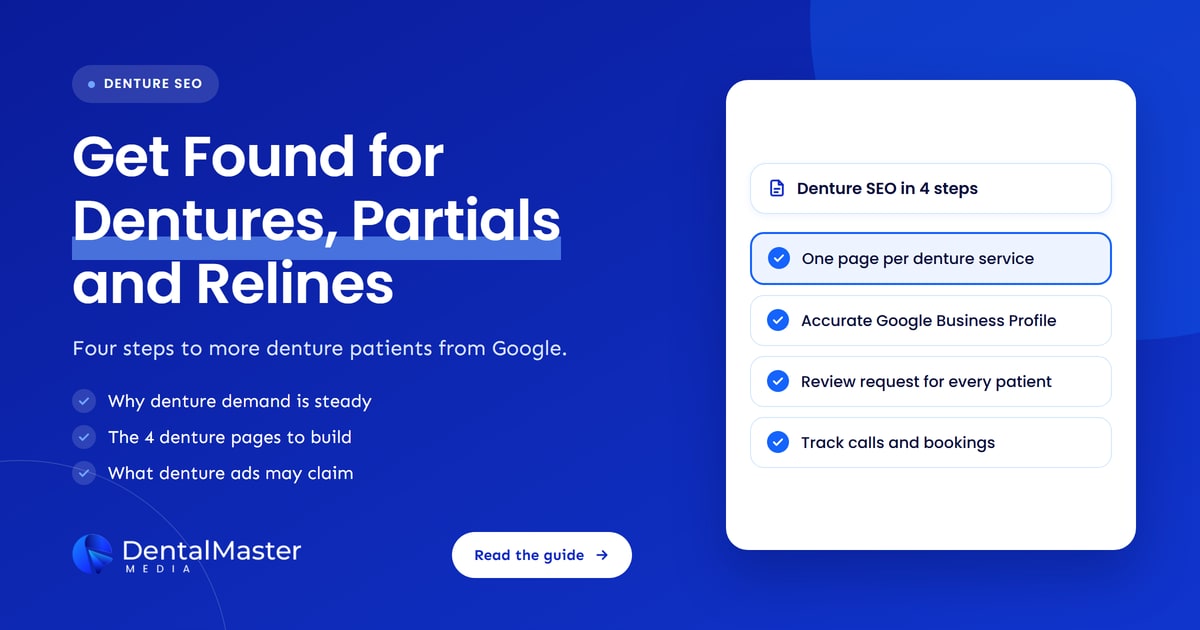
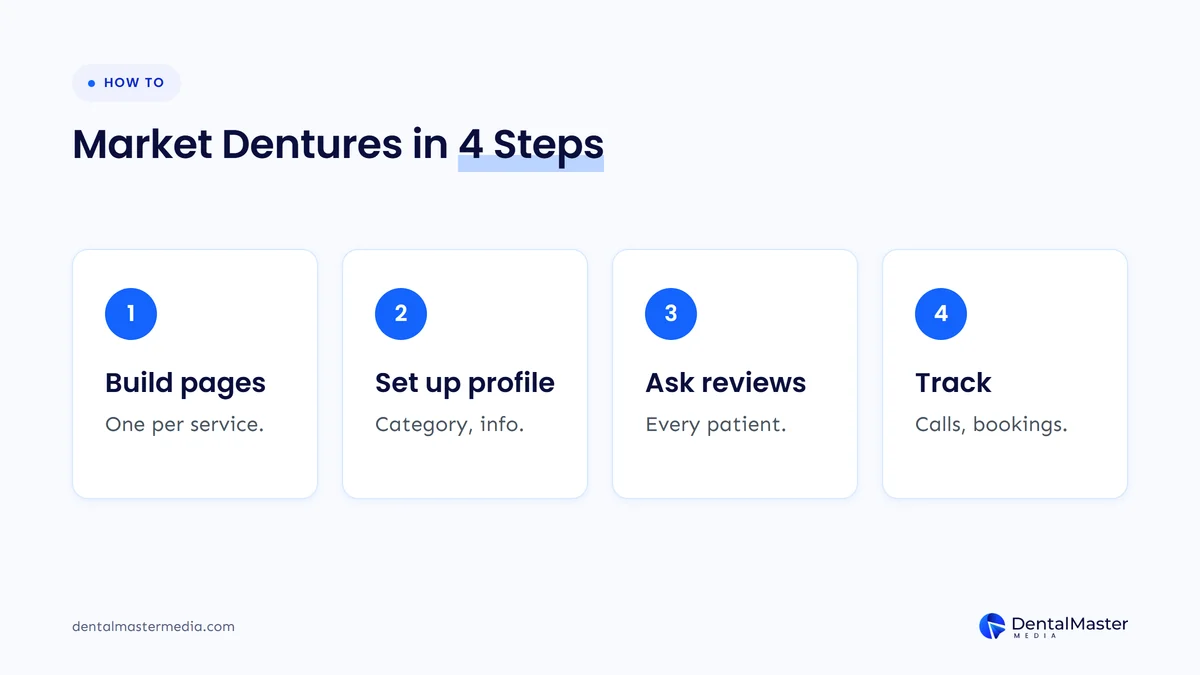
- The 4 steps are: build one page per service, set up the Google Business Profile, ask every patient for a review, and track calls.
- Denture claims must be truthful and backed by evidence under the Federal Trade Commission’s advertising rules.
- Implant SEO and denture SEO overlap, so the denture pages should link to the implant pages and the other way round.
What is denture SEO?
Denture SEO is the practice of improving a dental practice’s website and Google Business Profile so that people searching for full dentures, partial dentures, implant-retained dentures, relines and repairs find that practice in Google Search, Google Maps and AI answers. Denture SEO is a part of dental SEO, and it follows the same local search rules, with pages written for the questions denture patients ask.
Denture searches come in 3 kinds: a service search (“partial dentures”), a local search (“dentures near me”) and a repair search (“denture reline”). Each kind needs a page or a profile that answers it. Our dental SEO services cover that whole set of pages, profiles and reports, and this guide covers the denture part.
How many people need dentures, and what does that mean for denture SEO?
About 36 million Americans have no teeth and about 120 million are missing at least 1 tooth, according to the American College of Prosthodontists. Around 90% of people with no teeth have dentures, and about 15% of that group get new dentures each year, so a steady stream of patients searches for new dentures, replacements and relines.
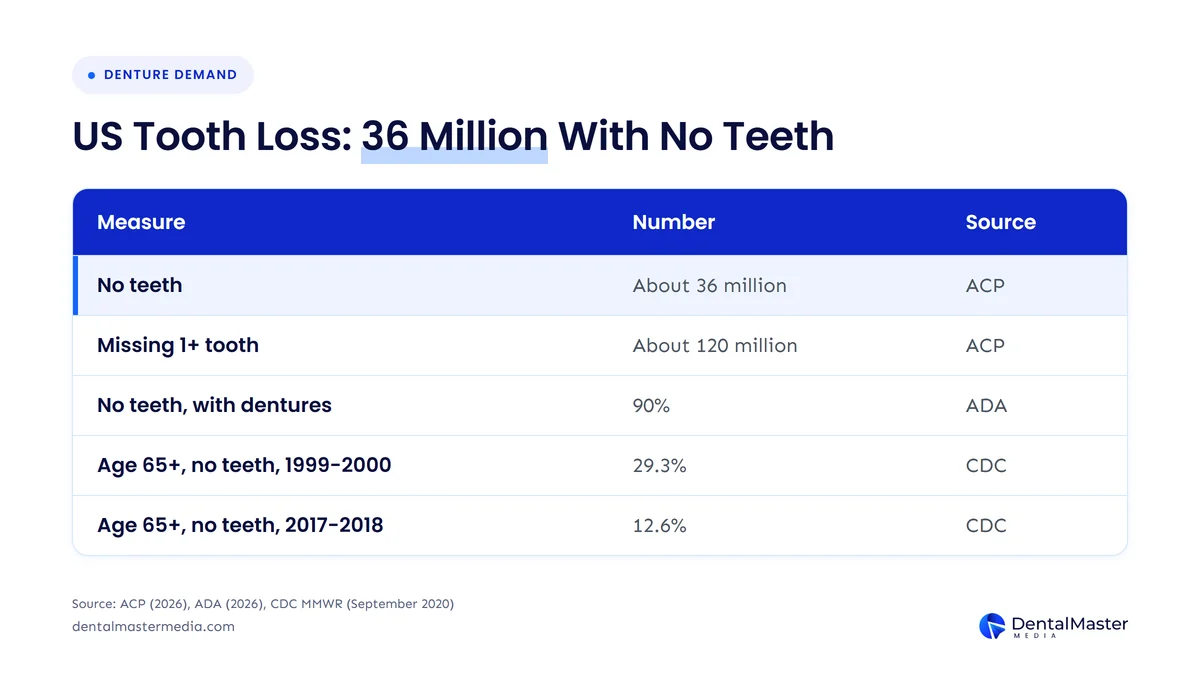
| Measure | Number | Source |
|---|---|---|
| Americans with no teeth | About 36 million | American College of Prosthodontists |
| Americans missing at least 1 tooth | About 120 million | American College of Prosthodontists |
| People with no teeth who have dentures | 90% | American Dental Association |
| People with no teeth who get new dentures each year | 15% | American Dental Association |
| Complete tooth loss in adults 65 and older, 1999-2000 | 29.3% | Centers for Disease Control and Prevention |
| Complete tooth loss in adults 65 and older, 2017-2018 | 12.6% | Centers for Disease Control and Prevention |
The table shows two things: denture demand is large today, and complete tooth loss in adults 65 and older fell from 29.3% in 1999-2000 to 12.6% in 2017-2018, according to the Centers for Disease Control and Prevention. The same CDC data showed 23.5% complete tooth loss among adults below 200% of the federal poverty level and 8.5% among adults at or above it in 2017-2018.
Fewer people have no teeth, so a denture page that talks only about full dentures reaches a smaller group each year. The American College of Prosthodontists says the number of partially edentulous patients will rise to more than 200 million within 15 years, which is why partial dentures and implant-retained dentures need their own pages.
What are the 4 denture services that need their own page?
A dental practice needs 4 denture pages, one for each service patients search for separately. Each service answers a different patient question and appears in different searches, so one page per service gives Google a clear match for each query. The 4 denture services are listed below.
- Full dentures: a complete set of replacement teeth for a patient with no teeth in the upper arch, the lower arch or both.
- Partial dentures: a removable appliance that replaces some teeth in an arch where other teeth remain.
- Implant-retained dentures: dentures that attach to dental implants, which the American Dental Association lists as the second main denture category next to nonimplant dentures.
- Relines and repairs: work that restores the fit or the strength of an existing denture for a patient who already wears one.
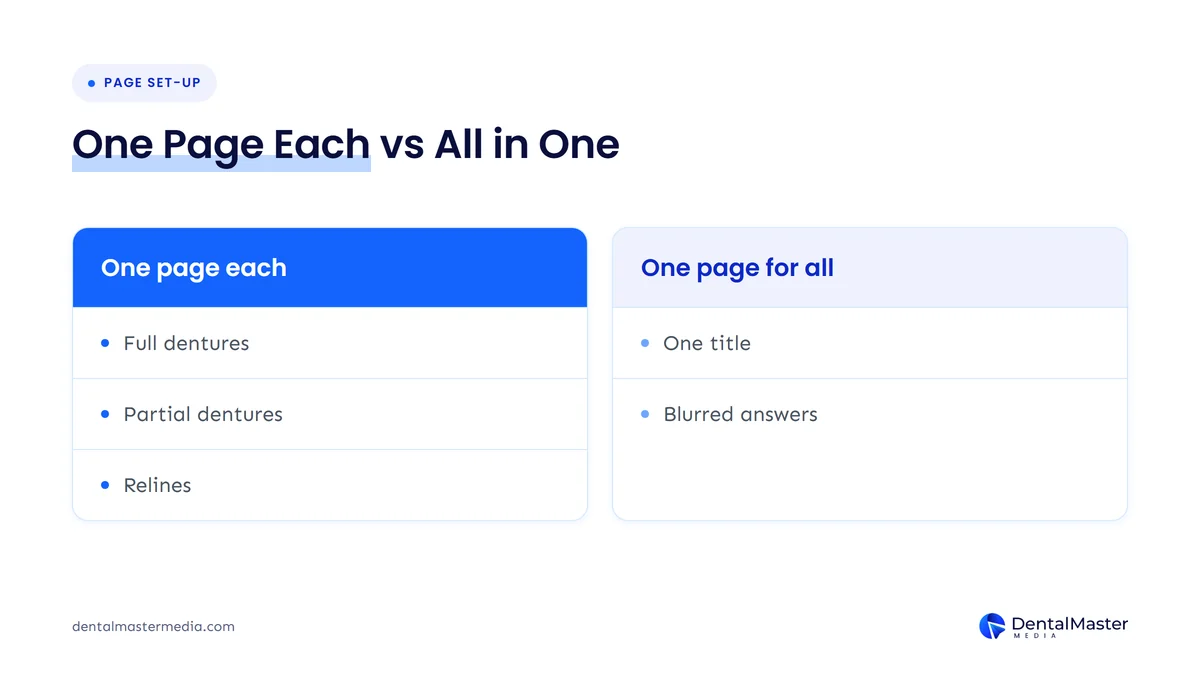
Our checklist for what a veneers and cosmetic dentistry page should include follows the same rule: one treatment, one page, one clear answer for the patient.
What is a denture reline, and how is it different from a rebase?
A denture reline resurfaces the tissue-facing side of a denture with new material, and a rebase replaces the entire denture base material while both keep the original artificial teeth. A 2026 rapid review in the Canadian Journal of Health Technologies uses those definitions and found no evidence-based guideline on how often a denture should be relined or rebased.
The American Dental Association says a denture should be evaluated for replacement if it is more than 5 years old, and that a poorly fitting denture may need to be relined or replaced. The same rapid review cites a Japanese study of 50 patients in which 47 relined or rebased dentures (94%) were well fitted at 1 year. A reline page should say what the service is, who it suits and when to book, and it should not promise a timeline the evidence does not support.
How do you market dentures online in 4 steps?
You market dentures online in 4 steps: build one page for each denture service, set up your Google Business Profile for dentures, ask every denture patient for a review, and track phone calls and consultation bookings. Each step has one outcome, and the first two make a practice findable while the last two prove that the work brings patients.
Step 1: Build one page for each denture service
Build one service page for each of the 4 denture services, and every denture page answers the patient’s main question in its first paragraph. The outcome of this step is 4 live denture pages, each with its own title, its own H1 and one clear next step such as a phone number or a booking button.
Google’s SEO Starter Guide says a good title is unique to the page, clear and concise, and accurately describes the contents of the page. Write the title of the partial dentures page for partial dentures and the title of the reline page for relines, so that no 2 denture pages compete for the same words. Google also says it finds most new pages through links from pages it already knows, so link the 4 denture pages to each other and to the main treatment page.
Put the content in this order on each page: what the service is, who it suits, how the appointments run, what it costs or how pricing works, and how to book. Use plain words, large text and a tap-to-call number, so that a patient who finds the page can call with one tap.
Step 2: Set up your Google Business Profile for dentures
Set up your Google Business Profile so that Google matches your practice to denture searches, because Google bases local results mainly on relevance, distance and prominence. The outcome of this step is a profile whose category, services and information agree with your denture pages.
Google Business Help defines relevance as how well a profile matches what someone is searching for, distance as how far the business is from the searcher, and prominence as how well known a business is. Google also states that there is no way to request or pay for a better local ranking. Choose the most specific primary category that fits your practice, and Google says not to select a category for every product or service. Our guide to Google Business Profile settings for dental practices lists the other fields to check.
Keep the practice name, address, phone number and hours identical on the profile, the website and your directory listings. A profile that lists a different phone number from the denture pages weakens the match that the first step built.
Step 3: Ask every denture patient for a review
Ask every denture patient for a Google review, because reviews and ratings can improve local ranking according to Google Business Help. The outcome of this step is a steady flow of reviews that mention dentures, partials and relines in the patients’ own words.
Google’s Maps policy on rating manipulation says merchants may not offer incentives such as payment, discounts or free goods or services for reviews. The same policy says merchants may not discourage or prohibit negative reviews or selectively solicit positive reviews. Send the same review request to every patient after a fitting, and reply to each review in a calm, factual tone without sharing any patient’s health information.
Step 4: Track phone calls and consultation bookings
Track phone calls and consultation bookings for each denture page, because impressions and rankings alone do not show whether denture patients are booking. The outcome of this step is a monthly count of calls and bookings per denture service that tells you which page to improve next.
Google Search Console shows which searches lead to your denture pages and how many clicks each page gets, and a tracked phone number or booking form shows what visitors do after the click. Review the 4 denture pages once a month. Move a page up the priority list if it gets impressions but no calls, because the title or the first paragraph is not answering the search.
What can denture pages and ads claim?
Denture pages and ads can claim only what is truthful and what you can support with evidence, because the Federal Trade Commission requires advertising to be truthful and non-deceptive. A claim such as “same-day dentures” or “a perfect fit” needs a factual basis before it goes on a page.
The FTC’s “Advertising FAQ’s: A Guide for Small Business” says a company needs a reasonable basis for its claims before it runs an ad, and that offering a refund is not a substitute for substantiation. The guide adds that statements from satisfied customers usually are not enough to support a health or safety claim. Disclosures must be clear and conspicuous, so a price or a condition cannot sit in fine print under a bold offer. Check the rules of your state dental board and country as well, because they can be stricter than the FTC’s.
How is denture SEO different from implant SEO?
Denture SEO targets people who want removable replacement teeth and often compare cost, comfort and fit, while implant SEO targets people who want fixed teeth anchored in the jaw and compare procedures, surgeons and timelines. The two overlap at implant-retained dentures, which belong on a denture page and an implant page at the same time.
On the implant-retained denture page, state what the service is and send the reader to the implant page for surgery details, so that no 2 pages answer the same question. Our implant denture SEO page sits in our implant SEO section for practices that want help with implant-retained dentures.
Frequently asked questions
How do I market dentures online?
You market dentures online by building one page for each denture service, setting up your Google Business Profile, asking every patient for a review and tracking calls and bookings. These 4 steps are the same for full dentures, partial dentures, implant-retained dentures and relines. Start with the page for the service you want to grow first.
Do I need a separate page for each type of denture?
Yes, a separate page for each type of denture is the clearest approach for local search. Patients search for full dentures, partial dentures and relines separately, and Google’s SEO Starter Guide asks for titles that are unique to the page and describe its contents. One page for all dentures forces a single title to cover 4 searches.
How much does denture SEO cost?
Dental SEO at Dental Master Media costs $749, $1,250 or $1,999 a month, depending on the plan, and denture pages are one part of that work. The right plan depends on how many services and locations your practice needs to cover.
Our post on how much dental SEO costs in 2026 shows what a retainer should include.
Does denture SEO help me appear in AI answers?
Yes, the same pages help, because Google’s guide to generative AI features says you do not need new machine-readable files, AI text files, special markup or Markdown to appear in them. Clear denture pages, a complete Google Business Profile and accurate facts are what AI answers draw on, and no extra file replaces them.
Can I offer a discount for denture reviews?
No, you cannot offer a discount, a payment or a free service in exchange for a Google review. Google’s Maps policy on rating manipulation says merchants may not offer incentives for reviews, and may not selectively solicit positive reviews. Ask every patient the same way and let them write what they want.
Denture SEO starts with one page per service
Denture SEO is 4 jobs: one page for each denture service, an accurate Google Business Profile, a review request for every patient and a monthly count of calls and consultation bookings. About 36 million Americans have no teeth and about 120 million are missing at least 1 tooth, so the search demand for dentures, partials and relines is real.
If you want these pages built and tracked for your practice, our dental SEO services at Dental Master Media start at $749 a month.
Plan your denture pages with us
In a free strategy call we look at how your practice appears for full dentures, partial dentures, implant-retained dentures and relines, and we show you which denture pages to build or fix first.
Sources
- American College of Prosthodontists, “Facts and Figures” (about 36 million Americans with no teeth, about 120 million missing at least 1 tooth), accessed November 20, 2026. https://gotoapro.org/facts-figures/
- American Dental Association, “Denture Care and Maintenance” (denture categories, 90% and 15% figures, 5-year replacement check), accessed November 20, 2026. https://www.ada.org/resources/ada-library/oral-health-topics/dentures
- Centers for Disease Control and Prevention, MMWR, “QuickStats: Prevalence of Complete Tooth Loss Among Adults Aged 65 Years or Older, by Federal Poverty Level, NHANES, United States, 1999-2018”, September 18, 2020. https://www.cdc.gov/mmwr/volumes/69/wr/mm6937a8.htm
- Canadian Journal of Health Technologies, “Longevity of Relined or Rebased Dentures” (rapid review RC1592, literature search completed March 19, 2026). https://www.canjhealthtechnol.ca/index.php/cjht/article/view/RC1592/3411
- Google Business Profile Help, “How to improve your local ranking on Google” (relevance, distance, prominence), accessed November 20, 2026. https://support.google.com/business/answer/7091
- Google Business Profile Help, guidance on choosing a primary business category, accessed November 20, 2026. https://support.google.com/business/answer/7249669
- Google Maps contributed content policy, “Fake and misleading content: Rating manipulation”, accessed November 20, 2026. https://support.google.com/contributionpolicy/answer/7400114
- Google Search Central, “SEO Starter Guide”, accessed November 20, 2026. https://developers.google.com/search/docs/fundamentals/seo-starter-guide
- Google Search Central, “Optimizing your website for generative AI features on Google Search”, May 15, 2026. https://developers.google.com/search/docs/fundamentals/ai-optimization-guide
- Federal Trade Commission, “Advertising FAQ’s: A Guide for Small Business”, edited January 2025. https://www.ftc.gov/business-guidance/resources/advertising-faqs-guide-small-business
- Ranktracker, “Denture Clinic SEO: Rank Higher, Attract More Patients, and Grow Your Practice”, accessed November 20, 2026 (top-ranking page reviewed for the brief). https://www.ranktracker.com/blog/denture-clinic-seo

Suraj Rana is the owner of Dental Master Media and a leading expert in SEO for dental practices. With a passion for dental marketing, he has successfully helped numerous dental clinics climb the search engine ranks. Suraj’s expertise makes him a go-to resource for effective, results-driven dental marketing.