

Quick answer: Google AI Mode has been seen showing up to four ads under a single answer, and Google says it is scaling ads to more users and more queries. For a dental practice, that means more paid competition near the bottom of AI answers. The answer itself still draws on organic pages and Business Profiles, so SEO and local work still decide who gets mentioned.
Key takeaways
- On November 2 and 4, 2026, Search Engine Watch and Search Engine Roundtable reported AI Mode showing four ads at the bottom of one response, up from the usual one or two.
- It isn’t clear whether four ads is a new limit. Google has not announced a set number for AI Mode.
- What Google has confirmed: ads in AI Mode are expanding to 10 more countries, multiturn ads are launching in the US, and ads are being scaled to more queries.
- Advertisers can’t opt out of AI Mode separately from Search, or target it on its own. Existing Search and Performance Max campaigns are already eligible.
- Google says there are no special optimizations needed to appear in AI Mode answers. Crawlable pages, clear text and an up-to-date Business Profile still do the work.
What changed with ads in Google AI Mode?
As of November 5, 2026, three things have changed. Google confirmed on October 28 that ads in AI Mode are expanding to new countries and to follow-up questions in the US. It told investors it is scaling ads to more queries. Then industry reporters spotted four ads under a single AI Mode answer.
Here is the order of events, starting with the official sources:
| Date (2026) | Source | What was said or seen | Status |
|---|---|---|---|
| October 28 | Google Keyword blog | Ads in AI Mode scaling in Australia, Canada, India, Kenya, Malaysia, New Zealand, Nigeria, Pakistan, the Philippines and Singapore. Brazil, Mexico and the UK planned for Q4. Multiturn ads launching in the US. | Official |
| October 28 to 29 | Alphabet earnings call, reported by Search Engine Roundtable | Google’s chief business officer said Google is scaling ads in AI Overviews and AI Mode “to more users and more queries”, and that AI Mode currently monetizes less than traditional search. | Official statement |
| November 2 | Search Engine Watch | A screenshot showed four ads at the bottom of an AI Mode response, after earlier sightings of three. | Observed |
| November 4 | Search Engine Roundtable | Reported that AI Mode can show up to four ads for one query, while noting it is unclear whether this is new. | Observed |
The official part is the direction: more ads, in more places, across more countries. The four-ad count is a sighting, not an announced rule, so treat it as a sign of where things are heading rather than a fixed layout.
What is Google AI Mode, and how do ads appear in it?
AI Mode is Google’s conversational search tab. Instead of a list of links, it writes an answer, cites web pages and lets people ask follow-up questions. Ads in AI Mode are labeled “Sponsored” and can appear within or alongside the answer, including on follow-up questions in the US.
A few terms are worth knowing before you talk to whoever runs your ads:
- Multiturn ads: ads shown on the follow-up questions in an AI Mode conversation, not only on the first question. Google is launching these in the US.
- Query fan-out: Google’s description of how AI Mode builds an answer by running several related searches across subtopics and sources at once.
- Sponsored label: every ad in AI Overviews and AI Mode carries this label and is visually separated from organic content, according to Google Ads Help.
Google also says AI Mode queries are on average three times longer than traditional searches, based on its own US report from May 2026. Longer questions give an AI answer more detail to work with, such as a treatment, a location and a concern in one sentence.
Is four ads in AI Mode actually new?
Nobody outside Google knows for sure. Search Engine Roundtable says it is unsure whether four ads is new, and points out that Google has shown up to four ads in regular search results since 2016. Most AI Mode answers still show one or two ads, and sometimes three.
What matters more for a practice owner is the trend. Search Engine Watch had already reported three bottom ads before it spotted four, and Google has said publicly that it wants ads on more AI Mode queries. Whether four is the ceiling or a test, the space around AI answers is getting more commercial, not less.
Which dental practices are affected?
Any dental practice whose patients use Google in the US, Australia, Canada, New Zealand or Singapore is already in a market where Google says ads in AI Mode are live or scaling. UK practices are next, with Google planning the UK for Q4 2026. Practices that run Google Ads are affected twice.
The effect depends on how you get patients from search today:
| Your situation | What the change means | Main thing to watch |
|---|---|---|
| You run Google Search or Performance Max campaigns | Your ads may already show in AI Mode, because existing campaigns are eligible automatically | Search terms, match types and cost per booked patient |
| You rely on organic search and Maps | More paid listings compete for attention around AI answers | Whether your practice is named or cited inside the answer |
| You do both | Paid and organic now share the same AI answer screen | Calls and bookings by source, not just clicks |
How do more AI Mode ads affect a dental practice’s visibility?
More ads mean more paid listings competing for the same patient’s attention, mostly at the bottom of the answer in the examples seen so far. They don’t change which practices the AI answer itself mentions. That part is still built from organic web pages and business information, which is where SEO and local work come in.
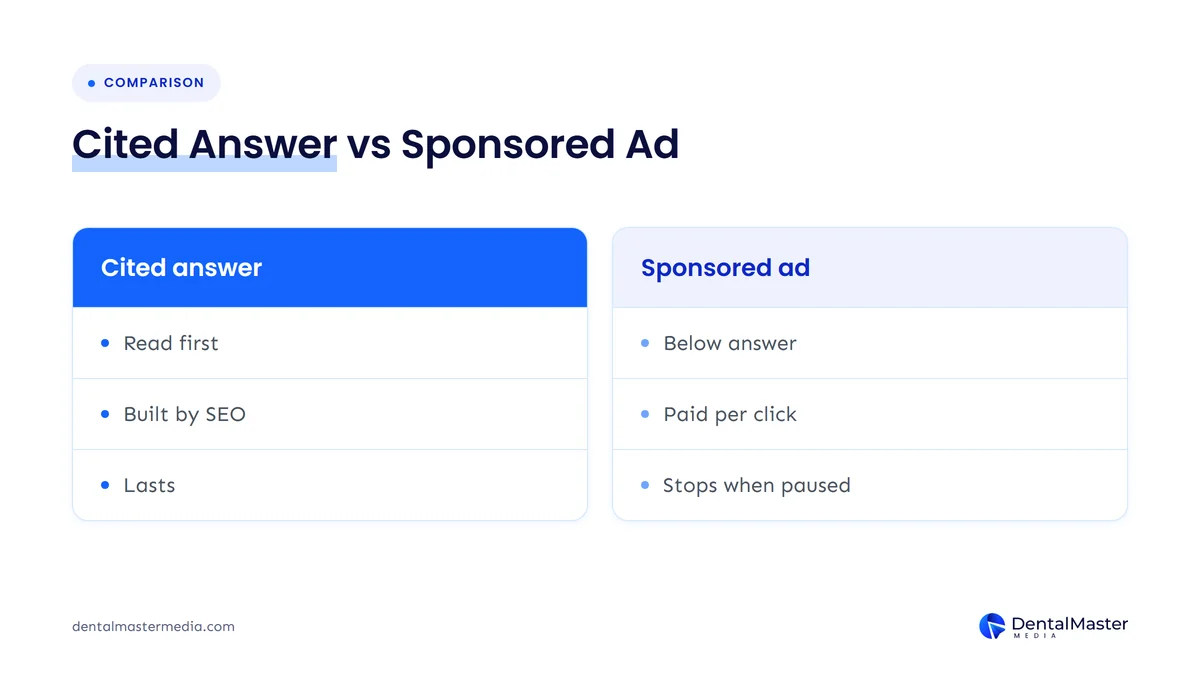
Think of an AI Mode screen as two zones. The first is the written answer, which may name practices, link to pages and pull details from Business Profiles. The second is the sponsored area, which in the reported screenshots sits below the answer. A patient reading the answer meets the organic zone first.
That is why we don’t see more ads as a reason to drop SEO. If anything, the organic zone becomes the place where trust is decided, while the ad zone becomes more crowded and, for some queries, more expensive to compete in. We have written more about the wider shift in how Google AI Mode is reshaping local search for dental practices.
One honest caveat: Google says click-through rates are already similar between sponsored and organic product listings in AI Mode. That figure covers shopping-style product lists, not dental searches, so it doesn’t tell us how patients treat dental ads in AI answers. No public data answers that yet.
Should a dental practice run ads in AI Mode?
If Google Ads already brings your practice booked patients at a cost you are happy with, there is no reason to stop because of this news. Ads and SEO do different jobs. Ads buy a visible slot for chosen searches while you pay. SEO builds the pages and profile that AI answers draw on, and that work keeps paying after you stop.
| Question | Google Ads in AI Mode | SEO and local visibility |
|---|---|---|
| Where you appear | Labeled “Sponsored”, within or alongside the answer | Named or cited inside the answer, plus Maps and organic results |
| Can you control placement? | Partly: you can’t target AI Mode only or opt out of it separately from Search | No direct control, but you control the pages and profile the answer reads |
| Speed | Can show as soon as campaigns are live | Builds over months |
| When you stop paying | Visibility stops | Pages, reviews and profile keep working |
| Reporting | AI Mode results are mixed into normal campaign reports | AI features are counted in Search Console’s overall Web traffic |
Many practices do best with both: ads for urgent, high-intent searches such as emergency care, and SEO for the treatment and trust questions people research over days or weeks. If you are weighing how much to rely on paid search, our article on what happens to new patient flow when you turn off Google Ads walks through the risks.
Does lower AI Mode monetization mean cheaper clicks?
Not necessarily. Google said AI Mode currently earns less per query than traditional search, but that describes Google’s revenue, not what each practice pays per click. Ad prices still come from the auction and from how many competitors bid on your searches. More ad slots could change prices in either direction.
Google’s chief business officer also said many AI Mode queries are early research and that monetization should improve over time. For a practice, the safe reading is simple: expect Google to keep adding ad space, and judge every campaign by cost per booked patient rather than by where the ad appears.
What should dental practices do now?
Start with what you can check this week. If you run ads, review how they match AI Mode questions and how you measure bookings. Whether or not you run ads, make sure the pages and Business Profile that AI Mode reads are accurate, complete and easy for Google to crawl.
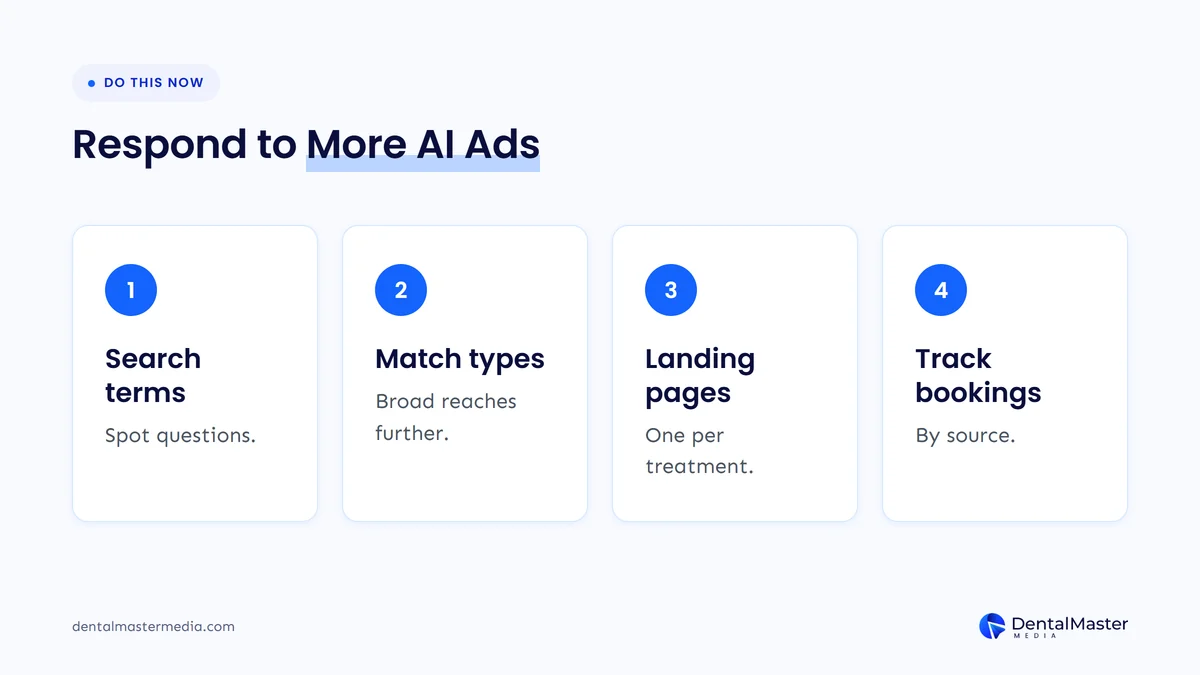
- Read your search terms report. Google includes AI Mode activity in standard campaign reports and the search terms report, so look for long, question-style searches that your ads now match.
- Check your match types. Google Ads Help says exact and phrase match keywords only show in AI experiences when a query has direct commercial intent. Broad match, AI Max and Performance Max can also match broader research questions, which may or may not suit your budget.
- Tighten negative keywords. Negative keywords and brand exclusions still apply, and they are your main control, since you can’t opt out of AI Mode on its own.
- Match each ad to a real treatment page. A patient who arrives from a detailed AI Mode question expects a page that answers it, not a generic homepage.
- Track calls and bookings by source. Neither Google Ads nor Search Console splits out AI Mode on its own, so call tracking and booking data are the most reliable way to see what is working.
What still earns organic visibility in AI Mode answers?
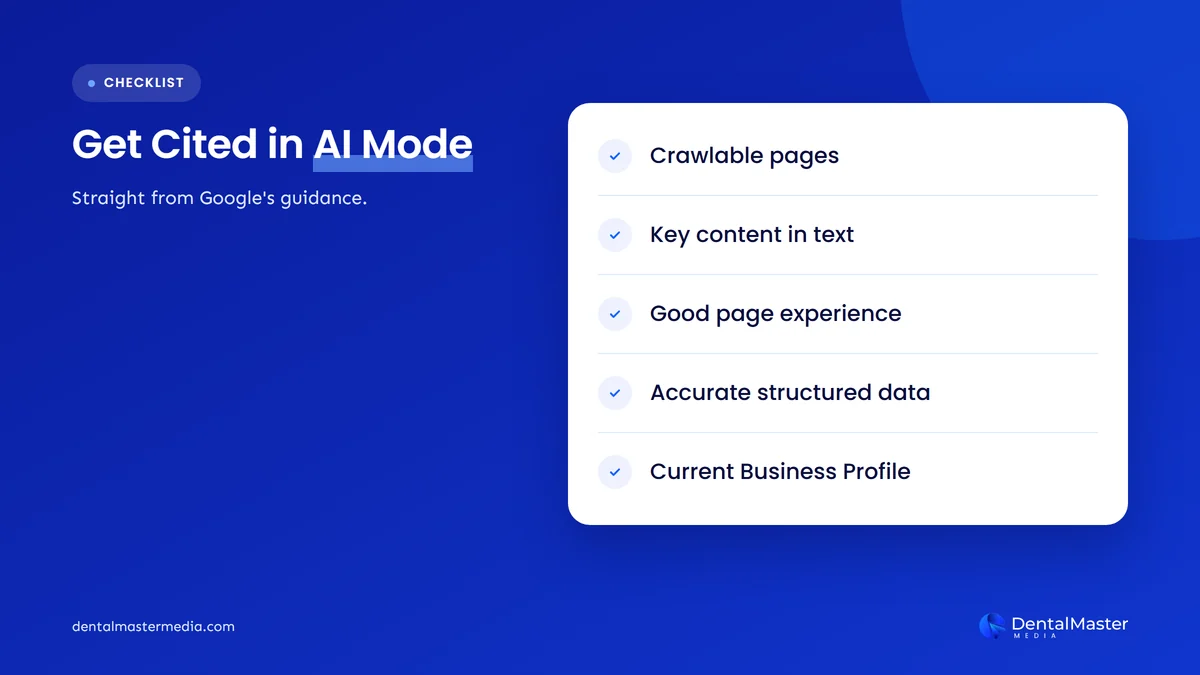
The same foundations as normal Google search. Google says there are no extra requirements or special optimizations needed to appear in AI Overviews or AI Mode. It lists practical basics instead: let Google crawl your site, put important content in text, offer a good page experience, keep structured data accurate and keep your Business Profile up to date.
Here is how those basics translate for a dental practice:
- Crawl access: check that robots.txt, your host and any security service allow Google to reach your treatment and location pages.
- Treatment pages written in text: explain each treatment, who it suits, what happens at the visit and how to book. Key details locked inside images or PDFs are hard for AI answers to use.
- Page experience: fast, mobile-friendly pages with the phone number and booking link easy to find.
- Accurate structured data: your schema should match what patients can see on the page, including hours, address and services.
- A current Google Business Profile: correct categories, services, hours and photos, with reviews answered. Our guide to Google Business Profile optimization for dentists covers each field.
Because AI Mode handles longer questions and fans them out into related searches, depth helps. A page that answers the follow-up questions patients actually ask, such as recovery time, payment options or what happens at the first visit, gives the answer more to cite. Our guide to writing dental service pages that AI search will cite shows how to structure them.
Frequently asked questions
Can my practice choose to show ads only in AI Mode?
No. Google Ads Help says you can’t target ads only to AI Overviews or AI Mode, and you can’t opt out of them separately from Search. Existing Search, Shopping and Performance Max campaigns are eligible automatically. Negative keywords and brand exclusions are the main ways to control when your ads show.
Will more AI Mode ads push my practice out of the answer?
Not directly. In the examples reported so far, the ads sit at the bottom of the AI Mode response, separate from the written answer. Which practices the answer mentions still depends on organic pages and business information. More ads do mean more paid competition for the patient’s attention on the same screen.
Do I need special AI optimization to appear in AI Mode?
No. Google says there are no additional requirements or special optimizations needed to appear in AI Overviews or AI Mode. Crawlable pages, clear text content, a good page experience, accurate structured data and an up-to-date Business Profile are the foundations Google itself recommends.
How can I tell if patients find my practice through AI Mode?
You can’t see it on its own yet. Google counts AI features within overall Web traffic in Search Console, and Google Ads mixes AI Mode results into normal campaign reports. Call tracking, booking forms and asking new patients how they found you are the most reliable checks.
Are ads in AI Mode available in the UK yet?
Google said on October 28, 2026 that it plans to expand ads in AI Mode to the UK, Brazil and Mexico in Q4 2026. At the time of that announcement, the UK was listed as planned rather than live. Australia, Canada, New Zealand and Singapore were among the 10 countries where ads are scaling.
What this means for your practice
Google is giving ads more room in AI Mode, and four ads under one answer may become a familiar sight. That is a reason to run ads carefully, with tight match types and booking-based tracking, not a reason to abandon them or to let organic visibility slide. The written answer patients read first is still built from organic pages and Business Profiles. At Dental Master Media, that is the part our dental SEO services focus on: treatment pages, local signals and tracking that show whether AI search is sending patients. For more background, read how AI Mode is changing local search for dentists and how to build service pages AI search will cite.
See how your practice shows up in AI search
Ads can buy a slot near the answer, but your website and Business Profile decide whether you are in it. Our free dental SEO audit checks the pages, profile and technical basics that AI Mode and Google Maps rely on, and shows what to fix first.
Sources
- Google, “Ads in AI Mode expand to new markets”, October 28, 2026. https://blog.google/products/ads-commerce/ads-in-ai-mode-global/
- Google Ads Help, “About ads in AI-powered experiences in Google Search”, accessed November 5, 2026. https://support.google.com/google-ads/answer/18826097
- Google Search Central, “AI features and your website”, accessed November 5, 2026. https://developers.google.com/search/docs/appearance/ai-features
- Search Engine Roundtable, “Google AI Mode Now With Up To Four Ads”, November 4, 2026. https://www.seroundtable.com/google-ai-mode-four-ads-42443.html
- Search Engine Watch, “Google AI Mode now showing four ads at the bottom”, November 2, 2026. https://searchenginewatch.com/google-ai-mode-now-showing-four-ads-at-the-bottom/
- Search Engine Roundtable, “Google: Ads In AI Mode Earning Less Than Traditional Search Ads”, October 29, 2026. https://www.seroundtable.com/google-ai-mode-ads-earn-less-42417.html
- Search Engine Roundtable, “Google Expands Ads In AI Mode To More Countries & Multiturn Ads In U.S.”, October 28, 2026. https://www.seroundtable.com/google-expands-ads-ai-mode-42412.html

Suraj Rana is the owner of Dental Master Media and a leading expert in SEO for dental practices. With a passion for dental marketing, he has successfully helped numerous dental clinics climb the search engine ranks. Suraj’s expertise makes him a go-to resource for effective, results-driven dental marketing.