
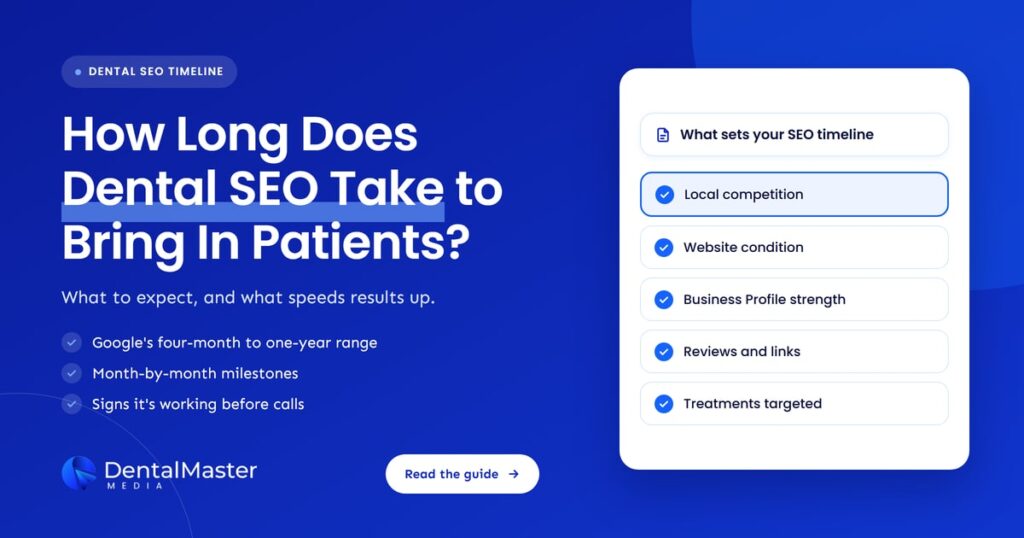
Quick answer: Most dental practices should plan on four months to a year before SEO brings a steady flow of new-patient calls, the range Google’s own hiring advice gave in 2017. Quick fixes can show up within weeks, but competitive treatments and busy cities take longer. Your local competition, website, Google Business Profile and reviews set the pace.
Key takeaways
- Plan on four months to a year for SEO to pay off. That range comes from Google’s own advice on hiring an SEO, and no honest provider can promise a fixed date.
- Changes reach Google at different speeds. Google says some take effect in hours and others take several months, so judge work after a few weeks, not a few days.
- Top-ranking pages tend to be old. Ahrefs found 72.9% of pages in Google’s top 10 are more than three years old, which is why steady work beats short bursts.
- AI Overviews and AI Mode don’t need a separate timeline. Google says the same SEO work applies, but AI answers can mean fewer clicks, so track calls and bookings rather than traffic alone.
- Leading signs come before calls: better Google Business Profile visibility, more impressions in Search Console, then more clicks and direction requests.
What is a dental SEO timeline?
A dental SEO timeline is the period between starting SEO work on a practice’s website and Google Business Profile and seeing a measurable rise in new-patient calls and bookings from search. It covers fixing problems, Google picking up the changes, rankings improving and patients choosing to contact the practice.
It helps to separate three different finish lines, because each one arrives at a different time:
- Visibility: your pages and profile start appearing for more searches. This shows up first, as impressions in Google Search Console and views in your Business Profile.
- Traffic: more people click through to your website, call from Maps or ask for directions.
- New patients: those visits turn into booked appointments that you can trace back to search.
When a provider says “SEO is working”, ask which of the three they mean. Only the third one pays for the work.
How long does dental SEO usually take to bring in new patients?
Expect four months to a year before SEO brings in new patients reliably. Google’s Maile Ohye gave that range in Google’s 2017 video on hiring an SEO, and it still matches what independent ranking data shows. Practices in quiet markets with sound websites tend to land at the shorter end of the range.
No single study measures dental SEO timelines specifically, so we lean on three sources that look at the question from different angles:
| Source | What it says about timing | What it means for a practice |
|---|---|---|
| Google (Maile Ohye, reported by Search Engine Roundtable, February 2017) | In most cases, SEOs need four months to a year to implement improvements and then see potential benefit. | Budget for at least two quarters before you judge results. |
| Google Search Central, SEO Starter Guide (updated December 2025) | Some changes take effect in a few hours, others could take several months. Wait a few weeks to assess whether work helped. | Don’t judge a single change after a few days. |
| Ahrefs ranking study (May 2025) | Only 1.74% of newly published pages in one sample reached the top 10 within a year, or 6.11% using a stricter sample of English pages. 72.9% of top-10 pages are more than three years old. | New treatment pages take time. Improving pages you already have is often faster. |
Two points from the Ahrefs study are worth knowing. First, pages that do reach the top 10 often get there fast: 40.82% of them did so within a month. Second, Ahrefs suggests updating a page that still isn’t in the top 10 after about six months, because its chances drop after that. Both findings cover all websites, not dentistry alone, and Ahrefs notes that part of the change from its 2017 study may come from sampling.
Also keep in mind that Google Maps and the local pack work differently from the ordinary blue links. Your Google Business Profile can gain visibility on its own timeline, which is why many practices see Maps activity move before website rankings do.
What should a practice expect month by month?
A realistic plan runs in three stages: fix the foundations in the first two months, watch for early signs of visibility from months three to six, and expect steadier new-patient calls from around six to twelve months. These are planning ranges built from the sources above, not promises, and a busy market can stretch every stage.
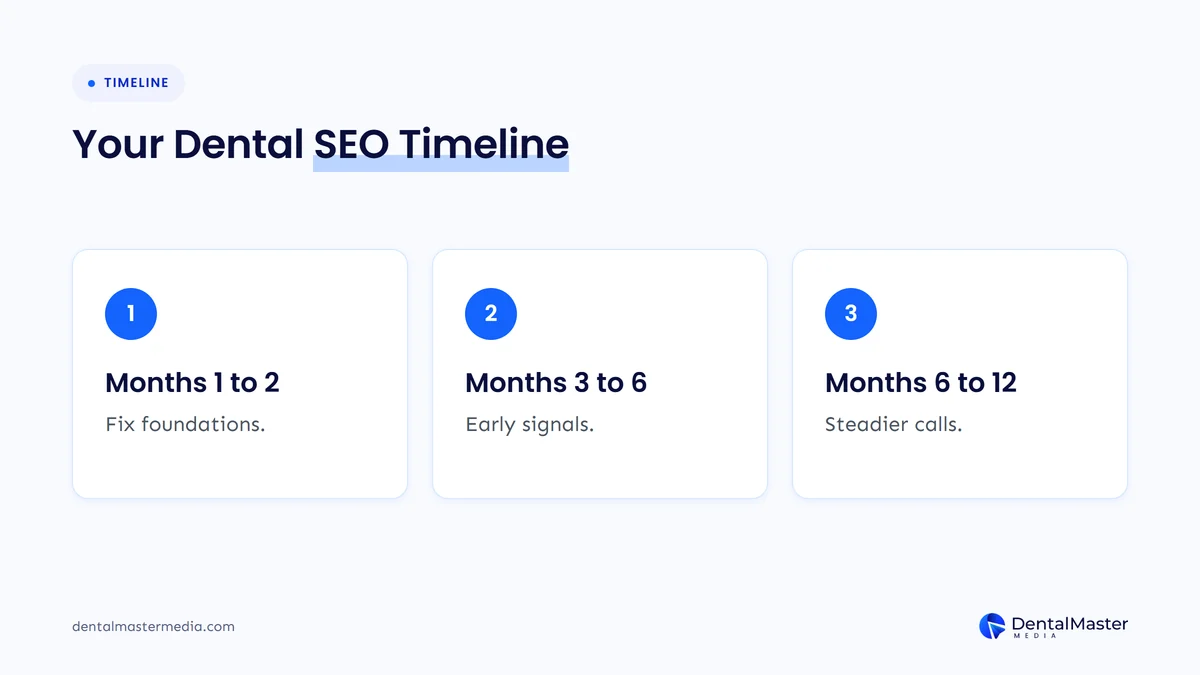
| Stage | Typical work | What you should see |
|---|---|---|
| Months 1 to 2: foundations | Audit, technical fixes, call and form tracking, Google Business Profile clean-up, fixing practice details across directories | A written plan, a list of every change made, and tracking that works |
| Months 3 to 6: early signals | Treatment pages improved or added, review requests, local links and mentions | More impressions in Search Console, more Business Profile views, the first rises in clicks and calls |
| Months 6 to 12: steadier calls | Updating pages that haven’t moved, more content for priority treatments, continued link and review work | More tracked calls and booking requests from organic search and Maps |
| Year 2 onward: compounding | Refreshing older pages, adding treatments or locations, protecting rankings | Steadier lead flow that relies less on paid ads |
At Dental Master Media, we set expectations this way before any work starts, so the practice knows what each monthly report should show. If a report in month four shows nothing except “work done”, that is the time to ask questions, not month twelve.
What makes dental SEO faster or slower?
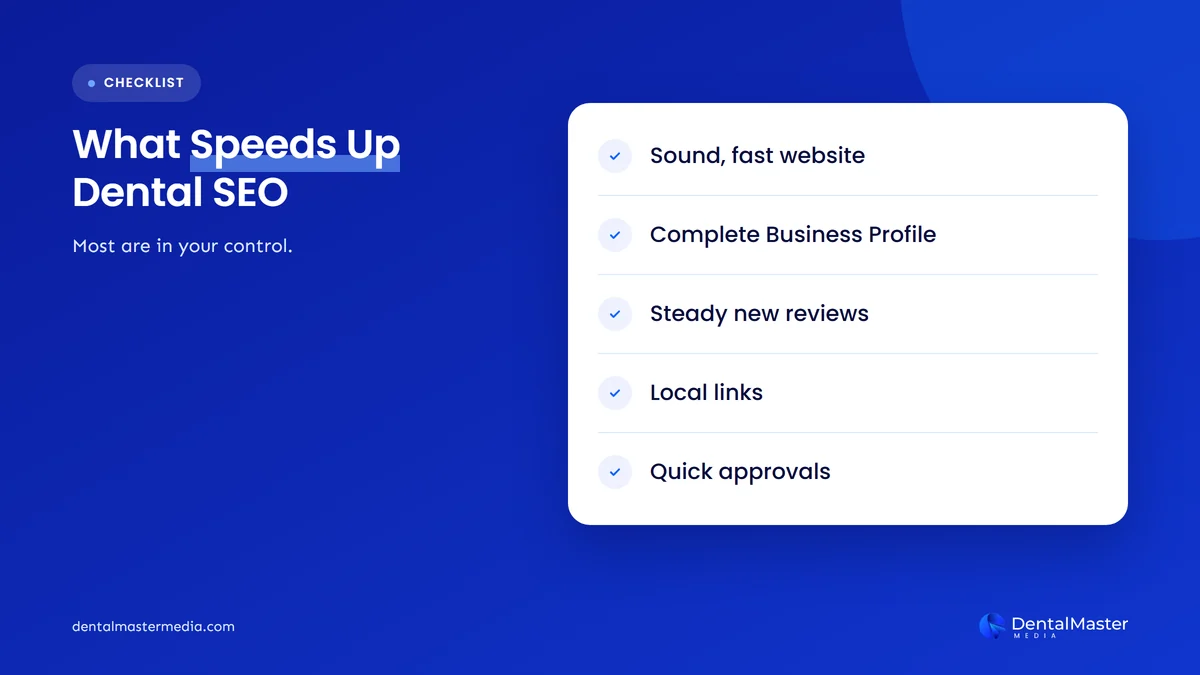
Dental SEO moves faster when the website is already sound, the Google Business Profile is complete, reviews keep coming in and local competition is light. It moves slower in dense cities, for high-value treatments such as implants and aligners, and when changes sit waiting for approval inside the practice.
How much local competition is there?
Local competition is the biggest single factor in a dental SEO timeline. A practice in a small town with a handful of competitors can climb quickly, while a practice in a large city competes with many established sites for the same searches. The Ahrefs finding that most top-ranking pages are years old shows why incumbents are hard to move.
What state is your website in?
A slow, outdated or badly structured website uses up the first months of an SEO plan in repairs. A recent redesign that lost old URLs without redirects can also set rankings back before new work begins. If you are planning a rebuild, read why dental practices lose rankings after a website redesign before you start.
How strong is your Google Business Profile?
Google says local results are based mainly on relevance, distance and prominence. Prominence includes how many websites link to your business and how many reviews you have, and Google notes that more reviews and positive ratings can help local ranking. Google also says there is no way to pay for a better local ranking, so profile and review work takes steady effort.
Where are your patients searching from?
Distance is the one factor no one can change. A searcher a few streets away will often see a different set of practices from someone across town. SEO can widen the area where you show up, but a practice will usually win its nearest neighborhoods first and spread outward from there.
Which treatments are you targeting?
General searches such as “dentist” and high-value searches such as “dental implants” move at different speeds. Every practice wants implant, veneer and aligner patients, so those searches are more competitive and usually take longer. A sensible plan targets some easier wins early while the harder treatment pages build up.
How quickly can your team approve changes?
SEO time only counts once the work is live. If new pages wait weeks for sign-off, or the practice can’t give access to the website and Business Profile, the clock effectively stops. Agree who approves content and how fast, before the plan starts.
Does AI search change how long dental SEO takes?
AI search doesn’t add a separate waiting period. Google says there are no extra requirements or special optimizations needed to appear in AI Overviews or AI Mode, so the same SEO work serves both. What changes is how results show up: AI answers can mean fewer clicks, so calls and bookings become the better measure.
Google’s guidance on AI features also says traffic from AI Overviews and AI Mode is reported in the Search Console Performance report under the “Web” search type, not as a separate line. So you won’t see a neat “AI patients” number.
Independent research points the same way on clicks. In September 2026, Search Engine Journal covered a randomized field experiment by researchers at the University of Pennsylvania and Northeastern University. It found that AI Mode sent people to websites less often, and that removing AI Overviews increased clicks to websites. Google, for its part, says clicks from pages with AI features tend to be higher quality.
For a dental practice, the practical lesson is simple:
- Don’t judge SEO on website traffic alone. Visibility in an AI answer may produce a call or a Maps visit without a website click.
- Track phone calls, booking requests and direction requests from search and your Business Profile.
- Be wary of paying extra for “AI SEO” that promises a faster timeline. The groundwork is the same, as we explain in our guide to how much dental SEO costs.
How can you tell dental SEO is working before the calls arrive?
Look at leading indicators. Within the first few months, a working plan should show more impressions in Google Search Console, more views and actions on your Google Business Profile, better positions for treatment searches and then more clicks. New-patient calls usually follow those signals rather than arriving first.
- Search Console impressions: your pages appear for more searches, often before clicks rise.
- Average position for priority treatments: pages move from the second or third page toward the first.
- Business Profile activity: more calls, website visits and direction requests from the profile.
- Organic clicks: more visitors from search to your treatment pages.
- Tracked calls and bookings: the result that matters, ideally split by source.
Google’s Starter Guide suggests waiting a few weeks before judging whether a change helped. That fits the pattern above: review the leading signs monthly, and judge new-patient numbers quarterly. Our guide to measuring dental SEO ROI explains how to set up that tracking.
Why is SEO slower than Google Ads, and should you run both?
Google Ads can show your practice as soon as a campaign goes live, while SEO has to earn its place over months. The trade-off is that ads stop the day you stop paying, and SEO keeps working. Many practices run ads while SEO builds, then rely on them less once organic calls grow.
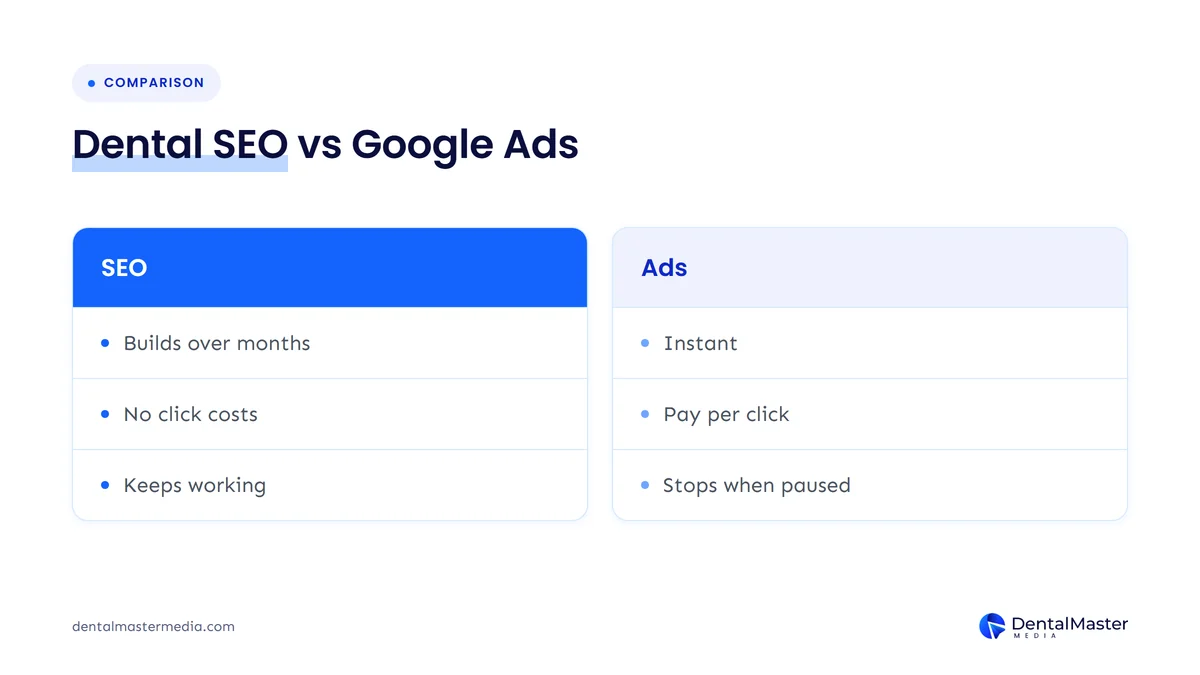
| Dental SEO | Google Ads | |
|---|---|---|
| When you appear | Builds over months | Once the campaign is approved and live |
| How you pay | Monthly fee or in-house time | Per click, plus management |
| When you stop | Rankings fade gradually, not overnight | Ads stop showing straight away |
| Best use | Long-term, lower-cost patient flow | Fast demand, new treatments, filling gaps |
If you are thinking about cutting ads once SEO starts working, read what happens to new-patient flow when you turn off Google Ads first, so the switch doesn’t leave a gap in your diary.
When should you worry that dental SEO isn’t working?
Worry when the leading signs stay flat. If there is no rise in impressions, Business Profile activity or positions after about six months of real work, something needs to change. Ahrefs suggests updating pages that haven’t reached the top 10 after about six months, and Google advises walking away from anyone who promises rankings.
Warning signs include:
- No list of changes. Google suggests asking whether a provider will share every change they make to your site.
- A promised date for first place. Google says no one can promise a number one ranking.
- Reports with rankings only, and no clicks, calls or bookings.
- No answer to “what results, by when?” Google’s own hiring advice suggests asking a provider what results they expect and in what timeframe.
Frequently asked questions
Can dental SEO bring in new patients in the first month?
Sometimes, but don’t plan on it. Fixing a broken Google Business Profile or a page Google can’t index can help quickly, and Google says some changes take effect within hours. Most practices need several months of steady work before new-patient calls from search become reliable.
Is dental SEO faster for Google Maps than for the website?
Often, yes. Your Google Business Profile ranks on relevance, distance and prominence, and a complete profile with a steady flow of reviews can gain visibility before treatment pages climb in the ordinary results. Competitive cities still take longer, and distance limits how far any profile reaches.
Why does SEO take longer for implants and aligners?
High-value treatments attract more competition because every practice wants those patients. More practices publish detailed pages and build links for implant and aligner searches, and Ahrefs data shows top-ranking pages tend to be years old, so newer pages need time and steady improvement to catch up.
Does a new dental practice take longer to rank?
A new practice starts without reviews, links or a history in search, so it usually needs more time to build prominence. That doesn’t rule out fast progress: a well-built site and a complete Google Business Profile can help a new practice compete with older clinics that have neglected theirs.
Do AI Overviews make dental SEO take longer?
No. Google says there are no special optimizations needed to appear in AI Overviews or AI Mode, so the same work applies. AI answers can reduce website clicks, though, so measure success by calls, bookings and Business Profile actions rather than traffic alone.
The bottom line on how long dental SEO takes
Plan on four months to a year before SEO brings in a steady flow of new patients, with visibility and Business Profile activity rising first and calls following. The pace depends on local competition, your website, your reviews and how fast changes go live. Ask any provider for a stage-by-stage plan and reports that track calls and bookings, not just rankings. To see how we run that process for practices, read about our dental SEO services at Dental Master Media.
Find out how far your practice is from page one
Your timeline depends on where you start. Our free dental SEO audit looks at your website, Google Business Profile and local competition, then shows which fixes could move first and which will take longer, so you can plan with real expectations.
Sources
- Search Engine Roundtable, “Google: Give SEOs 4-12 Months To See Positive Ranking Benefits”, February 16, 2017. https://www.seroundtable.com/google-give-seos-4-12-months-23419.html
- Google Search Central, “SEO Starter Guide”, updated December 10, 2025. https://developers.google.com/search/docs/fundamentals/seo-starter-guide
- Google Search Central, “Do you need an SEO?”, updated June 5, 2026. https://developers.google.com/search/docs/fundamentals/do-i-need-seo
- Ahrefs, “How Long Does It Take to Rank in Google? And How Old Are Top Ranking Pages?”, May 15, 2025. https://ahrefs.com/blog/how-long-does-it-take-to-rank/
- Google Business Profile Help, “Tips to improve your local ranking on Google”, accessed November 2, 2026. https://support.google.com/business/answer/7091
- Google Search Central, “AI features and your website”, updated December 10, 2025. https://developers.google.com/search/docs/appearance/ai-features
- Search Engine Journal, “Research Shows Google AI Mode Sends Less Clicks & Is A Poor User Experience”, September 21, 2026. https://www.searchenginejournal.com/research-shows-google-ai-mode-sends-less-clicks-is-a-poor-user-experience/590221/

Suraj Rana is the owner of Dental Master Media and a leading expert in SEO for dental practices. With a passion for dental marketing, he has successfully helped numerous dental clinics climb the search engine ranks. Suraj’s expertise makes him a go-to resource for effective, results-driven dental marketing.