Quick answer: On November 16, 2026, Google added a branded queries filter to the Google Search Console Search Analytics API. Developers can now group or filter search data by BRANDED and NON_BRANDED. A dental practice should check its property type, record a baseline and keep these numbers separate from Google Business Profile calls.
Key takeaways
- Google added 3 capabilities to the Search Analytics API on November 16, 2026, and the branded queries filter (brandedClassification) is the one that matters most to a dental practice.
- A branded query is a search that includes your practice name, a variation or misspelling of it, or a product or service unique to your site, according to Google.
- Branded data comes only from a top-level property with enough query and impression volume. Other properties get no rows.
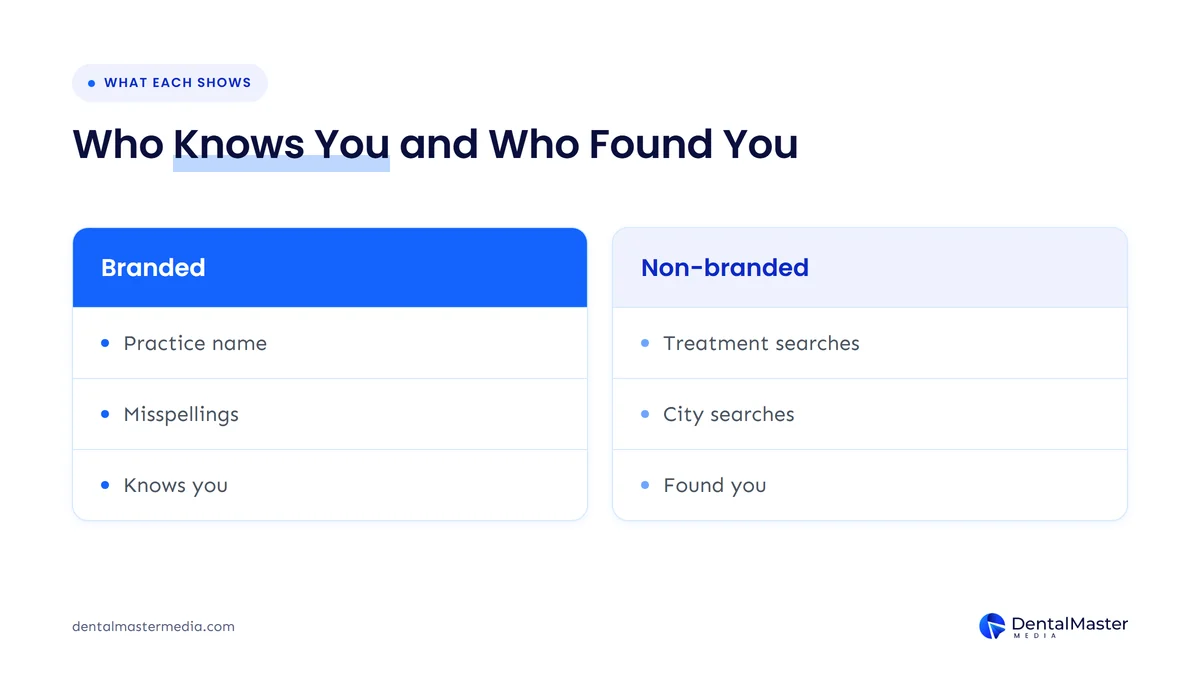
- Branded queries show who already knows your dental practice. Non-branded queries show who found you by searching for a treatment or a city.
- The filter has limits: Google’s AI-assisted system can misidentify a query, and it can’t be combined with a query filter in the same request.
- Google Business Profile reports calls, directions and website clicks in its own Performance view, so don’t add those numbers to Search Console clicks.
What did Google add to the Search Analytics API for branded queries?
Google added branded queries to the Search Analytics API on November 16, 2026, so developers and reporting tools can now group or filter Google Search Console data by the brandedClassification dimension. The Google Search Central post, written by Daniel Waisberg, Nati Yosephian and Karin Gadasi of the Search Console team, says the new option compares branded and non-branded performance, and Barry Schwartz reported it the same day at Search Engine Roundtable.
The Search Analytics API is the programming interface behind custom Search Console reports and automated dashboards. The branded filter was already in the Search Console web interface, and Google says it brought all 3 capabilities to the API in response to ecosystem requests for custom reporting and automated workflows. The 3 additions are listed below.
- Branded queries: the brandedClassification dimension groups or filters search data into BRANDED and NON_BRANDED queries, for eligible properties only.
- Web multimodal: setting the type to webMultimodal returns performance data from Google Lens, Circle to Search on Android and image uploads in Google Search, and it is also available in BigQuery for properties with an active bulk data export.
- Multi-country and multi-device filters: the new filterLists field filters by several countries or devices in one request.
This post covers the first item, because branded queries change how a dental practice reads its own search data. The webMultimodal and filterLists additions matter mostly to the developers who build reports.
What counts as a branded query in Google Search Console?
A branded query in Google Search Console is a search that includes your brand name, a variation or misspelling of it, or a product or service unique to your site. Google’s Search Central post of November 20, 2025, written by Michael Huzman, gives those 3 parts and uses Gmail as the example for google.com.
For a dental practice, the practice name and its misspellings clearly fit that definition. Google does not say whether a dentist’s personal name counts as a brand, so treat that as unconfirmed until you test it on your own data. Google says an internal, AI-assisted system makes the call, and that system is separate from the older method of filtering the query list by keyword.
Which dental practice sites get branded query data?
Only a dental practice site with a top-level property and enough query and impression volume gets branded query data. Google’s reference says the data starts on February 21, 2026, accepts 2 values and returns no rows for properties that don’t qualify. The table below sets out the facts in one place.
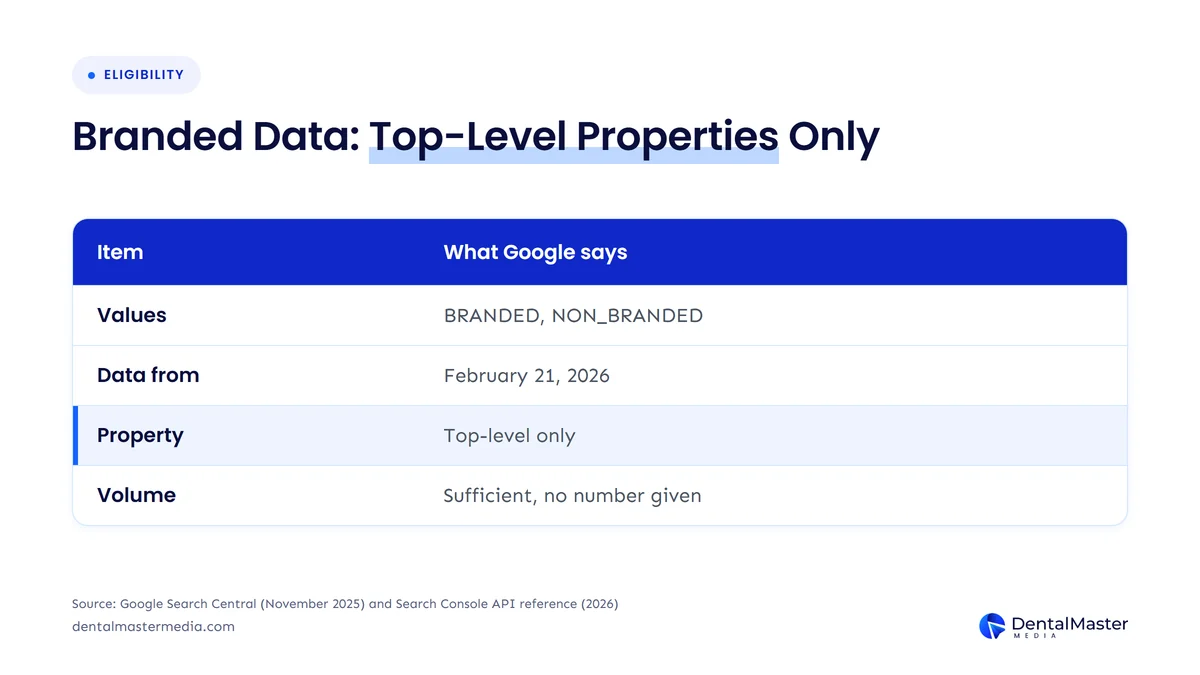
| Item | What Google says | Source |
|---|---|---|
| Accepted values | 2: BRANDED and NON_BRANDED | Search Analytics API reference |
| Data available from | February 21, 2026 | Search Analytics API reference |
| Property type | Top-level properties only; URL-path and subdomain properties are excluded | Google Search Central blog, November 20, 2025 |
| Volume | “Sufficient volume” of queries and impressions, with no threshold given | Google Search Central blog, November 20, 2025 |
| Web interface availability | All eligible sites since March 11, 2026 | Google Search Central blog, update note |
| Rows returned per request | 1 to 25,000, default 1,000 | Search Analytics API reference |
The table shows that eligibility, not the API itself, decides whether a practice sees branded data, and that a property verified for one folder or subdomain is excluded.
How do branded queries change what a dental practice sees in its search data?
Branded queries change the search data a dental practice sees by splitting its clicks and impressions into people who searched for the practice and people who searched for something else. Before the filter, a practice owner had to filter the query list by the practice name by hand and miss misspellings. The API now lets reports apply Google’s own split.
The split means 2 different questions get 2 different answers. Branded queries, such as the practice name or a misspelling of it, show how many people already know the practice and look it up. Non-branded queries, such as a treatment plus a city, show how many people found the practice without knowing it. A practice that grows through dental SEO services should see its non-branded queries rise first, because those are the new patients.
The change reaches a practice owner through the people who build the reports. An agency dashboard, a Looker Studio connector or an in-house script that calls the Search Analytics API can request brandedClassification, so the split can appear in reports without anyone opening Google Search Console. A report only shows it after its builder adds the new dimension, so ask whoever produces your reports whether they have.
What are the limits of the branded query filter?
The branded query filter has 5 limits that a dental practice should know before trusting a branded or non-branded number. Google’s API reference and its November 2025 post document them, and the 5 limits are listed below.
- Eligibility: a property with too little volume, or one limited to a URL path or subdomain, returns no branded rows.
- Misclassification: Google says “some queries may occasionally be misidentified”, because an AI-assisted system, not a keyword list, makes the call.
- One operator: a branded filter supports only the equals operator.
- No query filter in the same request: brandedClassification can’t be combined with a query filter in one request.
- No ranking effect: the filter is a reporting tool, and Google states it has no effect on how Google Search ranking works.
The filter describes Search Console data only. It does not report calls, direction requests or bookings from a Google Business Profile, which is why the bridge section below matters. For another example of how Google changes what practices can see in their reports, read our post on what the new Search Console AI Overviews report means for your dental clinic.
What should a dental practice check about branded queries now?
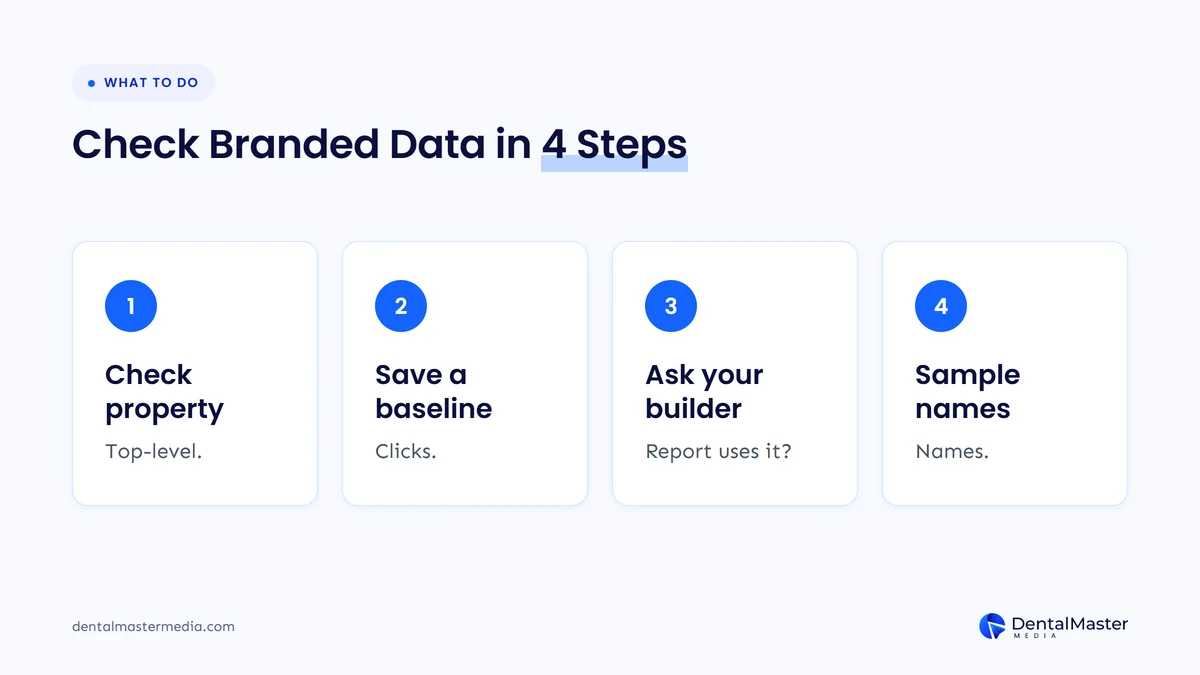
A dental practice should check 4 things about branded queries now: the property and its volume, the baseline, the report builders and the sample. None of them needs code, and each takes minutes in Google Search Console. The 4 checks are listed below.
- Check the property and its volume. Open Google Search Console and see whether your site is a top-level property or a URL-path or subdomain property. A practice that verified only a location folder, such as a path for one office, is excluded from branded data. Then open the Performance report and look for the Branded filter: if it is missing, the property may not have enough queries and impressions, and Google gives no number.
- Record a baseline. Save the current branded and non-branded clicks and impressions, because Google’s data starts on February 21, 2026 and a baseline lets you judge change later.
- Ask your report builder. Ask your agency or developer whether reports that use the Search Analytics API now request brandedClassification, and whether the report says what happens when a property returns no rows.
- Sample the split. Filter the query list by your practice name and each dentist’s name, then compare it with the BRANDED group, so you can see how Google treats the names your patients type.
Treat the first numbers as a starting point, not a verdict. Branded clicks that rise can mean patients remember your dental practice, and branded clicks that fall can mean less word of mouth or less advertising, and Google’s data doesn’t say which.
How is branded query data different from Google Business Profile data?
Branded query data is different from Google Business Profile data because they come from 2 separate reports with 2 sets of metrics. Google Search Console reports clicks, impressions, click-through rate and position for Google Search results. Business Profile Performance reports interactions on the profile itself, such as calls, directions, website clicks and bookings.
Google’s Business Profile Help page lists those metrics and says the Searches view shows the search terms people used to find the business. That makes the two tools look similar, but each one answers its own question, so a branded query in Search Console is not a call on your profile. Keep a practice’s reporting in 2 columns: Search Console for how people reach the website, and Business Profile Performance for what they do on the listing. If your Business Profile settings are incomplete, start with our guide to 7 Google Business Profile settings dental practices often get wrong.
Frequently asked questions
Does the branded query filter change my Google rankings?
No, the branded query filter does not change your Google rankings. Google’s November 2025 post says the filter has no effect on how Google Search ranking works. It only changes how Search Console groups the data you already have.
Why does my Search Console API request return no branded rows?
Your request returns no branded rows when the property is not eligible. Google returns no rows for properties without a top-level property or without enough query and impression volume, and the API reference lists no threshold.
Does a dentist’s name count as a branded query?
Google has not said whether a dentist’s name counts as a branded query. Its definition covers the brand name, variations and misspellings, and unique products or services. Compare your own query list with the BRANDED group to see how Google treats your dentists’ names.
Can I see branded queries without using the API?
Yes, you can see branded queries without the API. The branded filter has been in the Search Console Performance report since Google announced it on November 20, 2025, and Google says all eligible sites had it by March 11, 2026.
Is the new filter the same as filtering by my practice name?
No, the new filter is not the same as filtering by your practice name. A keyword filter matches the exact text you enter, while Google says its branded classification also covers typos, other languages and unique products or services without the brand name in the query.
Branded query data is a baseline, not a verdict
The branded queries filter in the Search Analytics API, added on November 16, 2026, splits a dental practice’s search data into BRANDED and NON_BRANDED queries for eligible top-level properties. It has 5 limits, it has no effect on rankings, and it does not replace Google Business Profile data. A practice should check its property type, record a baseline and ask its report builder to add the dimension.
Reading that data correctly is part of the work our dental SEO services cover at Dental Master Media.
See how patients find your practice on Google
Branded and non-branded queries tell you different things, and most dental practices have never separated them. Our free dental SEO audit reviews your Google Search Console setup, your service pages and your Google Business Profile, and shows where new patients could find you.
Sources
- Google Search Central Blog (Daniel Waisberg, Nati Yosephian, Karin Gadasi), “Search Analytics API update”, November 16, 2026. https://developers.google.com/search/blog/2026/11/search-analytics-api-update
- Search Engine Roundtable (Barry Schwartz), “Google Search Analytics API Adds Branded Queries, Multimodal & Country/Device Filters”, November 16, 2026. https://www.seroundtable.com/google-search-analytics-api-addition-42544.html
- Google Search Central Blog (Michael Huzman), “Search Console branded queries filter”, November 20, 2025, updated March 11, 2026. https://developers.google.com/search/blog/2025/11/search-console-branded-filter
- Google for Developers, “Search Analytics: query” (Search Console API reference), accessed November 21, 2026. https://developers.google.com/webmaster-tools/v1/searchanalytics/query
- Google Search Central Blog, “Web multimodal in Search Console”, September 24, 2026. https://developers.google.com/search/blog/2026/09/web-multimodal-in-sc
- Google Business Profile Help, “Understand your Business Profile performance and insights”, accessed November 21, 2026. https://support.google.com/business/answer/9918094

Suraj Rana is the owner of Dental Master Media and a leading expert in SEO for dental practices. With a passion for dental marketing, he has successfully helped numerous dental clinics climb the search engine ranks. Suraj’s expertise makes him a go-to resource for effective, results-driven dental marketing.