
Quick answer: Give a dedicated page to every treatment that patients research for a long time before booking: dental implants, full-arch implants, clear aligners, veneers, smile makeovers, emergency care, sedation dentistry, sleep apnea appliances and dentures. Each page should explain who the treatment suits, the steps, cost factors, alternatives, who performs it and how to book.
Key takeaways
- One “Our Services” page can’t answer the detailed questions patients now type into Google, AI Overviews, AI Mode and ChatGPT. Treatments that patients research before booking need their own pages.
- The nine treatments below share three traits: patients compare options before committing, the searches are specific, and the case matters to the practice.
- Every treatment page needs the same core sections: who it suits, the process, cost factors, alternatives, the treating dentist, FAQs and a clear way to book.
- Google treats health content as “Your Money or Your Life” material, so accuracy, a named author and a clinical review matter more here than on most pages.
- Keep the wording factual. Avoid superlatives, promised outcomes and specialist claims your dentists don’t hold, in line with ADA ethics and FTC rules.
What is a dedicated treatment page?
A dedicated treatment page is a single page on your practice website about one treatment, such as dental implants or clear aligners. It answers the questions a patient asks before booking that treatment, shows who performs it at your practice and gives a direct way to call or book. It is separate from your general services list.
A services list tells patients what you offer. A treatment page helps them decide. That difference matters because a patient comparing implants with a bridge, or aligners with braces, wants details a one-line bullet point can’t give: how many visits, what affects the fee, what the alternatives are and who will treat them.
Why do treatment pages matter more now that AI answers dental questions?
Patients now ask longer, more specific questions, and AI search tools answer them by pulling from several pages at once. Google says AI Overviews and AI Mode may run multiple related searches across subtopics to build one answer. A practice with one clear page per treatment gives those systems a precise page to find and cite.
The volume is large. At Google’s The Check Up 2026 event in March, a Google Search leader said the search engine receives about one billion health questions a day, according to PPC Land’s report of the event. Google’s own guidance for AI search, published in May 2025, asks site owners to create “unique, non-commodity content” because people now ask longer and more specific questions.
The scrutiny is large too. In January 2026, Google removed AI Overviews from some medical searches after a Guardian investigation found answers that could mislead people, as Gizmodo reported. Health content sits in what Google calls “Your Money or Your Life” territory, where its systems give extra weight to experience, expertise, authoritativeness and trust. In short: AI tools want accurate, specific treatment pages, and they are being held to a higher standard on health topics.
Google also says there are no special optimizations needed to appear in AI Overviews or AI Mode. The work is the same as good SEO: indexable pages, clear text, internal links and structured data that matches what visitors see. Our guide on writing dental service pages that AI search will cite covers the page-level detail.
Should each treatment have its own page or share one services page?
Each treatment that patients research before booking should have its own page. A shared services page works for routine care such as checkups and cleanings, but it can’t rank well for several different treatments at once, and it gives AI tools nothing specific to quote when a patient asks about implants, aligners or sedation.
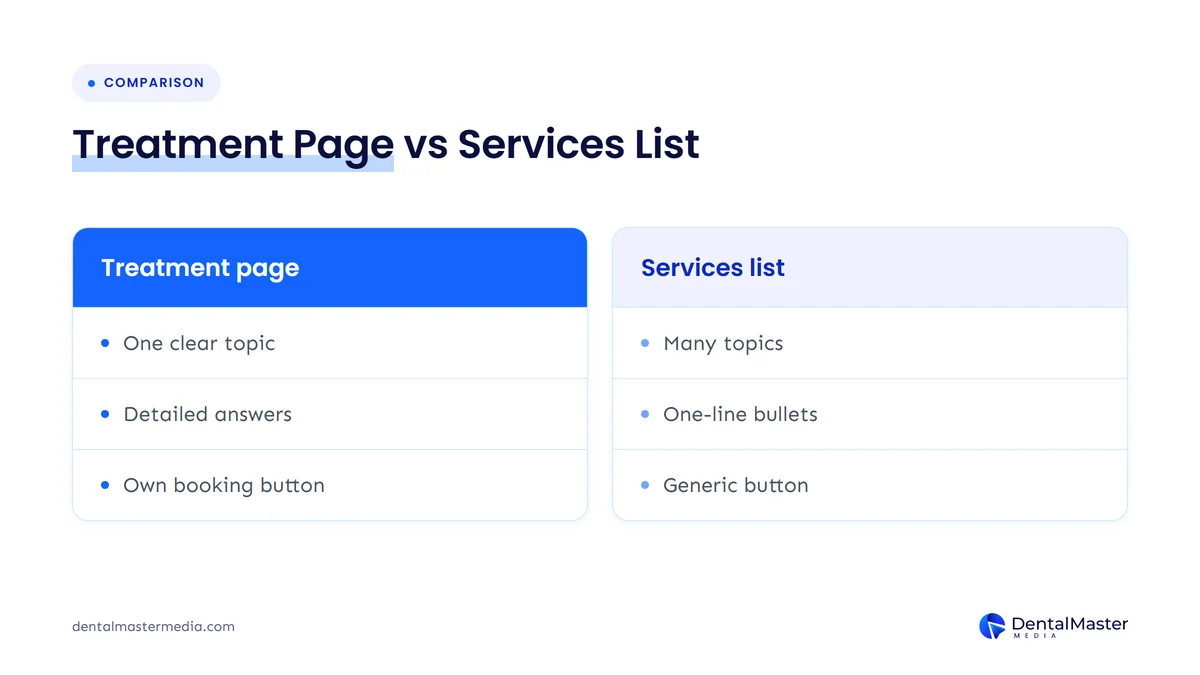
| Question | Dedicated treatment page | Shared services page |
|---|---|---|
| Can it match a specific search? | Yes, one treatment, one main topic | Only loosely, many topics compete |
| Can it answer detailed questions? | Yes: steps, cost factors, alternatives, FAQs | Usually a sentence or two per service |
| Can AI tools quote it? | Clear, self-contained answers are easy to lift | Short bullet points give little to cite |
| Can it carry its own call to action? | Yes, such as “Book an implant consultation” | One generic booking button |
| Best for | Treatments patients research and compare | Routine care such as checkups and cleanings |
One caution: a separate page only helps if it says something new. Google’s spam policies describe scaled content abuse as pages “generated for the primary purpose of manipulating search rankings.” Nine near-identical pages with the treatment name swapped would fall short. Each page needs its own process, its own questions and its own answers.
How did we choose these 9 treatments?
We chose treatments that meet at least three of four tests: patients research them before booking, the searches are specific, the treatment usually involves several visits or a planned case, and patients need reassurance about cost, comfort or results. Routine care such as cleanings fails most tests, so it can stay on a shared page.
- Research before booking: patients read, compare and ask questions for days or weeks first.
- Specific searches: people search for the treatment by name, not just “dentist near me.”
- Planned treatment: the case usually involves a consultation, a plan and several appointments.
- Need for reassurance: fear, cost or appearance concerns stop patients from booking unless a page answers them.
This list isn’t a ranking, and not every practice offers all nine. Build pages only for treatments your dentists actually provide.
What are the 9 dental treatments that deserve their own page?
The nine treatments are dental implants, full-arch implants, clear aligners, porcelain veneers, smile makeovers, emergency dental care, sedation dentistry, oral appliances for sleep apnea, and dentures, including implant-supported dentures. Each one draws specific searches and long research from patients, and each needs a page built around its own questions.
1. Dental implants
Dental implants deserve their own page because patients compare them with bridges and dentures, worry about cost and surgery, and often take weeks to decide. A single-tooth implant page should walk them through the decision honestly, from the first consultation to the final crown, so they arrive at your practice already informed.
- Who implants may suit, and why a consultation decides it, not the page.
- The stages in plain language and the typical number of visits.
- What affects the fee: scans, extractions, bone grafting, the crown. Say fees vary and are confirmed after an exam.
- Alternatives such as bridges and dentures, with a fair comparison.
Our dental implant SEO page explains how we help practices build and rank this page.
2. Full-arch implants (All-on-4 style treatment)
Full-arch implant treatment needs a page separate from single implants because the patient, the decision and the questions are different. These patients have lost most or all of their teeth, or are about to, and want to know about the procedure day, temporary teeth, healing and how the result compares with dentures.
- What the treatment involves, from records and planning to the final teeth.
- What happens on the day of surgery and in the healing months after.
- Financing options and the factors that change the fee, without quoting a price you can’t stand behind.
- Only use a brand name such as All-on-4 if your practice uses that system.
3. Clear aligners
Clear aligners deserve their own page because adults research them carefully, compare them with braces and with mail-order kits, and want to know about visits, wear time and refinements. A dedicated page lets you explain why in-person supervision by a dentist matters and what a patient’s treatment actually looks like.
- Who aligners may suit, and which cases may need braces instead.
- The process: scan, plan, check-ups, retainers.
- How your in-office care differs from direct-to-consumer aligners, stated factually.
- If you name Invisalign, follow the brand’s naming rules and only claim a provider tier you hold.
Our Invisalign SEO page covers how we approach aligner search for practices.
4. Porcelain veneers
Veneers deserve their own page because patients considering them are focused on appearance, permanence and cost, and they look closely at photos before contacting anyone. A veneers page should set realistic expectations, explain what preparing the teeth involves and show your own consented case photos rather than stock images.
- What veneers are and how they differ from bonding and crowns.
- The steps: consultation, trial smile if you offer one, preparation, fitting.
- Care and lifespan in general terms, without promising a fixed number of years.
- Before-and-after photos of your own patients, with consent and a note that results vary.
5. Smile makeovers
A smile makeover page serves patients who know they want a change but don’t know which treatments they need. It deserves its own page because it combines several services, such as whitening, aligners, bonding and veneers, into one plan, and patients need to understand how that planning process works before they book.
- How the consultation and planning visit works, including photos, scans or a digital preview.
- Which treatments may be combined, with links to each treatment page.
- How phasing and financing can spread the work over time.
- Avoid “perfect smile” and similar promises. Describe the process, not a promised look.
6. Emergency dental care
Emergency dental care deserves its own page because the patient is in pain, searching on a phone and ready to call now. The page has a different job from the others: help the patient reach you quickly, tell them what to expect and explain what counts as a dental emergency at your practice.
- A click-to-call number at the top and your real hours for same-day or urgent visits.
- Common emergencies you see, such as toothache, broken teeth or lost crowns.
- What to do before arriving, kept general, and when to go to a hospital instead.
- Only say “same-day” or “24/7” if it’s true every day.
For the local search side, read how to rank for emergency dental searches in your city.
7. Sedation dentistry
Sedation dentistry deserves its own page because anxious patients often delay care for years and search for comfort options before they search for a treatment. A sedation page can be the first page a nervous patient reads, so it needs a calm tone, clear facts about the options and honest information about who is qualified.
- The sedation types your practice offers, such as nitrous oxide, oral or IV sedation.
- Who provides each one and the permits or training they hold in your state.
- How to prepare, what the visit feels like and arranging a ride home.
- Avoid “pain-free” or “you’ll feel nothing.” Describe comfort, not certainty.
8. Oral appliances for sleep apnea and snoring
Sleep apnea appliances deserve their own page because patients often arrive from a physician’s referral or a partner’s complaint about snoring, and they need to understand how a dental practice fits into care. The page should explain the dentist’s role clearly and avoid any wording that sounds like a diagnosis or a cure.
- How your practice works with the patient’s physician and sleep testing.
- What a custom oral appliance is and how fitting and follow-up work.
- Who may not be a good fit, and other treatment options their doctor may discuss.
- Insurance and medical billing questions you can answer in general terms.
9. Dentures and implant-supported dentures
Dentures deserve their own page because the patients are often older, compare several options and want reassurance about comfort, eating and appearance. Many also ask whether implants could hold their dentures in place, so a page that compares traditional, partial and implant-supported dentures answers the full decision in one place.
- The denture types you offer and how each one is made and fitted.
- How implant-supported dentures differ, with a link to your implant pages.
- Adjustment, relines and aftercare.
- Cost factors and insurance questions, stated in general terms.
What should every dental treatment page include?
Every treatment page should include a short answer at the top, who the treatment may suit, the steps and visits, cost factors, alternatives, the dentist who provides it, real FAQs and a clear booking option. Add a reviewed-by line and a last-updated date, because Google asks whether it is clear who wrote health content.
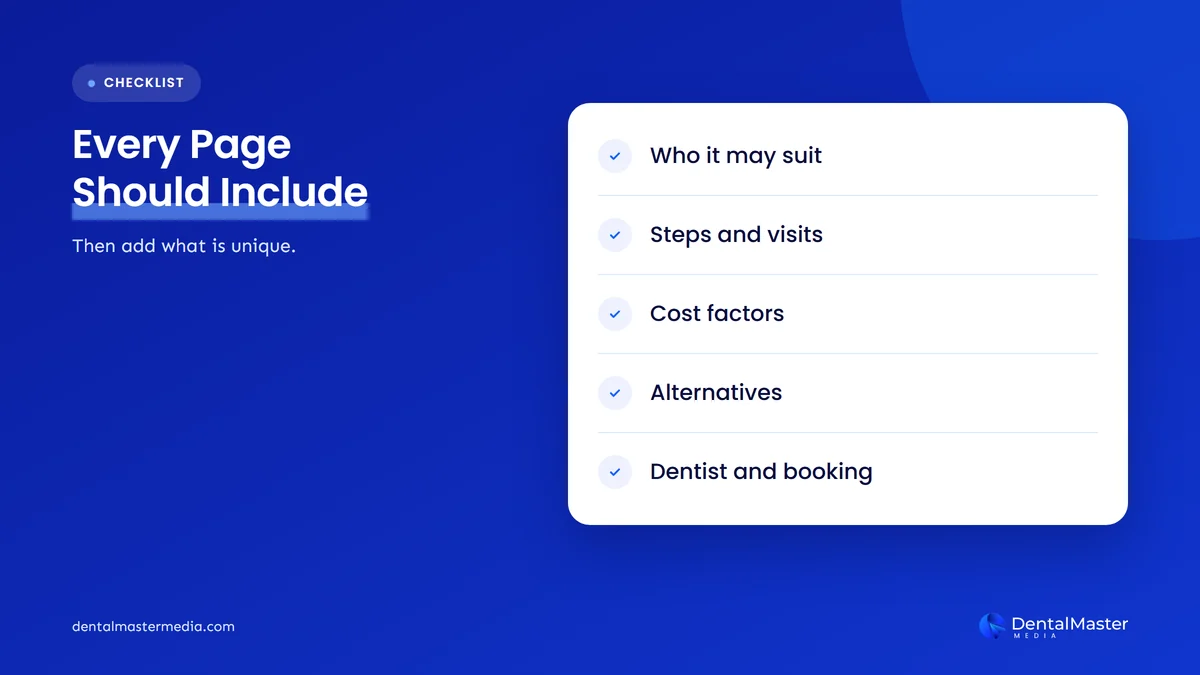
| Section | What it answers | Tip |
|---|---|---|
| Short answer at the top | “Is this the right page for me?” | 40 to 60 words that make sense on their own |
| Who it may suit | “Could this work for me?” | Point to a consultation for the real answer |
| Steps and visits | “What will happen?” | Numbered steps in plain language |
| Cost factors | “What will I pay?” | Explain what changes the fee, plus financing |
| Alternatives | “What else could I do?” | A fair comparison builds trust |
| Your dentist | “Who will treat me?” | Name, training and a real photo |
| FAQs | “What about my specific worry?” | Use questions your front desk actually hears |
| Booking | “How do I start?” | Call button and booking link, visible on phones |
Two more details help both patients and search engines. First, add structured data only where it matches the visible page, as Google’s guidance asks. Second, list the same treatments as services on your Google Business Profile, which lets you add a description to each one. Our article on how your GBP services list affects AI recommendations explains why that list matters.
How do you build treatment pages in the right order?
Start with the treatments that matter most to your practice’s growth plan, check what patients actually ask, then build one complete page at a time. Link each new page from your services list and related pages, list the treatment on your Google Business Profile, and review results before moving to the next page.
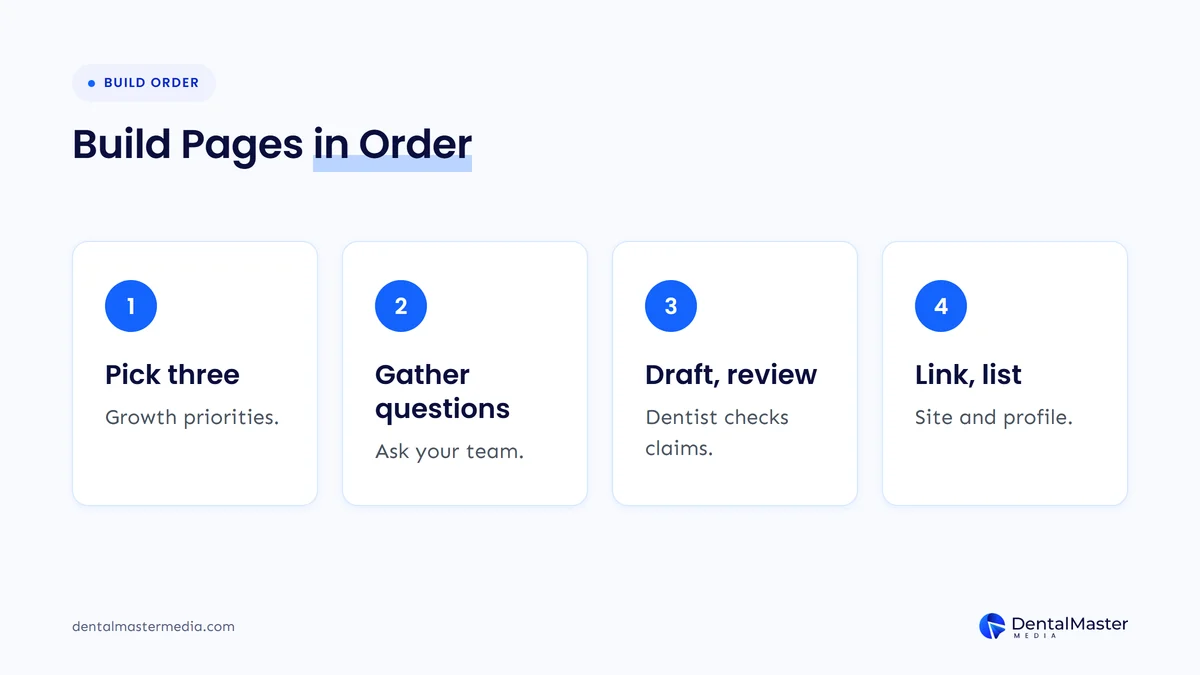
- Pick your first three. Choose the treatments your dentists most want to grow and have capacity for.
- Gather real questions. Ask your front desk and treatment coordinator what patients ask on the phone and at consultations.
- Write and review. Draft in plain language, then have the treating dentist check every clinical statement.
- Link and list. Link the page from your menu, homepage and related pages, and add the service to your Google Business Profile.
- Track calls and bookings. Measure which pages bring enquiries, not just visits, before deciding what to build next.
What wording keeps treatment pages ADA- and FTC-safe?
Keep treatment pages factual and verifiable. The ADA Code of Ethics says no dentist shall advertise in a manner that is false or misleading in any material respect. Avoid superlatives, promised results, unqualified specialist claims and testimonials showing results patients can’t generally expect. Check your state dental board’s advertising rules too.
| Avoid | Write instead | Why |
|---|---|---|
| “The best implant dentist in town” | A plain statement of the dentist’s implant training and experience | Superlatives are hard to prove; facts can be checked |
| “Pain-free treatment” | “We offer sedation options to help you feel more comfortable” | Comfort varies by patient |
| “Implant specialist” | Use “specialist” only if the dentist meets your state’s rules for it | Many states restrict specialty claims |
| “Results in days” or “lasts a lifetime” | “Your dentist will explain the expected timeline and care at your consultation” | Outcomes depend on the patient |
| Dramatic testimonials alone | Real reviews with a note that results vary from patient to patient | The FTC treats untypical results in testimonials as likely deceptive |
The FTC’s health claims guidance says testimonials reporting results “more dramatic than users can generally expect” are likely to be deceptive, and a “results not typical” note doesn’t fix that. The ADA’s marketing page also notes that most states regulate how dental specialties can be advertised. When in doubt, ask your state board or your practice’s attorney before publishing.
Frequently asked questions
How many treatment pages does a dental practice need?
There is no set number. Build a dedicated page for each treatment your practice provides that patients research before booking, such as implants, aligners or sedation. Routine services like cleanings and checkups can share a general page. Start with the three treatments that matter most to your growth plan.
Can I use the same template for every treatment page?
You can use the same section structure, but not the same text. Each page needs its own steps, cost factors, alternatives and questions. Google’s spam policies warn against many pages generated mainly to manipulate rankings, so pages that only swap the treatment name are a risk and add little for patients.
Should I put prices on treatment pages?
Only if you can stand behind them. Fees vary with each patient’s needs, so many practices explain what affects the cost and offer financing information instead of a fixed price. If you do show a price, make sure it is accurate, current and clear about what it includes.
Do treatment pages need special markup to appear in AI Overviews?
No. Google says there are no additional requirements or special optimizations needed to appear in AI Overviews or AI Mode. Treatment pages need to be indexable, clearly written and linked from other pages on your site. Any structured data you add should match what visitors can see.
Who should write or review dental treatment pages?
A writer who understands dental patients can draft the page, but the treating dentist should review every clinical statement before it goes live. Add the dentist’s name as the reviewer and a last-updated date. Google asks whether it is self-evident who created content, and that matters most on health topics.
Where to start with your treatment pages
The treatments patients research hardest deserve pages that answer their questions fully: implants, full-arch implants, aligners, veneers, smile makeovers, emergency care, sedation, sleep apnea appliances and dentures. Build them one at a time, keep every claim factual and have your dentist review each page. If you want help planning and writing these pages, see our dental SEO services at Dental Master Media.
Find out which treatment pages your practice is missing
Our free dental SEO audit checks which of your treatments have their own page, how those pages perform in Google and where gaps may be sending patients to other practices. You get a clear list of the pages to build or improve first.
Sources
- Google Search Central, “AI features and your website”, updated December 10, 2025. https://developers.google.com/search/docs/appearance/ai-features
- Google Search Central Blog, “Top ways to ensure your content performs well in Google’s AI experiences on Search”, May 21, 2025. https://developers.google.com/search/blog/2025/05/succeeding-in-ai-search
- Google Search Central, “Creating helpful, reliable, people-first content”, accessed November 9, 2026. https://developers.google.com/search/docs/fundamentals/creating-helpful-content
- Google Search Central, “Spam policies for Google web search”, accessed November 9, 2026. https://developers.google.com/search/docs/essentials/spam-policies
- Google Business Profile Help, “Manage your services on your Business Profile”, accessed November 9, 2026. https://support.google.com/business/answer/9455399
- PPC Land, “One billion health questions a day – what Google is doing with them”, March 21, 2026. https://ppc.land/one-billion-health-questions-a-day-what-google-is-doing-with-them/
- Gizmodo, “Google Pulls Some Health-Related AI Overviews as Industry Goes All-In on Healthcare”, January 13, 2026. https://gizmodo.com/google-pulls-some-health-related-ai-overviews-as-industry-goes-all-in-on-healthcare-2000709661
- American Dental Association, “Marketing and Advertising”, 2026. https://www.ada.org/en/resources/practice/legal-and-regulatory/marketing-and-advertising
- Federal Trade Commission, “Health Products Compliance Guidance”, December 2022. https://www.ftc.gov/business-guidance/resources/health-products-compliance-guidance

Suraj Rana is the owner of Dental Master Media and a leading expert in SEO for dental practices. With a passion for dental marketing, he has successfully helped numerous dental clinics climb the search engine ranks. Suraj’s expertise makes him a go-to resource for effective, results-driven dental marketing.