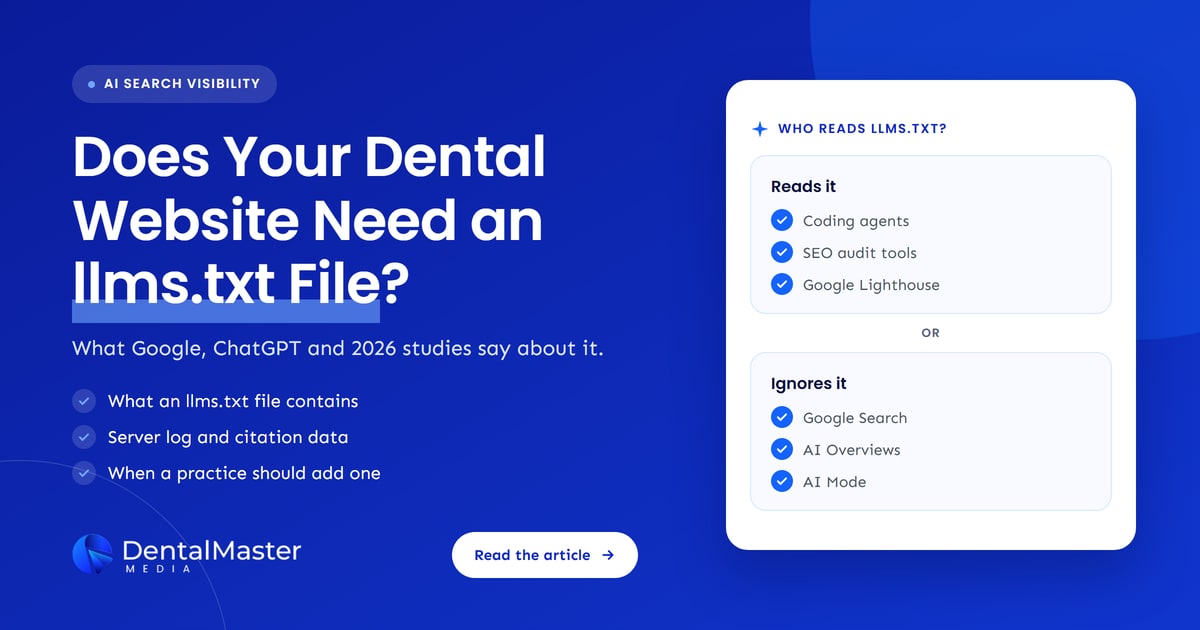
Quick answer: An llms.txt file is a Markdown file at the root of a website that lists its most useful pages for large language models. Google Search ignores it, OpenAI and Anthropic don’t list it as a crawler control, and Ahrefs found 97% of llms.txt files got zero requests in May 2026. A dental practice can add one, but it won’t change rankings.
Key takeaways
- An llms.txt file is a plain Markdown file, proposed by Jeremy Howard of Answer.AI on September 3, 2024, that points AI tools to a site’s key pages.
- Google Search does not use llms.txt. Google’s own guide says the file will neither help nor harm your visibility or rankings in Google Search.
- ChatGPT and other AI crawlers rarely read it. OpenAI and Anthropic control their crawlers through robots.txt, and named AI bots made 19.5% of the requests that reached llms.txt files in Ahrefs’ data.
- The research agrees: SE Ranking found no link between llms.txt and AI citations across nearly 300,000 domains.
- A dental practice doesn’t need an llms.txt file. If you add one, every fact in it must match your website and Google Business Profile.
- What helps a dental practice appear in AI answers is the work Google already rewards: crawlable service pages, original content and a complete Google Business Profile.
What is an llms.txt file?
An llms.txt file is a Markdown file placed at the root of your domain (yourpractice.com/llms.txt) that gives large language models a short, curated map of a website’s most useful pages. Jeremy Howard, co-founder of Answer.AI, proposed the llms.txt file on September 3, 2024, and the proposal at llmstxt.org reached version 2 in August 2026.
The llms.txt file exists because AI tools read websites through a small context window. A web page full of menus, scripts and pop-ups wastes that space, so the proposal offers a clean Markdown file that says “here is who we are, and here are the pages worth reading.” The idea started with software documentation, where a coding assistant needs the right API page, not the whole site.
For a dental website, an llms.txt file would list the practice name, a one-line summary, and links to the service pages, the dentists’ bio pages, the location and hours page and the new-patient page. Checking whether a site is readable by search engines and AI tools is one part of our dental SEO services, and llms.txt is the smallest item on that list.
What does an llms.txt file contain?
An llms.txt file contains up to 5 parts in a fixed order, and only the first part is required by the llmstxt.org proposal. The 5 parts of an llms.txt file are listed below.
- H1 title: the name of the site or practice, written as a Markdown heading. This is the only required section of an llms.txt file.
- Blockquote summary: a 1 to 2 sentence description of the site that a language model reads first.
- Detail paragraphs: optional plain text with extra context, such as the services a dental practice offers and the area it serves.
- H2 file lists: sections of Markdown links in the form [name](url), each with an optional note about the page.
- Optional section: an H2 named “Optional” for secondary links that an AI tool can skip when it has less room.
The proposal also suggests Markdown copies of individual pages at the same URL with .md added. A separate llms-full.txt file, which puts the full text of a site in one file, is a common variant, but the llmstxt.org page does not define it.
How is llms.txt different from robots.txt and sitemap.xml?
The llms.txt file is different from robots.txt and sitemap.xml because it suggests what to read, while robots.txt controls what crawlers may access and sitemap.xml lists every URL you want indexed. The table below compares the 3 root files a dental website can have.
| File | What it does | Who reads it | Effect on Google Search |
|---|---|---|---|
| robots.txt | Allows or blocks crawlers by user agent and path | Googlebot, GPTBot, OAI-SearchBot, ClaudeBot and other named crawlers | Controls what Google can crawl |
| sitemap.xml | Lists every URL you want search engines to find | Google, Bing and other search engines | Helps Google discover pages |
| llms.txt | Suggests a short list of key pages in Markdown | Mostly SEO audit tools and coding agents, per Ahrefs’ 2026 log data | None: Google Search ignores it |
Only robots.txt and sitemap.xml change how Google crawls a dental website, so those 2 files come first in any technical check.
Does Google use llms.txt?
No, Google Search does not use llms.txt, and an llms.txt file has no effect on rankings or on AI Overviews and AI Mode. Google Search Central published “Optimizing your website for generative AI features on Google Search” on May 15, 2026, and on June 15, 2026 it added a note that such files “will neither harm nor help” your site’s visibility, because Google Search ignores them.
The same Google guide says you don’t need new machine-readable files, AI text files, special markup or Markdown to appear in Google’s generative AI features. Google’s search team gave the same answer 3 times before the guide was written, as listed below.
- John Mueller, June 17, 2025: Google’s Search Advocate wrote on Bluesky that “no AI system currently uses llms.txt” and that this is obvious in server logs.
- Gary Illyes, July 2025: Google’s analyst said at a Google Search Central Live event that Google doesn’t support llms.txt and isn’t planning to.
- John Mueller, January 2026: asked whether an llms.txt file on a Google developer site was an endorsement, Mueller answered on Bluesky with a direct “no”.
Google’s guide points dental practice owners to Google Search Console instead, where the generative AI performance data shows how a site appears in AI features. We explained that data in our post on the new Search Console AI Overviews report.
Why does Google Lighthouse check llms.txt?
Google Lighthouse checks llms.txt because its agentic browsing audits test how well a site works for AI agents, not how it ranks in Google Search. The Lighthouse llms.txt audit fails only when the server returns an error for the file. A missing llms.txt file returns a 404 and is marked “not applicable”, because the file is optional.
A dental website without an llms.txt file therefore loses nothing in Lighthouse. A broken setup, where the server crashes or returns a 500 error for /llms.txt, is the only case worth fixing.
Do ChatGPT and other AI crawlers read llms.txt?
ChatGPT and other AI crawlers rarely read llms.txt: in the Ahrefs study of 137,210 domains, AI retrieval bots made just 1.1% of AI bot requests to llms.txt files in May 2026. OpenAI and Anthropic, the companies behind ChatGPT and Claude, describe robots.txt as the way to control their crawlers and don’t name llms.txt as a control.
The 6 AI crawlers a dental website is most likely to see, as named in OpenAI’s and Anthropic’s own documentation, are listed below.
- OAI-SearchBot (OpenAI): finds pages for ChatGPT search answers. Sites that block it don’t appear in ChatGPT search answers.
- GPTBot (OpenAI): collects content that may be used to train OpenAI’s models.
- ChatGPT-User (OpenAI): visits a page when a ChatGPT user asks for it, and robots.txt rules may not apply to it.
- ClaudeBot (Anthropic): collects content that could be used to train Claude.
- Claude-SearchBot (Anthropic): crawls pages to improve Claude’s search answers.
- Claude-User (Anthropic): fetches a page when a Claude user asks a question that needs it.
Some AI crawlers do fetch llms.txt files. GPTBot made 4.51% and ClaudeBot 0.8% of the requests in Ahrefs’ data, and in July 2025 Ray Martinez posted log files on X showing an OpenAI crawler requesting his llms.txt file every 15 minutes or so. A fetch is not the same as a ranking or citation signal, and neither OpenAI nor Anthropic has said that ChatGPT or Claude uses llms.txt to choose which practice to recommend.
The readers that do use llms.txt are coding agents. Ahrefs found that Claude Code, Anthropic’s coding tool, fetched llms.txt more often than every AI retrieval bot and AI assistant in the study, which fits the file’s origin in software documentation. If you want to see how much AI traffic reaches practices today, read our post on AI traffic to dental practice websites.
What does the research say about llms.txt?
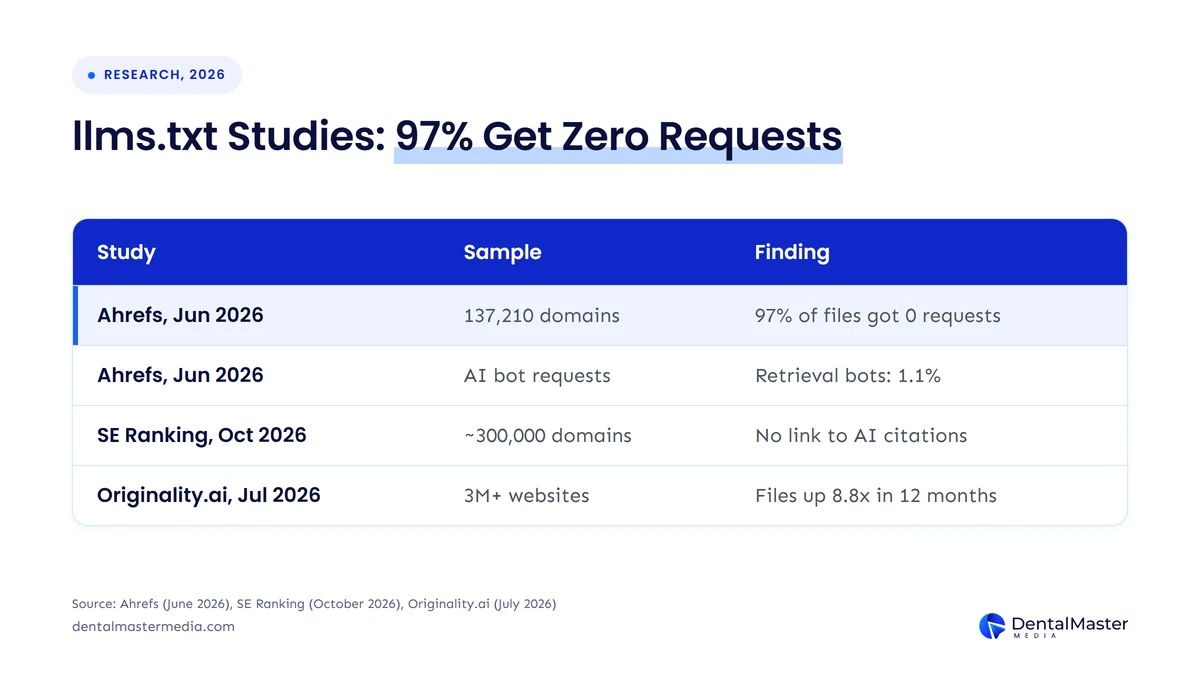
The research says llms.txt adoption is growing fast while use by AI crawlers and effect on AI citations stay close to zero. Three 2026 studies from Ahrefs, SE Ranking and Originality.ai measured adoption, server log requests and AI citations, and the table below sets their numbers side by side.
| Study (publisher, date) | Sample | What it measured | Finding |
|---|---|---|---|
| Ahrefs, June 15, 2026 | 137,210 domains | Requests to llms.txt files in server logs, May 2026 | 97% of about 38,000 valid llms.txt files got 0 requests |
| Ahrefs, June 15, 2026 | Requests that reached llms.txt files | Who sent the requests | SEO audit tools 21.7%, named AI bots 19.5%, GPTBot 4.51%, ClaudeBot 0.8% |
| Ahrefs, June 15, 2026 | 137,210 domains | Adoption | 28% of domains publish an llms.txt file |
| SE Ranking, October 15, 2026 | Nearly 300,000 domains | Adoption and AI citations | 10.13% have an llms.txt file, with no correlation to how often AI tools cite the domain |
| Originality.ai, July 3, 2026 | 3 million+ websites | Adoption growth | 4,088 llms.txt files in June 2025 rose to 36,120 in May 2026, an 8.8x increase |
The table shows that more sites publish an llms.txt file each month, while almost none of those files are read by AI crawlers or linked to more AI citations.
The 2 adoption figures differ because the samples differ. Ahrefs measured sites that use Ahrefs Web Analytics, which may skew toward SEO-aware businesses, so its 28% is higher than SE Ranking’s 10.13% across a broader set of domains. SE Ranking also reported that removing llms.txt from its XGBoost citation model made the model more accurate, which suggests the file added noise, not signal.
Should a dental practice add an llms.txt file?
No, a dental practice does not need an llms.txt file, because Google Search ignores it and no AI platform has said it uses the file to pick which dentist to cite. Adding one is still harmless, so a dental practice can add an llms.txt file once the basics that do affect visibility are in place.
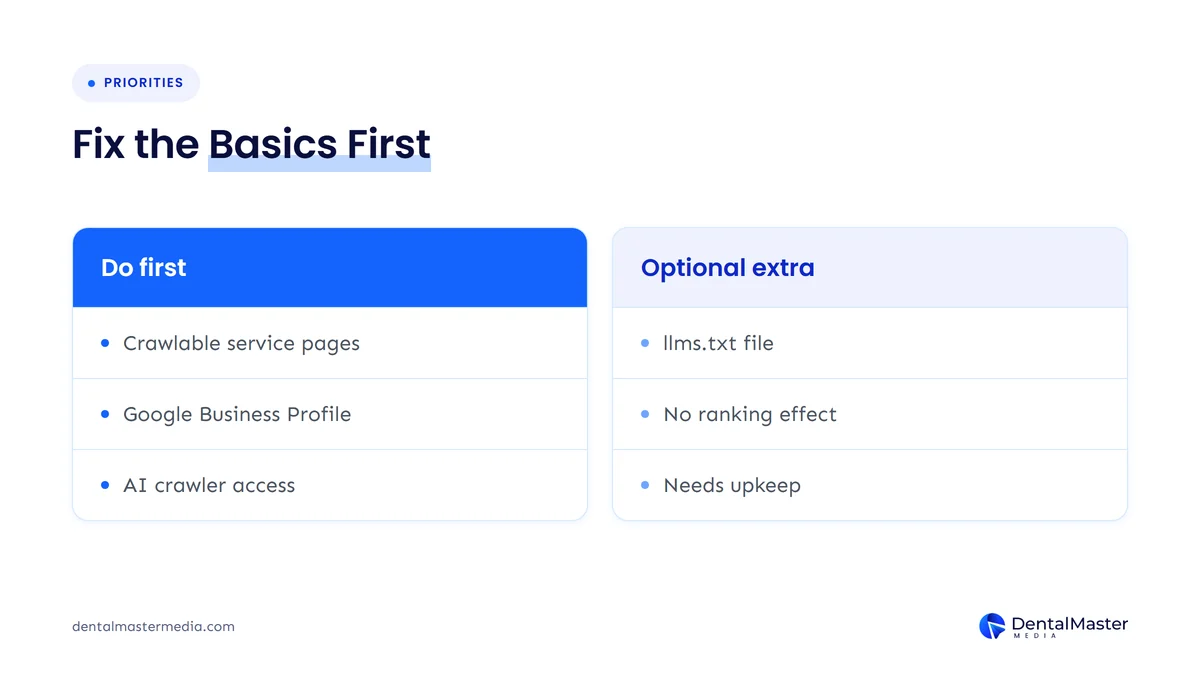
An llms.txt file is worth a dental practice’s time in 4 cases, listed below.
- Your website platform creates the llms.txt file for you: a dental website on a platform or plugin that generates the file only needs a check that the links and practice details are right.
- Your practice publishes patient resources at scale: a dental group with a large library of treatment and patient-education pages gains the most from a curated list of its best pages.
- Your server returns an error for /llms.txt: a broken response fails the Google Lighthouse audit, so either publish a valid llms.txt file or make the URL return a clean 404.
- Your agency already checks every other item: a dental website with fast, crawlable service pages and a complete Google Business Profile can add llms.txt as a low-cost test.
The main risk of an llms.txt file is drift. An llms.txt file that lists an old phone number, a dentist who has left or a service the practice no longer offers gives AI tools a second, wrong version of the practice. Keep every fact in the file identical to the website and the Google Business Profile.
How do you add an llms.txt file to a dental website?
You add an llms.txt file to a dental website by writing a short Markdown file that lists the practice’s key pages and uploading it to the root of your domain, so it loads at yourpractice.com/llms.txt. The whole job takes 4 steps and needs no change to the rest of the site.
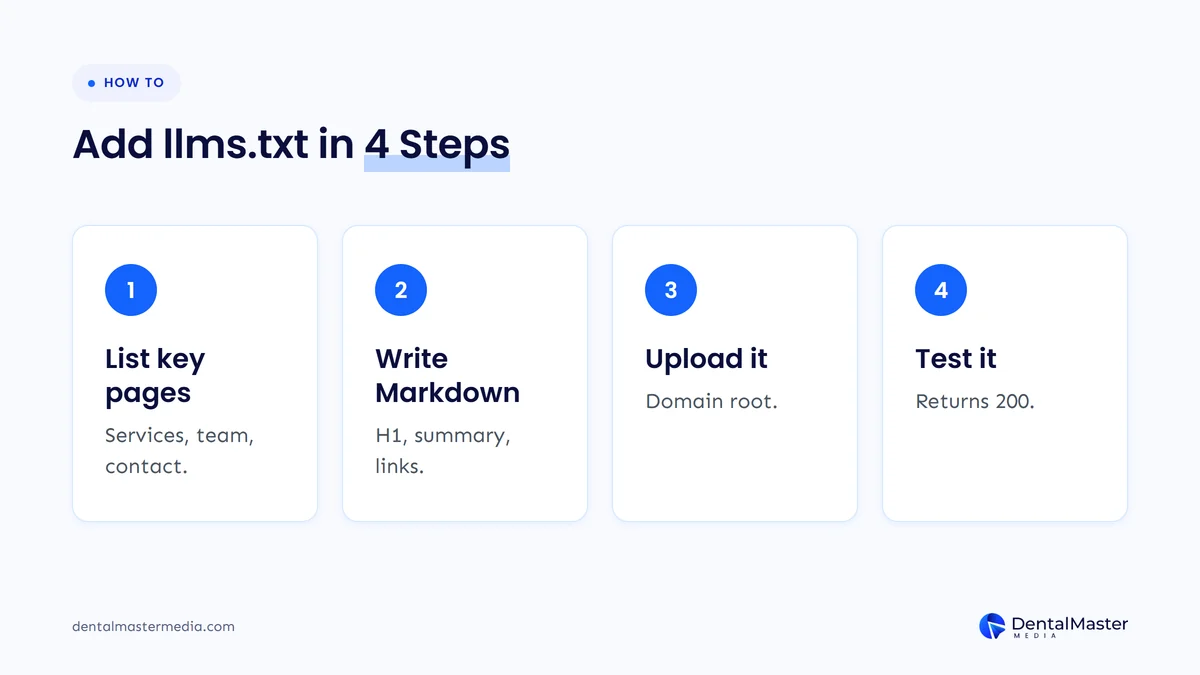
The 4 steps to add an llms.txt file to a dental website are listed below.
- List the pages that matter most: the homepage, each treatment page, the dentists’ bio pages, the location and hours page, insurance and payment information and the new-patient page of the dental website.
- Write the llms.txt file in Markdown: start with the practice name as the H1, add a one-sentence summary in a blockquote, then group the links under H2 headings such as “Treatments” and “About the practice”. Copy the practice name, address, phone number and hours exactly as they appear on the website and the Google Business Profile.
- Upload the llms.txt file to the root of your domain: place it in the same folder as robots.txt, or use your website platform’s setting if it generates the file.
- Test the llms.txt file and update it: open yourpractice.com/llms.txt in a browser, confirm it returns a 200 status as plain text, not an HTML page, and edit it whenever a service, dentist or address changes.
A short llms.txt file for a dental practice follows this pattern:
# Your Practice Name

> General and cosmetic dental practice in Your City, offering implants, clear aligners and emergency appointments.

## Treatments
- [Dental implants](https://yourpractice.com/dental-implants/): candidacy, procedure and recovery
- [Clear aligners](https://yourpractice.com/clear-aligners/): treatment process and timelines

## About the practice
- [Our dentists](https://yourpractice.com/our-team/): qualifications and experience
- [Location and hours](https://yourpractice.com/contact/): address, phone and opening hours
The llms.txt file sits beside robots.txt and sitemap.xml, so it belongs in the same technical review. Our technical SEO checklist for dental websites covers the root files that Google does read.
What helps a dental practice appear in AI answers instead?
A dental practice appears in AI answers through crawlable, original service pages, a complete Google Business Profile and open access for AI search crawlers, not through an llms.txt file. Google’s May 2026 guide says its generative AI features rely on the same core ranking and quality systems as Google Search, so standard SEO practice still applies.
The 4 levers that Google’s guide and the AI companies’ crawler documentation point to are listed below.
- Crawlable service pages: each treatment has its own page in plain HTML that Googlebot, OAI-SearchBot and Claude-SearchBot can read without scripts.
- Original, people-first content: dental pages written from the practice’s own experience, not commodity text that every other dental website repeats.
- A complete Google Business Profile: Google’s guide names Google Business Profile as the route to local visibility in its AI features.
- AI crawler access in robots.txt: a dental website that blocks OAI-SearchBot can’t appear in ChatGPT search answers, so check robots.txt before anything else.
Each of those levers has more depth than this page can cover. Our guide on how to get your dental clinic cited by ChatGPT and AI search picks up where llms.txt leaves off.
Frequently asked questions
Will an llms.txt file help my dental practice rank higher on Google?
No, an llms.txt file will not help your dental practice rank higher on Google. Google Search Central’s guide on generative AI features says llms.txt files will neither help nor harm visibility or rankings in Google Search, because Google Search ignores them. That applies to AI Overviews and AI Mode as well.
Does ChatGPT read llms.txt files?
No, ChatGPT has no documented use for llms.txt files. OpenAI’s crawler documentation explains robots.txt controls for OAI-SearchBot, GPTBot and ChatGPT-User and doesn’t describe llms.txt as a signal. OpenAI’s GPTBot made 4.51% of llms.txt requests in Ahrefs’ 2026 data, which shows occasional fetching, not use in answers.
Is llms.txt the same as robots.txt?
No, llms.txt is not the same as robots.txt. The robots.txt file tells crawlers which pages they may access, and Google, OpenAI and Anthropic all follow it. The llms.txt file only suggests which pages are worth reading, and no crawler is required to follow it.
Can an llms.txt file hurt my dental website?
No, an llms.txt file cannot hurt your dental website in Google Search, according to Google’s own guide. The practical risk is outdated information: an llms.txt file that lists an old phone number or a dentist who has left gives AI tools facts that conflict with your website and Google Business Profile.
Do I also need an llms-full.txt file?
No, a dental practice does not need an llms-full.txt file. The llms-full.txt variant puts a site’s full text in one file and is used mainly by documentation sites. Originality.ai counted 2,463 llms-full.txt files in May 2026, against 36,120 llms.txt files.
llms.txt is optional; the basics are not
An llms.txt file is a short Markdown map of a website for AI tools. Google Search ignores it, ChatGPT and Claude have not said they use it, and 2026 studies from Ahrefs, SE Ranking and Originality.ai show rising adoption with almost no requests and no link to AI citations. A dental practice can add an llms.txt file at little cost, but rankings and AI answers depend on crawlable service pages, original content and an accurate Google Business Profile.
That is the work our dental SEO services focus on at Dental Master Media.
See what AI search and Google can read on your site
Before you spend time on an llms.txt file, find out what Google, ChatGPT and other AI tools can already read on your dental website. Our free dental SEO audit checks your service pages, robots.txt, crawler access and Google Business Profile, and shows which fixes will make the biggest difference.
Sources
- llmstxt.org (Jeremy Howard, Answer.AI), “The /llms.txt file, v2”, proposed September 3, 2024, version 2 updated August 10, 2026. https://llmstxt.org/
- Google Search Central, “Optimizing your website for generative AI features on Google Search”, published May 15, 2026, accessed November 16, 2026. https://developers.google.com/search/docs/fundamentals/ai-optimization-guide
- Google Search Central, “Latest Google Search Documentation Updates: Clarifying guidance on llms.txt files”, June 15, 2026. https://developers.google.com/search/updates
- Chrome for Developers, “llms.txt” (Lighthouse agentic browsing audit), accessed November 16, 2026. https://developer.chrome.com/docs/lighthouse/agentic-browsing/llms-txt
- Ahrefs, “We Analyzed 137K Sites: 97% of llms.txt Files Never Get Read”, June 15, 2026. https://ahrefs.com/blog/llmstxt-study/
- SE Ranking, “Does LLMs.txt impact your AI visibility and citations? No, according to research”, October 15, 2026. https://seranking.com/blog/llms-txt/
- Originality.ai, “LLMs.txt Tracking Study and Live Dashboard”, July 3, 2026. https://originality.ai/blog/llms-txt-tracking-study
- OpenAI, “Overview of OpenAI Crawlers”, accessed November 16, 2026. https://developers.openai.com/api/docs/bots
- Anthropic, “Does Anthropic crawl data from the web, and how can site owners block the crawler?”, accessed November 16, 2026. https://support.claude.com/en/articles/8896518-does-anthropic-crawl-data-from-the-web-and-how-can-site-owners-block-the-crawler
- Search Engine Roundtable, “Google Says No AI System Currently Uses LLMs.txt”, June 18, 2025. https://www.seroundtable.com/google-ai-llms-txt-39607.html
- Search Engine Roundtable, “OpenAI Crawling LLMs.txt Files? Google Says It Won’t.”, July 24, 2025. https://www.seroundtable.com/openai-crawling-llms-txt-files-39811.html
- Search Engine Roundtable, “Google Does Not Endorse LLMs.txt Files”, January 20, 2026. https://www.seroundtable.com/google-does-not-endorse-llms-txt-40789.html
- Search Engine Roundtable, “Google Says LLMS.txt Files Won’t Help Or Hurt Your Search Rankings”, June 16, 2026. https://seroundtable.com/google-llms-txt-files-hurt-help-41512.html

Suraj Rana is the owner of Dental Master Media and a leading expert in SEO for dental practices. With a passion for dental marketing, he has successfully helped numerous dental clinics climb the search engine ranks. Suraj’s expertise makes him a go-to resource for effective, results-driven dental marketing.