Quick answer: HUMAN Security’s October 2026 report found that AI agents from Meta and OpenAI made nearly 90% of agent requests on the sites it protects, and 85% of those requests went to product and search pages. For a dental practice, check that bot rules aren’t blocking these visitors, that key details are easy to read and that booking works.
Key takeaways
- AI agents are browsing tools that visit websites on behalf of a person. HUMAN Security counted roughly 8 times as many agent requests in October 2026 as in August.
- Meta’s Muse agent made 59% of agent requests in October, and OpenAI’s agents made about 30%, so two companies now send most of this traffic.
- Most agent requests went to product and search pages, the pages where people compare options. For a practice, the closest match is service, location and booking pages.
- Muse has no name you can match in robots.txt, so whether it gets in depends on your security plugin, firewall or CDN bot rules.
- Most analytics tools can’t tell agents from human visitors, so treat any jump in odd-looking traffic with care before you react.
- The report counts requests, not orders or bookings. Nothing in it shows agents booking dental appointments today.
What changed?
AI agents went from a small share of automated traffic to a fast-growing one in a few months. HUMAN Security’s State of Agentic Traffic report for October 2026 found total agent requests were about 8 times August’s volume and about 2.6 times September’s, with Meta and OpenAI behind nearly 90% of them.
Search Engine Journal covered the report on November 14, 2026. The main figures, which describe sites and apps protected by HUMAN rather than the whole web, are below.
| Finding (October 2026) | Figure |
|---|---|
| Share of agent requests from Meta and OpenAI agents combined | Nearly 90% |
| Share from Meta’s Muse alone | 59%, up 19 percentage points from September |
| Share from OpenAI’s agents | About 30%, with three of the top 10 agents |
| Muse volume compared with ChatGPT Agent, the next-largest agent | 3.7 times as many requests |
| Agent requests to product and search pages | 85%, up from 81% |
| Agent requests to checkout and payment pages | 1.9%, down from 2.4% |
| Total agent requests | About 8 times August and 2.6 times September |
Other agents were much smaller. Google’s Gemini agent, launched on October 8, ranked eighth with 0.8% of requests, and Perplexity’s Comet fell to 3.6% after making 41% of requests in August. Ecommerce sites took about 60% of agent traffic, with travel second.
What is an AI agent, and how is it different from a crawler?
An AI agent is a tool that opens and uses websites for a person who gave it a task, such as comparing options or finding information. A crawler, like Googlebot, visits pages on its own schedule to build an index. Agents act in the moment for one user, which is why normal crawler controls often don’t apply to them.
OpenAI’s own crawler documentation shows the difference. It lists separate user agents for search indexing (OAI-SearchBot), model training (GPTBot) and user-initiated actions (ChatGPT-User). For the last one, OpenAI says that because the actions are started by a user, robots.txt rules may not apply.
| Type of visitor | Who starts the visit | Controlled by robots.txt? |
|---|---|---|
| Search crawler (for example Googlebot, OAI-SearchBot) | The search company, automatically | Yes |
| Training crawler (for example GPTBot) | The AI company, automatically | Yes |
| User-initiated fetch (for example ChatGPT-User) | A person asking a question | OpenAI says it may not apply |
| Browsing agent (for example Meta’s Muse) | A person giving the agent a task | Muse has no name to match, per the report’s coverage |
Who is affected?
Every business with a website can receive agent visits, but the report’s data leans heavily toward ecommerce and travel. HUMAN’s coverage doesn’t break out healthcare or dentistry, so there is no published figure for how many agents visit dental websites. Practices should read the report as an early signal, not a measure of their own traffic.
The pattern still matters for a practice. Agents mostly visit pages where a person compares choices. On a dental website, that means treatment pages, location pages, fees or insurance pages and the booking page. If those pages are hard for software to read, or are hidden behind a bot check, an agent working for a prospective patient may come away with less information about your practice than about the one down the road.
What does AI agent traffic mean for a dental practice website?
It means some visitors to your service and booking pages may soon be software acting for a patient rather than the patient. Those visitors need the same facts a person needs, such as services, hours, location, insurance and how to book, in a form they can load and read without getting blocked or stuck.
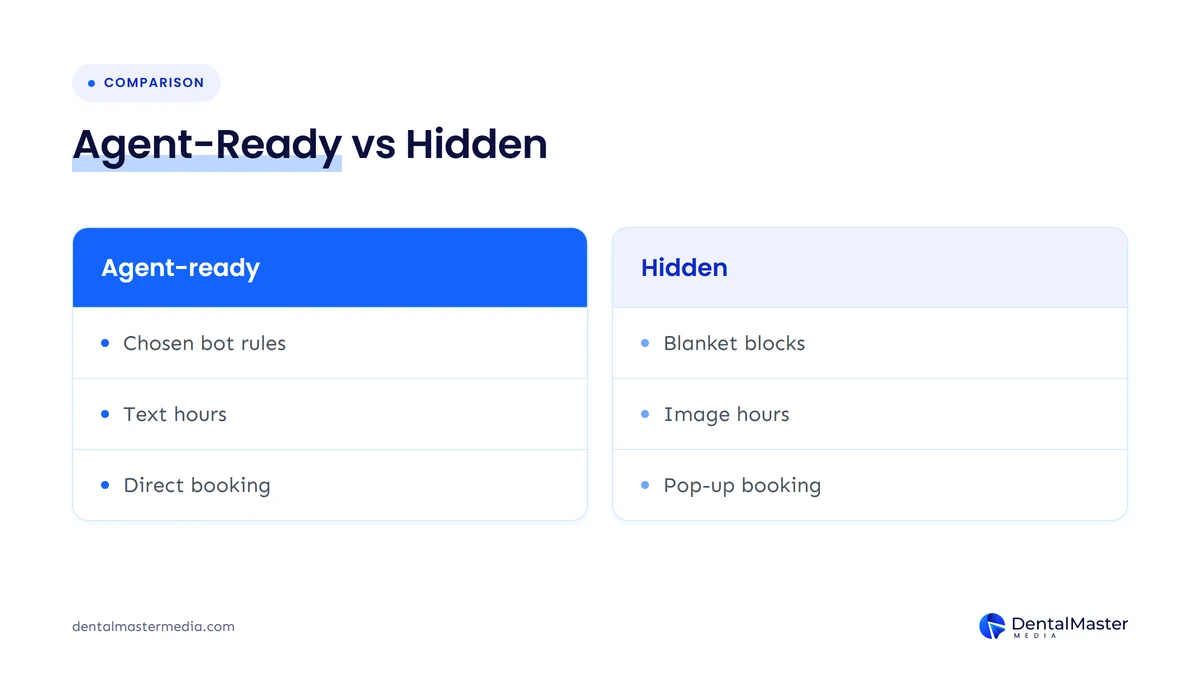
We see three practical effects:
- Access becomes a security setting, not only an SEO setting. If a firewall or plugin treats every unknown automated visitor as a threat, agents may be turned away before they reach a single page.
- Clarity counts more. An agent summarizing your practice can only use what it can find. Hours buried in an image, or insurance details spread over three pages, are easy to miss.
- Your reports get noisier. Agent visits can look like human visits in analytics, which can blur engagement and conversion numbers.
None of this means agents are booking appointments at dental practices today. The report counts requests, not completed actions, and a request to a checkout page doesn’t mean a purchase. Treat this as preparation, not an emergency.
Why can’t robots.txt control Meta’s Muse?
Robots.txt works by naming a crawler and telling it what it may visit. According to Search Engine Journal’s coverage of the report, Muse gives robots.txt no name to match, so the decision to allow or block it moves to bot protection tools such as security plugins, firewalls and CDN bot settings.
There is a newer way for agents to identify themselves: signed requests using Web Bot Auth, which bot protection tools can check. The coverage reports that Muse moved its signatures from meta.com to muse.ai between November 7 and 9, 2026, and that as of November 10, about half of Muse’s requests on DataDome’s network were unsigned. In plain terms, even the tools built to recognize agents are still catching up.
For a practice, the lesson is simple. Your robots.txt file is no longer the only place where AI access is decided. Whoever manages your hosting, firewall or CDN now plays a part too.
What should a dental practice check now?
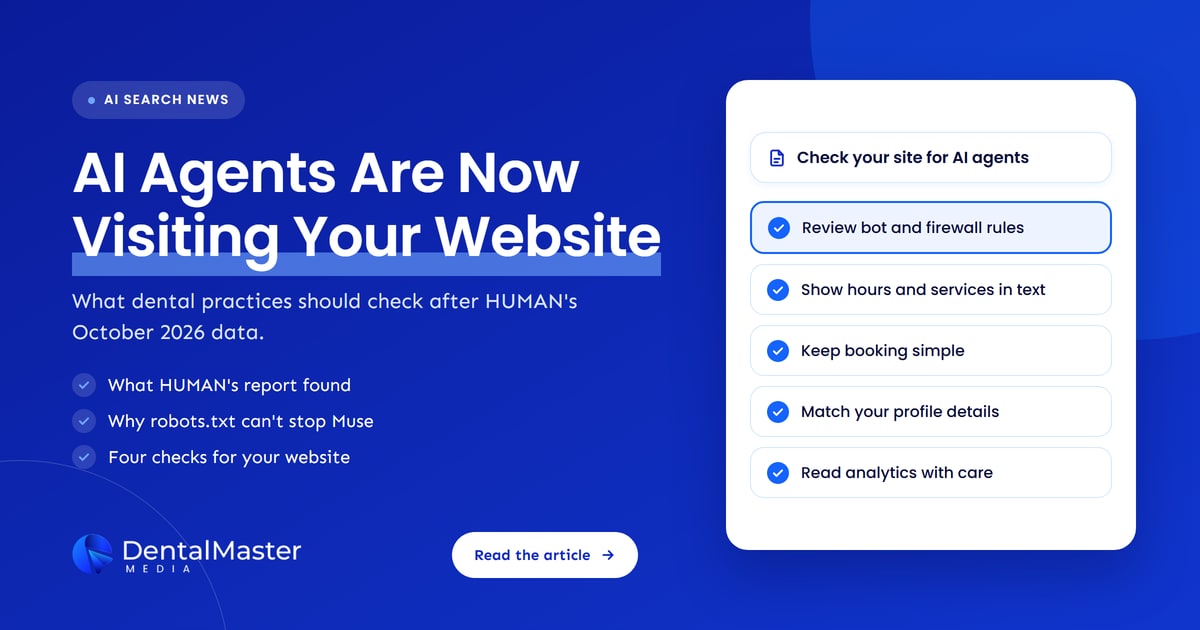
Start with four checks: make sure your security tools aren’t blocking agents and crawlers by accident, make your key practice details easy for software to read, confirm your booking path works without fragile scripts, and learn what your analytics can and can’t tell you about automated visits.
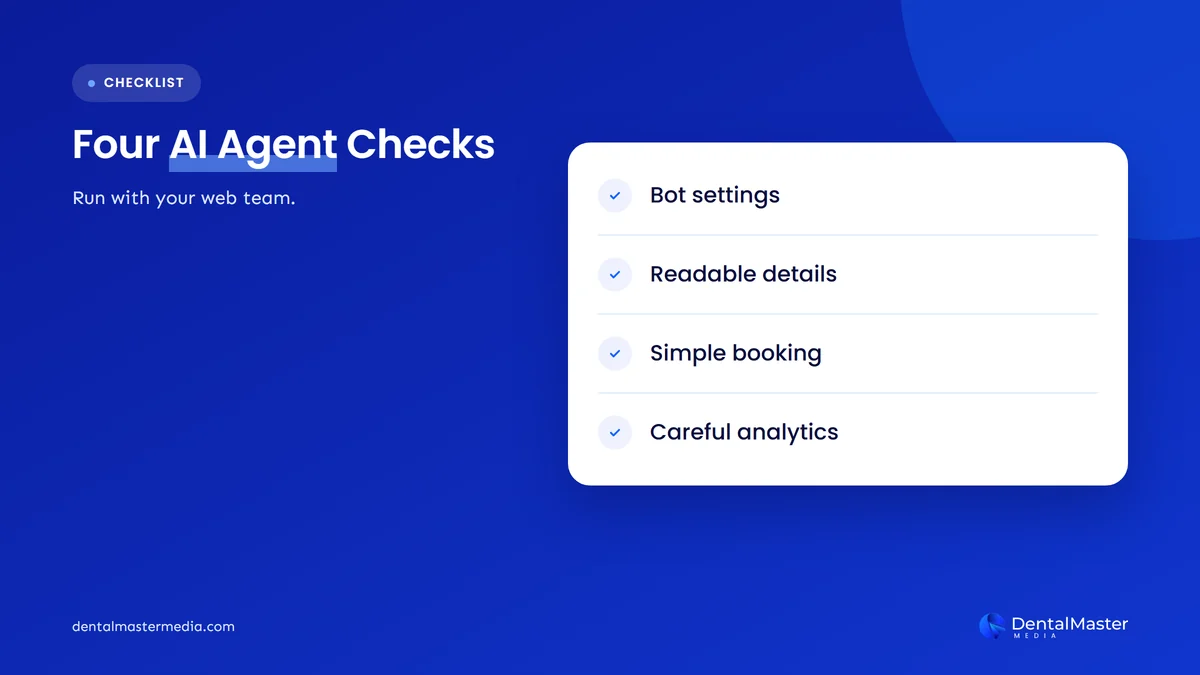
Check your bot and security settings
Ask whoever runs your website which bot rules are switched on. Security plugins, hosting firewalls and CDN services can include settings that block or challenge AI crawlers and automated traffic,. Blocking can be a valid choice, but it should be a decision you made, not one you inherited.
- List every security layer: WordPress security plugin, hosting firewall and any CDN.
- Find any setting that blocks “AI bots”, “AI crawlers” or “automated traffic”, and note what it covers.
- Check your robots.txt for rules that block search crawlers such as Googlebot or OAI-SearchBot by mistake.
- Decide on purpose which AI visitors you allow, and write that decision down.
Make hours, services, insurance and booking easy to read
Put the facts patients ask about in plain text on clear pages: services, opening hours, address, phone number, insurance or payment options and how to book. Text in images, PDFs or pop-ups is harder for software to read. Structured data adds a machine-readable layer on top of what the page already shows.
Google’s local business structured data documentation explains how markup can share details such as business hours, and it advises using the most specific business type available. Our guide to schema markup for dental websites covers which types fit a practice. Keep the details identical to your Google Business Profile, so that every source an agent checks tells the same story.
Make sure booking works without fragile scripts
Test your booking path the way a basic browser would see it. If the “Book now” button only works after a heavy script loads, or the booking form sits inside a pop-up with no link of its own, agents and some patients may never reach it. A plain link to a dedicated booking page, plus a visible phone number, is the safest base.
- Open your booking page from a direct link, not only from a pop-up.
- Check that the phone number is text that can be tapped or copied, not part of an image.
- Try the booking flow on a slow mobile connection and note anywhere it stalls.
- If you use a third-party booking tool, confirm it isn’t behind an extra bot check.
If patients can also book from Google, our guide to Google Business Profile booking links explains how those links work.
Read your analytics with agents in mind
According to the report’s coverage, analytics tools on most sites can’t separate AI agents from human visitors. So if a service page suddenly gets more visits with very short sessions and no calls, agent traffic is one possible explanation. Judge the page by tracked calls, form fills and bookings, not visits alone.
AI agent visits are different from AI referral visits, where a person clicks a link inside an AI answer. Our earlier article on AI traffic to dental practice websites explains how to find those referral visits in GA4. For the numbers that matter most, see our guide to tracking calls and bookings from your dental website.
How do you decide whether to allow or block AI agents?
Decide based on what each visitor does for your practice. Search crawlers help patients find you, so most practices should allow them. User-initiated agents act for a real person who is looking for information, often a prospective patient. Training crawlers don’t send patients directly, so blocking them is a business choice rather than an SEO one.
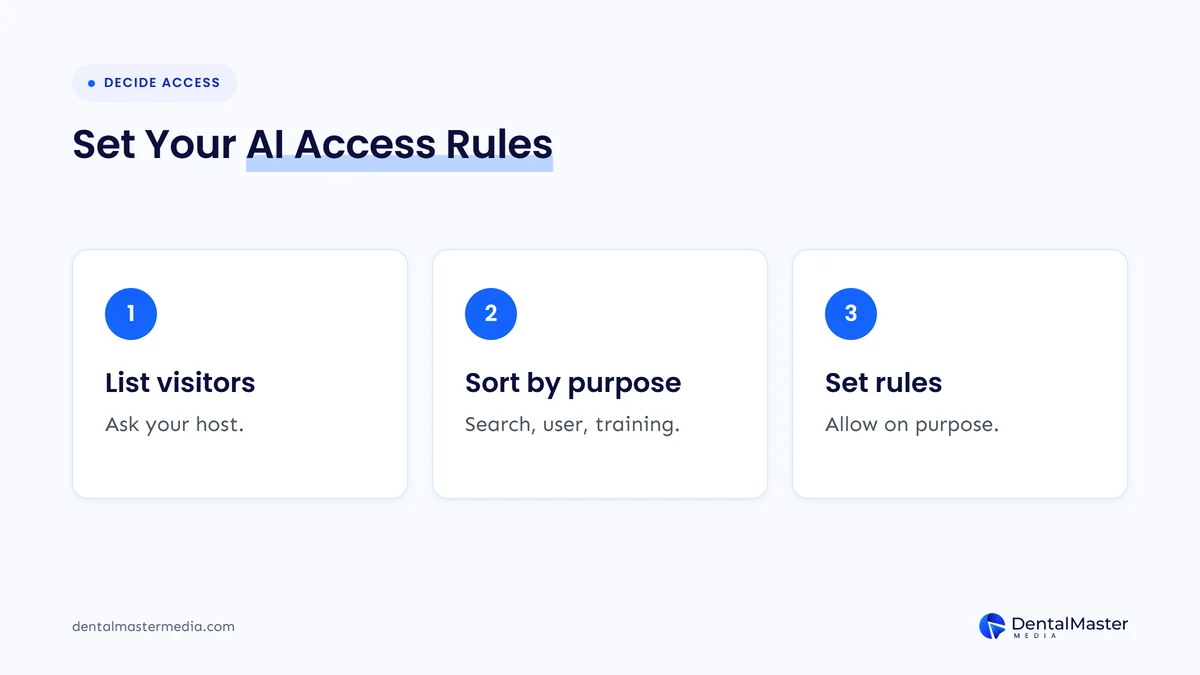
- List what is visiting. Ask your web team or host for a report of the main automated visitors, if their tools provide one.
- Sort by purpose. Group visitors into search, user-initiated and training, using the table earlier in this article.
- Set rules on purpose. Allow search and user-initiated visitors unless you have a clear reason not to, and block abusive traffic regardless of its name.
- Review after changes. Recheck your settings whenever you change host, plugin or CDN, or when a new agent appears in the news.
Security still comes first. Not every automated visitor is friendly, which is why the report’s coverage recommends bot rules that verify signatures rather than trusting a name. A good firewall can block abuse while letting verified agents through.
What’s likely next?
This section is our opinion, not a finding from the report. We expect agent traffic to keep growing and bot protection tools to get better at verifying agents by signature. HUMAN’s next report is due to cover agent behavior over Black Friday and Cyber Monday, which will show how agents behave during heavy shopping periods.
Dental websites are unlikely to be the first place agents complete tasks, because most agent activity is still in ecommerce and travel. But the basics that help agents, such as clear pages, consistent details and a booking path that works, also help human patients and search engines today. That makes them low-risk work to do now.
Frequently asked questions
Are AI agents booking dental appointments today?
We haven’t seen evidence of that. HUMAN’s report counts requests to pages, not completed bookings or purchases, and only 1.9% of agent requests went to checkout and payment pages in October 2026. Agents mostly look at product and search pages, which for a practice means service, location and booking pages.
Should my dental practice block AI agents?
Most practices shouldn’t block them by default. User-initiated agents act for real people, who may be prospective patients. Block traffic that is abusive or overloads your site, and make any wider block a deliberate business decision. Check with your web team before changing firewall or CDN bot rules.
Can I control Meta’s Muse with robots.txt?
Not directly, based on current coverage. Search Engine Journal reports that Muse gives robots.txt no name to match, so allowing or blocking it depends on bot protection tools such as security plugins, firewalls and CDN bot settings, ideally ones that verify signed requests.
Will AI agent visits show up in Google Analytics?
Some may, but they are hard to spot. According to coverage of HUMAN’s report, analytics tools on most sites can’t separate AI agents from human visitors. Judge your pages by calls, form fills and bookings, and treat sudden spikes of short visits with care.
Is AI agent traffic the same as AI referral traffic?
No. AI referral traffic is a person clicking a link in an AI answer, such as a cited source in ChatGPT. AI agent traffic is software visiting your site to complete a task for someone. Referral visits are easier to see in analytics. Agent visits often look like normal visits.
The bottom line
HUMAN Security’s October 2026 data shows AI agents are visiting websites at a much larger scale than a few months ago, led by Meta’s Muse and OpenAI’s agents, and focused on the pages where people compare options. For a dental practice, the right response is a short set of checks: confirm your bot rules are deliberate, make hours, services, insurance and booking easy to read, keep booking simple and read your analytics with care. If you want help with the technical side, our dental SEO services cover this work, and you can learn more about how we help practices at Dental Master Media.
Is your website ready for AI visitors?
Our free dental SEO audit checks whether your site is blocking the crawlers that help patients find you, whether your key practice details are easy for search engines and AI tools to read, and whether your booking path works on mobile.
Sources
- HUMAN Security, “State of Agentic Traffic, October 2026: Meta and OpenAI now account for 90% of agentic traffic”, November 9, 2026. https://www.humansecurity.com/learn/blog/october-2026-agentic-traffic/
- Search Engine Journal, “Meta & OpenAI Agents Made Nearly 90% Of Agent Requests In Bot Data”, November 14, 2026. https://www.searchenginejournal.com/meta-muse-ai-agent-requests-human-security/597388/
- OpenAI, “Overview of OpenAI Crawlers”, accessed November 16, 2026. https://developers.openai.com/api/docs/bots
- Google Search Central, “Local business (LocalBusiness) structured data”, accessed November 16, 2026. https://developers.google.com/search/docs/appearance/structured-data/local-business

Suraj Rana is the owner of Dental Master Media and a leading expert in SEO for dental practices. With a passion for dental marketing, he has successfully helped numerous dental clinics climb the search engine ranks. Suraj’s expertise makes him a go-to resource for effective, results-driven dental marketing.