
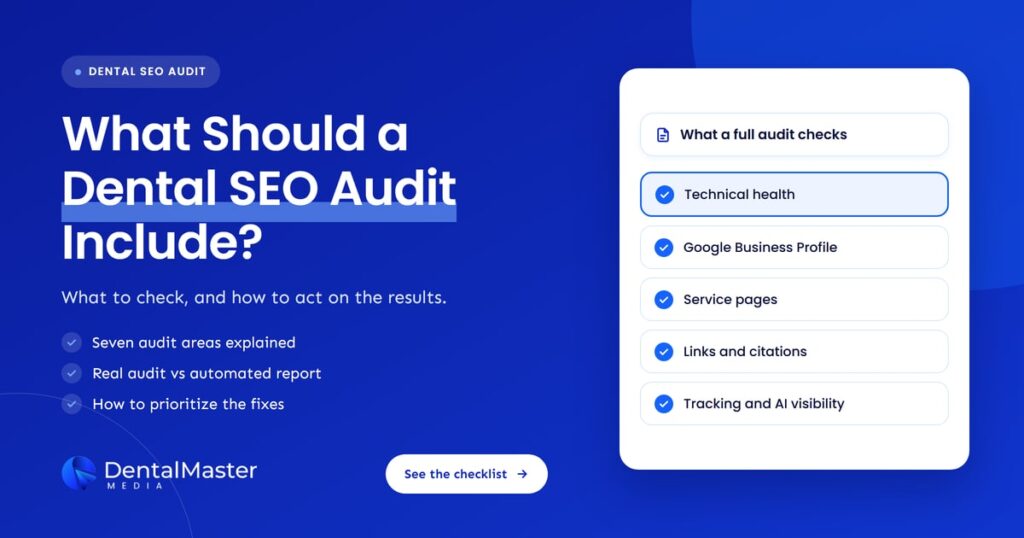
Quick answer: A proper dental SEO audit checks seven areas: technical health and indexing, site speed and mobile use, your Google Business Profile and local listings, service pages, content quality, links and citations, and call and booking tracking, plus how AI search describes your practice. It should end with a short, ranked list of fixes, not a raw error report.
Key takeaways
- A dental SEO audit is a diagnosis of why your practice does or doesn’t show up for local patients in Google Search, Google Maps and AI answers.
- The full scope covers the website, the Google Business Profile, local listings, links, tracking and AI visibility. An audit that only looks at the website misses half of local search.
- Search Console now has dedicated reports for AI Overviews and AI Mode impressions, so a 2026 audit can measure AI visibility with Google’s own data.
- The value of an audit is in the priorities. Fix anything that stops Google or patients reaching you first, then the work that brings calls, then longer-term content and links.
- Use the audit as a baseline. Re-check the same numbers after each round of fixes so you can see what changed.
What is a dental SEO audit?
A dental SEO audit is a structured review of everything that affects how a dental practice appears in search: the website, the Google Business Profile, local directory listings, links, content and tracking. It explains what is holding the practice back, why it matters and what to fix first, in order of impact on new-patient calls.
It is different from a website health score. Free crawlers are useful for spotting broken links or missing titles, but they can’t tell you whether your implant page answers the questions patients ask, whether your Business Profile categories are right, or whether calls from Google are being tracked at all. Those checks need a person who understands both search and dentistry.
Why does a dental SEO audit look different in 2026?
A 2026 audit has to cover more ground because patients now find practices in AI answers as well as in the map pack and regular results. Google has also added new Search Console reports this year, so some things that used to be guesswork, such as how often your pages appear in AI Overviews, can now be measured.
Three changes stand out for practice owners:
- AI impressions are now reported. On June 3, 2026, Google announced Search Generative AI performance reports in Search Console, showing how often your URLs appear in AI Overviews, AI Mode and Discover’s AI features. Google says these reports reached all websites worldwide on August 31, 2026. They report impressions, not clicks.
- Image searches are now reported. On September 24, 2026, Google added a multimodal filter covering searches made with Google Lens, Circle to Search and image uploads.
- Patients are asking AI for recommendations. BrightLocal’s 2026 Local Consumer Review Survey of 1,002 US adults found that 45% had used ChatGPT or other AI tools for local business recommendations, up from 6% the year before.
None of this replaces the basics. Google states that there are no additional requirements or special optimizations needed to appear in AI Overviews or AI Mode. A page still has to be indexed and eligible to show with a snippet, which is why technical and local checks still come first.
What should a dental SEO audit include?
A complete dental SEO audit should include seven areas: technical health and indexing, speed and mobile experience, Google Business Profile and local listings, on-page and service pages, content quality, links and citations, and tracking. AI search visibility now sits across all seven as an extra lens rather than a separate project.
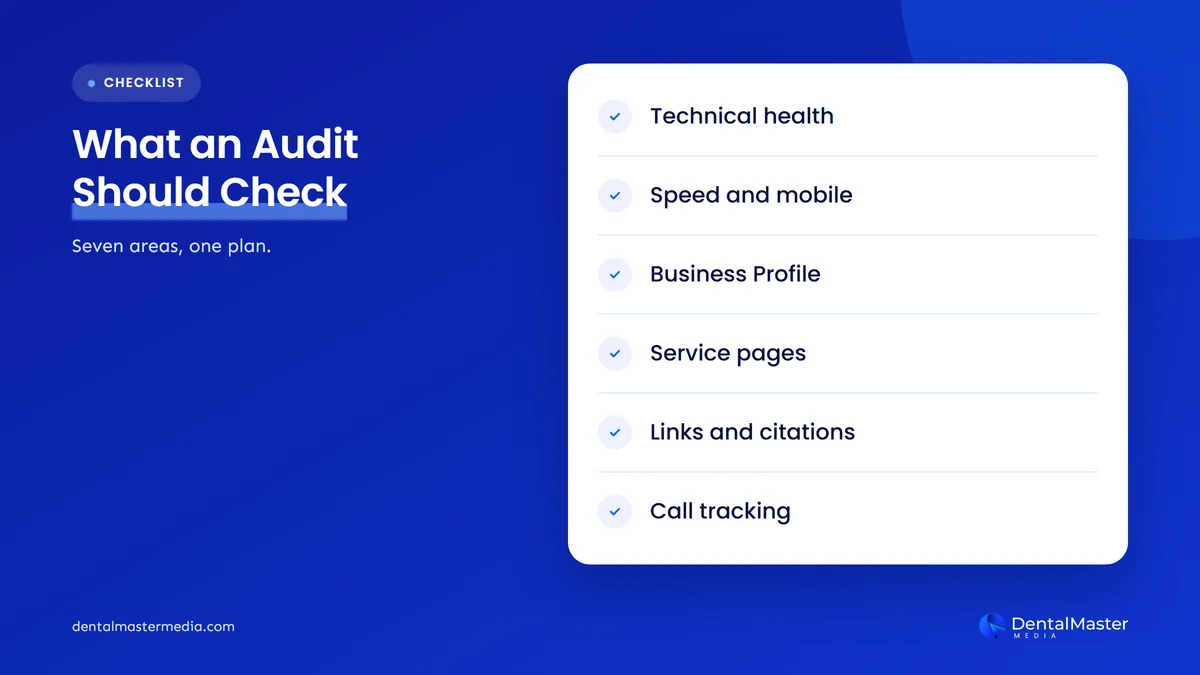
| Audit area | What it checks | Common warning sign |
|---|---|---|
| Technical health and indexing | Crawling, indexing, redirects, HTTPS, sitemaps, duplicate pages, structured data | Treatment pages missing from Google’s index |
| Speed and mobile | Core Web Vitals, mobile layout, tap-to-call buttons | Slow or jumpy pages on phones |
| Google Business Profile and listings | Categories, services, hours, photos, reviews, directory consistency | Different phone numbers or names across listings |
| On-page and service pages | Titles, headings, one page per key treatment, internal links | Several treatments squeezed onto one “Services” page |
| Content quality | Accuracy, author and dentist credentials, patient questions answered | Generic copy that could belong to any practice |
| Links and citations | Who links to you, local and dental mentions, harmful links | Few or no links from local or dental sources |
| Tracking and measurement | Search Console, analytics, call and booking tracking | No way to tell which calls came from Google |
1. Technical health and indexing
The technical check confirms that Google can find, crawl and index every page that matters. It reviews the Search Console Page indexing report, sitemaps, robots rules, redirects, HTTPS, duplicate and thin pages, broken links and structured data. If a treatment page is not indexed, nothing else you do to it will help it rank.
This is where audits often find the biggest, simplest wins: a service page accidentally set to noindex, old URLs from a redesign that were never redirected, or Google choosing only the homepage. Our guide to Google only indexing your dental website’s homepage covers that last problem, and our technical SEO checklist for dental websites goes deeper on every item.
2. Speed and mobile experience
The speed check measures how quickly and smoothly your pages load and respond on phones, where most patients search. Google’s Core Web Vitals guidance treats a page as good when the main content loads within 2.5 seconds, the page responds to taps in under 200 milliseconds (INP) and the layout shift score stays under 0.1.
A good audit uses field data from real visitors where it exists, not just a single lab test, and checks the patient journey on a phone: can someone find your number, tap to call and book without zooming or waiting?
3. Google Business Profile and local listings
The local check reviews the profile that appears in Google Maps and the local pack. Google says local results are based on relevance, distance and prominence, and that complete, accurate information and more reviews can help. The audit checks categories, services, hours, photos, review volume and replies, and whether your details match across directories.
For a dental practice, look closely at the primary category, the treatment list in the services section, booking links and whether the name, address and phone number are identical everywhere. Our Google Business Profile guide for dentists walks through each setting.
4. On-page SEO and service pages
The on-page check looks at whether each important treatment has its own page that clearly answers what a patient wants to know. It reviews page titles, headings, meta descriptions, internal links and how location is signaled. A single “Services” page that lists implants, aligners and emergency care in one paragraph rarely ranks for any of them.
The audit should map your most valuable treatments to pages, flag the gaps and note pages that compete with each other for the same search.
5. Content quality and trust
The content check asks whether your pages are accurate, specific to your practice and written for patients. It reviews whether each page names the dentist who provides the treatment, shows real qualifications, answers common questions about cost, pain and recovery, and stays within your local dental advertising rules. Generic, copied or outdated copy gets flagged.
6. Links and citations
The authority check reviews which websites link to your practice and where it is mentioned. Google lists links as one of the factors behind prominence in local results. A dental audit looks for links from local organizations, dental associations and community sites, checks citation consistency, and flags spammy or paid links that could cause problems.
7. Tracking and measurement
The tracking check confirms you can measure results in calls and bookings, not just rankings. It reviews Search Console access, analytics setup, conversion events for forms and booking widgets, and call tracking on both the website and the Business Profile. Without this, no audit or retainer can show whether the work is bringing in patients.
If this part of your audit comes back empty, start with our guide to tracking calls and bookings from your dental website.
Where does AI search visibility fit in?
AI visibility is one part of a full SEO audit, not a replacement for it. The audit checks your impressions in Search Console’s generative AI report, then asks the questions patients ask in AI tools and records whether your practice is named and described correctly. Most fixes that come out of this check land in the seven areas above.
We cover that part in detail in AI search visibility for dental practices: what an audit reveals, so we won’t repeat it here.
How is a real audit different from an automated SEO report?
A real audit is checked by a person, explains why each issue matters for your practice and ranks the fixes by likely impact on patient calls. An automated report lists every error a crawler can detect, often hundreds of them, with a score but no priorities. The report is a useful input, but it is not the diagnosis.
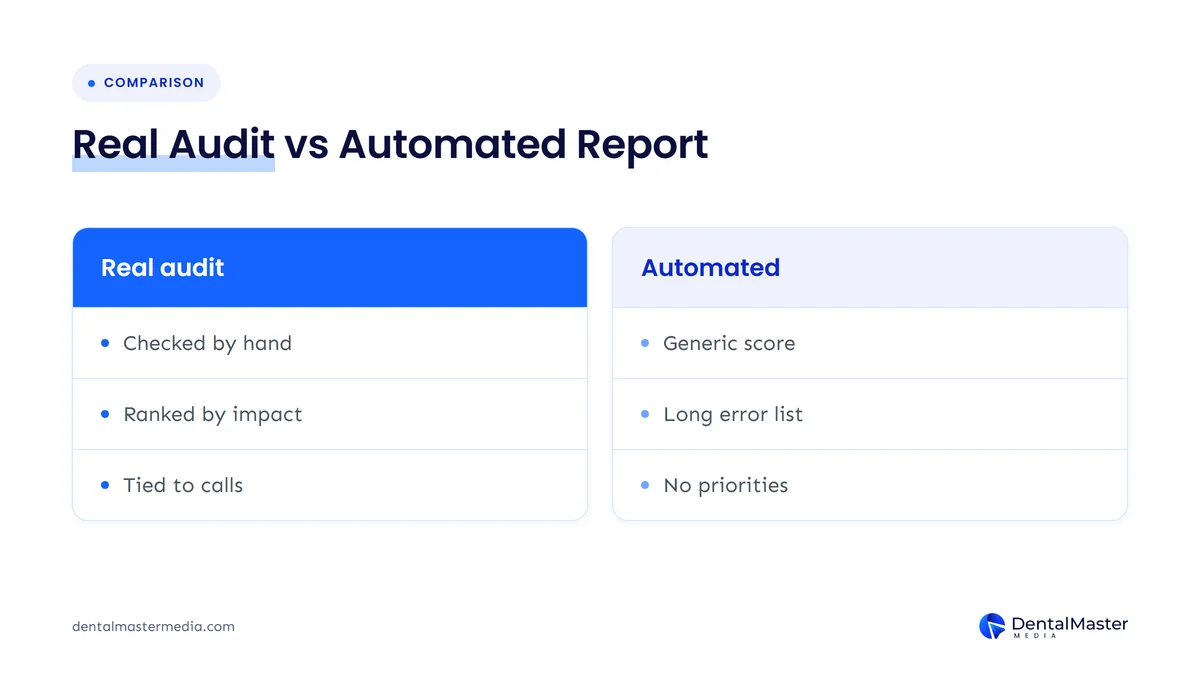
| Question | Real dental SEO audit | Automated report |
|---|---|---|
| What does it cover? | Website, Business Profile, listings, links, tracking and AI answers | Mostly what a crawler can see on the website |
| How are issues ranked? | By impact on visibility and calls | By count or a generic severity score |
| Does it know dentistry? | Checks treatment pages, categories and advertising rules | Treats a dental site like any other site |
| What do you get at the end? | A short action plan with owners and timing | A long list of warnings |
How should a practice use the results of an SEO audit?
Use the audit as a ranked to-do list and a baseline. Fix anything that blocks Google or patients first, then the changes most likely to bring calls, then longer-term content and link work. Record today’s numbers before you start so you can measure the effect of each round of fixes.
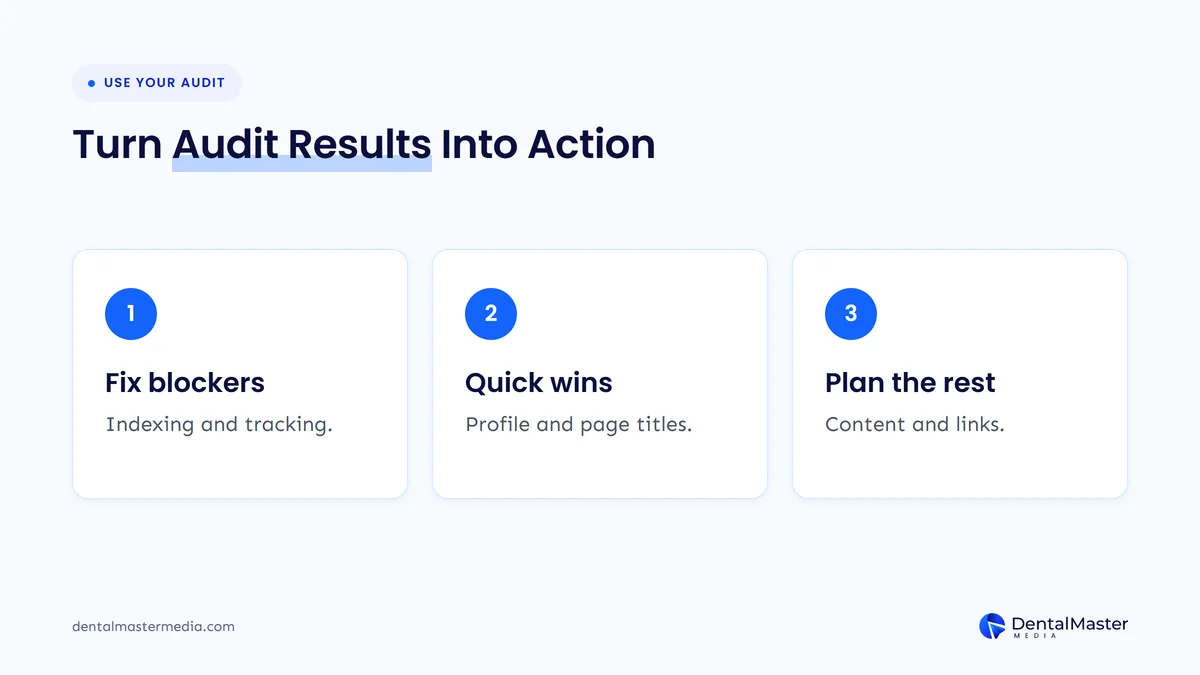
- Save a baseline. Note organic clicks, impressions and average position in Search Console, AI impressions in the generative AI report, Business Profile calls and website bookings.
- Fix blockers first. Indexing errors, broken redirects, a wrong primary category and missing call tracking come before anything else, because they stop every other fix from working or being measured.
- Take the quick wins. Complete the Business Profile, correct inconsistent listings, rewrite weak page titles and add internal links to key treatment pages.
- Plan the bigger work. New treatment pages, content rewrites and local link building take longer, so schedule them over the following months.
- Re-measure. Compare the same numbers against your baseline after each round, and keep a log of what changed and when.
This simple grid helps sort a long list of findings:
| Priority | Type of finding | Examples |
|---|---|---|
| Do now | Blocks Google, patients or measurement | Noindexed service pages, broken booking form, no call tracking |
| Do next | Quick changes with clear local impact | Profile categories and services, listing clean-up, page titles |
| Plan | Larger projects that build over months | New treatment pages, content rewrites, local links |
| Monitor | Minor issues with little effect on calls | Small image warnings, low-traffic page tweaks |
An audit is also the best way to judge an SEO proposal. If a provider’s plan doesn’t address the “do now” items, ask why. Our guide to how much dental SEO costs explains how to compare scope and price once you know what work you need.
How often should a dental practice get an SEO audit?
Most practices benefit from a full audit once a year and a lighter check every quarter. You should also run one before and after a website redesign or platform move, when you add a location, when calls or rankings drop without explanation, and before you hire a new SEO provider.
Between audits, the monthly report from your provider should track the same baseline numbers, so the next audit starts from evidence rather than from scratch.
What should you ask whoever runs your audit?
Ask what the audit covers, how findings are prioritized and what you will receive at the end. Google’s own advice on hiring an SEO suggests asking about experience in your industry and your city, how they measure success and whether they will share and explain every change they make.
- Does the audit cover the Google Business Profile and local listings, or only the website?
- Will you check call and booking tracking, and fix it if it’s missing?
- How will you rank the findings, and what would you fix first?
- Will I get a plain-English action plan, and can I keep it if I don’t hire you?
- Do you check how AI tools describe my practice, and with what data?
Frequently asked questions
How long does a dental SEO audit take?
It depends on the size of the site and the number of locations. A single-location practice with a small website can usually be audited in days, while a multi-location group with many pages takes longer. Be wary of a “full audit” delivered in minutes, because that is usually an automated report.
Can I audit my dental website myself?
You can check the basics yourself. Search Console shows indexing problems and search performance, your Business Profile shows whether details are complete, and searching your own treatments shows where you appear. Diagnosing the causes and ranking the fixes is where specialist experience helps most.
Is a free dental SEO audit worth it?
A free audit is worth it if it covers more than the website, explains each finding in plain English and gives you priorities you can act on, whoever does the work. If it is only a score and a sales pitch, treat it as a starting point rather than a diagnosis.
Does a dental SEO audit include AI search?
It should in 2026. A good audit checks your impressions in Search Console’s generative AI report and tests how AI tools describe your practice. Google says no special optimizations are needed for AI Overviews or AI Mode, so most AI fixes come from the same technical, local and content work.
What should I get at the end of an audit?
You should get a short summary of the main problems, a ranked list of fixes with the reason for each, a baseline of your current numbers and a clear view of which fixes you can do in-house and which need a developer or SEO specialist.
The bottom line on dental SEO audits
A proper dental SEO audit looks at the whole picture: technical health, speed, your Google Business Profile and listings, service pages, content, links and tracking, with AI visibility checked across them. What makes it useful is the ranked action plan and the baseline it gives you. Fix the blockers first, measure every change and use the findings to judge any SEO proposal. You can start with our free dental SEO audit, see how we turn audit findings into ongoing dental SEO services, or learn more about Dental Master Media.
See what your practice should fix first
Our free dental SEO audit reviews your website, Google Business Profile, local listings and tracking, then gives you a plain-English list of fixes ranked by impact on new-patient calls.
Sources
- Google Search Central Blog, “Introducing Search Generative AI performance reports in Search Console”, June 3, 2026. https://developers.google.com/search/blog/2026/06/gen-ai-performance-reports
- Google Search Central Blog, “Announcing web multimodal Search performance reporting in Search Console”, September 24, 2026. https://developers.google.com/search/blog/2026/09/web-multimodal-in-sc
- BrightLocal, “Local Consumer Review Survey 2026”, February 11, 2026. https://www.brightlocal.com/learn/local-consumer-review-survey/
- Google Search Central, “AI features and your website”, updated December 10, 2025. https://developers.google.com/search/docs/appearance/ai-features
- Google Search Central, “Understanding Core Web Vitals and Google search results”, accessed November 10, 2026. https://developers.google.com/search/docs/appearance/core-web-vitals
- Google Business Profile Help, “Tips to improve your local ranking on Google”, accessed November 10, 2026. https://support.google.com/business/answer/7091
- Google Search Central, “Do you need an SEO?”, updated June 5, 2026. https://developers.google.com/search/docs/fundamentals/do-i-need-seo

Suraj Rana is the owner of Dental Master Media and a leading expert in SEO for dental practices. With a passion for dental marketing, he has successfully helped numerous dental clinics climb the search engine ranks. Suraj’s expertise makes him a go-to resource for effective, results-driven dental marketing.