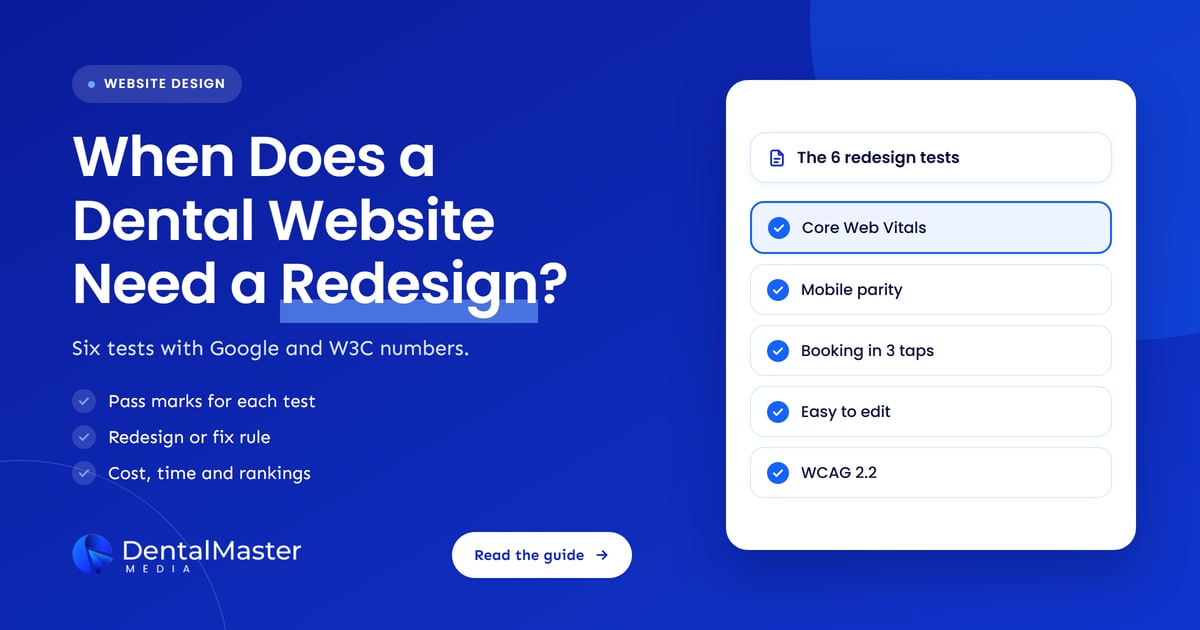
Quick answer: A dental practice should redesign its website when the site fails 2 or more of 6 tests: Core Web Vitals, mobile content parity, a call or booking within 3 taps, editing without a developer, WCAG 2.2 accessibility and a change of services or brand. Google rates a page good at 2.5 seconds, 200 milliseconds and 0.1.
Key takeaways
- A dental website redesign rebuilds the structure, design and content of the current site, and it is due when the site fails 2 or more of 6 tests (this is our rule at Dental Master Media, not a Google rule).
- Site age is a prompt to test, not a trigger: Dentaltown’s March 10, 2026 article treats a site launched in the last 3 to 5 years as a candidate for optimization, while a 2011 Dentalcompare article advised a redesign every 2 to 3 years.
- The 6 tests are Core Web Vitals, mobile parity, the booking path, editing limits, WCAG 2.2 accessibility and business change.
- Google rates Core Web Vitals as good at a Largest Contentful Paint of 2.5 seconds or less, an Interaction to Next Paint of 200 milliseconds or less and a Cumulative Layout Shift of 0.1 or less.
- You can run all 6 tests in 30 minutes with Google Search Console, a phone and your website login.
- Fix the current site when it fails 1 test or none. Redesign when it fails 2 or more, or when the practice has changed its services, brand or name.
- At Dental Master Media, a redesign costs $999 for up to 100 pages and takes about 30 days to build, and Google’s site move guide says to keep 301 redirects for at least 1 year.
What is a dental website redesign?
A dental website redesign is the rebuild of an existing dental practice website: its layout, structure, design and content are changed while the practice keeps its domain, its brand and the pages that already earn patients. A dental website redesign differs from a refresh, which changes the look or a few pages and leaves the structure alone.
A dental website redesign also differs from a first build. A new dental website starts from nothing, while a redesign has to protect the traffic, links and rankings that the old site collected. That is why the decision needs measurements and not only a feeling that the site looks old.
Redesign work and search work belong together, because a rebuilt site that Google cannot read brings in fewer patients than the old one. Our dental SEO services plan the redirects and page structure before a redesign begins, so the practice keeps the visibility it has already earned.
When should a dental practice redesign its website?
A dental practice should redesign its website when the site fails 2 or more of the 6 tests in this guide, or when the practice has changed its services, brand or name and the site no longer matches. One failed test is usually a fix, and 2 or more failed tests point to a structural problem.
Age alone does not decide it. A 2011 article in Dentalcompare by Dr. Larry Emmott advised updating a dental website at least once a year and considering a complete redesign every 2 to 3 years. Dentaltown’s article of March 10, 2026 gives a longer window: it says a site launched in the last 3 to 5 years, with responsive design and accurate content, is often a case for optimization. We treat both ranges as a reminder to run the tests, because neither is a standard that Google or any dental body has set.
The rule of 2 failed tests is our own rule of thumb at Dental Master Media. It exists to separate a site that needs repairs from a site whose structure, platform or content model blocks the repairs.
What are the 6 tests that show a dental website redesign is due?
The 6 tests that show a dental website redesign is due are listed in the table below, with the pass threshold, the place to check and the source of each threshold. Three of the tests rest on Google and W3C documentation, 1 is our own rule and 2 come from the dental marketing guidance of Dentaltown.
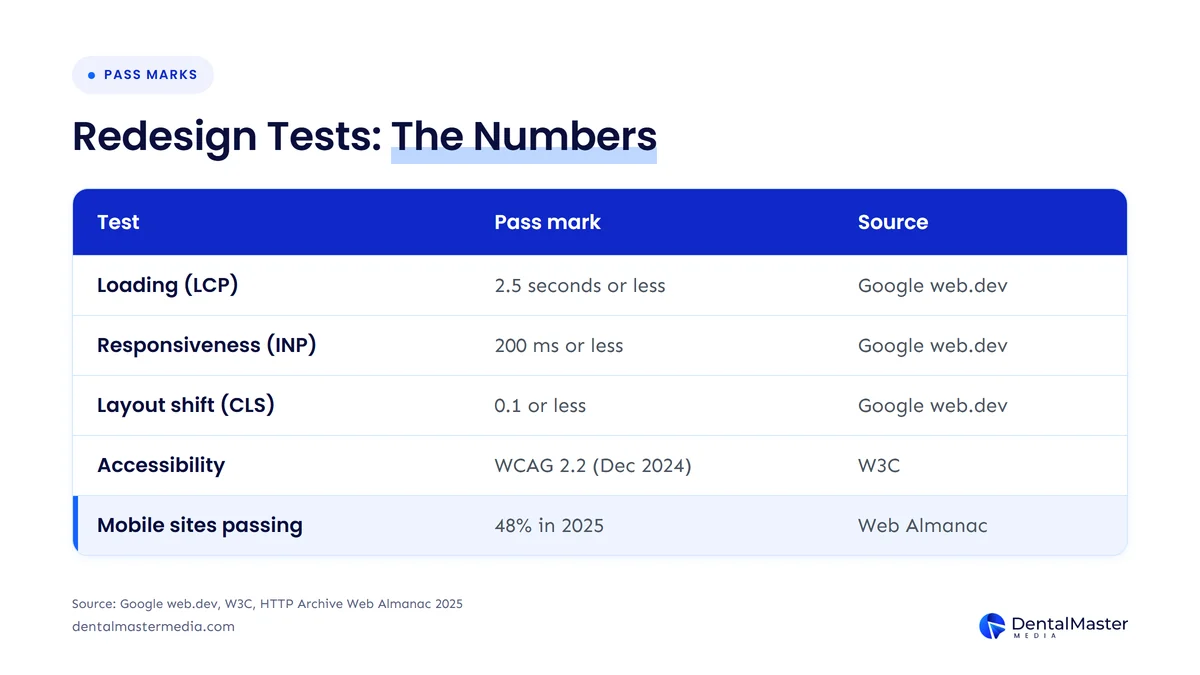
| Test | Pass threshold | Where to check | Source |
|---|---|---|---|
| 1. Speed | Largest Contentful Paint 2.5 seconds or less, Interaction to Next Paint 200 milliseconds or less, Cumulative Layout Shift 0.1 or less | Google Search Console, Core Web Vitals report | Google, web.dev “Web Vitals” |
| 2. Mobile parity | Same primary content and same structured data on the phone site as on the desktop site | A phone, then the desktop site | Google Search Central, mobile-first indexing |
| 3. Booking path | A call or a booking within 3 taps from every page | Your own phone | Dental Master Media rule of thumb |
| 4. Editing | The practice changes text and photos without a developer | Your website login | Dentaltown, March 10, 2026 (platform limits) |
| 5. Accessibility | Meets WCAG 2.2, which the W3C published on December 12, 2024 | An accessibility checker and a keyboard | W3C, WCAG 2.2 |
| 6. Business change | The site shows every current service, the current brand and the current name | A list of what the practice offers today | Dentaltown, March 10, 2026 |
The table shows that the speed test carries 3 exact numbers from Google, the accessibility test carries a W3C date and the booking path test is our own rule.
Does the site pass Core Web Vitals?
Yes, a dental website passes Core Web Vitals when its Largest Contentful Paint is 2.5 seconds or less, its Interaction to Next Paint is 200 milliseconds or less and its Cumulative Layout Shift is 0.1 or less, measured at the 75th percentile of page loads, according to Google’s web.dev. Google Search Console rates a URL group poor above 4 seconds, 500 milliseconds and 0.25.
The HTTP Archive’s Web Almanac 2025 found that 48% of mobile websites had good Core Web Vitals in July 2025, against 56% of desktop websites. A site below those marks is in the larger half of the web that fails. Google’s page experience documentation says Core Web Vitals are used by its ranking systems, but Search still prefers the most relevant content when the page experience is weaker. Speed alone will not rank a thin page, so a slow site with good pages is often a fix, and a slow site on a rigid platform is a redesign signal. The Core Web Vitals speed guide for dental websites covers the repairs.
Does the mobile site match the desktop site?
Yes, a dental website passes this test only when the phone version holds the same content and markup as the desktop version. Google Search Central says to make sure the mobile site contains the same content as the desktop site and the same structured data, because indexing comes from the mobile version under mobile-first indexing.
Open the home page, one treatment page and the contact page on a phone and compare them with the desktop pages. Missing treatment text, missing team details or a phone menu that cannot reach a service page are all failures of this test.
Can a patient call or book within 3 taps?
A patient should reach a call or a booking within 3 taps from every page of a dental website. This 3-tap limit is a rule of thumb that we use at Dental Master Media, not a published Google figure, and it works because a visitor on a phone is usually deciding in a few seconds.
Count the taps from the home page, a treatment page and a blog post to the phone call or the booking form. If the count is above 3 on every page, the booking path is a structural problem of the templates, and a layout redesign fixes it faster than a page-by-page edit.
Can your team edit the site without a developer?
A dental practice team should be able to change text, photos, hours and treatment details without calling a developer. Dentaltown’s article of March 10, 2026 lists an outdated platform or a rigid template that limits modern marketing as a reason to redesign and not only optimize.
Log into the site and try to change a headline and swap a photo. If that takes a developer, or breaks the layout, the platform fails this test. Our comparison of dental website platforms explains the options.
Does the site meet WCAG 2.2?
A dental website meets WCAG 2.2 when it passes the W3C’s Web Content Accessibility Guidelines 2.2, a W3C Recommendation published on December 12, 2024 that added 9 success criteria and removed 1. The U.S. Department of Justice says in its guidance of March 18, 2022 that the ADA applies to the web offerings of businesses open to the public.
The same DOJ guidance says it has no regulation with detailed web standards, and it names WCAG as a reference point. A site that fails basic keyboard use or text contrast on a rigid template is a redesign signal, because the repair touches every page. Read our dental website accessibility guide for the checks.
Did the practice change its services, brand or name?
Yes, a change of services, brand or name is a reason to redesign a dental website, even when the technical tests pass. Dentaltown’s article of March 10, 2026 lists a significant expansion of services and an updated brand identity as cases where a redesign is appropriate.
A new treatment, a second location or a new practice name leaves the old site describing a practice that no longer exists. A change of name or domain is also a site move, which Google treats separately, and the bridge section below covers it.
How do you run the 6 redesign tests in 30 minutes?
You run the 6 redesign tests in 30 minutes by following the 4 steps listed below, in order. Each step needs only Google Search Console, a phone and your website login.
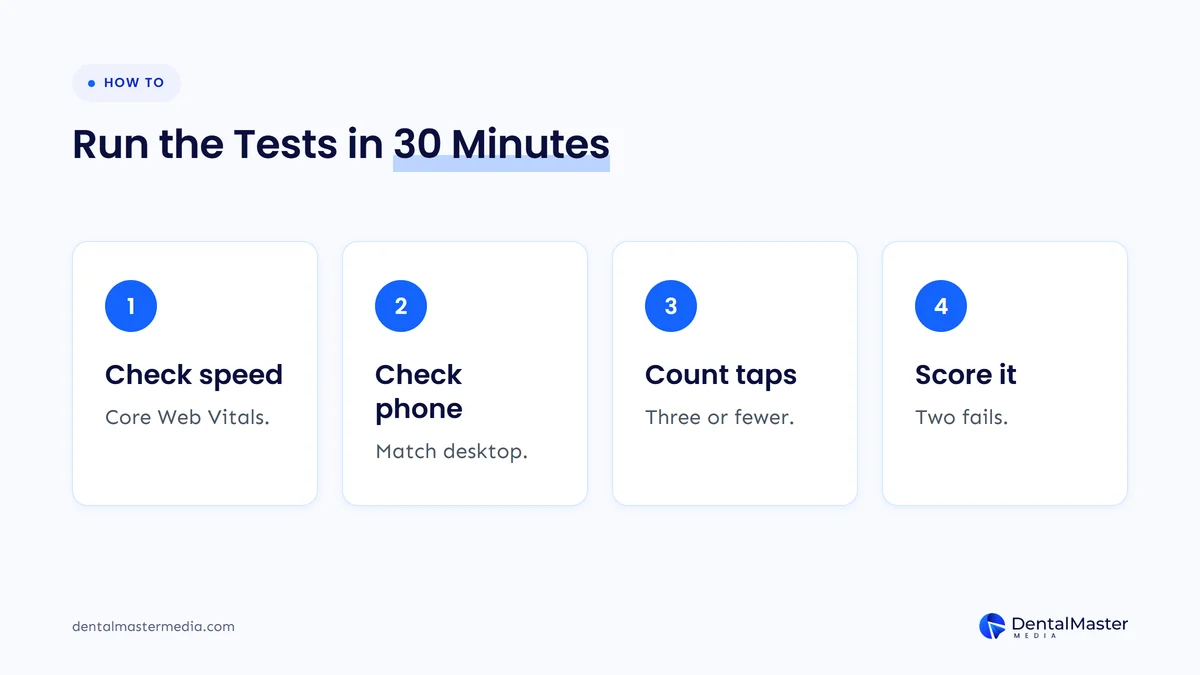
The 4 steps to run the tests are listed below.
- Open the Core Web Vitals report in Google Search Console and write down the status of the mobile and desktop URL groups (test 1).
- Open the home page, a treatment page and the contact page on a phone and compare them with the desktop pages (test 2).
- Count the taps from each page to a call or booking, then try to change a headline in your website login (tests 3 and 4).
- Check keyboard use and text contrast for WCAG 2.2, list any new service or brand change, and score 1 point for each failed test (tests 5 and 6).
A score of 2 or more means planning a redesign, and a score of 0 or 1 means fixing the current site.
Should a dental practice redesign or fix the current website?
A dental practice should fix the current website when it fails 1 test or none, and redesign it when it fails 2 or more tests or has changed its services, brand or name. Dentaltown’s March 10, 2026 article draws the same line: optimization suits a strong foundation with a few weak parts, and a redesign suits structural limits.
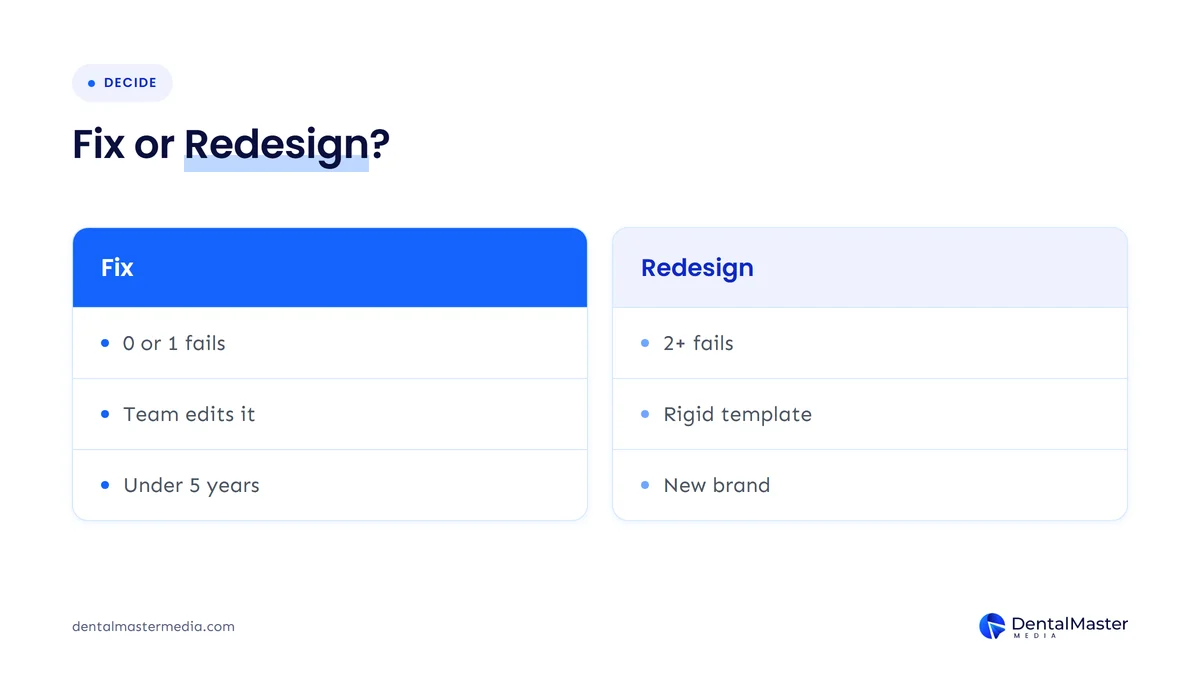
The cases below are listed by the action they call for.
- Fix the site when it fails 1 test or none, such as slow images on an otherwise sound template.
- Fix the site when it was launched in the last 3 to 5 years and the team can edit it.
- Redesign the site when it fails 2 or more tests, such as slow pages on a template that cannot be changed.
- Redesign the site when the practice has added services, rebranded or changed its name.
A good dental website has clear service pages, a fast mobile experience, an easy booking path and accessible design, and that is the checklist to build against once the decision is made.
How long does a dental website redesign take, and what does it cost?
A dental website redesign takes about 30 days to build and costs $999 at Dental Master Media for up to 100 pages, and we then give 30 days of support. The price covers the redesign of an existing site, and the page count covers the treatment, team and location pages that the practice already has.
Other agencies price differently, so ask any provider for the page count, the redirect plan and the support period in writing before you sign. Our questions to ask a dental website designer list the details to check.
How do you redesign a dental website without losing rankings?
You redesign a dental website without losing rankings by mapping every old URL to a new URL, setting 301 redirects, keeping them for at least 1 year and changing one thing at a time. Google Search Central’s site move guide gives all four rules and says a small or medium site takes a few weeks for most pages to move.
The same guide says to expect temporary fluctuation in rankings during a move. Keep the page addresses the same where you can, and redirect every address that changes, because a new design on the old addresses carries the least risk. Our post on what a site move does and does not fix covers the cases and numbers in detail.
Frequently asked questions
How often should a dental practice redesign its website?
A dental practice should redesign its website when it fails 2 or more of the 6 tests, and not on a fixed calendar. Dentaltown’s March 2026 article places the useful life of a well-built site at about 3 to 5 years, while a 2011 Dentalcompare article advised every 2 to 3 years, so use age to schedule a test.
Will a redesign improve my Google rankings?
No, a redesign does not raise rankings by itself. Google’s page experience documentation says Core Web Vitals are used by its ranking systems but that Search prefers the most relevant content even when the page experience is weaker, so better content and a sound site structure do the lifting.
Can I fix the problems without a full redesign?
Yes, you can fix the problems without a full redesign when the site fails 1 test or none and your team can edit it. Faster images, clearer buttons and a shorter path to booking are repairs, and they cost less than a rebuild.
How long does a dental website redesign take?
A dental website redesign takes about 30 days to build at Dental Master Media. Google’s site move guide adds that most pages of a small or medium site take a few weeks to move once the new site is live, so plan for a longer window of monitoring.
Do I need to redesign if my site looks fine?
Yes, a site that looks fine can still need a redesign when it fails the tests that visitors do not see, such as mobile parity, Core Web Vitals or WCAG 2.2.
Our guide to the signs your dental website needs a redesign lists the visible signs that pair with these tests.
Conclusion: when does a dental website need a redesign?
A dental website needs a redesign when it fails 2 or more of the 6 tests, or when the practice has changed its services, brand or name. Age is a reason to run the tests, and the thresholds from Google, the W3C and Dentaltown tell you whether the answer is a fix or a rebuild.
At Dental Master Media, we run the tests, plan the redirects and rebuild the site through our dental website design service, then keep it visible through dental SEO services. A redesign for up to 100 pages costs $999 and takes about 30 days to build.
Find out if your dental website needs a redesign
Book a free strategy call with Dental Master Media. We will run the 6 tests on your current site and tell you whether it needs a fix or a redesign.
Sources
- Google, web.dev, “Web Vitals”, updated October 31, 2024. https://web.dev/articles/vitals
- Google Search Console Help, “Core Web Vitals report”, accessed November 20, 2026. https://support.google.com/webmasters/answer/9205520
- Google Search Central, “Understanding page experience in Google Search results”, accessed November 20, 2026. https://developers.google.com/search/docs/appearance/page-experience
- Google Search Central, “Mobile-first indexing best practices”, accessed November 20, 2026. https://developers.google.com/search/docs/crawling-indexing/mobile/mobile-sites-mobile-first-indexing
- Google Search Central, “Site moves with URL changes”, accessed November 20, 2026. https://developers.google.com/search/docs/crawling-indexing/site-move-with-url-changes
- HTTP Archive, “Web Almanac 2025: Performance”, January 15, 2026. https://almanac.httparchive.org/en/2025/performance
- W3C, “Web Content Accessibility Guidelines (WCAG) 2.2”, December 12, 2024. https://www.w3.org/TR/WCAG22/
- U.S. Department of Justice, ADA.gov, “Guidance on Web Accessibility and the ADA”, March 18, 2022. https://www.ada.gov/resources/web-guidance/
- Dentaltown, “When a Website Redesign Makes Sense Versus When Optimization Is Enough”, March 10, 2026. https://www.dentaltown.com/blog/post/24767/when-a-website-redesign-makes-sense-versus-when-optimization-is-enough
- Dentalcompare, Dr. Larry Emmott, “Dental Website Design: When To Update Your Dental Practice Website”, September 28, 2011. https://www.dentalcompare.com/Featured-Articles/35184-Dental-Website-Design-When-To-Update-Your-Dental-Practice-Website/

Suraj Rana is the owner of Dental Master Media and a leading expert in SEO for dental practices. With a passion for dental marketing, he has successfully helped numerous dental clinics climb the search engine ranks. Suraj’s expertise makes him a go-to resource for effective, results-driven dental marketing.