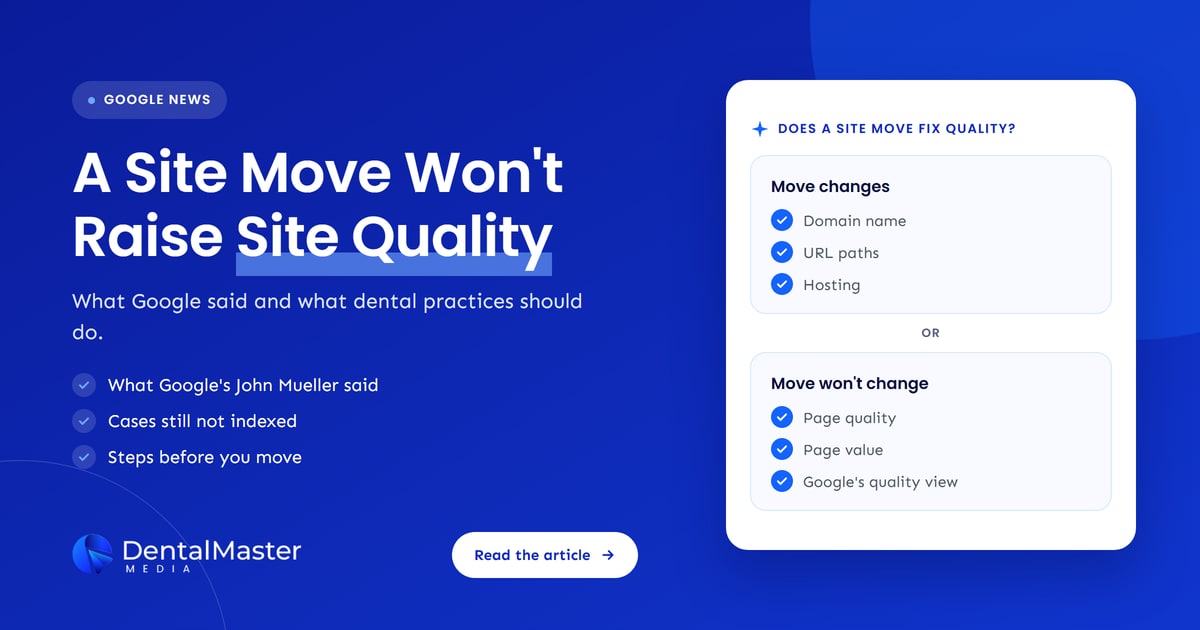
Quick answer: A site move does not improve a dental website’s overall quality, according to Google’s John Mueller, as reported by Search Engine Roundtable on November 17, 2026. A redesign or domain change can fix your brand name, URLs or hosting, but it won’t make Google’s quality systems trust weak pages. Fix quality first, then move for a business reason.
Key takeaways
- Google’s John Mueller said a site move does not improve a site’s overall quality, in a Bluesky post covered by Search Engine Roundtable on November 17, 2026.
- A site move is a change of domain, URL structure or hosting. Google’s site move guide says most pages of a small to medium site take a few weeks to move and rankings fluctuate for a time.
- Two recent cases show the risk: a site with a domain change 10 months earlier was still not indexed properly, and a Reddit poster reported 5,000+ pages as “Crawled, currently not indexed” 4 months after a move.
- A dental practice is affected if it plans a rebrand, a new domain, a platform switch with new URLs or a full redesign.
- A move is worth it for a business reason such as a new practice name. It is not a fix for thin pages or for a site that Google’s quality systems have not been convinced by.
- Before a move, map every old URL to a new URL, set up 301 redirects and keep them for at least 1 year. Afterward, work on what raises quality: original pages and accurate practice details.
What did Google say about a site move and overall quality?
Google’s John Mueller said a site move does not improve a site’s overall quality. Search Engine Roundtable’s Barry Schwartz reported the statement on November 17, 2026, from a Bluesky post by Mueller, and the post came in a thread about a site that moved its domain 10 months earlier and is still not indexed properly.
In that thread, Mueller said the cause is more likely that Google’s quality systems are not convinced by the site than the move itself. He also told the site owner to think about the overall value the site adds to the web. We have paraphrased his words because the post itself is on Bluesky and we are relying on Search Engine Roundtable’s report of it.
The statement repeats an older message. At Google Search Central Live Dubai in October 2025, a slide said links and site moves do not solve quality issues, as Search Engine Roundtable reported on October 23, 2025. Barry Schwartz also noted that Mueller has answered at least 2 such cases in the past month.
What is a site move?
A site move is a change to where a website lives, such as a new domain name, new URLs for existing pages or a new host. Google Search Central splits site moves into 2 groups: moves with URL changes, such as a domain change, and moves without URL changes, such as a switch of hosting provider or content delivery network.
For a dental practice, a site move happens when the practice rebrands to a new name and domain, when a redesign changes page addresses, or when the practice leaves one website platform for another. Planning and monitoring a move is part of our dental SEO services, because the redirect work decides how much search visibility carries over.
What do Google’s site move rules and recent cases show in numbers?
Google’s site move rules and recent cases show 4 rules and 2 warnings in numbers: redirects stay for at least 1 year, a move takes a few weeks, and two reported cases lasted 4 and 10 months. The table below lists each figure with its source.
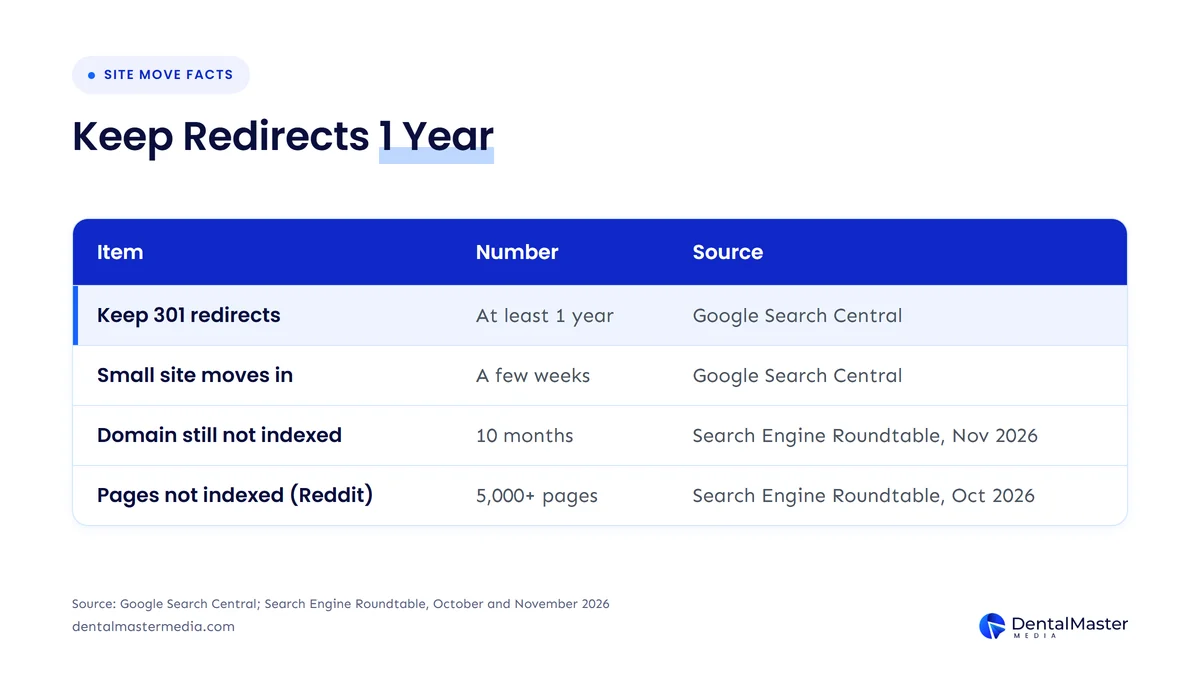
| Item | Number | Source (date) |
|---|---|---|
| How long to keep 301 redirects | Generally at least 1 year | Google Search Central, “Site moves with URL changes” |
| Time for most pages of a small to medium site to move | A few weeks | Google Search Central, “Site moves with URL changes” |
| Redirect hops Googlebot follows | Up to 10; keep chains under 5 | Google Search Central, “Site moves with URL changes” |
| DNS TTL change before a hosting move | At least 1 week ahead | Google Search Central, “Site moves without URL changes” |
| Domain moved, still not indexed properly | 10 months | Search Engine Roundtable (November 17, 2026) |
| Pages dropped as “Crawled, currently not indexed” (Reddit report) | 5,000+ pages, 4 months after the move | Search Engine Roundtable (October 13, 2026) |
The table shows that Google treats a site move as a process of weeks with redirects kept for a year, while the two reported cases ran for months.
Why can a moved dental website stay unindexed for months?
A moved dental website can stay unindexed for months when Google’s quality systems are not convinced the new pages deserve a place in the index, and the move itself is not the cause. Mueller gave that explanation for the domain that was still not indexed properly 10 months after its move.
The second case is a Reddit post that Search Engine Roundtable covered on October 13, 2026, and Barry Schwartz said he could not verify it beyond that thread. The owner reported changing the site’s name and domain at the start of 2026, setting up redirects and using the Change of Address tool in Google Search Console. By April the new domain had about 5,000 impressions per day. Four months later Google dropped 5,000+ pages as “Crawled, currently not indexed”, and impressions fell to about 20 per week while the old domain started showing again.
Mueller replied that some things take a particularly long time to be fully processed and advised setting up the Change of Address tool for both the www and non-www versions. A dental site that sees the same status can compare it with our guide to Google only indexing your dental website’s homepage.
Which dental practices does this site move news affect?
This site move news affects any dental practice that plans to change its domain, its URLs or its website platform in the next 12 months. The 5 situations a practice owner should recognize are listed below.
- Practice rebrand: a new practice name that comes with a new domain name.
- Domain change: a move from an old domain to a shorter or more local domain, for example from a .net to a .com.
- Redesign with new URLs: a dental website redesign that changes page addresses, such as /services/implants to /dental-implants/.
- Platform switch: a dental website moved from one builder or CMS to another, which often changes URL patterns.
- Practice merger: two dental practice websites combined into 1 domain.
A hosting or content delivery network switch that keeps every URL the same is also a site move, but Google treats it as a move without URL changes and the risk is smaller. A staggered move is the riskiest: in December 2025 Mueller said, as Search Engine Journal’s Roger Montti reported, that moving only the homepage would leave a messy situation until everything is moved.
Is a redesign or domain change worth it for a dental practice?
Yes, a redesign or domain change is worth it for a dental practice when there is a business reason, such as a new practice name or a website that cannot show your services clearly. No, a site move is not worth it when the goal is to fix rankings caused by weak pages, because Mueller said a site move does not improve overall quality.
Will a dental website redesign with the same URLs hurt rankings?
No, a redesign that keeps every URL does not need redirects, and Google’s guide for moves without URL changes says Googlebot’s crawl rate may dip briefly after launch and then rise again. Mueller’s statement was about site moves, so a redesign alone, like a move, should not be expected to raise overall quality either.
What should a dental practice do before a site move?
A dental practice should do 6 things before a site move: audit page quality, map URLs, test the new site, set up 301 redirects, tell Google Search Console and watch both sites. Google Search Central lists the same flow for moves with URL changes: prepare the new site, create a URL mapping, start the redirects and monitor traffic.
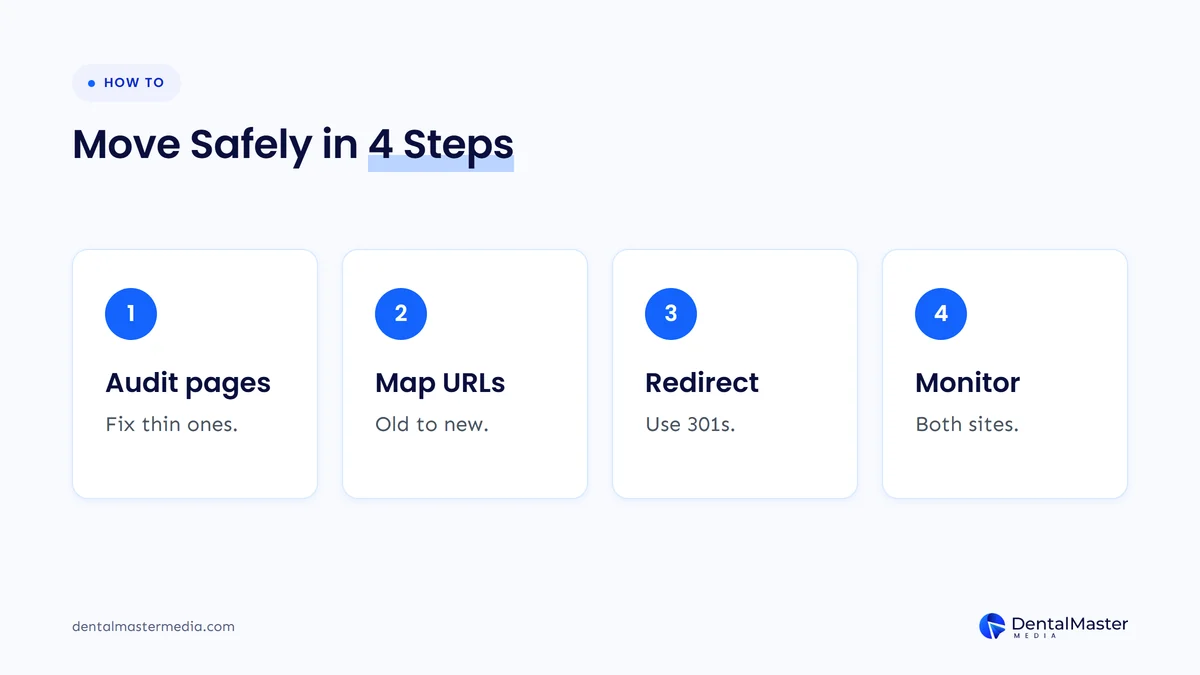
The 6 steps a dental practice should follow are listed below.
- Audit the quality of every page first. Thin, duplicate or outdated pages move with the site, so use our dental SEO audit checklist to find them before launch.
- Create a URL mapping. List every old URL next to its new URL, and send each old page to the closest matching new page, not to the new homepage.
- Test the new site on a noindex address. Check pages, images, forms and PDFs, and make sure Googlebot is not blocked by a firewall.
- Set up server-side 301 redirects. Send old URLs straight to the final URL, avoid redirect chains and keep the redirects for at least 1 year.
- Use the Change of Address tool for a domain change. Google says to use it only when moving between domains or subdomains, and to submit every verified version of the old domain, including www and non-www.
- Monitor both sites in Google Search Console. Watch impressions, indexing status and crawl errors on the old and new properties for the weeks after launch.
What should you check after a site move launches?
After a site move launches, check that every old URL returns a 301 redirect to the right new page, that the new sitemap is submitted and that calls and form bookings still work.
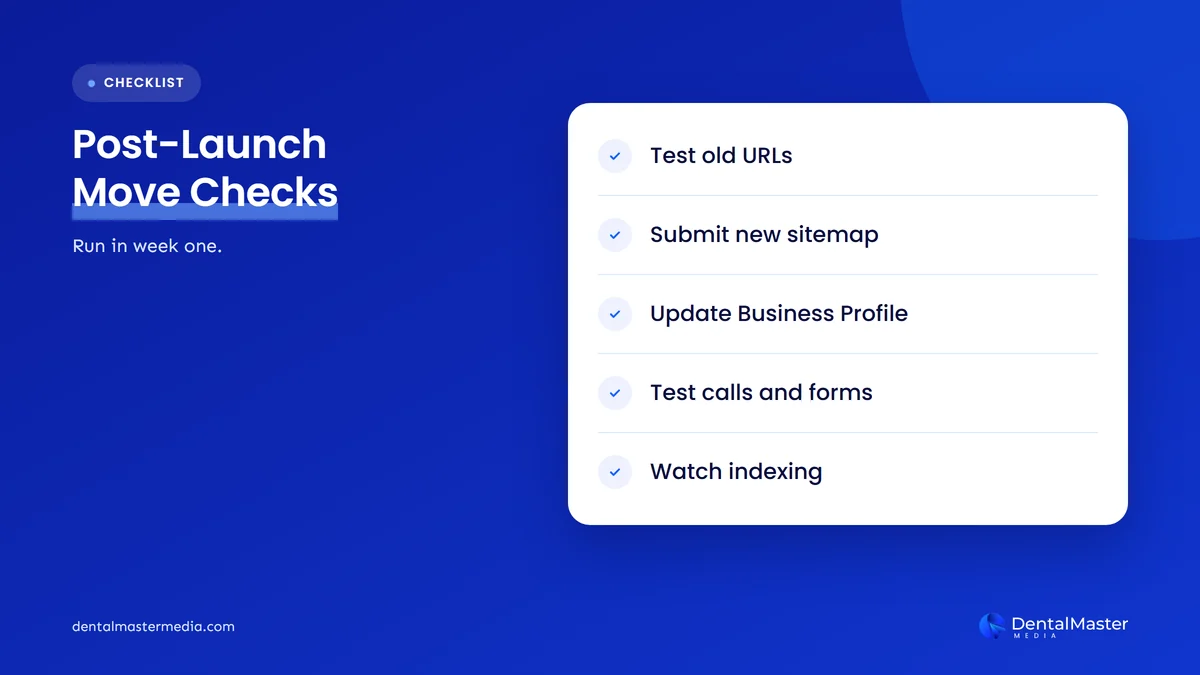
The 6 checks to run in the first week are listed below.
- Test 20 old URLs, including your top service pages, and confirm each one returns a 301 redirect to its matching new page.
- Submit the new sitemap in Google Search Console and check the indexing report each week.
- Update the website link in your Google Business Profile so it points to the new address.
- Check that phone numbers, forms and booking links on the new dental website still work.
- Review the “Crawled, currently not indexed” count in Google Search Console and compare it with the old site.
- Keep the old domain registered for at least 1 year, so redirects keep working.
What raises a dental website’s overall quality instead of a site move?
A dental website’s overall quality rises when each page adds value that other dental sites do not, which is how Mueller framed it: think about the overall value your site adds to the web. A site move changes the address of your pages, not their value to patients.
The 4 quality areas a practice can work on without a move are listed below.
- Original treatment pages: one page per treatment, written for your dentists and your patients in your area.
- Accurate practice details: the same name, address, phone number and hours on your website and your Google Business Profile.
- Removed or merged thin pages: pages that repeat the same text should be combined into 1 stronger page.
- Visible dentist information: bio pages that show real credentials and real locations.
Our post on the November 2026 core update for dental practices shows what to check on a dental website while Google’s latest quality update rolls out.
Frequently asked questions
Does changing my dental practice’s domain name hurt SEO?
It can, and it will not help your site quality either. Google’s site move guide expects temporary ranking fluctuation during a move and says most pages of a small to medium site take a few weeks to move. Good redirects reduce the risk, but a domain change should be done for a business reason.
How long should I keep 301 redirects after a site move?
Keep 301 redirects for at least 1 year. Google Search Central says to keep redirects generally at least 1 year, and users may benefit if you keep them longer. Update your own links and your biggest external links to the new URLs in that time.
Do I need the Change of Address tool for a redesign?
No, a redesign on the same domain does not need the Change of Address tool. Google says to use the tool only when you move between domains or subdomains, and not for HTTP to HTTPS, www to non-www or path changes. Use 301 redirects for changed URLs instead.
Will a new domain reset my dental practice’s rankings?
Not necessarily, but a new domain does not clear a quality problem either. Mueller said a site move does not improve overall quality, and the 2 cases covered above show that a moved site can stay unindexed for 4 to 10 months when Google’s quality systems are not convinced.
Is a hosting change the same as a site move?
Yes, a hosting change is a site move without URL changes. Google’s guide for these moves says to test the new host on a noindex address, lower the DNS TTL at least 1 week ahead and keep the old host running until its traffic reaches zero.
Conclusion
Google’s John Mueller said a site move does not improve overall quality, so a dental practice should treat a redesign or domain change as a business decision and treat quality as separate work.
Dental Master Media plans moves with a URL mapping, 301 redirects and monitoring, and our dental SEO services include the page-quality work that a move cannot do. If you are changing agencies as well, read how to switch dental SEO agencies without losing rankings.
Planning a redesign or a new domain?
Before you move, find out which pages on your dental website are strong, which are thin and which URLs need redirects. Our free dental SEO audit shows what to fix first, so the move carries your best pages across.
Sources
- Search Engine Roundtable (Barry Schwartz), “Google: A Site Move Doesn’t Improve A Site’s Overall Quality”, November 17, 2026, reporting John Mueller’s Bluesky post. https://www.seroundtable.com/google-site-move-quality-42545.html
- Bluesky, John Mueller (johnmu.com), post linked by Search Engine Roundtable, November 2026. https://bsky.app/profile/johnmu.com/post/3n2gs5wr3cc25
- Google Search Central, “Site moves with URL changes”, accessed November 19, 2026. https://developers.google.com/search/docs/crawling-indexing/site-move-with-url-changes
- Google Search Central, “Site moves without URL changes”, accessed November 19, 2026. https://developers.google.com/search/docs/crawling-indexing/site-move-no-url-changes
- Search Engine Roundtable (Barry Schwartz), “Google: Links, Site Moves & Technical SEO Don’t Fix Quality Issues”, October 23, 2025. https://www.seroundtable.com/google-links-site-moves-technical-seo-quality-40309.html
- Search Engine Roundtable (Barry Schwartz), report on a Reddit thread about a site move that ran 4 months, October 13, 2026. https://www.seroundtable.com/google-search-old-domain-42279.html
- Search Engine Journal (Roger Montti), report on Google’s John Mueller and staggered site migrations, December 15, 2025. https://www.searchenginejournal.com/google-staggered-site-migrations/563346/

Suraj Rana is the owner of Dental Master Media and a leading expert in SEO for dental practices. With a passion for dental marketing, he has successfully helped numerous dental clinics climb the search engine ranks. Suraj’s expertise makes him a go-to resource for effective, results-driven dental marketing.