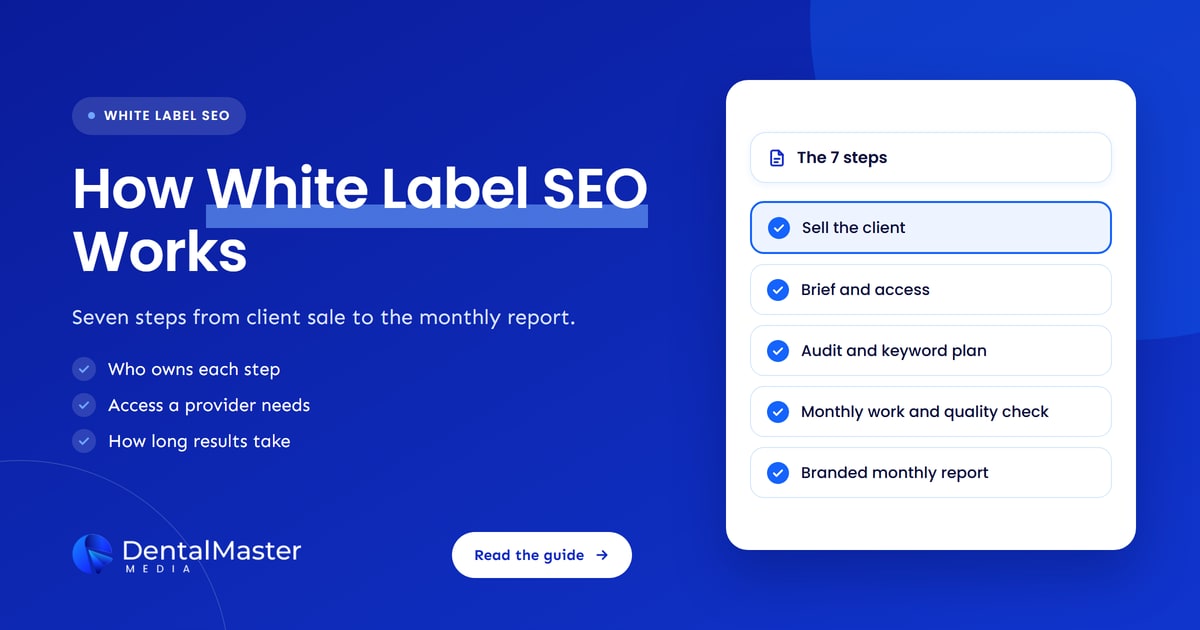
Quick answer: White label SEO works in 7 steps: the agency sells the client and sets the price, briefs the provider, opens client access, the provider audits and builds a keyword plan, delivers the work each month, runs a quality check, and the agency sends a branded monthly report. The agency keeps the client relationship, and the provider stays unseen.
Key takeaways
- White label SEO is SEO work done by a provider and sold under the agency’s brand, so the agency owns the client relationship and the provider does the delivery.
- The workflow has 7 steps: client sale, brief, access, audit and keyword plan, monthly execution, quality check and monthly report.
- Published guides count the steps differently: Stackmatix lists 4, Search Atlas 5 and Brand White Label Solutions 6, but all of them run from the sale to a branded report.
- The agency sells, sets the price and talks to the client. The provider audits, executes and builds the report. Both sides check quality before anything reaches the client.
- The provider needs access to the client’s website, Google Business Profile, Search Console and Google Analytics 4, and the client should keep ownership of those accounts.
- Dental Master Media’s own white label page states a 6-step process, a minimum of 2 active dental clients and keyword movement within 60 to 90 days for most practices.
What is white label SEO?
White label SEO is search engine optimization work that a provider carries out and an agency or freelancer sells to its own client under the agency’s brand. The agency signs the client, sets the price and sends the reports. The white label SEO provider does the audit, the technical SEO, the content, the Google Business Profile work and the link building behind the scenes.
The model suits agencies that sell websites, ads or marketing and want SEO on the menu without hiring a team. It also suits freelancers who can sell but not deliver at volume. In dental marketing, the same workflow is how our dental SEO services reach practices through agencies: the agency owns the client, and our team works from a defined list of steps. The sections below follow that workflow in order, from the first sales call to the report the client reads each month.
What are the 7 steps of white label SEO from client sale to monthly report?
The 7 steps of white label SEO are client sale, brief, access, audit and keyword plan, monthly execution, quality check and monthly report, and each step has one owner and one outcome. The agency owns steps 1 and 7, the provider owns steps 4 and 5, and steps 2, 3 and 6 are shared.
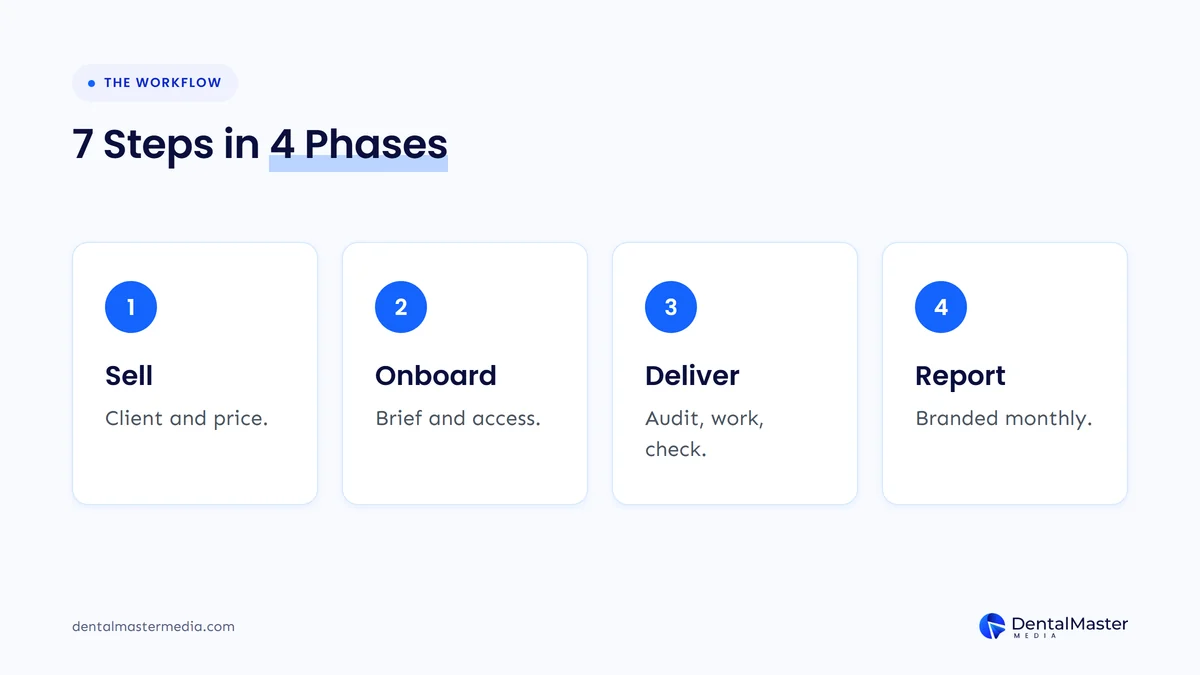
The 7 steps of the white label SEO workflow are listed below, each with its single outcome.
- Sell the client: the agency signs a client contract and sets the retail price for the white label SEO service.
- Brief the provider: the agency sends the client’s website, market, goals and SEO history to the white label SEO partner.
- Open client access: the client gives the provider access to the website, Google Business Profile, Search Console and Google Analytics 4.
- Audit and build the keyword plan: the provider audits the site and delivers an unbranded audit and keyword plan for the agency to present.
- Deliver the monthly work: the provider carries out technical SEO, content, local SEO and link building each month.
- Run the quality check: the agency and provider check the work and the numbers before the client sees them.
- Send the monthly report: the agency sends a branded report with results, completed work and next month’s priorities.
Published provider guides split the same workflow into a different number of steps, because each one groups the steps its own way. The table below lists how 3 provider guides and Dental Master Media’s white label page count the steps.
| Source (publisher, date) | Steps counted | First step | Last step |
|---|---|---|---|
| Stackmatix, September 3, 2026 | 4 | Sign a wholesale agreement and set the resale price | The agency forwards reports and manages the client conversation |
| Search Atlas, updated October 19, 2026 | 5 | Sign a client and set the price | Deliver branded reports and portal access |
| Brand White Label Solutions, updated September 22, 2026 | 6 | Discovery | Reporting and review |
| Dental Master Media, white label page, November 24, 2026 | 6 | Partner call and NDA | Monthly partner call |
The table shows that every guide starts with an agreement and ends with a report, so the 7 steps here split the middle of the workflow a little finer, not differently.
1. Sell the client and set the price
Sell the client first, because in white label SEO the agency signs the client contract and the provider never does. The client pays the agency’s retail price, and the agency pays the provider a wholesale fee per client. Set the retail price before the sales call, so the margin is known.
The agency should also agree the scope in writing: which services the retainer includes, how often reports arrive and what the client can expect in the first 90 days. Our post on white label SEO pricing and agency markup covers how to set the number.
2. Brief the white label SEO provider
Brief the provider with the facts it needs to start, so the first audit is not delayed by missing information. A good brief fits on one page and is sent once, with the checklist below as the minimum.
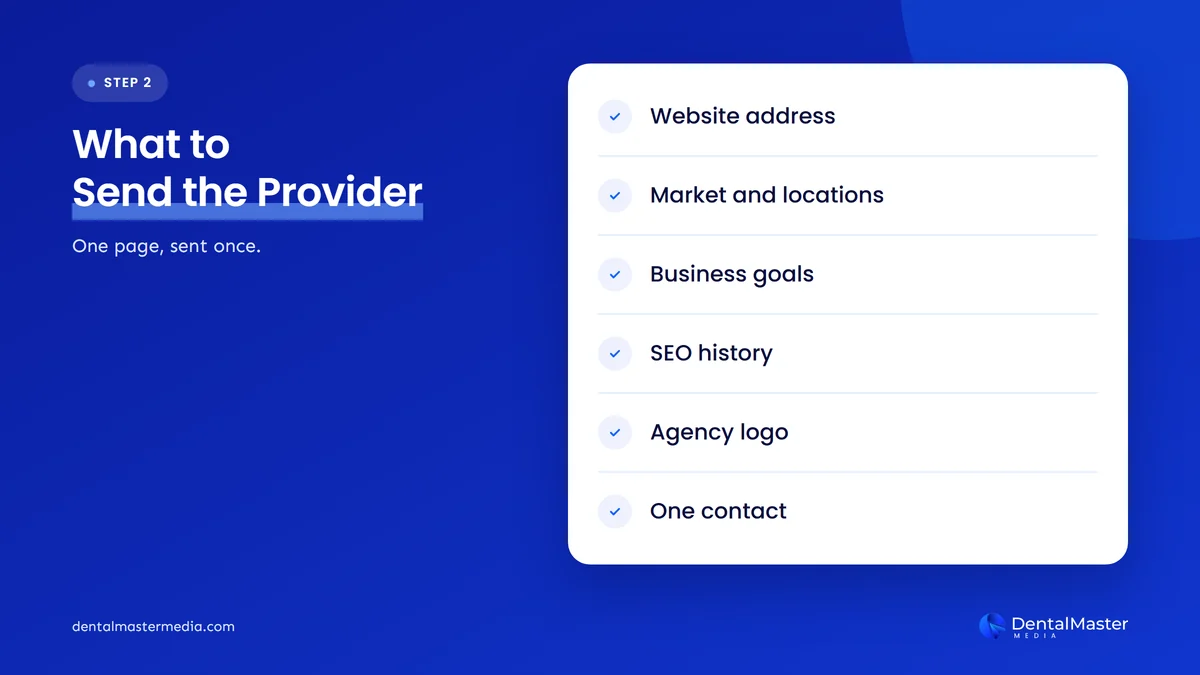
The minimum white label SEO brief contains the client’s website address, the target market and locations, the business goals, the SEO history and any past agency work, plus the agency’s logo and one named point of contact. Brand White Label Solutions opens its workflow with a Discovery step for the same reason: the provider cannot audit what it has not been told.
3. Open client access to the accounts
Open client access by asking the client to add the provider’s email addresses to the website, Google Business Profile, Search Console and Google Analytics 4. The client should stay the owner of each account, and the provider should hold the lowest role that lets it do the work. A later section explains which roles to request.
Access is also where an NDA belongs. Sign it before any client data moves, and confirm in writing that the provider will not contact the client unless the agency asks.
4. Audit the site and build the keyword plan
Audit the site and build the keyword plan before any monthly work starts, because the audit sets the order of everything that follows. The provider checks technical SEO, on-page content, local listings and the current keyword positions, then ranks the fixes and the keywords to target.
The audit and keyword plan should arrive unbranded, so the agency can put its own logo on them and present them as its own work. That one deliverable is usually the agency’s first proof of value to the client.
5. Deliver the monthly work
Deliver the monthly work as a repeating cycle of technical SEO fixes, content, Google Business Profile management and link building, ordered by the keyword plan. The provider reports each completed task to the agency, and the agency decides what the client hears.
A fixed monthly cycle is what makes the service scalable: the provider repeats the same cycle for each client, and the agency adds clients without adding staff.
6. Run the quality check before the client sees anything
Run a quality check before the client sees any page, post or number, because the agency answers to the client for work the provider did. The quality check is an industry practice, and Search Atlas names “quality checks” and “who does and who approves the work” as 2 of its 7 criteria for choosing a provider.
The quality check should cover 4 points: the content is accurate and matches the client’s real services, the technical changes were tested, the report numbers match the source accounts, and nothing names the provider.
7. Send the branded monthly report
Send the branded monthly report as the agency, with the agency’s logo, so the client sees one team. The report should show rankings, traffic and leads, list the work completed and set out the priorities for next month.
A Looker Studio dashboard or a PDF both work, and the agency should add its own commentary before sending. Our guide to white label SEO reports and what you can brand covers the format, sharing options and data access in full.
Who does what in white label SEO, the agency or the provider?
In white label SEO the agency owns the client relationship, the price and the report, and the provider owns the audit, the keyword plan and the monthly delivery. The table below lists who leads each of the 7 steps and what the other side does.
| Step | Agency | White label SEO provider |
|---|---|---|
| 1. Client sale | Leads: signs the client, sets the price | Gives wholesale terms |
| 2. Brief | Sends the brief | Confirms scope |
| 3. Access | Asks the client to share access | Uses the access it is given |
| 4. Audit and keyword plan | Presents it as its own | Leads: builds it, unbranded |
| 5. Monthly execution | Reviews progress | Leads: carries out the work |
| 6. Quality check | Checks before sending | Checks before handing over |
| 7. Monthly report | Leads: sends it under its brand | Builds the data and draft |
The pattern is that the agency leads where the client is in the room, and the provider leads where the work happens. Our full explainer on white label SEO for agencies covers the model, the margins and the risks around this split.
Which client access does a white label SEO provider need?
A white label SEO provider needs access to the client’s website, Google Business Profile, Search Console and Google Analytics 4, and the client should stay the owner of each account. Google’s help pages set the roles and limits, which the table below lists.
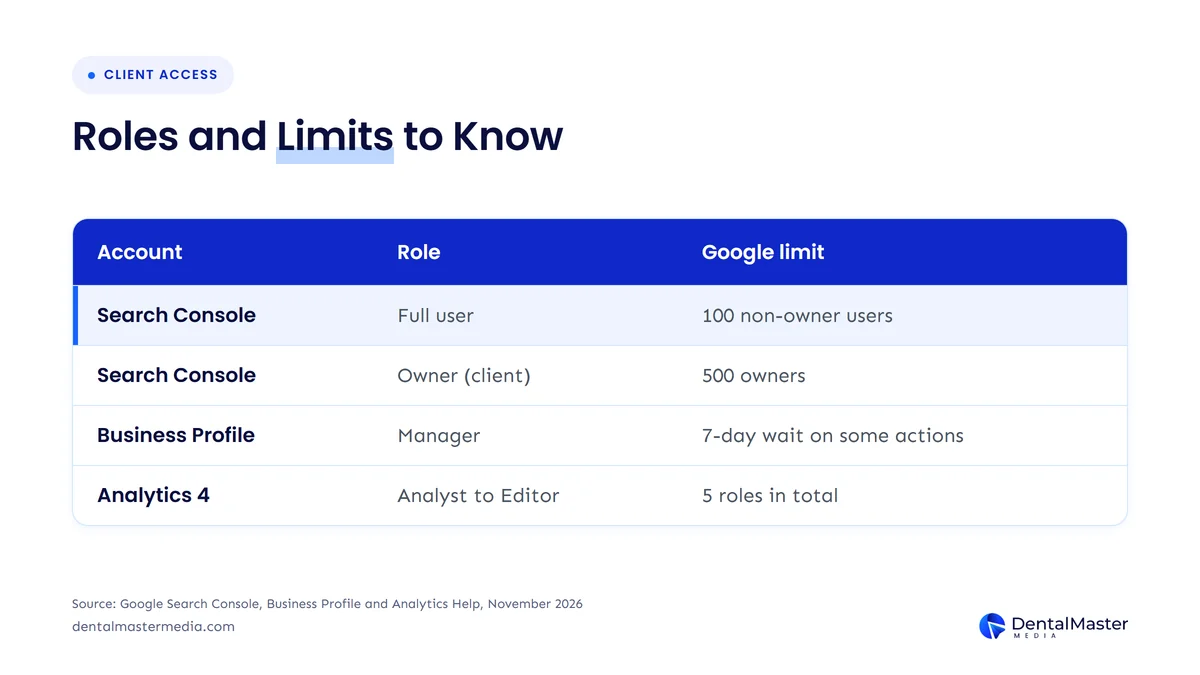
| Account | Role to request | What the role allows | Limit from Google |
|---|---|---|---|
| Google Search Console | Full user | Views all data and takes actions such as submitting sitemaps, but cannot manage users | Up to 100 non-owner users per property |
| Google Search Console | Owner (kept by the client) | Adds and removes users and changes settings | Up to 500 verified and delegated owners |
| Google Business Profile | Manager | Mostly the same access as an owner, but cannot add or remove users | New owners and managers wait 7 days for certain actions |
| Google Analytics 4 | Analyst to Editor, set by an Administrator | Five roles run from Viewer to Administrator, and only an Administrator can assign roles | 5 roles in total |
The table shows that Google lets a client give a provider working access while keeping the owner role, so the client keeps control of its own data. Google Search Console Help, Google Business Profile Help and Google Analytics Help describe these roles, and the sources are listed at the end of this page.
How long does white label SEO take to show results?
White label SEO takes 60 to 90 days to show keyword movement for most dental practices and 4 to 6 months for competitive treatments, according to Dental Master Media’s white label page. No provider can promise a specific ranking: Google’s guide “Do you need an SEO?” says no one can promise a first-place ranking.
The 3 time points an agency can give a client are listed below.
- Day 1: the partner call and NDA are signed, and the client access and brief follow.
- 60 to 90 days: keyword movement shows for most practices, according to the same page.
- Months 4 to 6: competitive treatments often show bigger gains.
Google’s guide also advises anyone hiring an SEO to ask what results to expect and in what timeframe. An agency should ask its white label SEO provider that same question and put the answer in the client contract.
How does Dental Master Media run white label SEO for dental clients?
Dental Master Media runs white label SEO for dental clients in 6 steps, according to its own white label dental SEO page: a partner call and NDA on day one, client onboarding, a full audit and keyword plan, monthly execution, a monthly branded report and a monthly partner call. We state only what that page states.
The facts from that page, as of November 24, 2026, are listed below.
- Eligibility: a minimum of 2 active dental clients, access to each client’s website, Google Business Profile, Search Console and Google Analytics 4, and one agency point of contact.
- Scope: 8 services, covering audit and strategy, technical SEO, on-page and treatment pages, local SEO and Google Business Profile management, compliant content, link building, AI search visibility work and monthly white label reporting.
- Branding: reports carry the agency’s logo, and the audit and keyword plan are delivered unbranded for the agency to present.
- Markets: clients in the USA, UK, Australia, Canada, New Zealand and Singapore.
- Support: a dedicated account manager, Slack or email access, a monthly call for agency owners, and a reply to applications within 1 business day.
- Pricing: wholesale per client, shared on the partner call.
The monthly report on that page covers rankings, organic traffic, Google Business Profile views, calls, direction requests, booking and website clicks, form enquiries and grid rankings for key treatments. Dental clients are one niche where the same 7-step workflow applies, and the workflow itself works for any niche an agency serves.
How do you choose a white label SEO partner for this workflow?
Choose a white label SEO partner by checking that it can run each of the 7 steps, from the brief to the monthly report, and by asking for a sample report with your logo before you sign. A partner that cannot explain steps 3, 6 and 7 plainly is the most likely to cause trouble later.
The 5 questions to ask for this workflow are listed below.
- What happens in the first 30 days? Ask for the order of the brief, access, audit and keyword plan.
- Who does the work? Ask whether the provider uses employees or subcontractors.
- Which accounts do you need? Ask for the role in each account, and refuse owner access if a lower role works.
- How is quality checked? Ask who reviews content, technical changes and report numbers.
- Will you contact my client? Ask for a written no, unless the agency asks.
We wrote out 25 such questions in how to choose a white label SEO provider, grouped into proof, methods, delivery, reporting and contract questions.
Frequently asked questions
How does white label SEO work for an agency?
White label SEO works for an agency by splitting the job in two: the agency sells the client and sends the reports, and the provider does the audit and the monthly work unseen. The agency signs the client contract and sets the price, then pays the provider a wholesale fee per client.
Do clients know a white label SEO partner does the work?
No, clients do not need to know, because white label work is delivered under the agency’s brand. The agency stays the client’s only contact, and the provider’s audit, keyword plan and report carry the agency’s name. Dental Master Media’s white label page says clients are never contacted directly unless the agency asks.
Who should own the Google accounts in white label SEO?
The client should own the Google accounts, and the provider should hold the lowest role that lets it work. Google lets an owner add users as full users in Search Console and managers in Google Business Profile, so a provider can work without owning the account.
How long does white label SEO onboarding take?
White label SEO onboarding has no fixed length across the industry, and the time depends on how fast the client gives access. Dental Master Media’s white label page does not state an onboarding time, but it says applications get a reply within 1 business day and the NDA is signed on day one.
Can a freelancer use the same white label SEO workflow?
Yes, a freelancer can use the same 7 steps, with the freelancer as the single agency contact. The main difference is volume: a freelancer with 2 clients can run the quality check personally, but one with 20 clients needs a repeatable checklist.
White label SEO works when each step has an owner
White label SEO works when every one of the 7 steps has a named owner and a single outcome, from the client sale to the monthly report. The agency keeps the client relationship, the provider carries out the monthly work, and both run a quality check before anything reaches the client.
If you resell SEO and want a partner for dental clients, read about our white label dental SEO services or our wider dental SEO services, and meet the team at Dental Master Media. To go through the workflow for your own agency, you can book a free dental SEO strategy call.
Talk through the 7 steps for your agency
If you sell SEO and want to add dental clients without hiring a team, book a free strategy call. We will walk through the white label workflow, what access we need, what the monthly report covers and how wholesale pricing works for your agency.
Sources
- Dental Master Media, “White Label Dental SEO Services”, accessed November 24, 2026. https://dentalmastermedia.com/white-label-dental-seo-services/
- Brand White Label Solutions, “How White Label SEO Works in 2026: Agency Guide”, updated September 22, 2026. https://www.brandwhitelabel.com/blog/how-white-label-seo-works/
- Search Atlas, “What Is White Label SEO? A Guide for Agencies”, updated October 19, 2026. https://searchatlas.com/blog/what-is-white-label-seo/
- Stackmatix, “White Label SEO: How Agencies Resell Search Services (2026)”, published September 3, 2026. https://www.stackmatix.com/blog/white-label-seo
- Google Search Console Help, “Add, remove, or change owners, users, and permissions”, accessed November 24, 2026. https://support.google.com/webmasters/answer/7687615
- Google Business Profile Help, “Manage Business Profile users”, accessed November 24, 2026. https://support.google.com/business/answer/3403100
- Google Analytics Help, “Access and data-restriction management”, accessed November 24, 2026. https://support.google.com/analytics/answer/9305587
- Google Search Central, “Do you need an SEO?”, accessed November 24, 2026. https://developers.google.com/search/docs/fundamentals/do-i-need-seo

Suraj Rana is the owner of Dental Master Media and a leading expert in SEO for dental practices. With a passion for dental marketing, he has successfully helped numerous dental clinics climb the search engine ranks. Suraj’s expertise makes him a go-to resource for effective, results-driven dental marketing.