Quick answer: Patients ask AI assistants 8 kinds of questions before choosing a dentist, from who treats their problem to who takes their insurance and how to book. A dental website answers each one in plain text on the page that owns that topic, with the same facts as the Google Business Profile.
Key takeaways
- 47% of 992 US adults surveyed by rater8 in April 2026 had used AI to research or find a healthcare provider, up from 31% in 2025, so patients ask AI before they call.
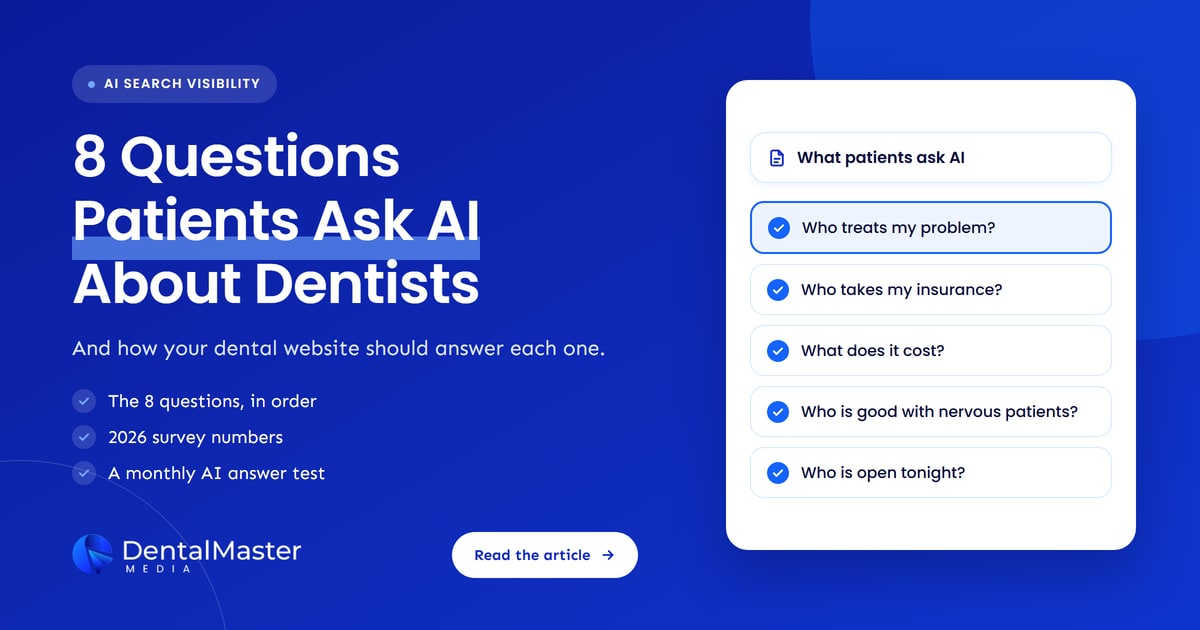
- The 8 questions are: which dentist treats my problem, accepts my insurance, what it costs, who is good with nervous patients, who is open, what patients say, who the dentist is and how to book.
- Each question has one page that should answer it: a treatment page, an insurance page, a first-visit page, a dentist bio page, and the hours and contact page.
- Put the answer in the first sentence under a question heading, in plain text, and keep every fact identical to the Google Business Profile.
- 66% of the 465 AI users in the rater8 survey had seen incorrect provider information from an AI tool, so test what AI says about your practice every month.
What do patients ask AI assistants before choosing a dentist?
Patients ask AI assistants to match a treatment, a place and a personal condition in a single question, such as a dentist near them who treats a specific problem, takes their insurance and is good with nervous patients. Dental marketing guides from Vydhai Dental (August 2026) and CSP Marketing Solutions (February 2026) list prompts of this shape, and no public survey yet measures how often each question is asked.
What surveys do measure is how many patients use AI at all. rater8’s 2026 Patient Choice Report found that 47% of 992 US adult patients had used AI to research or find a healthcare provider, up from 31% in 2025. Use was highest among adults aged 45 to 60 (64%) and lowest among adults over 60 (10%). The survey covers healthcare providers in general, not dentists alone, and the table below sets it beside 2 other studies.
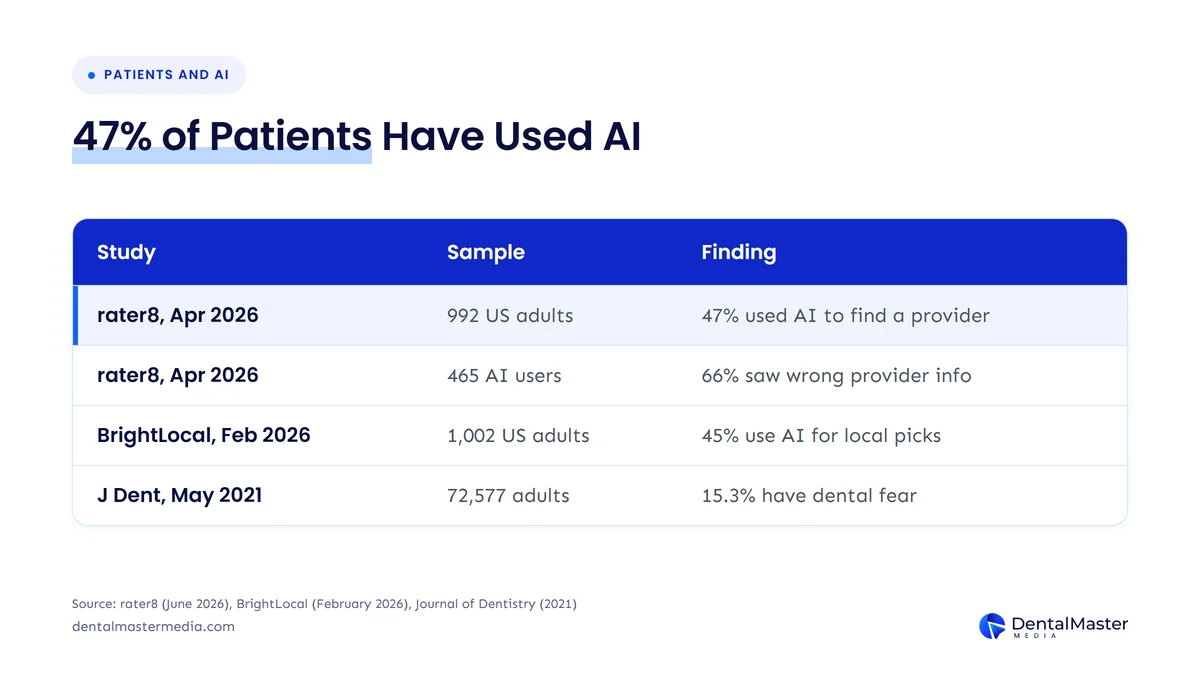
| Study (publisher, date) | Sample | What it measured | Finding |
|---|---|---|---|
| rater8, 2026 Patient Choice Report (survey April 2026) | 992 US adults | AI use to research or find a healthcare provider | 47% have used AI, up from 31% in 2025 |
| rater8, 2026 Patient Choice Report | 465 AI users | Accuracy of provider information from AI tools | 66% saw incorrect provider information; 60% trusted an AI summary without checking further |
| BrightLocal, Local Consumer Review Survey 2026 (February 11, 2026) | 1,002 US adults | Use of ChatGPT or other generative AI for local recommendations | 45% use it, up from 6% a year earlier |
| Silveira et al., Journal of Dentistry (May 2021) | 31 studies, 72,577 adults | Dental fear and anxiety in adults worldwide | 15.3% have dental fear and anxiety; 12.4% have high dental fear |
The table shows that close to half of patients now put a question to AI, that AI answers carry errors patients notice, and that dental fear is common enough to be a question of its own.
Making a practice easy for AI assistants to understand is part of our dental SEO services, and the 8 questions below are the checklist we start from.
What are the 8 questions patients ask AI about dentists?
Patients ask AI about dentists in 8 recurring question types, and each type has a page on a dental website that should answer it. The 8 questions are listed below in the order a patient decides: find, qualify, afford, trust and book.
- Which dentist near me treats my problem? A treatment page answers it.
- Which dentist accepts my insurance? An insurance page answers it.
- How much does a dental treatment cost? A fees and financing section answers it.
- Which dentist is good with nervous patients? A nervous-patient section answers it.
- Which dentist is open tonight or on Saturday? The hours and emergency page answers it.
- What do patients say about this dentist? Online reviews on the Google Business Profile and the website answer it.
- Who is the dentist and what are their qualifications? A dentist bio page answers it.
- What happens at the first visit and how do I book? A first-visit page answers it.
Which dentist near me treats my problem?
A patient who asks AI which dentist near them treats a problem gets named practices only when a website states the treatment, the city and the dentist who provides it in plain text. This question pairs a treatment, such as implants, clear aligners or an emergency, with a place, and the dental marketing guides above give prompts of exactly that shape.
The page that answers is a dedicated treatment page, one for each treatment, not a single services list. The treatment page should name the treatment in its H1, say who it is for, list the dentists who perform it, describe the service area in words and show the same address and phone number as the Google Business Profile. Google’s May 2026 guide on generative AI features says Google Business Profiles can help products and services be visible in AI responses. Our post on a dedicated page for each dental treatment shows how to build those pages.
Which dentist accepts my insurance?
A patient who asks AI which dentist accepts their insurance needs a dental website that lists each plan by name, because AI answers draw on pages that state the detail clearly. A line such as “we accept most plans” gives the assistant nothing to repeat.
Insurance is a heavy topic for AI assistants in health generally: OpenAI’s Chengpeng Mou said in April 2026 that US users send about 2 million messages a week to ChatGPT about health insurance, as reported by The Decoder. That figure covers all health insurance, not dental plans alone. The insurance page of a dental website should state the 4 details listed below.
- In-network plans: the insurance plans the practice is in network with, spelled as each insurer spells them.
- Out-of-network plans: the plans the practice accepts out of network, and what the patient pays at the visit.
- Claim filing: whether the practice files insurance claims for the patient.
- Check date: the date the insurance plans list was last checked.
How much does a dental treatment cost?
A patient who asks AI how much a dental treatment costs wants a price range, the factors that move it and the financing options, and a dental website that gives all 3 in text answers the question where “call for a quote” does not. The American Dental Association’s Health Policy Institute names affordability issues, fear of the dentist and no convenient location or appointment time among the top reasons adults avoid the dentist, so cost is a reason to ask before booking.
Publish a range only if the practice can stand behind it, and say what the fee includes and what can change it, such as the number of teeth, the materials or the need for imaging. A financing section with the options the practice offers finishes the answer. Our post on whether your dental website should show prices covers what to publish and what to leave out.
Which dentist is good with nervous patients?
A patient who asks AI which dentist is good with nervous patients is describing dental fear, which a 2021 Journal of Dentistry review of 31 studies and 72,577 adults estimated at 15.3% of adults worldwide, with 12.4% having high dental fear. That makes nervous patients one of the larger groups a dental practice can speak to directly.
The website should say what the practice does for them. A short nervous-patient section, or a part of the first-visit page, can describe how the team explains each step, how a patient can ask for a break and which sedation options the practice provides, if any, with the qualification of the dentist who provides them. State only what the practice really offers, and leave out promises about pain or outcomes.
Which dentist is open tonight or on Saturday?
A patient who asks AI which dentist is open tonight or on Saturday needs the opening hours, the emergency policy and a statement on whether the practice is taking new patients, all in text on the website and matching the Google Business Profile. A dental practice with hours only inside an image or a scheduling widget gives the assistant nothing to quote.
Timing is part of the question: OpenAI’s Chengpeng Mou said that 7 in 10 health queries to ChatGPT arrive outside regular office hours, as reported by The Decoder in April 2026. The ADA also lists no convenient location or appointment time among the top reasons adults avoid the dentist. Write the opening hours as text, add holiday and emergency hours, and say how a patient reaches the practice after hours. Our post on 7 Google Business Profile settings dental practices often get wrong covers keeping the hours on the profile correct.
What do patients say about this dentist?
A patient who asks AI what patients say about a dentist gets a summary of online reviews, and the star rating often decides the next step: rater8 found that 75% of patients won’t book a provider rated below 4.0 stars. The same report found that 66% say seeing a provider’s response to reviews influences their trust.
BrightLocal’s 2026 survey of 1,002 US adults found that 82% read AI-generated review summaries. Overall, 23% would rely on the summary alone and 39% would read the summary plus a range of written reviews. The website should show real online reviews with the source and date, link to the Google Business Profile reviews, and the practice should reply to each review. Patients also ask AI the negative version of this question, which we cover in negative questions make ChatGPT harsher about brands.
Who is the dentist and what are their qualifications?
A patient who asks AI who the dentist is and what their qualifications are wants to know that a real, qualified person will treat them, and a bio page for each dentist answers that question. Without a bio page, the assistant fills the gap from whatever listings it finds.
Each dentist bio should state the full name, the degree and school, the state of licensure, the treatments the dentist provides and a photo, with the same name and credentials as on the Google Business Profile and other listings. A mismatch has a cost: 66% of the 465 AI users in the rater8 survey had come across incorrect provider information from an AI tool. Our post on cross-platform consistency and how AI search learns to trust a dental practice explains how to keep those facts aligned.
What happens at the first visit and how do I book?
A patient who asks AI what happens at the first visit and how to book needs a first-visit page that says what the appointment includes, how long it takes, what to bring and how to book online or by phone. The first visit is the step between choosing a dentist and becoming a patient, so an unclear answer loses the new patient at the last stage.
State the length of the first appointment, the forms to complete and the booking route, and use the same booking link on the website and the Google Business Profile. Our post on how patients can book your dental practice directly from Google explains how booking links appear on the profile.
How should a dental website answer the questions patients ask AI?
A dental website answers the questions patients ask AI by putting a direct answer in the first sentence under a question heading, in plain text, on the page that owns the topic. Google’s May 2026 guide says content that people find unique, compelling and useful will likely influence presence in generative AI search more than any other suggestion in the guide.
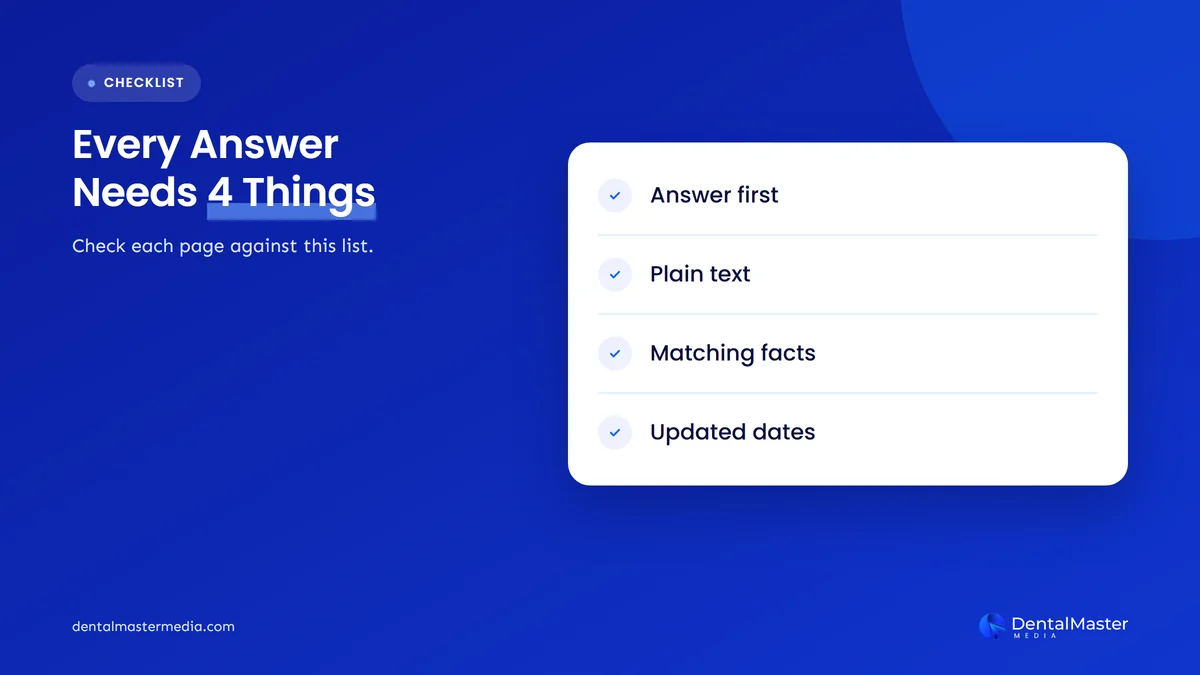
The 4 rules for an answer to a question patients ask AI are listed below.
- Answer first: the first sentence under the heading states the plan, the price range, the hours or the credential, and the details follow.
- Plain text: the answer sits in page text, so patients, Google and AI assistants read the same words.
- Matching facts: every name, phone number, address, hour and insurance plan is identical on the website, the Google Business Profile and other listings.
- Updated dates: the page shows when it was last checked, and the practice changes it whenever hours, dentists or plans change.
Answer each question on the page that owns it, not on a separate page for every question. Google’s guide warns against producing content only to chase other queries people have asked in order to influence rankings or AI responses, and it says structured data isn’t required for generative AI search. A short FAQ block on a treatment page, with questions real patients ask, fits that advice.
How do you check what AI says about your dental practice?
You check what AI says about your dental practice by asking the 8 questions above in 3 AI assistants, saving each reply and comparing the names, hours, plans and prices with your website and Google Business Profile. The 3 assistants to test are ChatGPT, Gemini and Google AI Mode, and the same test applies to Google AI Overviews that appear in a normal Google search.
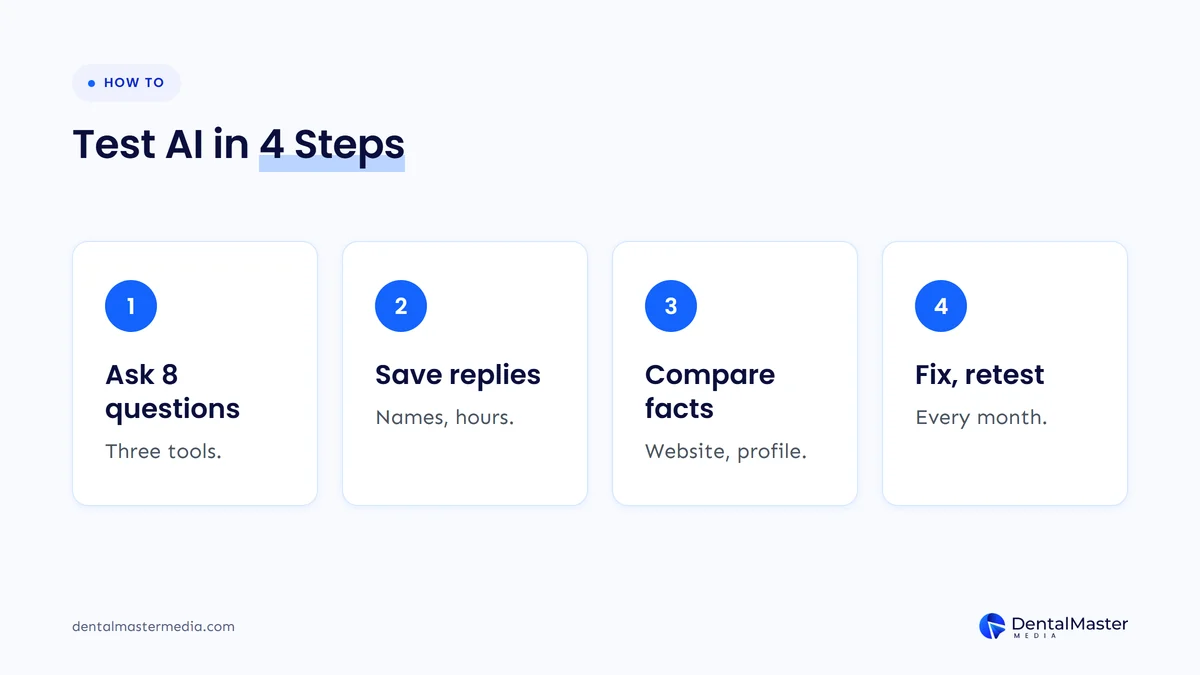
The 4 steps to test what AI says about a dental practice are listed below.
- Ask the 8 questions: type each one in ChatGPT, Gemini and Google AI Mode, adding your city and a treatment you want to be found for.
- Save the replies: record the date, the tool and the practices it names, because the same question can return different answers on a different day.
- Compare the facts: check every hour, plan, price and dentist name in the reply against your website and Google Business Profile.
- Fix the source and retest: correct the page or listing that holds the wrong fact, then ask again the next month.
ChatGPT also lets businesses claim a listing, which we explain in our post on ChatGPT letting businesses claim their listing.
Frequently asked questions
Do patients really ask AI to choose a dentist?
Yes, a growing share of patients use AI to research providers. rater8 found that 47% of 992 US adults had used AI to research or find a healthcare provider in 2026, up from 31% in 2025, and BrightLocal found that 45% of 1,002 US adults use generative AI for local recommendations. Neither study measures dentists alone, and research use is not the same as a booking decision.
Should I write a separate page for every question patients ask AI?
No, answer each question on the page that owns the topic instead of building a page per question. Google’s May 2026 guide warns against creating content only to chase other queries people have asked, so put the insurance answer on the insurance page and the cost answer in the fees section of the treatment page.
Do I need schema markup for AI assistants to answer these questions?
No, structured data isn’t required for generative AI search, according to Google’s May 2026 guide, and there is no special markup to add. Structured data still helps with rich results in Google Search, so use it as part of normal SEO, and put the answer in plain text first.
How often should a dental practice check AI answers?
A dental practice should check the 8 questions once a month and after any change to hours, dentists, insurance plans or prices. AI assistants can give different answers on different days, so keep the date and the tool next to each saved reply.
What if an AI assistant gives wrong information about my practice?
Correct the source the wrong fact came from: your website, your Google Business Profile or a directory listing. In the rater8 survey, 66% of the 465 AI users had seen incorrect provider information from an AI tool, so wrong answers are common enough to test for every month.
Answer what patients ask AI on your own website
Patients ask AI 8 kinds of questions before they choose a dentist: who treats their problem, who takes their insurance, what it costs, who is good with nervous patients, who is open, what patients say, who the dentist is and how to book. A dental website answers each one in the first sentence under a question heading, in plain text, with facts that match the Google Business Profile, and a monthly test shows what ChatGPT, Gemini and Google AI Mode say in return.
That is the work our dental SEO services focus on at Dental Master Media.
See what patients ask AI about your practice
Find out what ChatGPT, Gemini and Google AI Mode say when patients ask AI about dentists in your city. Our free dental SEO audit checks your treatment pages, insurance and hours information, Google Business Profile and online reviews, and shows which fixes will make the biggest difference.
Sources
- rater8, “2026 Patient Choice Report” (survey fielded April 2026, 992 clean responses), June 2026. https://rater8.com/2026-patient-choice-report/
- BrightLocal, “Local Consumer Review Survey 2026” (1,002 US adults), February 11, 2026. https://www.brightlocal.com/research/local-consumer-review-survey/
- Silveira et al., “Estimated prevalence of dental fear in adults: A systematic review and meta-analysis”, Journal of Dentistry, volume 108, May 2021. https://doi.org/10.1016/j.jdent.2021.103632
- Google Search Central, “Optimizing your website for generative AI features on Google Search”, published May 15, 2026, accessed November 24, 2026. https://developers.google.com/search/docs/fundamentals/ai-optimization-guide
- American Dental Association Health Policy Institute, “State of the U.S. Dental Economy” (dental care market page, FAQ on why people avoid the dentist), accessed November 24, 2026. https://www.ada.org/resources/research/health-policy-institute/dental-care-market
- The Decoder, “OpenAI reveals 600,000 weekly health queries from hospital deserts as seven in ten come after hours” (figures from OpenAI’s Chengpeng Mou), April 6, 2026. https://the-decoder.com/openai-reveals-600000-weekly-health-queries-from-hospital-deserts-as-seven-in-ten-come-after-hours/
- Vydhai Dental, “How Patients Are Starting to Use ChatGPT and AI Search to Choose a Dentist”, August 22, 2026, updated September 15, 2026. https://www.vydhaidental.com/insights/patients-using-chatgpt-to-choose-a-dentist
- CSP Marketing Solutions, “Will ChatGPT Recommend Your Dental Practice? A 2026 AI Search Visibility Guide for Dentists”, February 24, 2026. https://cspmarketingsolutions.com/blog/geo-for-dentists-chatgpt/

Suraj Rana is the owner of Dental Master Media and a leading expert in SEO for dental practices. With a passion for dental marketing, he has successfully helped numerous dental clinics climb the search engine ranks. Suraj’s expertise makes him a go-to resource for effective, results-driven dental marketing.