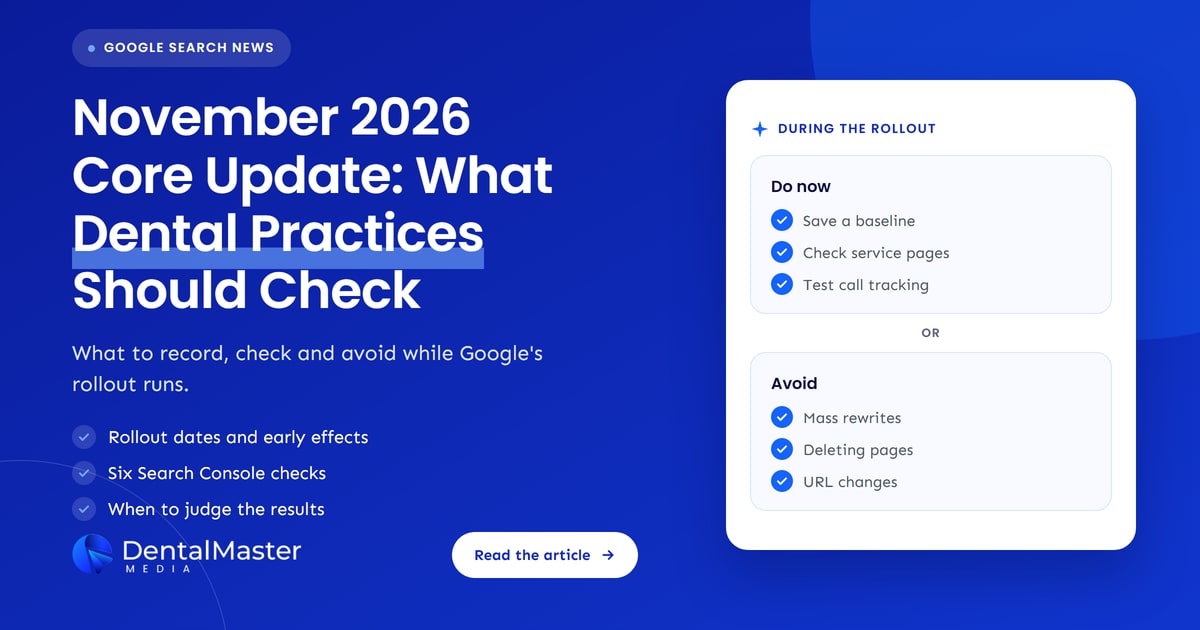
Quick answer: Google’s November 2026 core update started on November 10, 2026 and may take up to 2 weeks to roll out. While it runs, a dental practice should save a Search Console baseline, check its service pages and tracking, and avoid rewriting, deleting or moving pages. Judge the results only a full week after Google marks the rollout complete.
Key takeaways
- The November 2026 core update is Google’s third core update of 2026. It began at 10:06 a.m. Pacific on November 10 and applies globally and to all languages.
- The rollout may take up to 2 weeks, which points to a finish around November 24, 2026. The March and May 2026 core updates each took about 12 days.
- Early reports are mixed: chatter rose on November 14, Search Console data has been slow to update, and sites that scaled AI-generated content are among the first reported drops.
- Dental practices are affected through their organic rankings for treatment and patient-question pages. The Google Maps local pack runs on its own local factors.
- In Search Console, export a baseline for November 3 to 9, then watch your service pages, queries, manual actions and indexing.
- Avoid big changes during the rollout. Analyze results only after a full week has passed since completion, and keep Thanksgiving week in mind.
What is the November 2026 core update?
The November 2026 core update is a broad change to Google’s ranking systems that Google released on November 10, 2026, and that affects search results in every country and language. Google’s Search Status Dashboard logged the start at 10:06 a.m. Pacific and said the rollout “may take up to 2 weeks to complete.”
Google described the November 2026 core update on LinkedIn as “a regular update designed to better surface relevant, satisfying content for searchers from all types of sites.” Google Search Central’s documentation on core updates says these updates don’t target specific sites or individual pages. A dental website that moves down during a core update has not received a penalty: Google’s systems have reassessed which pages answer a search best.
The November 2026 core update is the third core update of 2026, after March and May, and the eighth ranking update on Google’s Search Status Dashboard this year, according to Search Engine Journal’s November 10 report. Watching these updates and reading what they mean for patient searches is part of our dental SEO services.
How long will the November 2026 core update take?
The November 2026 core update will take up to 2 weeks, according to Google, which puts the expected finish around November 24, 2026. Google can mark the rollout complete earlier or later, so the Search Status Dashboard is the only reliable signal that the core update has ended.
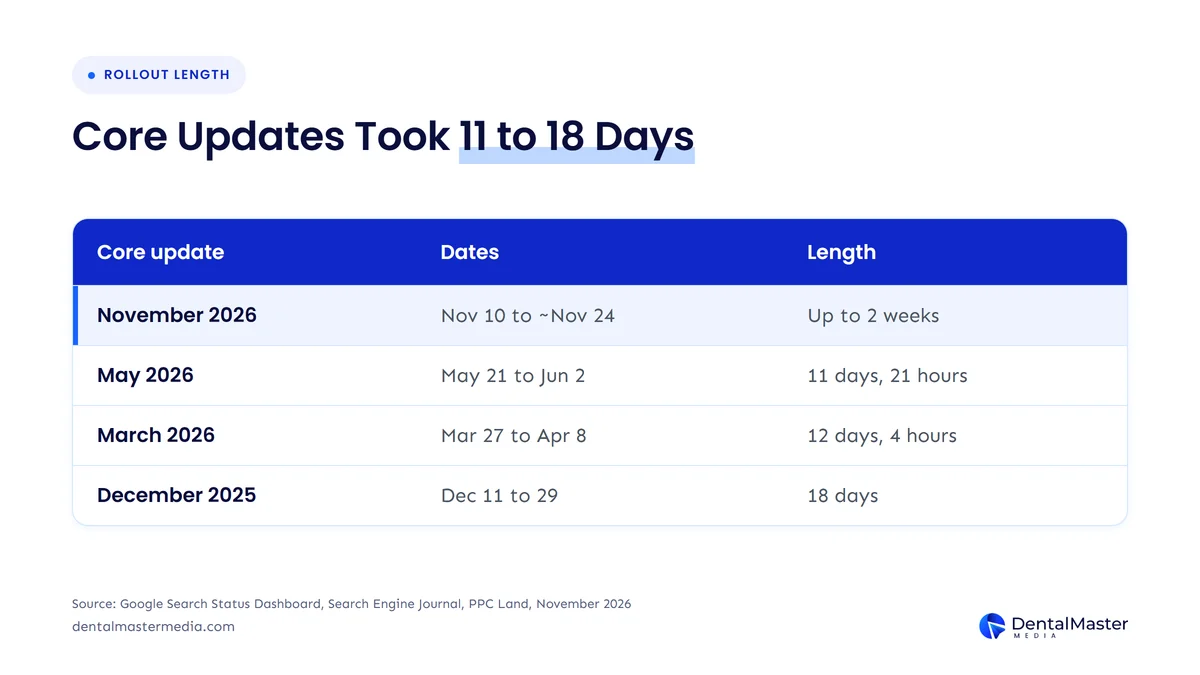
The 3 core updates before this one took between 11 days 21 hours and 18 days, as the table below shows.
| Core update | Rollout dates | Rollout length | Source |
|---|---|---|---|
| November 2026 core update | November 10, 2026 to about November 24, 2026 | Up to 2 weeks (in progress) | Google Search Status Dashboard |
| May 2026 core update | May 21 to June 2, 2026 | 11 days, 21 hours | Search Engine Journal, November 10, 2026 |
| March 2026 core update | March 27 to April 8, 2026 | 12 days, 4 hours | Search Engine Journal, November 10, 2026 |
| December 2025 core update | December 11 to 29, 2025 | 18 days | PPC Land, November 10, 2026 |
The table shows that 2026 core updates finished in about 12 days, while the December 2025 rollout ran 6 days longer than Google’s usual 2-week window.
Earlier 2026 updates also moved rankings hard. After the March 2026 core update, 79.5% of top-3 URLs changed position and 24.1% of top-10 pages dropped out of the top 100, according to SE Ranking data reported by PPC Land. Those figures cover all industries, not dental websites alone, but they show how far a single core update can move results.
What has the November 2026 core update changed so far?
The November 2026 core update has produced mixed and slower-than-usual changes so far, with both drops and gains and less volatility than a typical core update. Barry Schwartz of Search Engine Roundtable reported on November 16, 2026 that chatter rose on Saturday, November 14, and that Google Search Console performance reporting has been “a bit laggy.”
Site owners in the Search Engine Roundtable report described both directions: one saw traffic rising over 2 days, while another reported a drop of more than 20% from the previous week. Search Engine Roundtable also noted that third-party rank trackers have struggled to track results, which may make the core update look calmer than it is.
The clearest early pattern involves AI-generated content at scale. Glenn Gabe, an SEO consultant who tracks core updates, wrote on X that he saw 2 domains that scaled heavily with AI-generated content dropping so far, and posted this update on the morning of November 16.
“The November core update is a bit clearer this morning after the weekend”
Glenn Gabe (@glenngabe) on X, November 16, 2026 (source)
Two domains are not a rule, and Google has not said the November 2026 core update targets AI content. Google’s spam policies already treat scaled content abuse as a violation, though, and we explained how that applies to practices in Google’s spam update is targeting scaled content on dental websites.
Which dental practices does the core update affect?
The core update affects every dental practice whose website gets organic Google traffic, because a core update reassesses the pages that rank in the main search results. Dental websites feel it most on treatment pages, such as dental implants and clear aligners, and on patient-question pages and blog posts.
Dental content is health information, so Google holds it to a high standard for trust. Google’s guidance on helpful, reliable, people-first content asks whether content shows first-hand expertise and whether readers would trust it. A dental practice whose pages are written or reviewed by a named dentist is in a stronger position than one with anonymous, generic treatment pages. Our guide to E-E-A-T for dental websites covers how to show that expertise on the page.
A practice that gets most new patients from Google Ads or referrals will see less effect from the core update, because paid ads are not ranked by core updates. Your Google Business Profile listing also runs on a separate system, as the next section explains.
Does the core update affect the Google Maps local pack?
No, Google does not describe the core update as a change to the Google Maps local pack, which ranks dental practices on 3 local factors: relevance, distance and prominence. Google Business Profile Help lists those 3 factors and adds that a practice’s position in organic web results also counts toward prominence.
That last point links the 2 systems. A dental website that loses organic rankings during the core update can lose a little prominence in the local pack too, so check both reports instead of assuming one explains the other.
What should a dental practice check in Search Console during the core update?
A dental practice should check its baseline, service pages, queries, manual actions and indexing in Search Console during the core update, without acting on day-to-day swings. Google Search Console is the most direct record of how Google search treats your dental website, and it records what rank trackers miss.
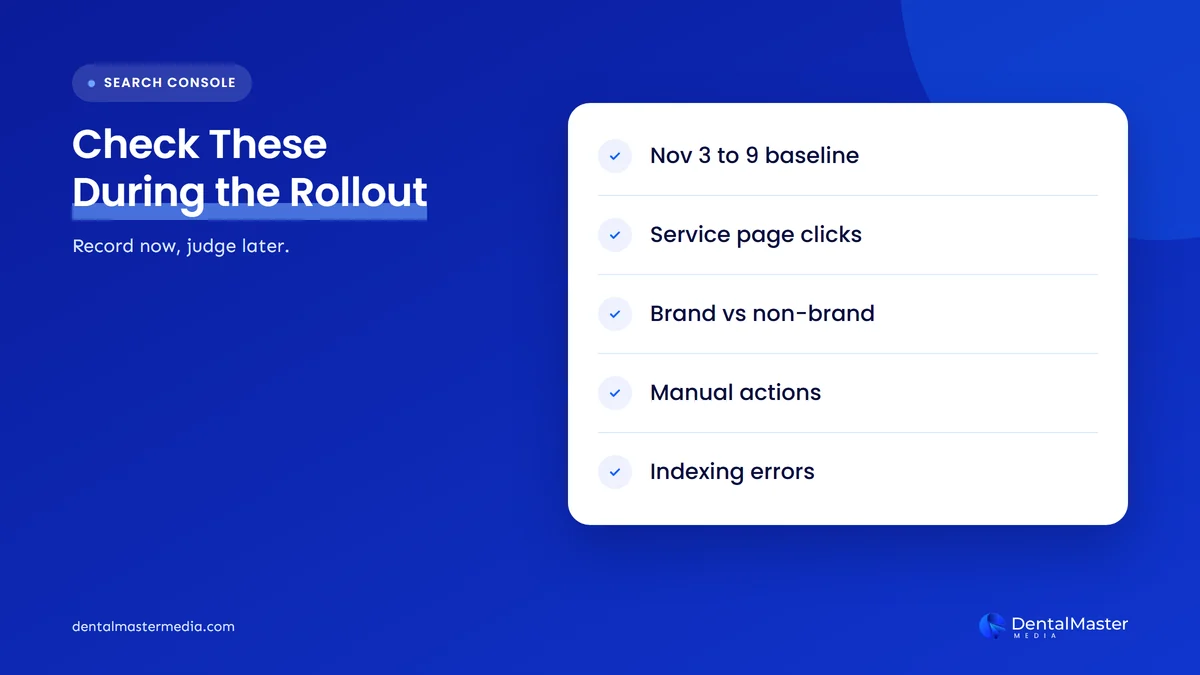
The 6 Search Console checks to run during the November 2026 core update are listed below.
- Export a baseline for November 3 to 9, 2026: save clicks, impressions and average position from the Performance report by page and by query for the full week before the rollout. That week is the comparison point Google’s core update guidance asks for.
- Note the core update dates: record November 10 as the start and add the end date when the Search Status Dashboard confirms it, so every later comparison uses the same window.
- Watch your service pages, not only the homepage: filter the Performance report by page for each treatment page, such as implants, aligners, veneers and emergency dentistry, because these pages bring patients who book.
- Split brand and non-brand queries: a drop in searches for your practice name points to a different cause than a drop in searches like “dentist near me” or “dental implants cost.”
- Check the Manual actions report: a core update never produces a manual action, so an entry here means a separate spam problem that needs its own fix.
- Check the Pages report for indexing errors: a sudden rise in pages that are not indexed often comes from a technical fault, such as a plugin update or a noindex tag, that started during the same week.
Expect Search Console performance data to arrive later than usual this week, given the delays Search Engine Roundtable reported. If you also want to see how much traffic Google sends outside Search Console, read our post on how Google’s new guide shows how to spot Google Search traffic.
What should a dental practice check on its website during the core update?
A dental practice should check that its website stays accessible, accurate and trackable during the core update, so that any ranking change can be read cleanly once the rollout ends. These checks change nothing that Google is reassessing; they protect the data and the patient journey.
The 5 website checks for a dental practice during the November 2026 core update are listed below.
- Test the service pages load: open each treatment page on a phone and confirm it loads, shows the phone number and has a working booking button.
- Confirm the practice details match: the practice name, address, phone number and hours on the dental website should match the Google Business Profile exactly.
- List thin or duplicated pages: note location pages or blog posts that repeat the same text with a city name swapped, for review after the rollout, not today.
- Check author and dentist pages: make sure every treatment page names the dentist who wrote or reviewed it and links to a dentist bio page.
- Confirm call and booking tracking works: calls, form fills and online bookings are the numbers that show whether a ranking change affected new patients.
Tracking matters most because rankings and clicks don’t pay the bills; booked patients do. Our guide on how to track dental website calls and bookings shows how to set that up before the post-update comparison.
What should a dental practice avoid while the core update rolls out?
A dental practice should avoid large changes while the core update rolls out, because Google is still reassessing pages and any edit made now blurs the cause of later ranking changes. Google’s core update documentation advises against quick fixes and recommends changes that make sense for users and last.
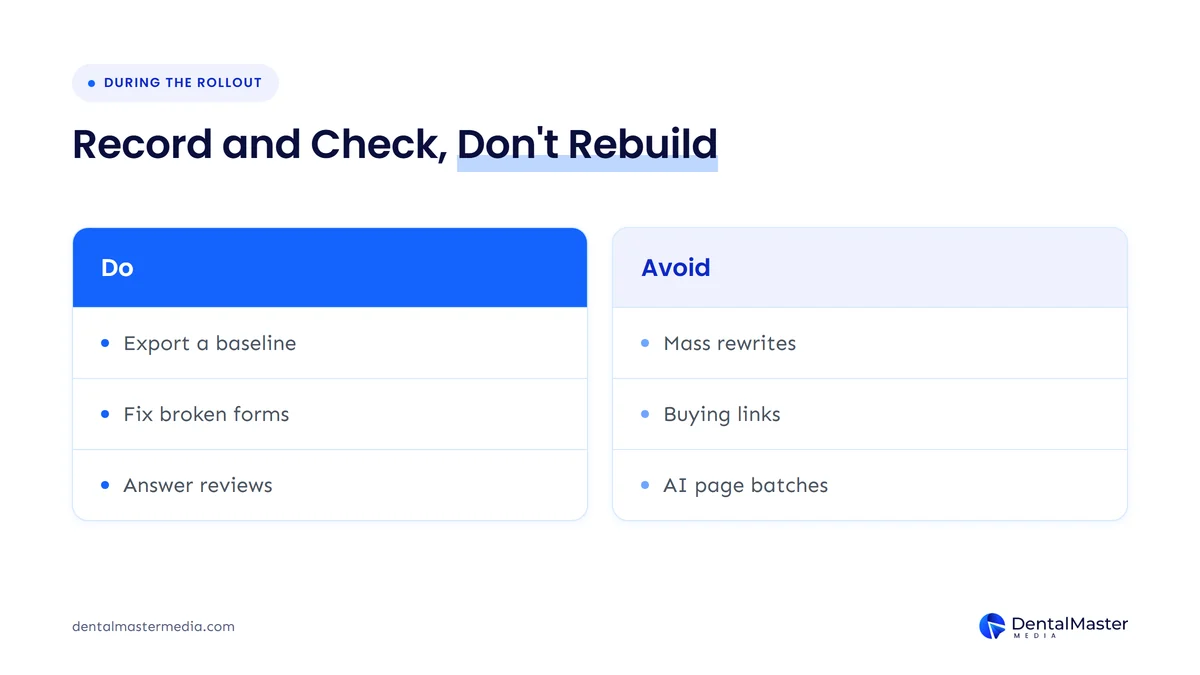
The 6 actions a dental practice should avoid during the November 2026 core update are listed below.
- Mass rewrites of service pages: rewriting 10 treatment pages mid-rollout makes it impossible to tell whether the core update or the rewrite moved them.
- Deleting pages that dropped: Google’s guidance calls deleting content a last resort, and a page that fell on day 3 can return by day 12.
- URL changes or a website redesign: new URLs and redirects add a second ranking change on top of the core update.
- Buying links: paid links break Google’s spam policies and can lead to a manual action that lasts long after the rollout ends.
- Publishing batches of AI-written pages: the first reported drops involve sites that scaled AI-generated content, and scaled content abuse is already a spam policy violation.
- Reacting to daily rank tracker swings: PPC Land reported that DemandSphere saw spurious results on about 11% of daily rank checks and Nozzle counted 8.0% of results pages as poisoned, so tracker data is noisy this month.
Routine work can continue. Fixing a broken booking form, answering Google reviews and publishing a planned blog post are normal activity, not reactions to the core update.
When should a dental practice analyze the core update results?
A dental practice should analyze the core update results at least a full week after Google marks the rollout complete, which means no earlier than December 1, 2026 if the update ends on November 24. Google Search Central recommends comparing the week after completion with the week before the rollout started.
The timing this year adds one complication for practices in the United States. Thanksgiving falls on November 26, 2026, inside the first week after the expected finish, and a holiday week can change how patients search and book. Compare the post-update week with your November 3 to 9 baseline, and also with the same weeks of 2025, before you treat a drop as a core update loss.
Google’s documentation also says a small drop of a few positions doesn’t call for drastic action. A practice whose service pages moved from position 3 to position 5 should watch for 2 to 4 weeks, while a practice whose implant page fell off page 1 needs a deeper review.
How does a dental practice recover if the core update drops its rankings?
A dental practice recovers from a core update drop by improving the affected pages for patients, not by making quick technical fixes, and recovery can take several months. Google Search Central says its systems need time to confirm improvements, and some sites only see a change at the next core update.
Start with the pages that lost the most clicks, compare them with the pages that now outrank them, and ask whether your page answers the patient’s question better, with a named dentist, real photos and clear treatment details. Our guide to a dental website content refresh to recover lost rankings covers that process step by step, and our earlier post on the May 2026 Google core update shows what changed for dental clinics last time.
Frequently asked questions
Is the November 2026 core update a penalty?
No, the November 2026 core update is not a penalty. Google says core updates are broad changes that don’t target specific sites or pages. A dental website that drops has been outranked by pages Google now judges more helpful. Penalties for spam appear as manual actions in Search Console.
When will the November 2026 core update finish?
The November 2026 core update should finish by about November 24, 2026, because Google said the rollout may take up to 2 weeks from November 10. The Google Search Status Dashboard will show the official end date once Google marks the rollout complete.
Should I change my dental website during the core update?
No, you should not make large changes to your dental website during the core update. Rewriting, deleting or moving pages mid-rollout hides the cause of any ranking change. Keep routine work going, such as fixing broken forms or answering reviews, and plan bigger changes after the analysis.
Does the core update change my Google Maps ranking?
No, the core update does not directly change the Google Maps local pack, which ranks practices on relevance, distance and prominence. Organic web rankings feed into prominence, though, so a large organic drop can have a small knock-on effect in the local pack.
Will AI-written dental content drop in the November 2026 core update?
AI-written dental content is not dropped for being AI-written, but content scaled up with little value can lose rankings. Early reports from Glenn Gabe point to drops on 2 domains that scaled heavily with AI-generated content, and Google’s spam policies already prohibit scaled content abuse.
The November 2026 core update: record, check, then wait
The November 2026 core update started on November 10 and should finish around November 24, 2026. During the rollout, a dental practice should save a Search Console baseline for November 3 to 9, check service pages, manual actions, indexing and tracking, and avoid rewrites, deletions, URL changes, bought links and AI page batches. Analyze the results a full week after the official end, with Thanksgiving week in mind.
If you want a second opinion on what the core update did to your rankings, that review is part of our dental SEO services at Dental Master Media.
Find out what the core update did to your rankings
Our free dental SEO audit compares your service pages, Search Console data and Google Business Profile before and after the November 2026 core update, and shows which pages need attention first.
Sources
- Google Search Status Dashboard, “November 2026 core update”, November 10, 2026. https://status.search.google.com/incidents/WLxcJyC6jMWMfryxsKMc
- Google Search Central, “Google Search’s core updates and your website”, accessed November 17, 2026. https://developers.google.com/search/docs/appearance/core-updates
- Google Search Central, “Creating helpful, reliable, people-first content”, accessed November 17, 2026. https://developers.google.com/search/docs/fundamentals/creating-helpful-content
- Google Search Central, “Spam policies for Google web search”, accessed November 17, 2026. https://developers.google.com/search/docs/essentials/spam-policies
- Google Business Profile Help, “Tips to improve your local ranking on Google”, accessed November 17, 2026. https://support.google.com/business/answer/7091
- Search Engine Roundtable, “Google November 2026 Core Update Is Rolling Out”, November 10, 2026. https://www.seroundtable.com/google-november-2026-core-update-42504.html
- Search Engine Roundtable, “Google November 2026 Core Update Ranking Flux – What We’re Seeing”, November 16, 2026. https://www.seroundtable.com/google-november-2026-core-update-ranking-volatility-42543.html
- Search Engine Journal, “Google’s November 2026 Core Update Starts Rolling Out”, November 10, 2026. https://www.searchenginejournal.com/google-november-2026-core-update/596614
- PPC Land, “Google’s core update shifts rankings for up to 2 weeks before Black Friday”, November 10, 2026. https://ppc.land/googles-core-update-shifts-rankings-for-up-to-2-weeks-before-black-friday/
- Glenn Gabe (@glenngabe) on X, November 16, 2026. https://x.com/glenngabe/status/2122310281824981370

Suraj Rana is the owner of Dental Master Media and a leading expert in SEO for dental practices. With a passion for dental marketing, he has successfully helped numerous dental clinics climb the search engine ranks. Suraj’s expertise makes him a go-to resource for effective, results-driven dental marketing.