Quick answer: Dental SEO is the ongoing work of making a dental practice easy to find, understand and choose when patients search on Google, Google Maps and AI answers. It covers your website, service pages, Google Business Profile and reviews. It is not paid advertising or a bought ranking. It brings new patients when a search ends in a call or booking.
Key takeaways
- Dental SEO is search engine optimization for a dental practice. Google defines SEO as helping search engines understand your content, and dental SEO applies that to treatments, locations and patient questions.
- Dental SEO has 5 parts: technical SEO, local SEO, service pages, authority and measurement.
- Dental SEO is not advertising, not a bought ranking, not a one-off project and not a separate trick for AI. Google says there is no way to pay for a better local ranking.
- Dental SEO brings new patients through a 4-step path: the patient searches, compares, visits your site and books. BrightLocal’s 2026 survey found 52% of consumers start a local search on Google Search.
- Google ranks local results on 3 factors: relevance, distance and prominence. Reviews and a complete Google Business Profile feed prominence and relevance.
- Dental SEO is paid for as a monthly retainer and takes months, not days. Google says changes take from a few hours to several months to show.
- Dental SEO still applies to AI answers: Google says SEO is the foundation for AI Overviews and AI Mode.
What is dental SEO?
Dental SEO is search engine optimization for a dental practice: the work of helping Google and other search tools understand your practice, so they show it to patients who search for a dentist or a treatment. Google Search Central describes SEO as “helping search engines understand your content” and helping people decide whether to visit your site.
A dental practice has 2 audiences at once: the search engine that decides what to show, and the patient who decides whether to call. Dental SEO serves both. A patient who types “dentist near me” or “dental implants cost” sees search results, a map and, increasingly, an AI answer, and dental SEO decides whether your practice appears in them. Our dental SEO services cover each of the 5 parts described below.
What are the 5 parts of dental SEO?
Dental SEO has 5 parts, and a complete dental SEO plan covers all of them. The 5 parts are listed below, in the order most practices should fix them.
- Technical SEO: a fast, mobile-friendly dental website that Google can crawl and index, with working redirects and no broken pages.
- Local SEO: a complete Google Business Profile, consistent practice details on Google Maps and directories, and patient reviews.
- Service pages: one page per treatment, such as implants, aligners and emergency care, that answers the questions new patients ask.
- Authority: links and mentions from local organizations and trusted publications that show Google your practice is well known.
- Measurement: tracking of phone calls, form fills and bookings, plus Google Search Console data on which searches show your practice.
When 2 dental SEO quotes look very different, one usually covers all 5 parts and the other covers 1 or 2.
What is dental SEO not?
Dental SEO is not paid advertising, a bought ranking, a one-off project, a separate trick for AI or a rankings report. It is steady work on your website and Google Business Profile, and the image below sets what it is next to what it is not.
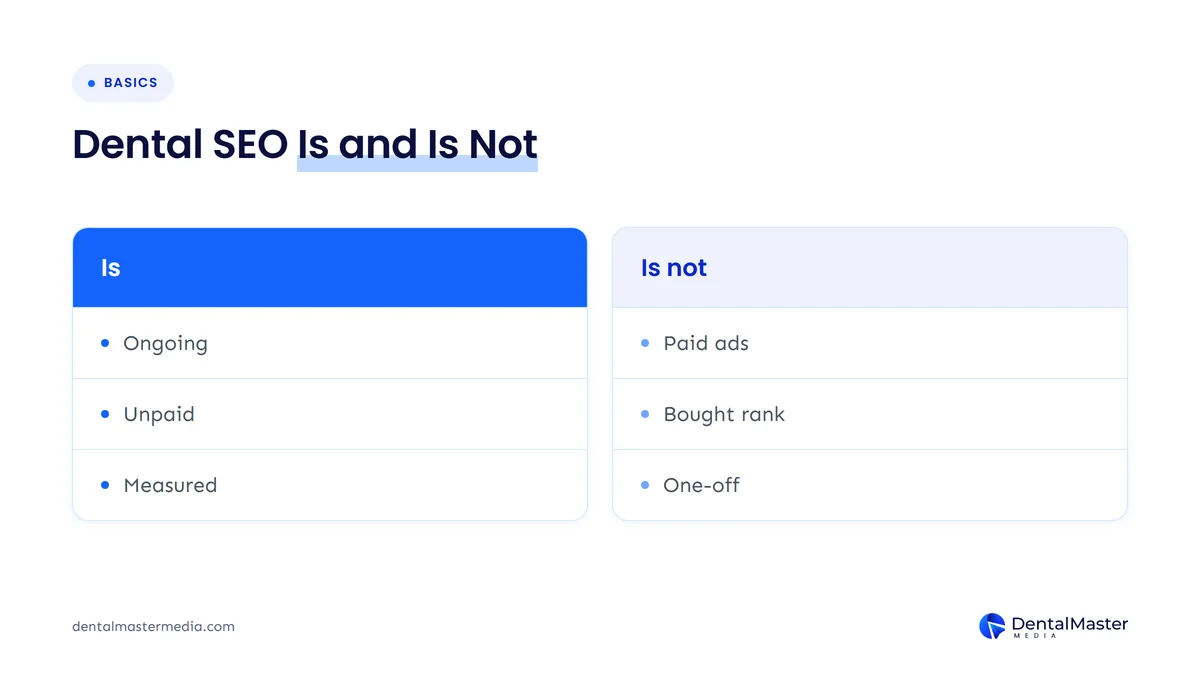
The 5 most common misunderstandings of dental SEO are listed below.
- Paid advertising: Google Ads is a paid placement, while dental SEO earns unpaid placement. Google’s Business Profile help states that there is “no way to request or pay for a better local ranking on Google.”
- A bought ranking: no dental SEO provider can buy first place. Google’s SEO Starter Guide says “there are no secrets here that’ll automatically rank your site first in Google.”
- A one-off project: a dental SEO fix is not finished when it goes live. Google says every change takes time to be reflected, from a few hours to several months.
- A separate trick for AI: dental SEO for AI answers is the same work as dental SEO for Google. Google’s May 2026 guide says you do not need llms.txt files, special markup or a special writing style.
- A rankings report: dental SEO is judged by new patients, phone calls and bookings, not by a ranking screenshot.
If you wonder whether a file such as llms.txt belongs on your site, we tested that question in our post on whether your dental website needs an llms.txt file.
How does dental SEO bring new patients?
Dental SEO brings new patients by placing your dental practice in front of people at the moment they search, then making it easy for them to call or book. The path has 4 steps, shown in the image below, and a break at any step loses the patient.
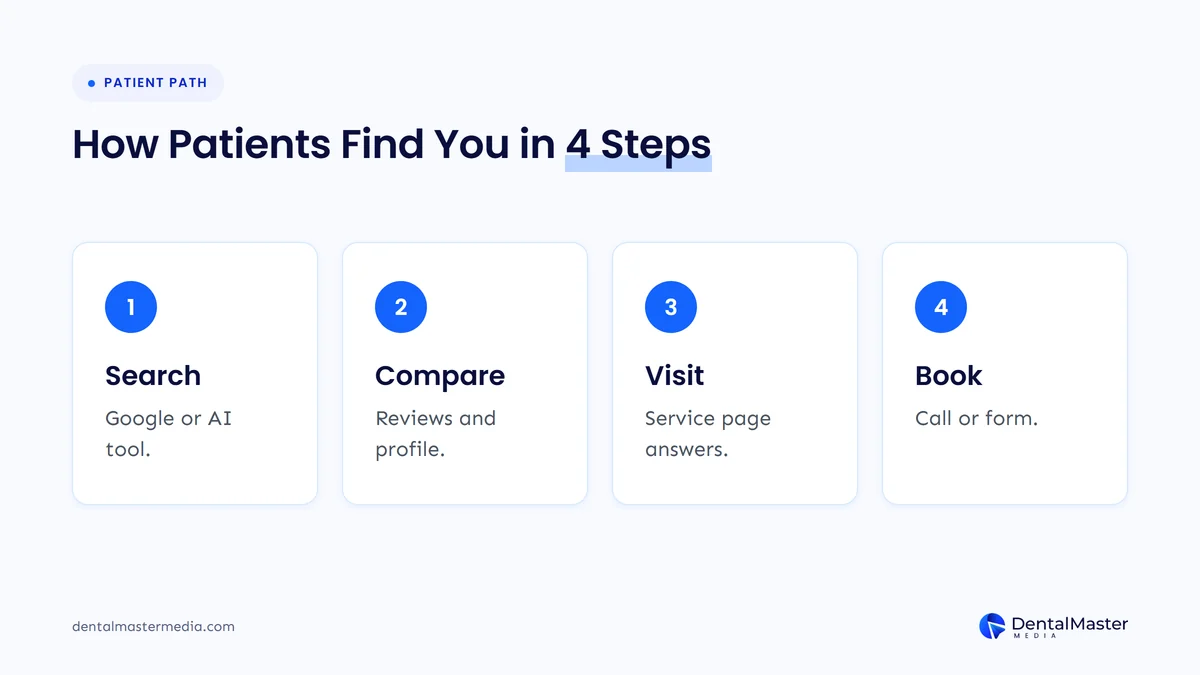
The 4 steps of the patient path are listed below.
- Search: the patient types a dentist or treatment search into Google Search, Google Maps or an AI tool.
- Compare: the patient reads patient reviews, ratings, hours and photos in the local pack and the Google Business Profile.
- Visit: the patient opens your website, and the service pages answer the question that started the search.
- Book: the patient makes phone calls, sends a form or uses a booking link, and your tracking records it.
What do patients do when they search for a dentist?
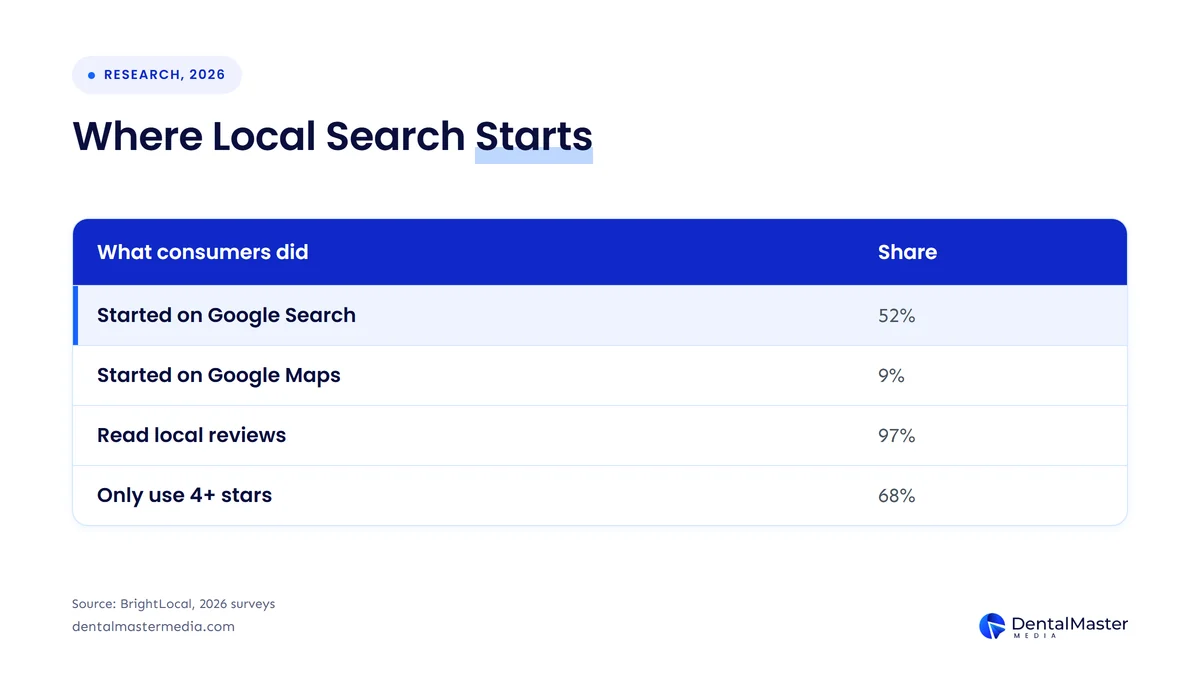
Patients start on Google and then compare, according to BrightLocal’s 2026 surveys. In the Consumer Search Behavior Survey 2026, 52% of 1,227 US consumers started their latest local business search on Google Search, and the table below sets that next to the review data.
| What consumers did | Share | Survey (sample) |
|---|---|---|
| Started their latest local search on Google Search | 52% | BrightLocal Consumer Search Behavior Survey 2026 (1,227 US consumers) |
| Started their latest local search on Google Maps | 9% | BrightLocal Consumer Search Behavior Survey 2026 |
| Used Google Search at some point in the search | 71% | BrightLocal Consumer Search Behavior Survey 2026 |
| Used more than 1 channel in the search | 75% | BrightLocal Consumer Search Behavior Survey 2026 |
| Read reviews for local businesses | 97% | BrightLocal Local Consumer Review Survey 2026 (1,002 US adults) |
| Will only use a business rated 4 stars or more | 68% | BrightLocal Local Consumer Review Survey 2026 |
The table shows that a local search often begins on Google Search or Google Maps, moves between channels, and ends with a check of patient reviews and star ratings. The BrightLocal surveys cover local businesses in general, not dental practices alone, so read the shares as the direction of patient behavior.
How does Google decide which dental practice to show in local results?
Google decides which dental practice to show in local results using 3 factors: relevance, distance and prominence. Google’s Business Profile help defines relevance as “how well a Business Profile matches what someone is searching for,” distance as how far each business is from the searcher, and prominence as “how well-known a business is.”
Each factor links to something a dental practice controls or influences, as listed below.
- Relevance: a complete Google Business Profile with the right categories, services and hours, and service pages that match each treatment.
- Distance: your practice address and service area, which dental SEO cannot change, but which the local pack always weighs.
- Prominence: review count, review rating, links and mentions across the web, which dental SEO builds over time.
Google does not publish how it weighs the 3 factors, so no one outside Google can promise a position. The settings that most often go wrong on a profile are covered in our guide to Google Business Profile settings for dental practices.
What should a practice owner expect from dental SEO?
A practice owner should expect dental SEO to be a monthly service with a clear scope, a timeline measured in months and reports tied to new patients. The 3 questions owners ask first are cost, time and where they stand today.
How much does dental SEO cost?
Dental SEO costs a monthly retainer, and our plans at Dental Master Media cost $749, $1,250 and $1,999 a month. The price depends on local competition, the number of locations, the condition of your website and the work included across the 5 parts of dental SEO.
Our post on how much dental SEO costs compares published pricing surveys and the scope you should expect for the money.
How long does dental SEO take?
Dental SEO takes months to show steady results, and Google says changes take from a few hours to several months to be reflected. Google’s SEO Starter Guide also suggests waiting a few weeks before judging whether a change helped.
Our dental SEO timeline guide breaks the wait into stages.
How do you check where your dental SEO stands today?
You check where your dental SEO stands today with an audit of your website, Google Business Profile, service pages, links and tracking. Google Search Console shows the searches that already bring people to your site, and an audit turns that data into a ranked list of fixes.
We list the checks in what a dental SEO audit should include.
What does dental SEO mean for AI answers like AI Overviews and ChatGPT?
Dental SEO still applies to AI answers, because Google’s May 15, 2026 guide says SEO remains the foundation for AI features such as AI Overviews and AI Mode. The guide recommends unique, expert-led content, pages that Google can crawl and index, and a Google Business Profile, which it says can help products and services appear in AI responses.
Patients already use AI tools in local searches. BrightLocal’s 2026 survey found that 23% of consumers used AI in their latest local business search, 31% use AI tools for local recommendations at least monthly, and only 18% of those who use AI for local searches felt ready to contact a recommended business without more checking. AI tools send patients to compare on Google and your website, so the 5 parts of dental SEO come first. We measured how much AI traffic reaches practices in our post on AI traffic to dental practice websites.
Frequently asked questions
Is dental SEO worth it for a dental practice?
Yes, dental SEO is worth considering for a dental practice because patients start on Google. BrightLocal found that 52% of consumers began their latest local search on Google Search and 97% read reviews, so a practice that is hard to find or poorly reviewed loses new patients before the phone rings.
Can I do dental SEO myself?
Yes, you can do dental SEO yourself, because Google’s SEO Starter Guide is written for site owners. The guide also says that if you are short on time you might consider hiring a professional, and most practices find the 5 parts of dental SEO take more hours than the practice can spare.
Is dental SEO the same as Google Ads?
No, dental SEO is not the same as Google Ads. Google Ads is paid placement that stops when the budget stops, while dental SEO earns unpaid placement in search results and Google Maps. Google says there is no way to pay for a better local ranking.
Can dental SEO promise first place on Google?
No, no one can promise first place on Google. Google’s SEO Starter Guide says there are no secrets that automatically rank a site first, and Google keeps the weighting of relevance, distance and prominence confidential. A trustworthy dental SEO plan promises work and reporting, not a position.
Does dental SEO still matter now that patients use ChatGPT?
Yes, dental SEO still matters, because Google’s 2026 guide calls SEO the foundation for AI Overviews and AI Mode. BrightLocal found 23% of consumers used AI in their latest local search, and the same survey found 71% used Google Search at some point in a local search.
Dental SEO is steady work that ends in a booking
Dental SEO is the ongoing work of making a dental practice easy to find, understand and choose. It has 5 parts, from technical SEO to measurement. It is not paid advertising, a bought ranking or a trick for AI. It brings new patients when a search on Google, Google Maps or an AI tool leads to phone calls and bookings. Google ranks local results on relevance, distance and prominence, and results take months, not days.
That is the work we do for dental practices at Dental Master Media, and you can see how each part fits together in our dental SEO services.
Talk through a dental SEO plan for your practice
Book a free dental SEO strategy call. We look at how your practice appears on Google and Google Maps today, which of the 5 parts of dental SEO need work first, and what a monthly plan would include. You leave with a clear next step and no obligation.
Sources
- Google Search Central, “SEO Starter Guide: The Basics”, accessed November 19, 2026. https://developers.google.com/search/docs/fundamentals/seo-starter-guide
- Google Business Profile Help, “Tips to improve your local ranking on Google”, accessed November 19, 2026. https://support.google.com/business/answer/7091
- Google Search Central, “Optimizing your website for generative AI features on Google Search”, May 15, 2026. https://developers.google.com/search/docs/fundamentals/ai-optimization-guide
- BrightLocal, “Consumer Search Behavior Survey 2026” (1,227 US consumers), 2026. https://www.brightlocal.com/research/consumer-search-behavior-channels/
- BrightLocal, “Local Consumer Review Survey 2026” (1,002 US adults), February 11, 2026. https://www.brightlocal.com/research/local-consumer-review-survey/

Suraj Rana is the owner of Dental Master Media and a leading expert in SEO for dental practices. With a passion for dental marketing, he has successfully helped numerous dental clinics climb the search engine ranks. Suraj’s expertise makes him a go-to resource for effective, results-driven dental marketing.