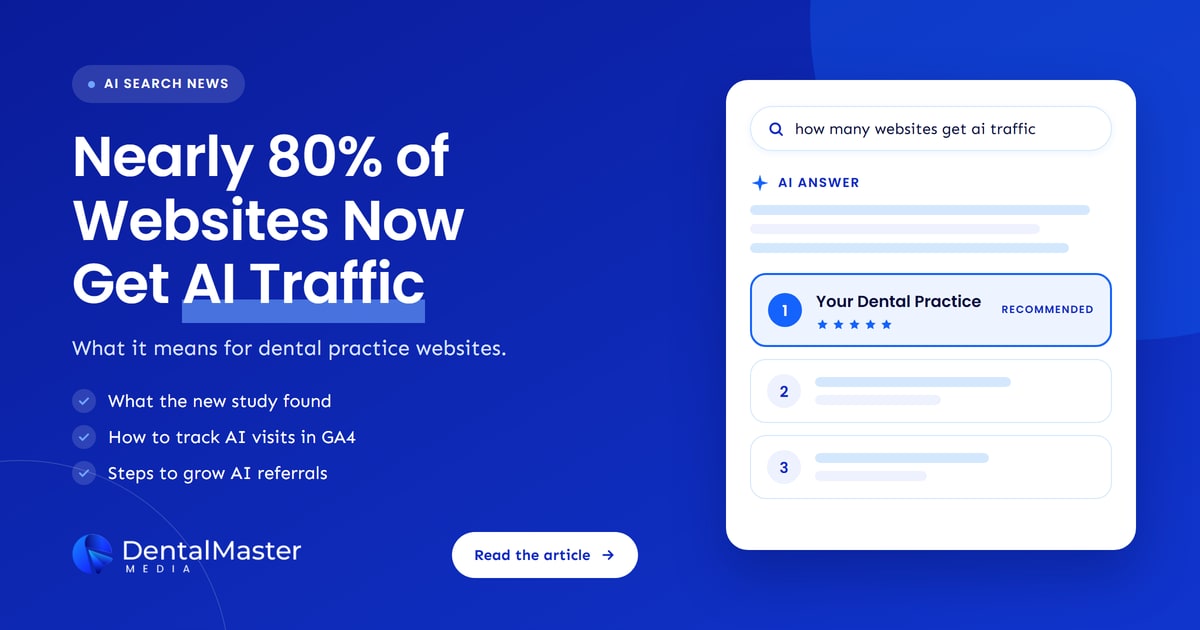
Quick answer: A new SE Visible study of 28,500 websites found that 79.2% got at least one visit from an AI tool in September 2026, up from 39.7% in January 2025. For most sites the volume is still small. Dental practices should track these visits in GA4, check which pages they land on and measure calls and bookings.
Key takeaways
- SE Visible (part of SE Ranking) published a study on November 12, 2026 showing the share of websites with AI referral traffic roughly doubled between January 2025 and September 2026.
- Among sites with at least 1,000 organic visits a month, 99.7% received some AI traffic in September 2026.
- The most common level was 2 to 5 AI visits for every 100 organic search visits. AI traffic is growing, but Google is still the main source of visits.
- This is a vendor study that describes a sample. It doesn’t break results down by industry, and one AI visit doesn’t mean a new patient.
- Google Analytics 4 now groups visits from AI assistants such as ChatGPT, Gemini and Claude in a default AI Assistant channel, so you can check your own numbers today.
What changed?
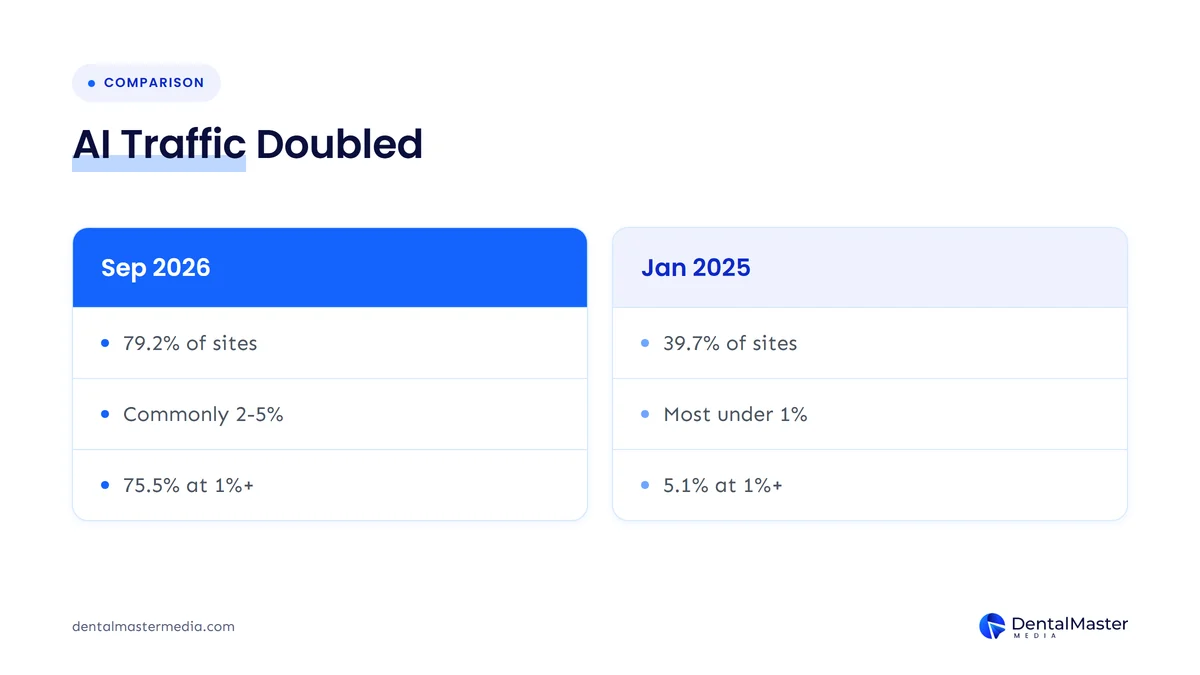
AI referral traffic went from something a minority of websites saw to something almost every established website now gets. In SE Visible’s sample, the share of sites with at least one AI referral rose from 39.7% in January 2025 to 79.2% in September 2026, with the biggest jump between May and June 2026.
The study, written by Yulia Deda, tracked 28,500 randomly selected websites that received organic search traffic in every month from January 2025 to September 2026. A site counted as getting AI traffic if it recorded at least one AI referral visit in a month. The authors note that this doesn’t mean a steady flow of visitors or any conversions.
The growth wasn’t smooth. The share climbed to 54.3% by June 2025, then barely moved for almost a year, sitting at 58.4% in May 2026. It then jumped to 73.1% in June 2026, before reaching 79.2% in September 2026.
| Month | Share of sampled websites with AI referral traffic |
|---|---|
| January 2025 | 39.7% |
| June 2025 | 54.3% |
| May 2026 | 58.4% |
| June 2026 | 73.1% |
| September 2026 | 79.2% |
How much AI traffic are websites actually getting?
For most websites, AI traffic is still a small slice next to Google. In September 2026, the most common level among sites with at least 1,000 organic visits was 2 to 5 AI visits for every 100 organic search visits, covering 34.2% of those sites. About one in five sites got 5 or more.
The change from early 2025 is still large. In January 2025, 77.8% of these sites got less than 1 AI visit per 100 organic visits, and none reached 5. By September 2026, 75.5% got at least 1 per 100, 13.5% were in the 5 to 10 range and 6.5% got 10 or more.
To put the ratio in practice terms, here is a simple illustration rather than a measured figure: a dental website with 1,000 organic search visits a month, at 2 to 5 AI visits per 100, would see roughly 20 to 50 visits a month from AI tools.
Why did AI traffic jump in mid-2026?
The study doesn’t prove a cause, but it points to ChatGPT. The authors cite earlier research finding ChatGPT sent roughly three out of every four AI referrals worldwide in early 2026, and note that ChatGPT made brand names more visible and clickable in its answers around May 7, 2026.
The authors label these as possible explanations, not established causes. A higher AI-to-organic ratio can also come from organic traffic falling rather than AI traffic rising, which is worth remembering when you look at your own reports.
What is AI referral traffic?
AI referral traffic is a visit to your website that comes from a link inside an AI tool’s answer, such as a cited source in ChatGPT, Gemini, Claude or Perplexity. The visitor asked the AI a question, saw your website named or linked, and clicked through. It is separate from visits that come from Google’s own search results.
One point causes confusion: clicks from Google AI Overviews and AI Mode are not counted as AI referral traffic in most reports. Google says that sites appearing in these features are included in overall search traffic in Search Console, under the Web search type. Those visits arrive from Google and sit with your normal Google Search traffic.
| Where the visit starts | Where to see it | What to know |
|---|---|---|
| ChatGPT, Gemini, Claude and other AI assistants | GA4, AI Assistant channel | Google names examples but hasn’t published the full list of AI sources it recognizes. |
| Google AI Overviews and AI Mode | Search Console Performance report, Web search type | Not split out from regular Google Search clicks. |
| Regular Google Search results | Search Console and GA4 Organic Search | Still the largest source of search visits for most sites in the study. |
| AI visits with no referrer | Often lands in Direct in GA4 | Some visits arrive without referrer details, so AI numbers are a floor, not a total. |
Who is affected?
Almost every dental practice with an established website is likely getting some AI traffic already, even if nobody has looked. In the study, nearly all sites with 1,000 or more organic visits a month got AI referrals in September 2026. Smaller sites were less likely to, but the overall share still reached 79.2%.
The study has no industry breakdown and no healthcare data, so we can’t tell you how dental websites compare with the average. What we can say is that patients use AI tools to ask about treatments, costs and which practice to choose. When an AI answer names your practice and links to your site, that is a referral you can measure.
Practices that will notice the most are those with clear treatment pages, consistent practice details across the web and content that answers patient questions directly. Those are the pages AI tools can find, understand and link to.
How do you see AI traffic in Google Analytics 4?
Open the Traffic acquisition report in GA4 and look for the AI Assistant channel. Google added this default channel in May 2026. It gives visits from recognized AI assistants the medium “ai-assistant”, so they no longer mix with ordinary referral traffic from other websites.
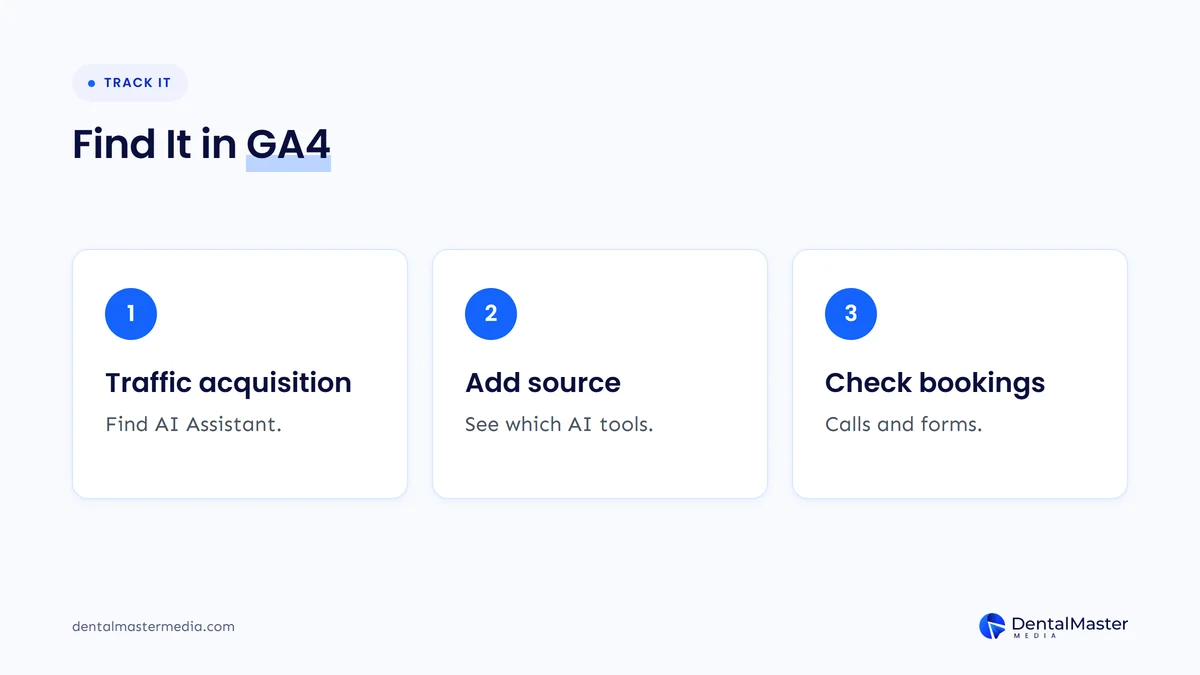
- Open Reports, then Acquisition, then Traffic acquisition. Keep the primary dimension set to Session default channel group and find the AI Assistant row.
- Add Session source as a secondary dimension. This shows which AI tools sent the visits.
- Check landing pages. In an exploration or the Landing page report, filter to the AI Assistant channel to see which pages AI tools link to most.
- Compare with conversions. If you track calls, form fills and online bookings as key events, compare how AI visits convert with organic search visits.
- Review older data in Referral. Before the AI Assistant channel existed, these visits were grouped as Referral, so check sources there for longer trends.
If your site doesn’t track calls and bookings yet, start there. Our guide on tracking calls and bookings from your dental website walks through the setup. For checking how Google itself shows up in your logs and analytics, see our post on how to spot Google Search traffic.
What should dental practices do now?
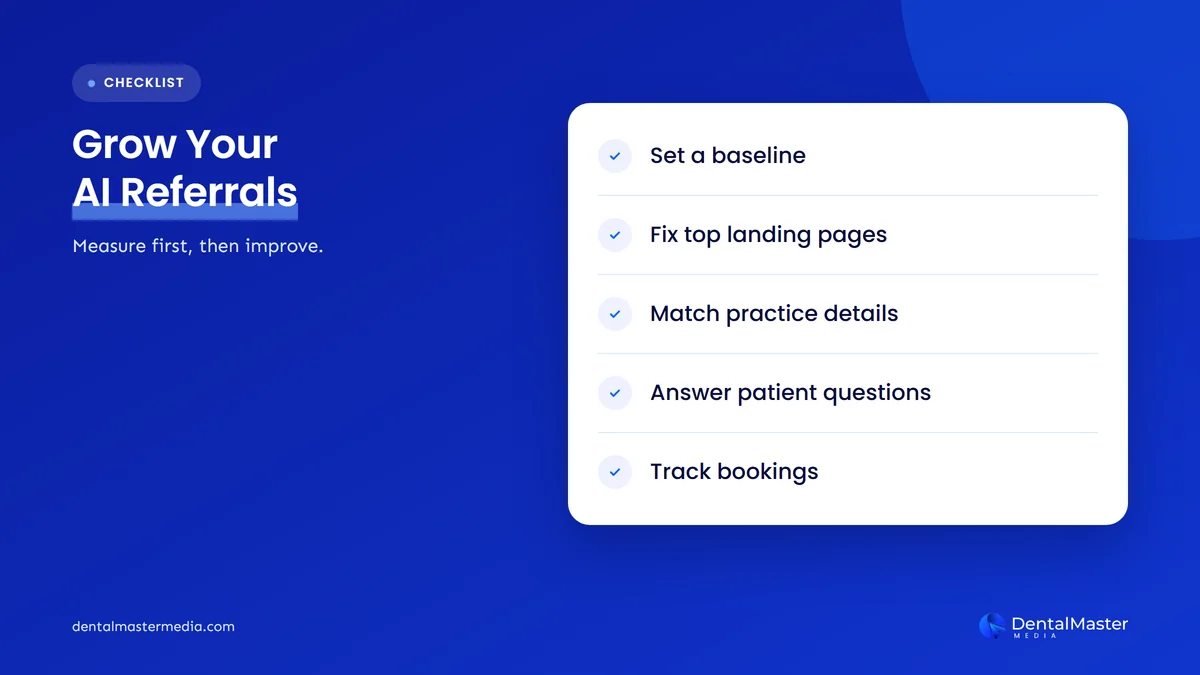
Measure your AI traffic, find the pages that earn it and make your practice easy for AI tools to describe correctly. Keep your expectations in proportion: in the study, Google Search was still the larger source of visits for most sites, so treat AI referrals as an extra source to grow, not a replacement.
Set a baseline this month
Note your AI Assistant sessions, the main sources and the top landing pages for the last 30 days. Compare them with your organic search sessions for the same period to get your own AI-to-organic ratio. Repeat the check each month so you can see the trend rather than one number.
Improve the pages AI tools already link to
Whatever pages appear at the top of your AI landing page list are the ones AI tools trust. Make sure each one opens with a short, direct answer, states which dentist provides the treatment, shows your location and makes calling or booking obvious. A visitor from an AI answer has often already done their research.
Keep your practice details consistent everywhere
AI tools build answers from many sources. If your practice name, address, phone number, hours or dentists differ between your website, your Google Business Profile and directories, an AI answer may get them wrong or skip you. Fix mismatches before you work on anything else.
Write treatment pages that answer real patient questions
Patients ask AI tools specific questions about cost, pain, recovery and suitability. Pages that answer those questions clearly, with local detail, give AI tools something worth citing. Our guide on getting your dental clinic cited by ChatGPT and AI search covers the content side in more depth.
Check your listing inside ChatGPT
Ask ChatGPT about your practice and treatments in your area and see what it says. Note wrong details and fix them at the source. If you haven’t yet, read our news post on how ChatGPT now lets businesses claim their listing.
Judge AI traffic by patients, not visits
The study’s authors are clear that an AI referral is not a conversion. A handful of AI visits that turn into implant or aligner consultations is worth more than a large number that never call. Report on calls, form fills and booked appointments by channel.
What does this study not tell us?
It doesn’t tell us how dental websites perform, which AI tools sent the visits or whether those visits led to patients. It is a descriptive study by a company that sells AI visibility tools, based on its own index of websites, so the findings describe patterns in that sample rather than every website.
- No industry data. The study has no breakdown for healthcare or dental sites.
- No platform list. The article doesn’t say which AI tools were tracked or exactly how referrals were identified.
- No conversion data. One AI visit in a month was enough for a site to count.
- Only established sites. Sites without organic traffic in every month of the period were left out.
- No proven cause. The authors say platform timing suggests explanations but doesn’t establish them.
Even with those limits, the direction is clear enough to act on. Checking your own GA4 data costs nothing and tells you more about your practice than any industry average.
Frequently asked questions
How many websites get traffic from AI tools like ChatGPT?
In SE Visible’s study of 28,500 websites, 79.2% received at least one AI referral visit in September 2026, up from 39.7% in January 2025. Among sites with at least 1,000 organic visits a month, the figure was 99.7%.
Does AI traffic replace Google traffic for dental practices?
No. In the study, the most common level was 2 to 5 AI visits for every 100 organic search visits. Organic search still brought far more visits for most sites, so AI traffic is an extra source to grow rather than a replacement.
Do clicks from Google AI Overviews count as AI traffic in GA4?
Not in the AI Assistant channel. Google says clicks from AI Overviews and AI Mode are included in overall search traffic in Search Console, under the Web search type. Those visits arrive from Google and are reported with your regular Google Search traffic.
Why is my AI Assistant channel empty in GA4?
Your site may get very few AI visits, or some may arrive without referrer details and land in Direct. Visits from before Google added the channel in May 2026 may still sit under Referral. Check the date range and look at Referral sources for older AI visits.
How can a dental practice get more traffic from AI tools?
Keep your practice details consistent across your website, Google Business Profile and directories, and write treatment pages that answer patient questions directly with local detail. Then track which pages AI tools link to and improve those first.
The bottom line
AI referrals are now normal for most websites, but for most of them the numbers are still small next to Google. For a dental practice, the right move is to measure AI traffic in GA4, see which pages earn it and judge it by calls and bookings. Clear treatment pages and consistent practice details help with both Google and AI tools. If you want help building that foundation, see our dental SEO services at Dental Master Media.
Find out where your patients are really coming from
At Dental Master Media, every project starts with an audit. Our free dental SEO audit looks at where your website visits come from, which pages lead to calls and bookings, and what to fix so Google and AI tools describe your practice correctly.
Sources
- SE Visible (SE Ranking), Yulia Deda, “Nearly 80% of websites now get AI traffic, 2x more than in early 2025”, November 12, 2026. https://visible.seranking.com/blog/ai-traffic-adoption-study/
- Google Analytics Help, “What’s new in Google Analytics” (AI Assistant channel, May 13, 2026). https://support.google.com/analytics/answer/9164320?hl=en
- Search Engine Journal, Matt G. Southern, “Google Analytics Adds AI Assistant As Default Channel Group”, May 14, 2026. https://www.searchenginejournal.com/google-analytics-adds-ai-assistant-as-default-channel-group/574974/
- Google Search Central, “AI features and your website”, updated December 10, 2025. https://developers.google.com/search/docs/appearance/ai-features
- Google Search Central, “Identify Google Search traffic in your web analytics or server logs”, November 12, 2026. https://developers.google.com/search/docs/monitor-debug/identify-google-search-traffic

Suraj Rana is the owner of Dental Master Media and a leading expert in SEO for dental practices. With a passion for dental marketing, he has successfully helped numerous dental clinics climb the search engine ranks. Suraj’s expertise makes him a go-to resource for effective, results-driven dental marketing.