Quick answer: Google now appears to show AI Overviews for definition searches fully expanded, with no “Show more” click, so web results sit lower on the page. Google hasn’t confirmed it. For dental practices, simple “what is” treatment pages may lose some clicks, while pages that help patients choose and book locally matter more.
Key takeaways
- Search Engine Roundtable reported on November 11, 2026 that AI Overviews for definition searches now open fully expanded by default, pushing web results below the fold.
- The change was spotted by SEO consultant Glenn Gabe. Google has not confirmed it, so treat it as an observed change that could still shift.
- Patient questions such as “what is a root canal” are the same kind of search. Expect fewer clicks to pages that only define a treatment.
- Google says there are no special optimizations needed to appear in AI Overviews. Clear, accurate, well-structured pages are still what gets cited.
- The searches that bring booked appointments, such as treatment plus your town, cost questions and “near me”, are where to focus effort now.
What changed?
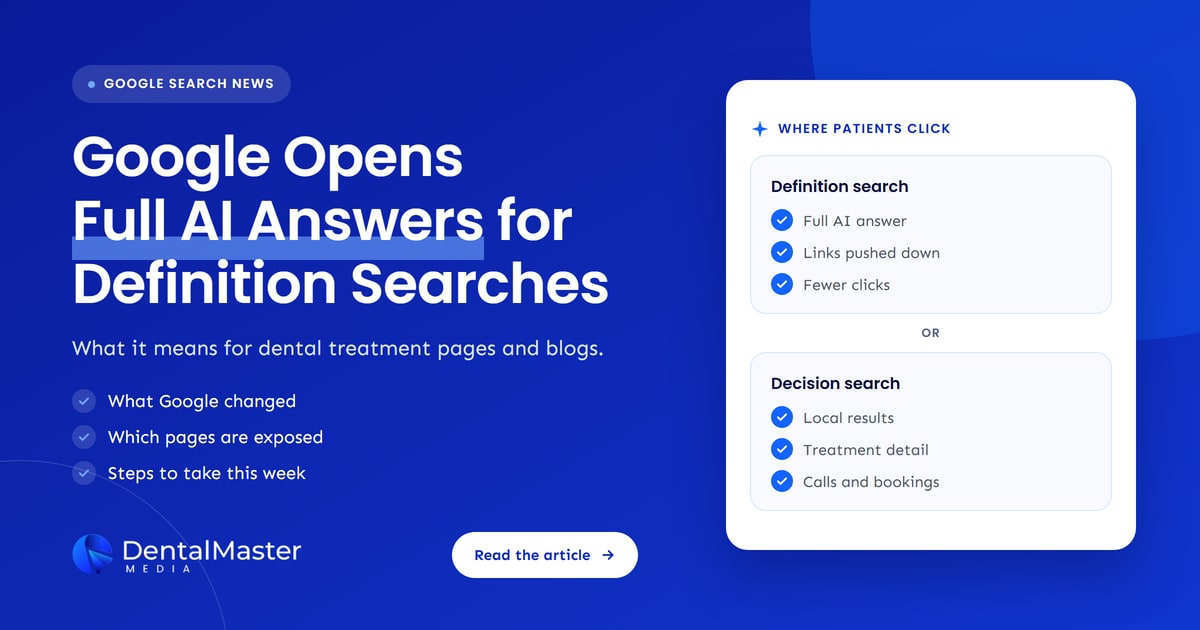
For definition searches, Google now opens the AI Overview fully by default instead of showing a short preview with a “Show more” button. The full answer fills the top of the results page, so searchers must scroll past it to reach any website. This was observed on November 11, 2026, not announced by Google.
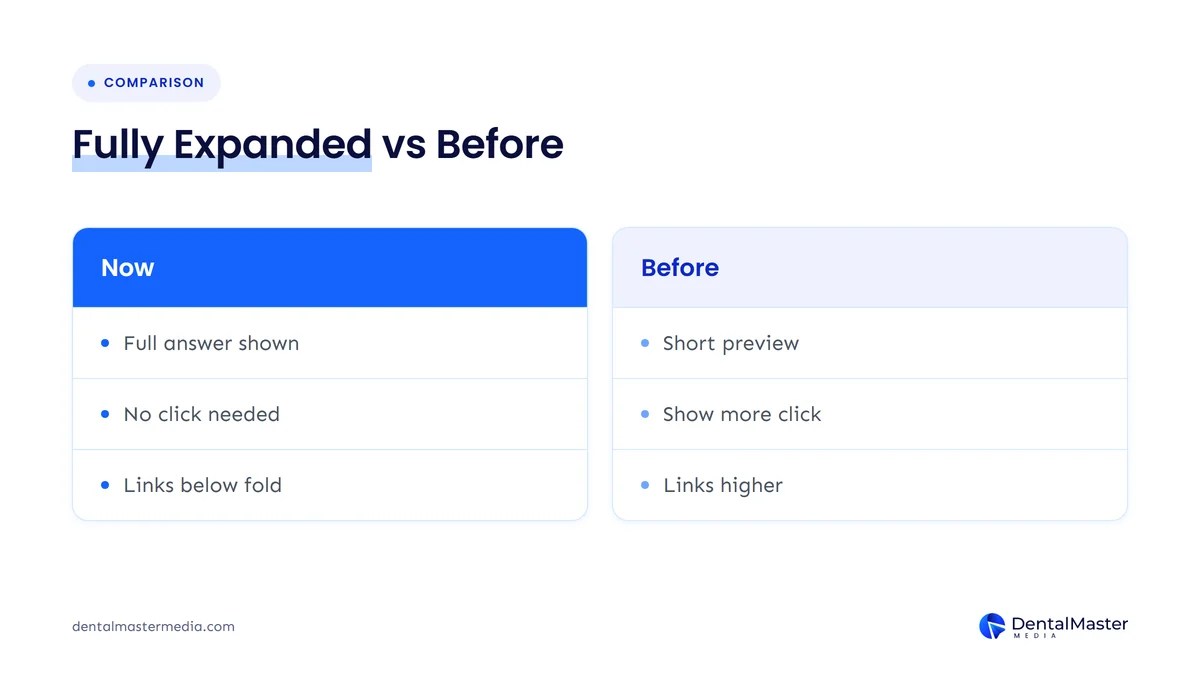
Search Engine Roundtable’s Barry Schwartz reported the change, using the search “define expandable” as an example. In his screenshots, the expanded AI Overview takes up the visible part of the page and the first web result only appears after scrolling. He compared it with the older collapsed version, which needed a “Show more” click to open.
The change was first flagged on X by Glenn Gabe, an SEO consultant who tracks Google search changes closely. He checked saved snapshots of the same results and found the AI Overviews had recently been collapsed or not shown at all. His summary was short:
“Big heads-up for sites providing definitions and meanings.”
Glenn Gabe (@glenngabe) on X, November 11, 2026 (source)
Has Google done this before?
Yes, for some searches. In August 2026, Google confirmed that certain AI Overviews expand automatically for topics where its systems judge a fuller answer to be useful. The November change looks like the same behavior now applied to definition searches as a group, rather than to selected topics.
When Search Engine Roundtable covered the August change, Google’s Robby Stein said AI Overviews only expand dynamically where Google’s systems find it most useful, that the expansion stops if you have already started scrolling, and that Google is always testing and tuning these features. That last point matters: what you see this week may not be what you see next month.
What counts as a definition search?
A definition search is a query where the searcher wants to know what something is or what a word means, such as “define bruxism” or “what is a dental crown”. The intent is to understand a term, not to compare providers or book a visit, so a full on-page answer often satisfies it without a click.
Google hasn’t published a list of which searches it treats as definitions. The reported examples used “define” queries. Patient questions that ask what a treatment or condition is are close cousins, so it is sensible to assume some of them are affected and check your own data rather than guess.
| Type of patient search | Example | Likely effect of a fully expanded AI Overview |
|---|---|---|
| Definition | “what is a root canal”, “define gingivitis” | Most exposed. The full answer may satisfy the searcher before any click. |
| Explainer | “how long does a dental implant last” | Partly exposed, depending on whether Google expands the answer. |
| Decision | “dental implants vs bridge”, “Invisalign cost” | Less exposed. Patients want detail, options and a trusted practice. |
| Local and booking | “emergency dentist near me”, “crowns in [your town]” | Least exposed. These searches lead to maps, calls and booking pages. |
Who is affected?
Any site whose pages mainly explain what terms mean is affected, and many dental websites fit that description in part. Practices with blog posts or glossary pages built around “what is” questions are the most exposed. Practices whose traffic comes mostly from local, treatment and booking searches will notice far less.
Look at where your website traffic actually comes from. Many dental sites have older blog posts such as “What is a dental bridge?” or “What is periodontal disease?” that once pulled in steady visits from all over the country. Those visitors were rarely local, and few of them booked. If those pages lose clicks, your reports may show a traffic drop that has little effect on new patient numbers.
The pages that matter most to a practice are different: treatment pages that explain options, process, costs and recovery in your town, and the pages patients use to call or book. Those are built for searches with a decision behind them, which are less likely to end on Google’s results page.
What does this mean for dental practice websites?
It means a page that only defines a treatment is now worth less as a traffic source, but it can still earn a citation inside the AI answer. The value of your treatment content shifts toward being the source Google quotes, and toward helping patients who are ready to choose a dentist.
Three practical points follow from that:
- Clicks on simple definition pages may fall. If a patient gets a full explanation of a root canal at the top of Google, fewer will click through to read yours.
- Citations still carry your name. AI Overviews show links to the pages they draw from. A clear, accurate explanation on your site can still be one of them.
- Decision-stage content gains weight. Questions about cost, suitability, pain, recovery and who to see in your area need more than a definition, and they bring patients closer to booking.
This doesn’t mean you should delete your explainer pages. Patients who are already on your site still read them, and they support your treatment pages with internal links. It means they should do more than define a term.
How can you check whether your site is affected?
Use the Performance report in Google Search Console. Google includes AI Overview and AI Mode traffic in the normal Web search data rather than a separate report, so filter queries that start with “what is” or “define” and compare clicks and click-through rate before and after November 11, 2026.
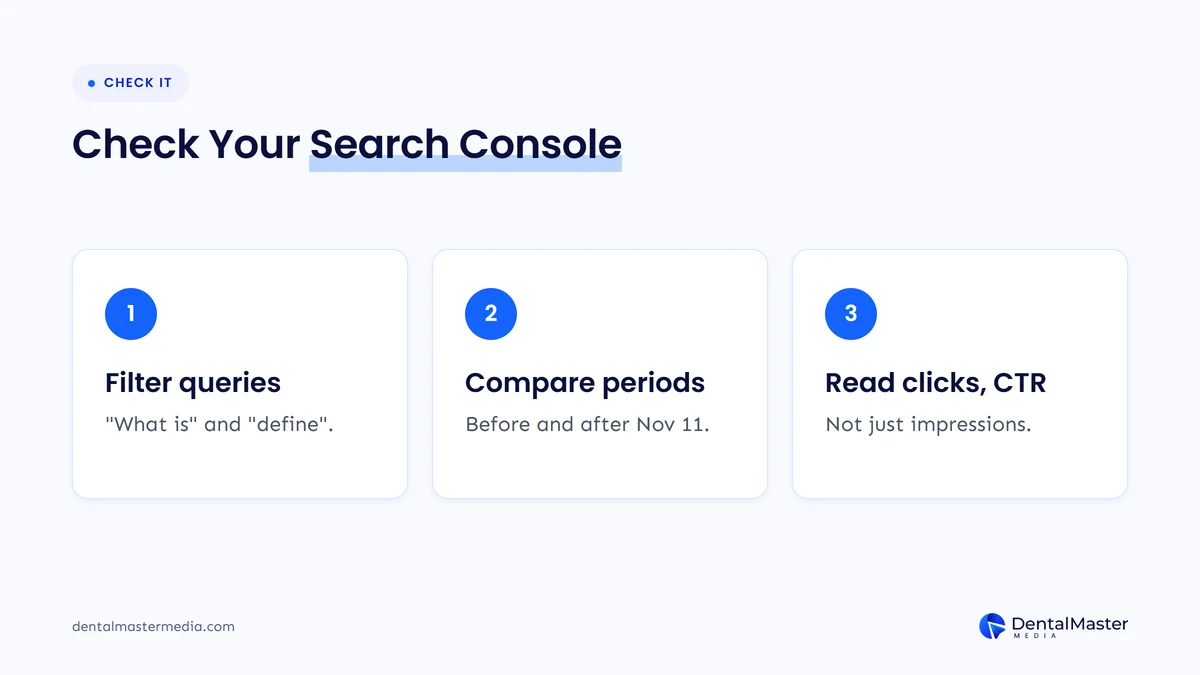
- Open the Performance report for your website and keep the search type set to Web.
- Filter the queries. Use a query filter with a regular expression such as
^(what is|what are|define|meaning of)to isolate definition-style searches. - Compare date ranges. Set a period after November 11, 2026 against an equal period before it. Allow two to four weeks of data so a few quiet days don’t mislead you.
- Look at clicks and click-through rate, not just impressions. If impressions hold steady while clicks and click-through rate fall, the expanded AI answer is a likely cause.
- Check the pages, not just the queries. Switch to the Pages tab to see which posts lost the most clicks, then decide which ones to improve.
Then look at what actually matters: calls, form fills and bookings. If you aren’t tracking those by source yet, our guide on tracking calls and bookings from your dental website shows how to set it up.
What should dental practices do now?
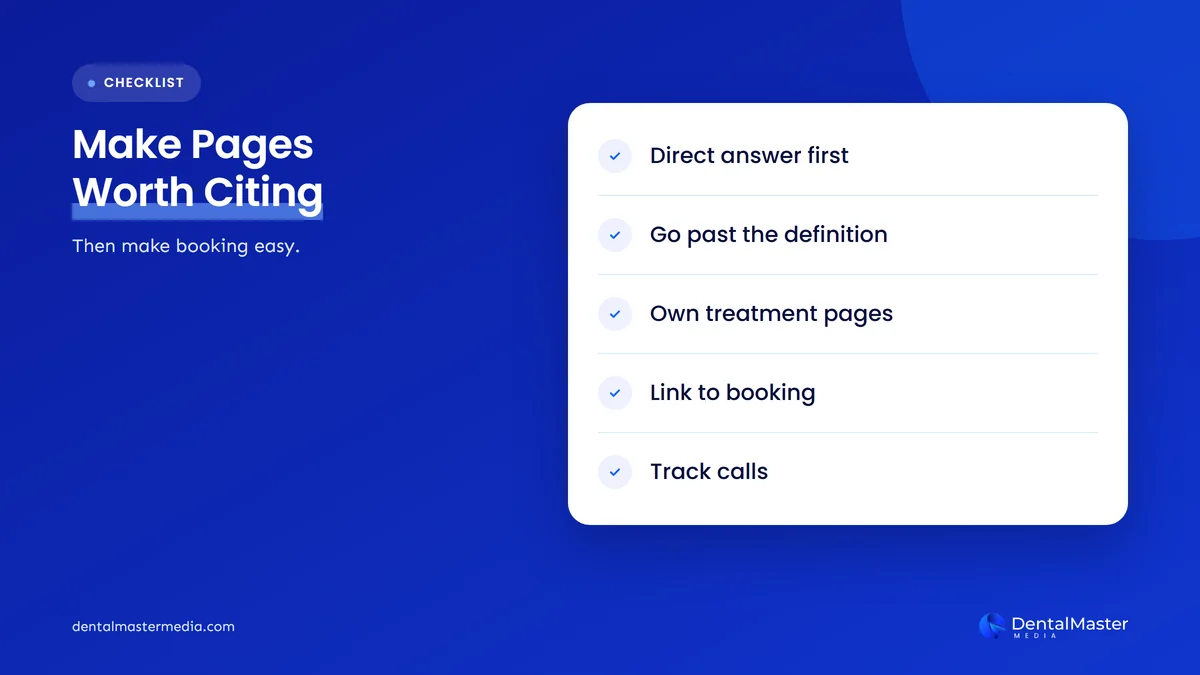
Make your treatment pages easy for Google to quote, move effort toward decision-stage and local content, and judge results by calls and bookings rather than raw traffic. None of this needs special AI markup. Google says the normal SEO basics are what make a page eligible to appear in AI Overviews.
Make your explainer content citable
Open each treatment section with a short, direct answer of two or three sentences, then add detail below. Use question-style headings that match how patients ask, keep facts accurate and current, and name the dentist who reviewed the page. Our guide on writing dental service pages that AI search will cite covers this in more depth.
Go past the definition
A definition is the start of a patient’s question, not the end. Add what Google’s short answer can’t easily give: how the treatment works at your practice, who it suits, what the appointments involve, how recovery goes and what affects the cost. That is the content patients compare practices on.
Give high-value treatments their own pages
If implants, aligners, veneers or emergency care are buried on a single services page, they compete poorly for decision searches. Separate pages with local detail give Google and patients something specific to land on. See our list of dental treatments that deserve their own page.
Link explainers to the pages that convert
Every blog post that explains a term should link clearly to the matching treatment page and to your booking page. Patients who do click through from a definition search are often early in their research, so give them an easy next step. Mapping content to each stage is covered in our dental patient journey content guide.
Don’t block your pages from AI answers
Google offers controls such as nosnippet to limit what it shows from your pages. Using them on treatment pages would also remove your normal search snippets, and you would lose the chance to be cited. For most practices, being the quoted source is the better outcome.
What’s likely next?
Google hasn’t said whether fully expanded AI Overviews will spread beyond definition searches, and it describes these features as constantly tested and tuned. The safest plan is to assume more informational searches will get fuller AI answers over time, and to keep strengthening the local and decision-stage pages that bring patients in.
We will watch how this settles over the coming weeks. If Google confirms the change or extends it to other types of searches, the steps above stay the same: be the source worth quoting, and make the next step to booking obvious.
Frequently asked questions
Has Google confirmed that definition AI Overviews are now fully expanded?
No. The change was spotted by Glenn Gabe and reported by Search Engine Roundtable on November 11, 2026. Google has not made a statement about it. In August 2026, Google said AI Overviews expand automatically only where its systems find it most useful, and that it keeps testing these features.
Should I delete the “what is” posts on my dental blog?
No. They still help patients already on your site and support your treatment pages through internal links. Improve them instead: add a short direct answer, link to the matching treatment and booking pages, and add local detail that a general AI answer can’t give.
Can my dental website still appear in an AI Overview?
Yes. AI Overviews show links to the pages they draw from. Google says a page needs to be indexed and eligible to show with a snippet in Search, and that there are no extra requirements or special optimizations needed to appear in AI Overviews or AI Mode.
Will this change affect my Google Maps or local rankings?
The reported change is about definition searches, not local searches. Searches such as “dentist near me” or “dental implants in [town]” have a different intent and usually show local results. Your Google Business Profile and treatment pages remain the main drivers of local visibility.
How do I see AI Overview traffic in Search Console?
Google doesn’t split it out. Clicks and impressions from AI Overviews and AI Mode are included in the Performance report under the Web search type. To spot an effect, filter definition-style queries and compare clicks and click-through rate across matching date ranges.
The bottom line
Google appears to be giving definition searches a full AI answer at the top of the page, which means fewer clicks for pages that only explain what a treatment is. For a dental practice, that traffic was rarely where new patients came from. Make your explanations clear enough to be cited, put more effort into local and decision-stage treatment pages, and measure success by calls and bookings. If you want help focusing your website on the searches that bring patients in, see our dental SEO services at Dental Master Media.
Find out which of your pages still bring in patients
At Dental Master Media, we start every project with an audit. Our free dental SEO audit shows which of your pages are losing clicks, which searches lead to calls and bookings, and which treatment pages need work so Google and AI answers can cite them.
Sources
- Search Engine Roundtable, “Google Search AI Overview Definitions Expanded By Default”, November 11, 2026. https://www.seroundtable.com/google-expanding-definitions-42514.html
- Glenn Gabe (@glenngabe) on X, post on definition AI Overviews expanded by default, November 11, 2026. https://x.com/glenngabe/status/2120599408714584424
- Search Engine Roundtable, “Google AI Overviews Pushing Searchers Into AI Mode, Drops Show More Button”, August 28, 2026. https://www.seroundtable.com/google-ai-overviews-push-ai-mode-responses-41974.html
- Google Search Central, “AI features and your website”, updated December 10, 2025. https://developers.google.com/search/docs/appearance/ai-features

Suraj Rana is the owner of Dental Master Media and a leading expert in SEO for dental practices. With a passion for dental marketing, he has successfully helped numerous dental clinics climb the search engine ranks. Suraj’s expertise makes him a go-to resource for effective, results-driven dental marketing.