Quick answer: A veneers and cosmetic dentistry page should include a plain definition of veneers, porcelain and composite options with cost and lifespan ranges, who is a candidate, the visit-by-visit process, honest before-and-after photos, the treating dentist’s credentials and a visible consultation request. It should load fast and make no outcome promises.
Key takeaways
- A cosmetic dentistry page is the hub for smile treatments on a dental practice website, and a veneers page is the dedicated treatment page that sits under it.
- The page needs 9 parts: overview, materials, candidacy, process, cost and financing, credentials, photos and reviews, questions answered and a consultation request.
- Porcelain veneers cost $900 to $2,500 per tooth and last 10 to 20 years, while composite veneers cost about $800 to $1,100 per tooth and last 5 to 7 years, according to WebMD (2023).
- Before-and-after photos and reviews must be real, permitted by the patient and not presented as typical results the practice cannot support.
- The page ranks when it has its own URL, descriptive alt text on every image and passing Core Web Vitals, which means an LCP of 2.5 seconds or less.
- The page converts when a consultation request button appears at the top and again after the cost section and the photo gallery.
What is a veneers and cosmetic dentistry page?
A cosmetic dentistry page is the page on a dental practice website that explains smile-improving treatments to local patients and invites them to book a consultation. A veneers page is the same kind of page for one treatment. The American Dental Association’s MouthHealthy site defines dental veneers as custom-made, natural-looking coverings for your teeth that cover only the front surface of a tooth, unlike crowns, which cover the entire tooth.
Veneers can improve teeth that are chipped or broken, stained, or crooked or misshapen, and they can mask gaps in the smile, according to the American Dental Association. The veneers page is often where a patient compares materials, prices and dentists before calling the practice.
The cosmetic dentistry page works as a hub that introduces every smile treatment in the practice, and each high-value treatment links down to its own treatment page. Our dental SEO services start from this structure because a treatment that has its own URL, title and answers can rank and convert better than one paragraph on a general page.
What should a cosmetic dentistry page include?
A cosmetic dentistry page should include 9 parts: a veneers overview, a material comparison, candidacy, the process, cost and financing, the dentist’s credentials, before-and-after photos and reviews, answers to patient questions and a consultation request. Each part answers a question a patient would otherwise phone the practice to ask. The 9 parts are listed below in the order a patient reads them.
- Veneers overview: what a veneer is and which problems it treats.
- Material comparison: porcelain veneers and composite veneers side by side.
- Candidacy: who is a good candidate and who is not.
- Process: the visits from consultation to final placement.
- Cost and financing: a price range, what the fee includes and the payment options.
- Credentials: the name, training and experience of the treating dentist.
- Photos and reviews: real cases and patient feedback shown within advertising rules.
- Patient questions: short answers on discomfort, upkeep and permanence.
- Consultation request: a button, phone number and form that are easy to find.
Parts 1 to 5 build understanding, parts 6 and 7 build trust and parts 8 and 9 start the booking. If you want the wider marketing picture around this page, read our guide to marketing cosmetic dentistry, which covers veneers and whitening.
What should the veneers explanation cover?
The veneers explanation should state what a veneer is, which problems it treats and how porcelain veneers differ from composite veneers. The American Dental Association says porcelain veneers are thin custom-made shells that are strong, long-lasting and natural-looking, and they tend to cost more. Composite veneers are made from tooth-colored filling material bonded to the tooth, may need less enamel removal and fewer visits, are easier to repair and are less resistant to stains and wear.
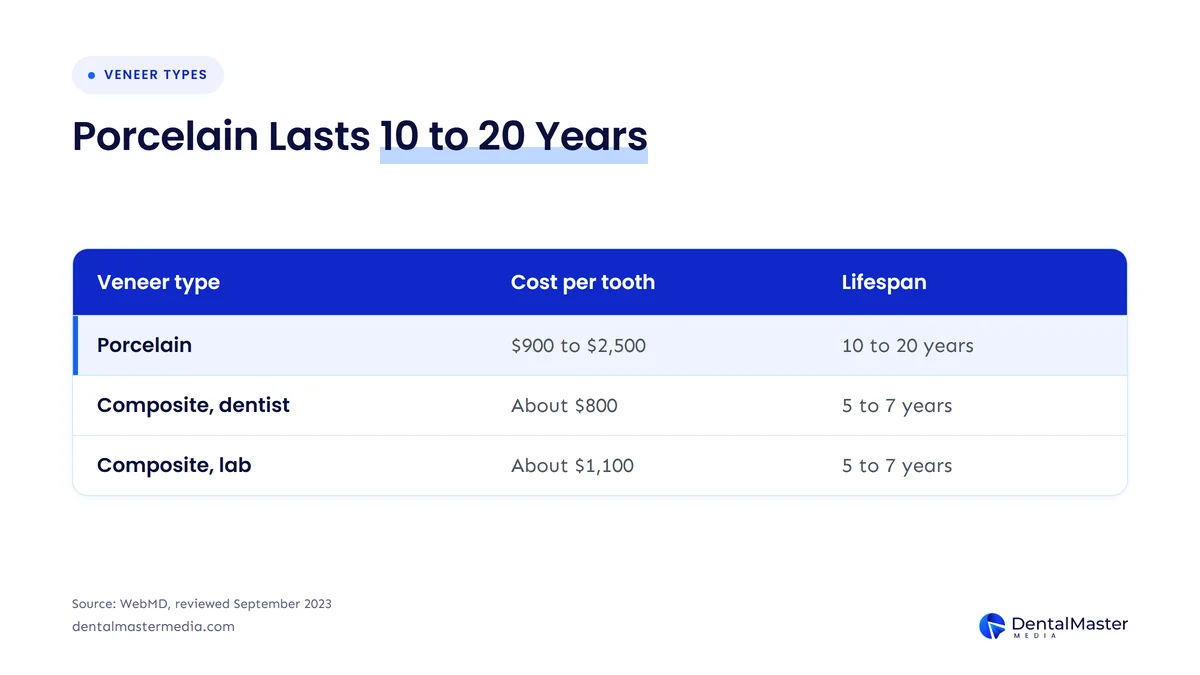
| Attribute | Porcelain veneers | Composite veneers | Source |
|---|---|---|---|
| Cost per tooth | $900 to $2,500, average about $1,500 | About $800 placed by the dentist, about $1,100 made in a lab | WebMD, reviewed September 7, 2023 |
| Lifespan | 10 to 20 years | 5 to 7 years | WebMD, reviewed September 7, 2023 |
| Visits | Usually 3: 1 consultation and 2 to make and place | Some are finished in 1 visit | WebMD, reviewed September 7, 2023 |
| Enamel removal | Enamel roughly equal to the veneer’s thickness | May need less | WebMD; American Dental Association |
| Stain and wear resistance | Strong and long-lasting | Less resistant to stains and wear | American Dental Association |
The table shows that porcelain veneers cost more per tooth and last roughly 2 to 3 times longer, while composite veneers cost less and are easier to repair. Show both materials on the veneers page and say that the dentist recommends one after an exam.
Who is a good candidate for veneers?
A good candidate for veneers has healthy teeth and gums and enough enamel, and a dentist confirms this at an exam. The American Dental Association says decay and gum disease must be treated first, and that veneers may not suit people who clench or grind their teeth or have a deep overbite. The 4 candidacy points a veneers page should state are listed below.
- Healthy teeth and gums: decay and gum disease are treated before veneers are placed.
- Enough enamel: WebMD lists too little enamel and teeth weakened by decay, fracture or large fillings as reasons veneers may not fit.
- Controlled grinding: clenching or grinding can chip or crack porcelain, so the dentist checks for it.
- Cosmetic goals: veneers are considered cosmetic, so insurance may not cover them unless they are medically necessary.
The page should also say that veneer treatment is not reversible, because enamel is removed, as the American Dental Association explains.
What should the process section show?
The process section should show the steps from consultation to final bonding and the number of visits, which WebMD puts at 3 for most porcelain cases: 1 consultation and 2 to make and place the veneers. Some composite veneers are finished in 1 visit. The 4 steps to describe on the page are listed below.
- Describe the consultation: the exam, the questions the dentist asks and the goals the patient shares.
- Explain the preparation: how the teeth are prepared and how the shape and shade of each veneer are planned.
- Show the placement visit: how the veneers are fitted and bonded, and how long the appointment lasts at your practice.
- List the aftercare: the follow-up visit, cleaning advice and a night guard if the patient grinds.
Your own protocol sets the order and timing, so write the section from how your dentist actually works.
How should the page present cost and financing?
The page should present a price range per tooth, state what the fee includes and list the payment options, with a date beside every number. WebMD reports porcelain veneers at $900 to $2,500 per tooth, averaging about $1,500, and composite veneers at about $800 to $1,100 per tooth. Those are general ranges, so publish your own range only if you can keep it accurate and current. The 4 cost points a veneers page should cover are listed below.
- Price range per tooth: one range for porcelain veneers and one for composite veneers, with the date it was last checked.
- Fee contents: the consultation, planning, the veneers themselves and the follow-up visit, listed one by one.
- Payment options: monthly plans, third-party financing and accepted cards, if the practice offers them.
- Insurance: WebMD says insurance usually does not cover veneers placed for cosmetic reasons, so say so plainly.
This cost and financing section also captures searches such as “how much are veneers”, which patients type before they pick a dentist.
Who should the page name as the treating dentist?
The page should name the dentist who plans and places the veneers, with a photo, training and years of cosmetic experience. The American Dental Association says treatment should be done by a licensed dentist, and patients want to know who that person is before they book. State only the training and credentials the dentist actually holds, and leave out words such as “best” or “top”.
How do before-and-after photos and reviews fit on a cosmetic dentistry page?
Before-and-after photos and reviews belong on a cosmetic dentistry page when they are real, shared with the patient’s written permission and not presented as typical results the practice cannot support. The American Dental Association’s Principles of Ethics ask whether an ad, judged as a whole, is false or misleading in any material respect, and photos are judged by the same test.
The Federal Trade Commission’s Health Products Compliance Guidance adds 2 rules that apply to testimonials. A testimonial cannot be used to make a claim the advertiser could not make directly, and a result more dramatic than typical needs a clear disclosure of what a typical patient can expect. The Federal Trade Commission says a label such as “results not typical” does not cure a deceptive testimonial. The American Dental Association also notes that a photo or video of a patient may be protected health information, so privacy rules apply to a photo gallery. The 5 rules for a photo gallery are listed below.
- Show only your own cases: publish before-and-after photos of treatment your dentist performed, never stock photos or manufacturer images.
- Get written permission: ask each patient to sign before you publish a photo, and ask your privacy officer or attorney for the form.
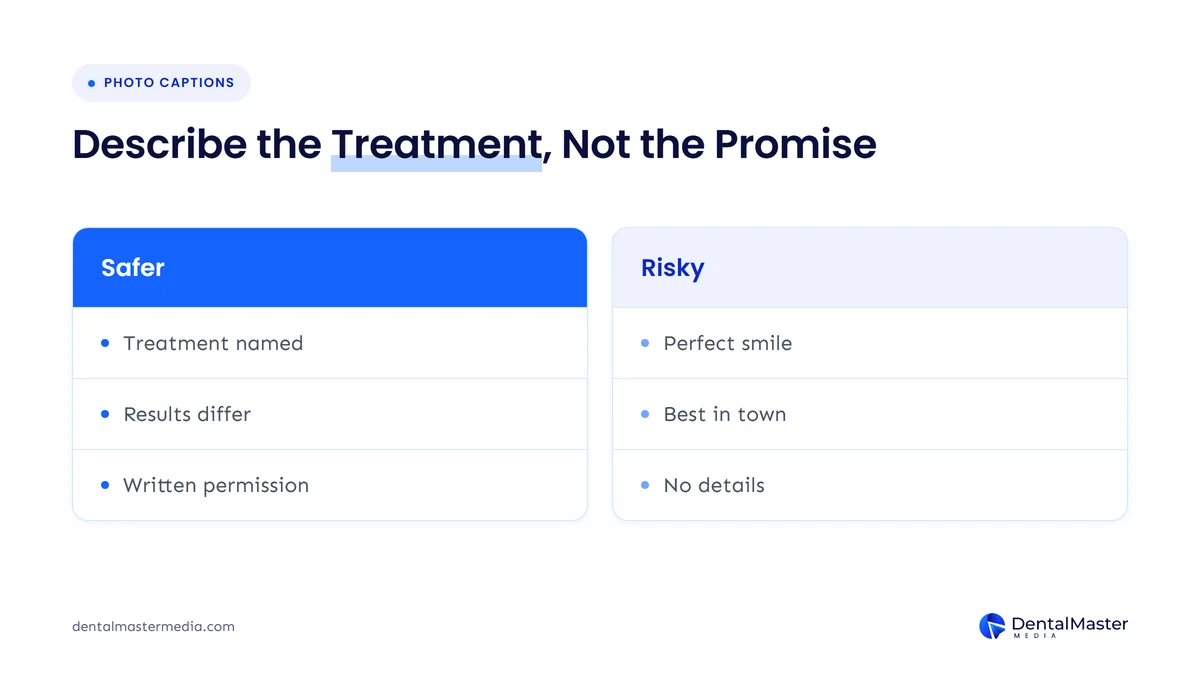
- Label every case: name the treatment, say how many teeth were treated and state that results differ between patients.
- Keep the photos honest: use the same lighting and angle before and after, and do not retouch the images.
- Write captions without promises: describe what was done, not what the patient will get.
The table below shows how to reword the claims that cause the most trouble on a cosmetic dentistry page.
| Risky wording | Safer wording |
|---|---|
| “Perfect smile in one visit” | “Treatment time depends on your case. Your dentist explains the number of visits after an exam.” |
| “Veneers that last a lifetime” | “Porcelain veneers last 10 to 20 years according to WebMD, and any veneer may chip, crack or loosen.” |
| “The best veneers dentist in town” | “Our dentist lists the veneer training completed and the year placing veneers began.” |
| A before photo and an after photo with no details | A caption with the treatment, the number of teeth and a note that results differ between patients |
State dental boards can set stricter advertising rules than these, so have your compliance lead or attorney review the final page before it goes live.
How do you build a cosmetic dentistry page so it ranks on Google?
You build a cosmetic dentistry page to rank on Google by giving each treatment its own crawlable URL, a title and H1 in the patient’s words, descriptive alt text on every image and Core Web Vitals that pass. Google Search treats the page like any other page, so the basics decide whether the veneers page can be found. A title such as “Veneers in Your City | Practice Name” matches how patients search.
Image handling matters most on a cosmetic page, because the gallery is the heaviest part. Google Search Central says alt text is the most important attribute for image metadata, that file names should be short but descriptive and that Google finds images through the src attribute of HTML img elements. Google Search Central also says Google does not index CSS images, so a gallery built from CSS background images is invisible to image search.
Google’s Core Web Vitals measure how fast and stable the page feels, and a gallery of large photos can push a page past the limits. Web.dev lists the 3 thresholds in the table below, measured at the 75th percentile of page loads.
| Core Web Vitals metric | What it measures | Good threshold |
|---|---|---|
| Largest Contentful Paint (LCP) | Loading speed | 2.5 seconds or less |
| Interaction to Next Paint (INP) | Responsiveness | 200 milliseconds or less |
| Cumulative Layout Shift (CLS) | Visual stability | 0.1 or less |
The table shows the 3 limits a veneers page must pass, and you can check them for your own page in Google Search Console. Set a width and height on every gallery image so the layout does not jump, and compress photos before upload.
Two more steps help the page rank. Link to the veneers page from the cosmetic dentistry page and the main menu, as we explain in our guide to what a dental homepage should include. Then add the page URL to the services section of your Google Business Profile, so the profile and the page tell the same story.
How do you turn cosmetic dentistry page visitors into consultation requests?
You turn cosmetic dentistry page visitors into consultation requests by placing a request button on the first screen, repeating it after the cost section and the photo gallery, and keeping the form to the fields needed to book. A patient who has read the price and seen real cases is ready to act, so the button must be there at that moment.
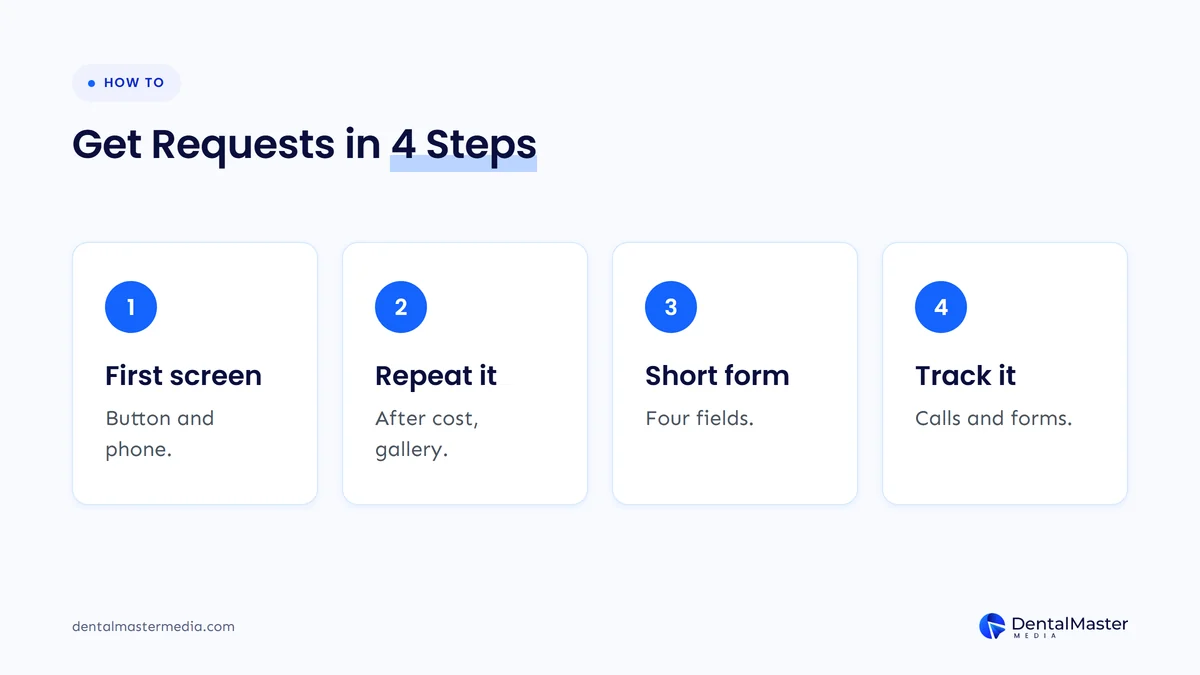
The 4 steps to build the consultation request are listed below.
- Place a button on the first screen: use a clear label such as “Request a veneers consultation” next to a tap-to-call phone number on mobile.
- Repeat the button after the cost section and the gallery: each placement catches patients at a different stage of the decision.
- Keep the form short: ask for name, phone number, email and a preferred time, and nothing a patient has to look up.
- Track every consultation request: count calls and form submissions separately so you can see which section produces them.
If your practice takes online appointments, connect the same booking path to your profile, as we explain in our post on Google Business Profile booking links.
Should every cosmetic treatment have its own page?
Yes, a high-value treatment such as veneers should have its own page, and other cosmetic treatments such as teeth whitening and clear aligners should get one when they have distinct patient questions and search demand. A treatment that cannot fill a page with its own answers can stay as a section on the cosmetic dentistry page.
Which treatments earn a page, and how to order them, is a larger question than this checklist covers. Our guide on dental treatments that deserve their own page explains how to decide.
Frequently asked questions
Should a veneers page list prices?
Yes, a veneers page should give a price range per tooth or explain the factors that set the price. WebMD reports porcelain veneers at $900 to $2,500 per tooth in its 2023 review, so patients already expect numbers. Date your own range, say what the fee includes and list your payment options.
Can a cosmetic dentistry page use before-and-after photos?
Yes, a cosmetic dentistry page can use before-and-after photos when they show your own patients’ treatment, the patient gave written permission and each case is labeled with the treatment and a note that results differ. Avoid captions that promise an outcome, because the Federal Trade Commission treats testimonials the same way as direct claims.
Do porcelain and composite veneers need separate pages?
No, one veneers page can cover porcelain veneers and composite veneers, because the American Dental Association describes both as types of veneers. Compare them in one table, as above. Create a separate page only if the practice offers a distinct treatment, such as a full smile makeover, with its own patient questions.
Can a cosmetic dentistry page promise a perfect smile?
No, a cosmetic dentistry page should not promise a perfect smile or any specific result. The American Dental Association’s test is whether an ad is false or misleading in any material respect, and a promised outcome is hard to support. Describe the treatment and the dentist’s process, and let the photos and reviews speak for themselves.
How do I know whether the veneers page brings in consultations?
You know by tracking consultation requests from calls and forms and comparing them with the visits the page receives in Google Search Console. Record the number of requests each month and which button or phone number produced them.
Our guide to call tracking for dental practices explains how to set this up, and our guide to the clear aligner page shows the same tracking on another treatment page.
A veneers page that ranks and books consultations
A veneers and cosmetic dentistry page earns consultations when it explains veneers in plain words, compares porcelain veneers and composite veneers with real cost and lifespan ranges, states who is a candidate, shows the process, names the dentist, uses real photos within advertising rules, loads within Core Web Vitals limits and offers a consultation request at every decision point. It makes no outcome promises.
At Dental Master Media, building treatment pages that rank and convert is a core part of our dental SEO services.
See how your cosmetic dentistry page performs
Our free dental SEO audit reviews your veneers and cosmetic dentistry pages the way patients and Google read them. It checks your content, photo gallery, page speed and booking path, and shows which fixes will bring in more consultation requests first.
Sources
- American Dental Association, MouthHealthy, “Veneers”, accessed November 19, 2026. https://www.mouthhealthy.org/all-topics-a-z/veneers
- WebMD, “Veneers: What They Are, Types and Costs”, medically reviewed September 7, 2023. https://www.webmd.com/oral-health/guide/veneers
- American Dental Association, “Marketing and Advertising”, accessed November 19, 2026. https://www.ada.org/en/resources/practice/legal-and-regulatory/marketing-and-advertising
- Federal Trade Commission, “Health Products Compliance Guidance”, December 2022. https://www.ftc.gov/business-guidance/resources/health-products-compliance-guidance
- Google Search Central, “Google Image SEO Best Practices”, accessed November 19, 2026. https://developers.google.com/search/docs/appearance/google-images
- web.dev, “Web Vitals”, last updated October 31, 2024. https://web.dev/articles/vitals

Suraj Rana is the owner of Dental Master Media and a leading expert in SEO for dental practices. With a passion for dental marketing, he has successfully helped numerous dental clinics climb the search engine ranks. Suraj’s expertise makes him a go-to resource for effective, results-driven dental marketing.