Quick answer: Yes, a dental website should show prices for its standard services, as a price range with what is included, and leave full fee schedules and patient-specific quotes for the consultation. In 2025, 12.9% of people in the US skipped needed dental care because of cost, the highest of any care type, and a price page speaks to that barrier.
Key takeaways
- Showing prices on a dental website means publishing a starting price or price range for common services, with what is included and what changes the final fee.
- A dental website should show prices: dental care had the highest cost barrier of any care type in 2025, at 12.9% of people, against 5% for medical care.
- Publish 5 to 8 standard services, financing and the insurance plans you accept. Leave out patient-specific quotes, insurance-adjusted amounts and a full fee schedule.
- Published prices help patients plan, give Google original local content, and give AI answers a figure from your practice instead of someone else’s.
- The American Dental Association says ads must be truthful and substantiated, and 47% of patients now use AI to research providers, so every posted price must be accurate and dated.
- A price page works best next to a booking path: a clear call to action, an insurance estimate request and a Google Business Profile that shows the same prices.
What does it mean for a dental website to show prices?
Showing prices on a dental website means publishing what a treatment costs at your dental practice, in a form a patient can read before calling. The form can be a fixed fee, a starting price, a price range, or a statement of how the practice produces a quote.
A price page is the single page of a dental website that holds those figures, grouped by service, with what is included and the factors that move the final treatment cost. Patients read it when they compare practices, and the same text can be read by Google and by AI tools that answer cost questions.
Deciding which prices belong on that page is a content decision, so it sits inside the planning we do as part of our dental SEO services, next to service pages, Google Business Profile and tracking.
What are the 4 ways to show prices on a dental website?
A dental website can show prices in 4 ways, and most practices use a mix of them. The 4 ways to show prices are listed below, from the most specific to the least.
- Fixed fee: one price for a service with a set scope, such as an exam or a cleaning, with what is included written beside it.
- Starting price: a “from” figure for a service that varies, with the factors that raise it.
- Price range: a low and a high figure for a treatment, based on the cases the practice has actually charged.
- Estimate process: no figure, but a clear description of how a patient gets an insurance estimate or a written quote, and how long it takes.
The first 3 forms show a number. The fourth shows none, and it is the weakest of the 4 for patients who are comparing practices.
Should a dental website show prices?
Yes, a dental website should show prices for its standard services, as a starting price or price range, because cost is the main reason people skip dental care. The ADA Health Policy Institute found that 12.9% of people in the US went without needed dental care in 2025 because of cost, and the table below sets that number beside the other figures behind this advice.
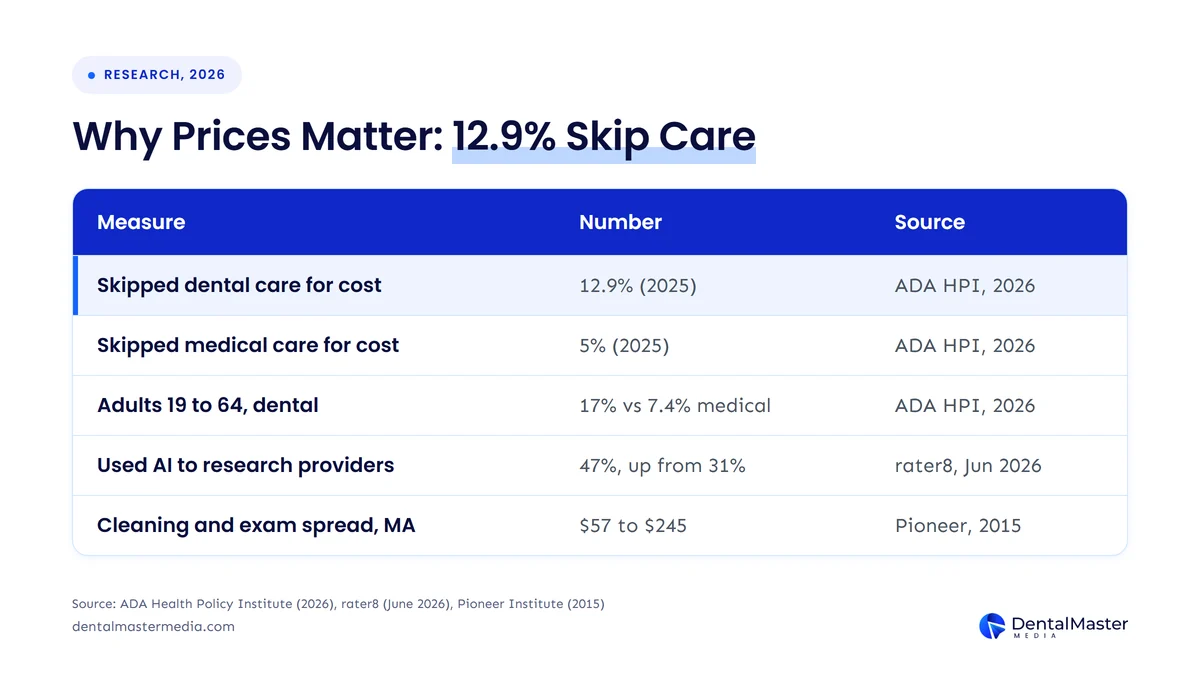
| Measure | Number | Source and date | What it means for a price page |
|---|---|---|---|
| Skipped needed dental care because of cost, 2025 | 12.9% of people | ADA Health Policy Institute analysis of the National Health Interview Survey, reported by Becker’s Dental, 2026 | Cost is a barrier before the first call |
| Skipped needed medical care because of cost, 2025 | 5% | Same analysis | Dental has the highest cost barrier of any care type |
| Adults 19 to 64 who skipped dental care because of cost | 17%, against 7.4% for medical care | Same analysis | Working-age patients are the most price-sensitive group |
| Patients who used AI to research a provider | 47%, up from 31% at the end of 2025 | rater8 survey, reported by TechTarget, June 3, 2026 | AI answers are now part of the search path |
| Cleaning and exam price spread in Massachusetts | $57 to $245, most $150 to $200 | Pioneer Institute call test, reported by Dentistry Today, August 17, 2015 | Patients meet large price gaps, so a missing price is a gap they fill elsewhere |
The table shows that cost keeps patients away from dental care, that AI tools are a growing research route, and that the same service can differ by more than $180 between practices. The 2015 figure is the oldest in the table and is shown only to illustrate the size of the spread.
The ADA Health Policy Institute reported the same pattern within age groups: 10.9% of adults 65 and older and 3.8% of children skipped dental care because of cost, and dental had the highest cost barrier in both groups.
What prices should a dental website publish?
A dental website should publish a starting price or price range for the 5 to 8 services patients ask about most, plus what is included, the financing options and the insurance plans the practice accepts. Start with the services your front desk quotes by phone every week.
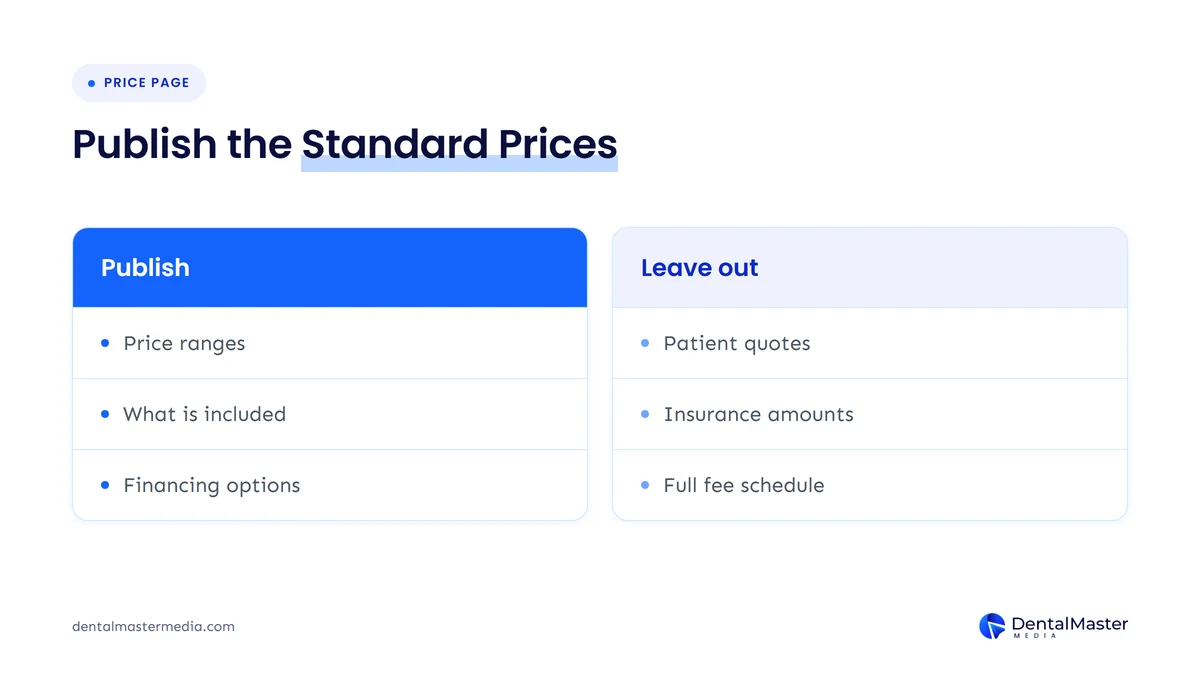
The 6 items worth publishing on a price page are listed below.
- Standard service prices: a starting price or price range for an exam, cleaning, X-rays, whitening, fillings and crowns, based on your own fee schedule.
- What is included: the visits, imaging and materials inside each price, so a patient can compare like with like.
- What changes the price: the factors that move a treatment cost, such as the number of teeth, the material and whether a specialist is needed.
- Insurance plans accepted: the plan names you work with and a plain line that the plan decides what the patient pays.
- Financing and payment plans: the monthly payment options, with the provider named.
- Membership plan prices: the yearly or monthly fee, if the practice runs an in-house plan for patients without insurance.
What prices should a dental website leave out?
A dental website should leave out any price that only an exam can set, because a wrong figure on a public page becomes a promise a patient can quote back. The 4 kinds of price to keep off the page are listed below.
- Patient-specific quotes: a full-mouth or implant case depends on the exam, and the page should invite a consultation for it.
- Insurance-adjusted amounts: what a plan pays is set by the plan, so the page should point to an insurance estimate instead.
- The full fee schedule: a list of every code and fee gives patients a document they cannot interpret without the treatment plan.
- Unsubstantiated price claims: phrases such as “lowest prices in town” need evidence you can show, so leave them out.
How do published prices affect patients?
Published prices help patients decide before they call, because they show the likely treatment cost and remove the guess that stops 12.9% of people from booking needed care. A patient who has seen a price range arrives with a budget, and the front desk starts the conversation at the treatment, not at the cost.
Insurance is the reason a range works better than a single figure. In a letter to Congress dated July 1, 2026, the American Dental Association said that “dental plans rather than dental practices control many of the factors that determine a patient’s financial responsibility.” A price page that states the practice’s fee and says the plan sets the patient’s share is accurate on both counts.
The same page also filters the inquiry. A patient who reads a price range for a crown and still calls has accepted the scale of the treatment cost, which makes the consultation shorter and the booking more likely to hold.
How do published prices affect SEO?
Published prices give a dental website original local content, but no Google document says that listing prices is a ranking factor. Google Search Central’s guide on generative AI features, published May 15, 2026, says unique, valuable content will likely influence a site’s presence in Google’s AI features more than any other suggestion, and the guide does not mention pricing.
A fee range based on your own fee schedule is non-commodity content in Google’s terms: no other practice can copy it, because no other practice charges your fees. A competitor page that says “call for pricing” offers nothing a searcher could not read anywhere else.
The same guide warns against large numbers of pages made mainly to match query variations, which can violate Google’s scaled content abuse policy. Write one price page, not 40 near-identical pages for each treatment and suburb, and make it part of a dental website design that links to each service page.
How do published prices affect AI answers?
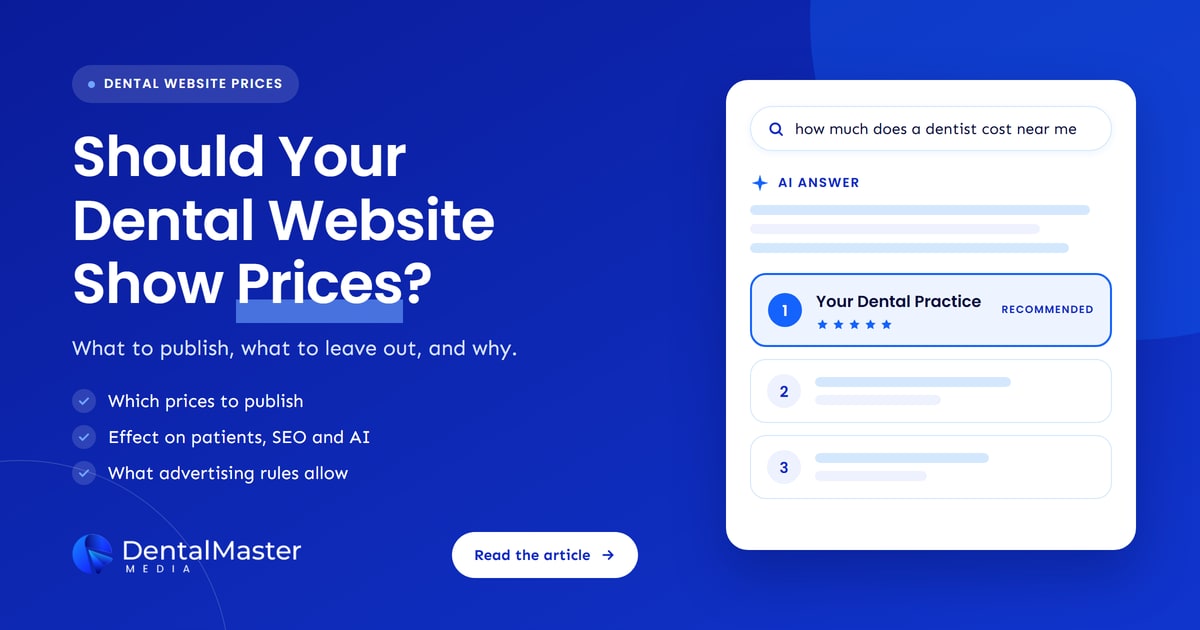
Published prices give AI answers a figure from your dental practice, while a practice with no price page leaves ChatGPT, Google AI Overviews and similar tools to take a figure from another source. A rater8 survey reported by TechTarget on June 3, 2026 found that 47% of patients used AI to research providers, up from 31% at the end of 2025.
The accuracy risk is documented. Of the 465 respondents in that survey who had used AI to research a provider, two-thirds said they had met incorrect provider information, and 60% said they trust AI summaries without verifying them. A clear, dated price page on your own website is the source an AI tool can quote correctly.
The page should be plain text a crawler can read, not an image of a price list or a PDF. Google’s guide says no special markup or schema.org structured data is required for its generative AI features, so headings, short paragraphs and a table of services are enough. Our guide on how to get your dental clinic cited by ChatGPT and AI search covers the wider steps.
What do advertising rules say about prices on a dental website?
Advertising rules say a price on a dental website must be truthful, not misleading and supported by evidence. The American Dental Association’s marketing guidance cites the Federal Trade Commission Act: “Advertising must be truthful and non-deceptive,” and every state has laws against false or unsubstantiated claims in dental advertising.
The ADA guidance adds 3 specific points that apply to a price page, as listed below.
- Former prices: a “was” price in an offer must be a price the practice actually charged on a regular basis.
- Competitor comparisons: a comparison with another practice’s fees must reflect the prices that practice actually charges.
- Fee and discount ads: multiple states regulate fee and discount advertising, so check your state dental board’s rules before you publish an offer.
Rules differ by country. Massachusetts passed a transparency law in 2012 that requires providers to disclose a price within 2 business days when a patient asks. In Ireland, the Dental Council’s code on display of fees took effect on June 1, 2011 and requires private fees for a set list of treatments, with a minimum and maximum where the fee varies.
The ADA also questions hospital-style fee posting. In a June 9, 2026 letter to the House Energy and Commerce Committee about the Patients Deserve Price Tags Act, it argued that posting full fee schedules “may in fact hinder clear pricing information,” and asked for real-time, patient-specific cost information from dental plans instead. That position supports the range-plus-estimate approach above: a price range gives patients a starting point, and the plan or the exam gives the exact figure.
How do you add prices to a dental website?
You add prices to a dental website by building one price page from your own fee schedule, reviewing it against the advertising rules and dating it.
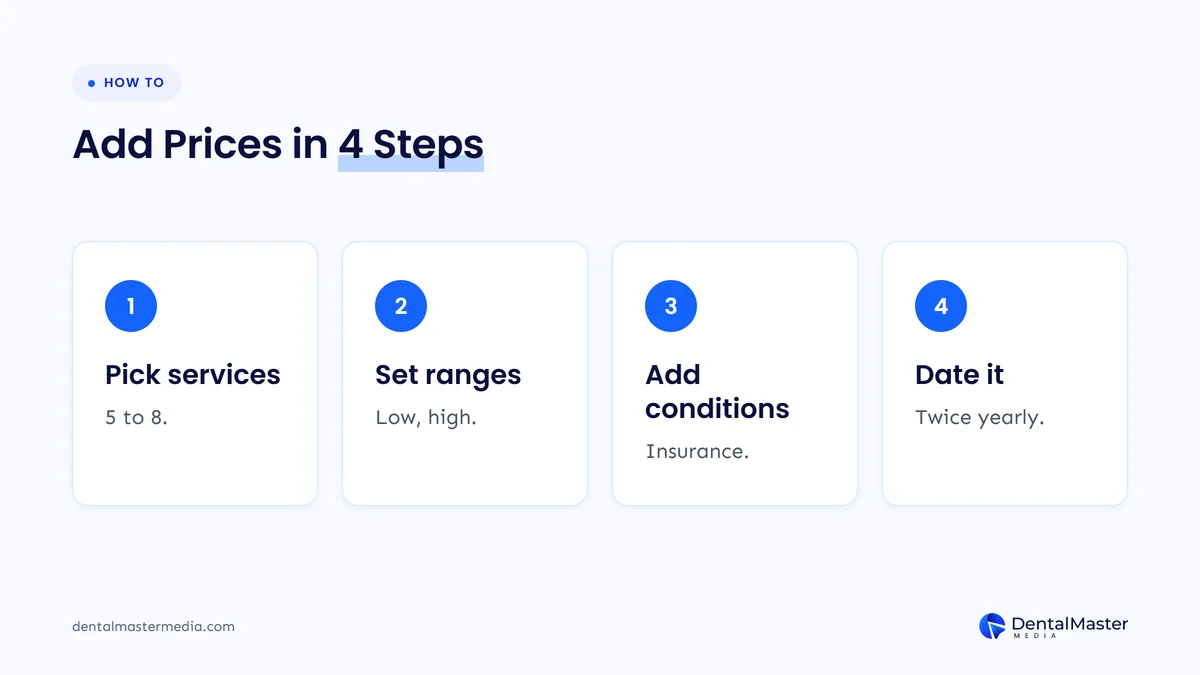
The 4 steps to add prices to a dental website are listed below.
- Pick the services: choose the 5 to 8 treatments your front desk quotes most often.
- Set the price range: take the low and high fee from the cases you have charged, and write what is included beside each price.
- Add the conditions: write what changes the treatment cost, the insurance plans you accept and the financing options.
- Date the page: write “Prices checked on” with the date, review the page every 6 months or when your fee schedule changes, and copy the same figures into Google Business Profile.
Google Business Profile Help says you can add a price and description to each service when you edit your services, and that custom service names containing prices are automatically rejected. Put the figure in the price field, not in the name, and follow our guide to Google Business Profile settings for dental practices for the rest of the profile.
How does a price page turn visitors into booked appointments?
A price page turns visitors into booked appointments when it ends each price with a next step: a booking button, a request for an insurance estimate or a call-back form. A price with no next step informs the patient and then loses them.
Place one call to action under the price table and one at the bottom of the page, and name what happens next, such as “We reply with your insurance estimate within 1 business day” if that is true for your practice. Our guide to dental website conversion and booked appointments covers the booking path in depth.
Frequently asked questions
Will showing prices scare patients away?
No, showing prices is unlikely to scare away patients who are already weighing cost. Dental care had the highest cost barrier of any care type in 2025, at 12.9% of people, so a patient with no price information is the patient more likely to skip care. A range that includes financing and an estimate option keeps the conversation open.
Can competitors copy my dental prices if I publish them?
Yes, competitors can read prices you publish, but they can already collect prices by phone. The 2015 Pioneer Institute call test in Massachusetts gathered cleaning and exam prices from practices by calling them. A price range with what is included is hard to copy as a strategy, because patients choose on the scope, the dentist and the reviews as well.
Is it legal for a dentist to list prices on a website?
Yes, a dentist can list prices on a website if the prices are truthful, not misleading and supported by evidence, according to the American Dental Association’s marketing guidance. Multiple states regulate fee and discount advertising, and some countries require fee display, so check your state dental board or national regulator before you publish.
Should a dental practice that takes insurance still show prices?
Yes, a practice that takes insurance should show its own fee range and say plainly that the patient’s plan decides what the patient pays. The American Dental Association states that dental plans control key factors behind a patient’s financial responsibility, so add an insurance estimate request beside the prices.
How often should a dental practice update its website prices?
A dental practice should update its website prices every 6 months and whenever its fee schedule changes. Put a “Prices checked on” date on the page, and change the same figures in Google Business Profile on the same day, so the website, the profile and AI answers do not contradict each other.
Conclusion
A dental website should show prices for its standard services, as a starting price or price range with what is included. Cost is the barrier that keeps 12.9% of people from needed care, published prices help patients plan, give Google original local content and give AI answers a correct figure, and advertising rules require that every price be truthful, current and supported.
At Dental Master Media, we build the price page as part of the website and the Google Business Profile, so the figures match everywhere a patient or an AI tool looks. If you want that done alongside the rest of your visibility work, see our dental SEO services, or read how much dental SEO costs for the way we think about publishing our own prices.
See how your website handles prices today
Our free dental SEO audit checks whether your website, service pages and Google Business Profile answer the cost questions patients ask, and shows which fixes will make the biggest difference.
Sources
- ADA Health Policy Institute, “National trends in dental care use, dental insurance coverage, and cost barriers” (HPI report, 2026, National Health Interview Survey 2025 data; the 12.9%, 5% and 17% figures are as reported by Becker’s Dental Review, “Dental care has the highest cost barriers in healthcare: 7 things to know”, 2026). https://www.ada.org/resources/research/health-policy-institute/coverage-access-outcomes
- TechTarget, “Almost half of patients use AI for online provider search” (rater8 survey), June 3, 2026. https://www.techtarget.com/patientengagement/news/366643954/Almost-half-of-patients-use-AI-for-online-provider-search
- Dentistry Today, “Dentists shine in meeting Massachusetts transparency law” (Pioneer Institute call test), August 17, 2015. https://www.dentistrytoday.com/dentists-shine-in-meeting-massachusetts-transparency-law/
- American Dental Association, “Marketing and advertising”, accessed November 23, 2026. https://www.ada.org/en/resources/practice/legal-and-regulatory/marketing-and-advertising
- ADA News, “ADA seeks dental-specific changes to Patients Deserve Price Tags Act” (letter of July 1, 2026), July 2, 2026. https://adanews.ada.org/ada-news/2026/july/ada-seeks-dentalspecific-changes-to-patients-deserve-price-tags-act/
- ADA News, “ADA urges Congress to focus transparency efforts on dental benefit plans” (letter of June 9, 2026), June 11, 2026. https://adanews.ada.org/ada-news/2026/june/ada-urges-congress-to-focus-transparency-efforts-on-dental-benefit-plans
- Google Search Central, “Optimizing your website for generative AI features on Google Search”, published May 15, 2026, accessed November 23, 2026. https://developers.google.com/search/docs/fundamentals/ai-optimization-guide
- Google Business Profile Help, “Manage your services on your Business Profile”, accessed November 23, 2026. https://support.google.com/business/answer/9455399?hl=en
- Dental Council (Ireland), “Display of fees” (Code of Practice, approved February 2011, in force June 1, 2011), accessed November 23, 2026. https://www.dentalcouncil.ie/code-of-practice/display-of-fees

Suraj Rana is the owner of Dental Master Media and a leading expert in SEO for dental practices. With a passion for dental marketing, he has successfully helped numerous dental clinics climb the search engine ranks. Suraj’s expertise makes him a go-to resource for effective, results-driven dental marketing.