Quick answer: A practice attracts more pediatric dental patients online by publishing what parents search for: a children’s dentist page, a first-visit page and an accurate Google Business Profile. The American Academy of Pediatric Dentistry (AAPD) says a child should have a dental home by 12 months, and a 2015 survey found 60% of parents used the Internet to find a dentist.
Key takeaways
- Pediatric dentistry is an age-defined specialty for infants through adolescents, and a first dental visit should happen no later than 12 months of age, according to the AAPD.
- Parents search on Google first: 60% of 111 caregivers in a 2015 Virginia survey used the Internet to find a dentist, and over 90% of participants used Google.
- The Centers for Disease Control and Prevention (CDC) found dental caries in 50.5% of children aged 6 to 11 in 2015 to 2016, so the demand for pediatric dental care is steady.
- A pediatric dental practice wins those searches with 3 things: a service page, a first-visit page and a Google Business Profile that matches the website.
- A general dentist must not imply a specialty: the American Dental Association (ADA) Code says to state that services are provided by general dentists.
- Track every new family’s source each month, and give pediatric dentistry its own page if your general practice treats children.
What is pediatric dentistry, and what do parents expect from a children’s dentist?
Pediatric dentistry is an age-defined dental specialty that provides primary and comprehensive preventive and therapeutic oral health care for infants and children through adolescence, including children with special health care needs, according to the AAPD. A children’s dentist is the plain-English name parents use for the dentist who provides that care.
A pediatric dentist is a dentist who has completed at least 24 months in an advanced education program accredited by the Commission on Dental Accreditation, which adds knowledge and skills beyond the DDS or DMD degree, according to the AAPD’s Reference Manual of Pediatric Dentistry 2026-2027. A pediatric dental practice treats children as its main work. A general practice that sees children treats them as one patient group among others, and the two should describe themselves differently, as the naming section below explains.
A parent who searches for a children’s dentist is choosing care for someone else, so the website has to answer the parent’s questions as well as the child’s needs. Our dental SEO services start from that point: who is searching, what they type, and what they need to see before they call.
When should a child have a first dental visit?
A child should have a first dental visit no later than 12 months of age, because the AAPD encourages parents and other care providers to help every child establish a dental home by that age. The AAPD’s Policy on the Dental Home was last revised in 2023 and is printed in the Reference Manual of Pediatric Dentistry 2026-2027.
A dental home is the ongoing relationship between a child and one dental practice. The AAPD says a dental home for children should provide care that is safe, individualized, comprehensive, continuous, accessible and coordinated. For a pediatric dental practice, that makes a first dental visit at age 1 a normal request, and the website should say so in plain words.
How do parents search for a children’s dentist?
Parents search for a children’s dentist mainly on Google: in a 2015 survey of 111 caregivers at a Richmond, Virginia pediatric dental office, 60% used the Internet to look for a dentist or pediatric oral health information, Google was the most popular search engine at over 90% of participants, and 10% to 15% used social media. DentistryIQ published the study, by James Musselwhite, John H. Unkel and Clark Morris, on February 4, 2016.
The study covers one practice and one city, and its authors noted the small sample. We found no larger public study of how parents search for a pediatric dentist, so treat the 60% figure as direction, not a benchmark for your town. The 5 types of search a pediatric dental practice should plan for are listed below.
- Provider searches: phrases such as “pediatric dentist near me”, “children’s dentist” and “kids dentist” plus a city name, where the parent wants a pediatric dental practice nearby.
- Age searches: phrases such as “dentist for toddlers” and “first dental visit age”, where the parent wants to know when to start.
- Problem searches: phrases such as “child toothache” and “child dental emergency”, where the parent needs an appointment soon.
- Comfort searches: phrases such as “dentist for anxious kids” and “dentist for special needs children”, where the parent wants to know how the team treats a nervous child.
- Logistics searches: searches for hours, insurance and booking, where the parent is close to choosing.
These 5 types are our grouping of common phrase variants, not search volumes. Check the real queries for your city in Google Search Console before you plan pages.
What do the numbers show about pediatric dental demand?
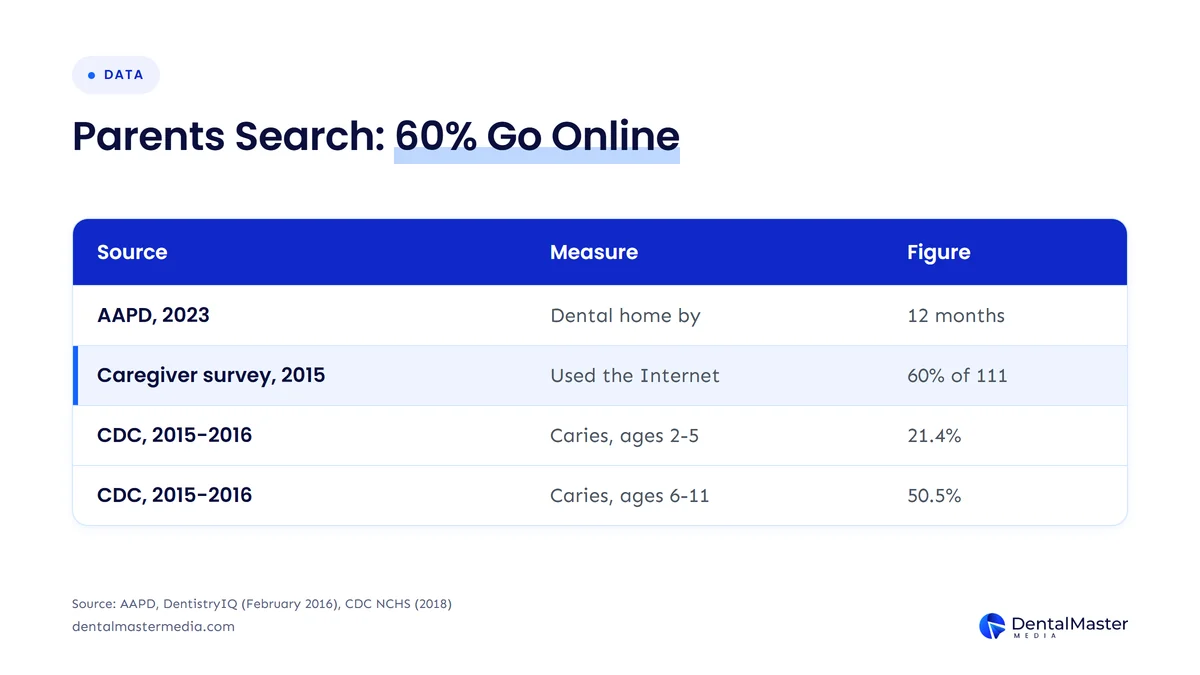
The numbers show that children need dental care early and often: the CDC’s National Center for Health Statistics reported dental caries in 21.4% of children aged 2 to 5, 50.5% aged 6 to 11 and 53.8% aged 12 to 19 in 2015 to 2016, and the AAPD asks for a dental home by 12 months. The table below lists the 6 figures this article relies on.
| Fact | Number | Source |
|---|---|---|
| Age by which a child should have a dental home | No later than 12 months | AAPD, Policy on the Dental Home, revised 2023 |
| Caregivers who used the Internet to find a dentist or oral health information | 60% of 111 caregivers | DentistryIQ, caregiver survey, February 4, 2016 |
| Participants who used Google as their search engine | Over 90% | DentistryIQ, caregiver survey, February 4, 2016 |
| Children aged 2 to 5 with dental caries (treated or untreated) | 21.4% | CDC NCHS Data Brief 307, 2015 to 2016 |
| Children aged 6 to 11 with dental caries (treated or untreated) | 50.5% | CDC NCHS Data Brief 307, 2015 to 2016 |
| Children aged 6 to 11 with untreated caries | 15.3% | CDC NCHS Data Brief 307, 2015 to 2016 |
The table shows that dental caries rises from 21.4% at ages 2 to 5 to 50.5% at ages 6 to 11, which matches the AAPD’s advice to start dental visits in the first year.
The caries figures come from NCHS Data Brief 307 by Eleanor Fleming and Joseph Afful, published in April 2018 and revised on July 25, 2018. The CDC’s Fast Facts page on cavities, dated May 15, 2024, reports that half of children aged 6 to 9 (50%) have had cavities in primary or permanent teeth. These numbers describe what families need. They do not predict how many patients a practice will win.
What should a pediatric dental practice publish to win parents?
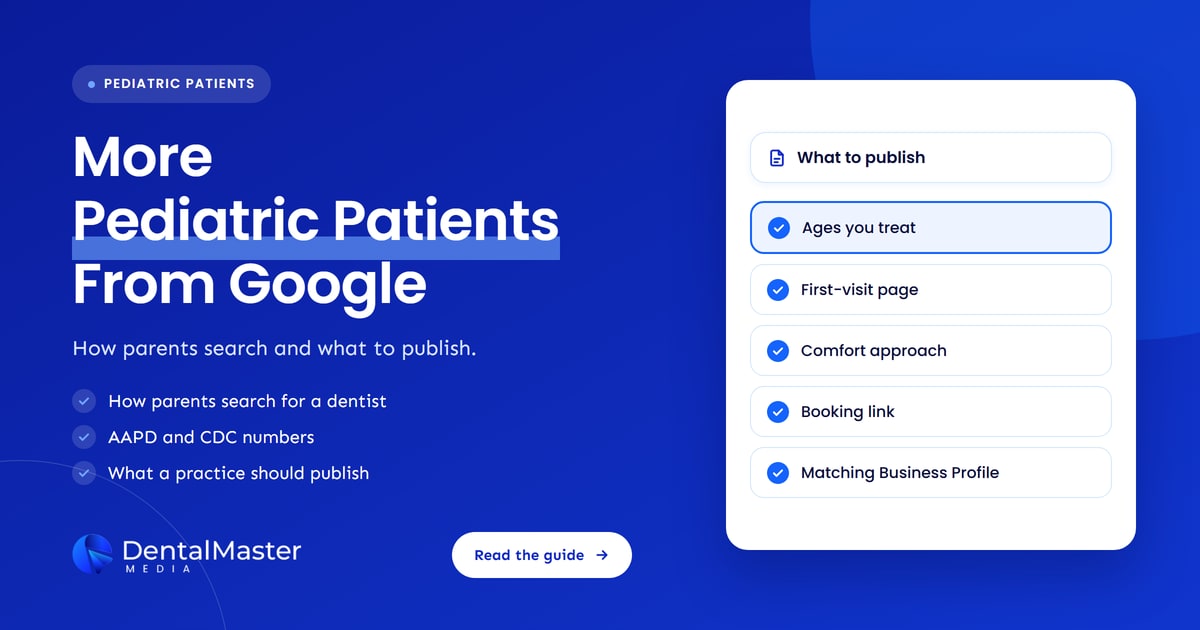
A pediatric dental practice should publish 3 things to win parents’ searches: a pediatric dental service page, a first-visit page and a complete Google Business Profile. The service page answers provider and problem searches, the first-visit page answers age and comfort searches, and the Business Profile answers provider and logistics searches.
What should a pediatric dental service page include?
A pediatric dental service page should state the ages the practice treats, the children’s services it provides, the team, the comfort approach and the practical details, so a parent can decide without calling.
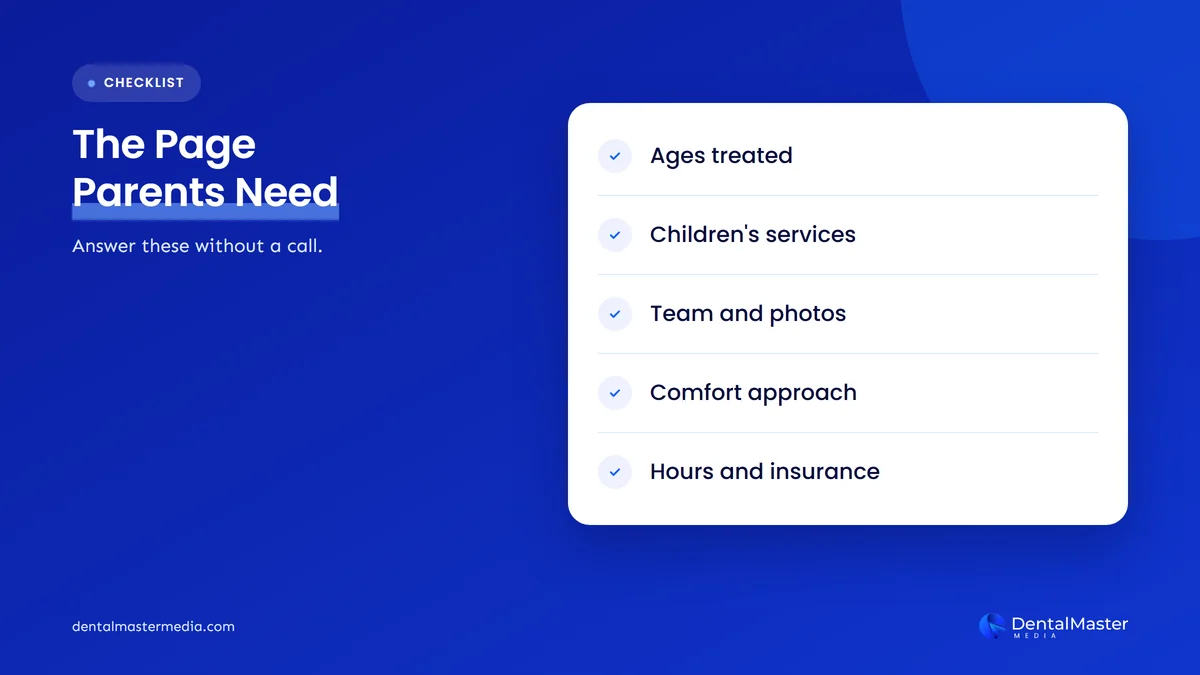
The 6 parts of a pediatric dental service page are listed below.
- Ages treated: the youngest and oldest age the pediatric dental practice sees, for example “from first tooth through age 17”, if that is true for your practice.
- Children’s services: the services your practice provides to children, named the way parents search for them.
- Team: the names, credentials and original photos of the dentists and staff who treat children.
- Comfort approach: how the team helps an anxious child and a child with special health care needs, in plain words.
- Practical details: address, phone number, opening hours and accepted insurance, written exactly as on your Google Business Profile.
- Next step: a booking button and a link to the first-visit page.
The same structure works for any treatment. Our checklist on what a veneers and cosmetic dentistry page should include shows it for a different service.
Which first-visit questions should the page answer?
A first-visit page should answer 5 parent questions: when a child should first come, what happens at the visit, how the team helps an anxious child, what a parent should bring and how to book. The 5 answers are listed below.
- Age: a first dental visit by 12 months of age, as the AAPD recommends, and a note that older children are welcome too.
- Visit steps: the exam steps your team follows, written in the order they happen.
- Comfort steps: what your team does when a child is scared, with the words your team really uses.
- Parent preparation: the forms, insurance details and medical history a parent should bring.
- Booking: the phone number and online booking link, with the time a parent can expect a reply.
A first-visit page works only if the booking step is easy, which we cover in our guide to dental website conversion and booked appointments.
How should a pediatric dental practice set up its Google Business Profile?
A pediatric dental practice should set up its Google Business Profile with the fewest and most specific categories that describe its main business, because Google Business Profile Help says to use as few categories as possible and to choose categories as specific as possible but representative of the main business. Google Maps shows that profile when a parent searches for a children’s dentist nearby.
A practice limited to children should choose the category “Pediatric dentist”. A practice that sees all ages should keep the category for its main business and describe its children’s services in the services list, the description and its posts. Every detail on the profile, from phone number to hours, must match the website.
Parents who search from a phone often want to book at once, so add an appointment link. We explain the steps in our post on booking links on Google Business Profile.
Should a general dental practice call itself a pediatric dentist?
No, a general dental practice should not call itself a pediatric dentist, because section 5.I of the ADA Principles of Ethics and Code of Professional Conduct lets general dentists announce their services only if they avoid communications that express or imply specialization and state that the services are provided by general dentists. Section 5.H adds that dentists who announce as specialists must limit their practice exclusively to the specialty.
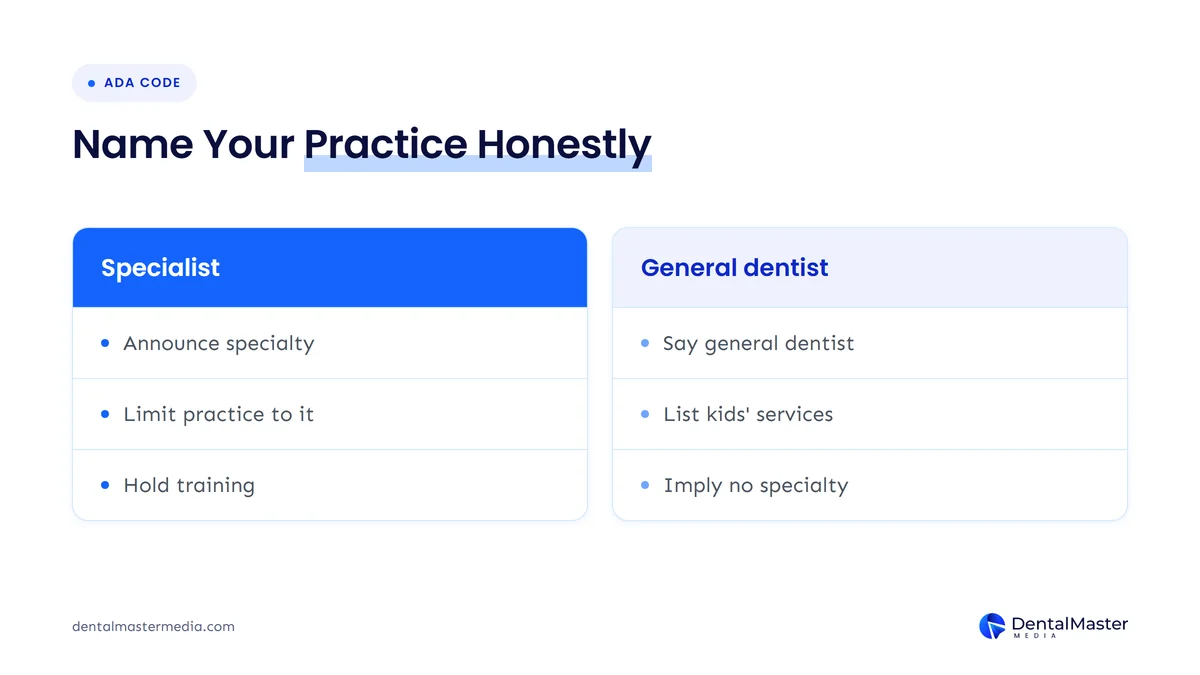
A general dentist can still win children’s searches honestly. Write “general dentist, children welcome”, list the children’s services and the ages you treat, and leave out the word “specialist”. State dental boards can add their own advertising rules, so check yours before you publish. This section describes professional advertising rules and is not legal advice.
How can a pediatric dental practice track new patients from online searches?
A pediatric dental practice tracks new patients from online searches by recording how each new family found the practice, then comparing calls, booking requests and Google Business Profile actions each month. The record needs one fixed question on every new-patient form and phone script.
Ask “How did you hear about us?” and offer fixed answers such as Google search, Google Maps, a friend or family member, and a school or doctor referral. Enter the answer in the patient record, then total each answer at the end of the month. Google Search Console adds the queries and pages that brought parents to the site. Our guide to tracking calls and bookings from a dental website shows how to set it up.
Should pediatric dentistry get its own page on a general dental website?
Yes, a general dental website that treats children should give pediatric dentistry its own page, because the page can match one search intent: the parent who wants a children’s dentist. A single page that lists every service for every age cannot answer that search as directly.
The same reasoning applies to other treatments, and the choice of which treatments earn a page has its own guide: 9 High-Value Dental Treatments That Deserve Their Own Page. Start with pediatric dentistry if children are a large share of your appointments.
Frequently asked questions
Do parents use Google to find a children’s dentist?
Yes, parents use Google to find a children’s dentist. In a 2015 survey of 111 caregivers at one Richmond, Virginia pediatric dental office, 60% used the Internet to search for a dentist or pediatric oral health information, and Google was the most popular search engine, used by over 90% of participants. The sample was small and from one location.
Does a pediatric dental practice need a blog?
No, a pediatric dental practice does not need a blog before it has the basics. You should publish the service page, the first-visit page and a matching Google Business Profile first, because they answer the searches that lead to appointments. A blog can come later for the questions parents ask after those pages exist.
How many pages does a pediatric dental section need?
A pediatric dental section needs 3 pages to start: the pediatric dental service page, the first-visit page and a contact and booking page. We recommend adding a page only when a separate parent question needs a full answer, such as care for children with special health care needs.
Is a children’s dentist the same as a pediatric dentist?
No, a children’s dentist is not always a pediatric dentist. “Children’s dentist” is the plain-English term parents use for any dentist who treats children, while “pediatric dentist” names a specialty that the AAPD defines and that requires at least 24 months of accredited advanced education.
Do pediatric dental patients include teenagers?
Yes, pediatric dental patients include teenagers. The AAPD defines pediatric dentistry as care for infants and children through adolescence, including those with special health care needs, so a pediatric dental practice can state the full age range it treats on its service page.
Publish for the parent before the parent calls
A practice attracts more pediatric dental patients online by matching what parents search for. The AAPD sets the first dental visit by 12 months, a 2015 survey found 60% of caregivers used the Internet to find a dentist, and CDC data shows dental caries in 50.5% of children aged 6 to 11. A pediatric dental practice should publish a service page, a first-visit page and an accurate Google Business Profile, name itself honestly under the ADA Code, and track each new family’s source.
That is the work our dental SEO services cover at Dental Master Media, from search research to the pages and profiles parents see.
See what parents find when they search for your practice
Before you plan new pages for pediatric dental patients, find out what parents already see when they search for a children’s dentist near you. Our free dental SEO audit checks your service pages, Google Business Profile and local visibility, and shows which fixes will bring in more new families.
Sources
- American Academy of Pediatric Dentistry, “Policy on the Dental Home”, revised 2023, The Reference Manual of Pediatric Dentistry 2026-2027, accessed November 25, 2026. https://www.aapd.org/research/oral-health-policies–recommendations/dental-home-2/
- American Academy of Pediatric Dentistry, “Overview: Definitions and scope of pediatric dentistry”, revised 2025, The Reference Manual of Pediatric Dentistry 2026-2027, accessed November 25, 2026. https://www.aapd.org/research/oral-health-policies–recommendations/overview/
- DentistryIQ, James Musselwhite, John H. Unkel and Clark Morris, “National Children’s Dental Health Month: Caregiver use of Internet and social media to gather pediatric oral health information: A research paper”, February 4, 2016. https://www.dentistryiq.com/practice-management/marketing/article/16353041/national-childrens-dental-health-month-caregiver-use-of-internet-and-social-media-to-gather-pediatric-oral-health-information-a-research-paper
- Centers for Disease Control and Prevention, National Center for Health Statistics, Eleanor Fleming and Joseph Afful, “Prevalence of Total and Untreated Dental Caries Among Youth: United States, 2015-2016”, NCHS Data Brief No. 307, April 2018, revised July 25, 2018. https://cdc.gov/nchs/products/databriefs/db307.htm
- Centers for Disease Control and Prevention, “Fast Facts: Cavities”, May 15, 2024. https://www.cdc.gov/oral-health/data-research/facts-stats/fast-facts-cavities.html
- Google Business Profile Help, “Guidelines for representing your business on Google”, accessed November 25, 2026. https://support.google.com/business/answer/3038177
- American Dental Association, “Principles of Ethics and Code of Professional Conduct, Section 5: Veracity”, accessed November 25, 2026. https://www.ada.org/en/about/principles/code-of-ethics/veracity

Suraj Rana is the owner of Dental Master Media and a leading expert in SEO for dental practices. With a passion for dental marketing, he has successfully helped numerous dental clinics climb the search engine ranks. Suraj’s expertise makes him a go-to resource for effective, results-driven dental marketing.