Quick answer: A clear aligner page that wins patients explains who aligners may suit, shows the in-person exam and follow-up visits, gives honest cost factors and payment options, names the dentist who plans treatment, answers real patient questions and offers an easy consultation booking. It competes on supervised care and local trust, not on price alone.
Key takeaways
- Your clear aligner page competes with two groups at once: national direct-to-consumer (DTC) aligner brands and the other dentists and orthodontists near you.
- In 2026 the FDA made the case for supervised care itself: its consumer page says clear aligners are prescription devices and recommends an in-person evaluation before treatment.
- Patients compare price, convenience and trust. A strong page answers all three plainly, without attacking anyone.
- Against nearby practices, the page wins on proof you can show: the treating dentist, real local details, a clear process and fast booking.
- Use brand names such as Invisalign accurately, avoid outcome promises and superiority claims, and keep every claim supportable.
What is a clear aligner page?
A clear aligner page is the treatment page on a dental practice website that explains clear aligner orthodontics to local patients and invites them to book a consultation. It targets searches such as “clear aligners near me” and “Invisalign dentist”, and it is often the page a patient reads just before choosing where to start treatment.
Clear aligners are removable, transparent trays that move teeth gradually. The FDA describes them as prescription devices available from a licensed practitioner, such as a dentist or orthodontist. That fact shapes the whole page: you are not selling a product in a box, you are offering supervised treatment that starts with an exam.
If your website folds aligners into a general “cosmetic dentistry” page, start by giving them their own page. Our guide to dental treatments that deserve their own page explains why high-value treatments rank and convert better on dedicated pages.
Who is your clear aligner page competing against?
Your clear aligner page competes with national direct-to-consumer aligner brands that advertise heavily and sell remote treatment, and with nearby dentists and orthodontists who offer the same in-office care. Each group wins patients for different reasons, so the page has to answer both, rather than copy either one.
Google’s own guidance explains why the local side matters. Google says local results are based mainly on relevance, distance and prominence. A national DTC brand has prominence, but it has no practice down the road. A nearby competitor has distance on its side too. Your page has to be the most relevant and most trustworthy answer for patients in your area.
| Competitor | What patients see in its marketing | What your page should answer |
|---|---|---|
| DTC aligner brands | Convenience, remote starts, prices shown up front | What an in-person exam adds, your cost range and payment options, how few visits you need |
| Nearby general dentists | A familiar local practice, often the same aligner brands | Who plans your treatment, their aligner experience, how you handle check-ups and refinements |
| Local orthodontists | Specialist training and orthodontic focus | Which cases you treat, when you refer, and how you work with specialists |
Being honest about that last row builds trust. A general practice that says which cases it refers to an orthodontist sounds more credible than one that claims it can treat everything.
What changed for direct-to-consumer aligners in 2026?
In 2026 the FDA updated its consumer page on clear dental aligners and warned the public about aligners sold directly to consumers without professional supervision. The agency says it has not authorized those products and has received reports of jaw pain, bite problems and worsening misalignment. ADA News covered the warning on October 1, 2026.
Here is what the FDA page, updated September 9, 2026, says in plain terms:
- Clear aligners are available by prescription from a licensed practitioner, such as a dentist or orthodontist.
- The FDA has not authorized aligners sold directly to consumers without dental or orthodontic supervision.
- Reported problems include new or worsening dental pain, jaw pain, bite problems, worsening misalignment and new gaps between teeth.
- An in-person exam can help lower risks, and the FDA recommends periodic in-person visits during treatment.
- “FDA-registered” is not the same as FDA-authorized.
This gives practices a factual, neutral way to explain supervised care. The key word is factual. Your page can explain what the FDA recommends and what your exam includes. It should not suggest that every remote or teledentistry service is unsafe, name competitors or use fear to sell. As ADA News reported, the FDA says virtual visits and teledentistry can be useful, while stressing in-person care.
What should a clear aligner page include?
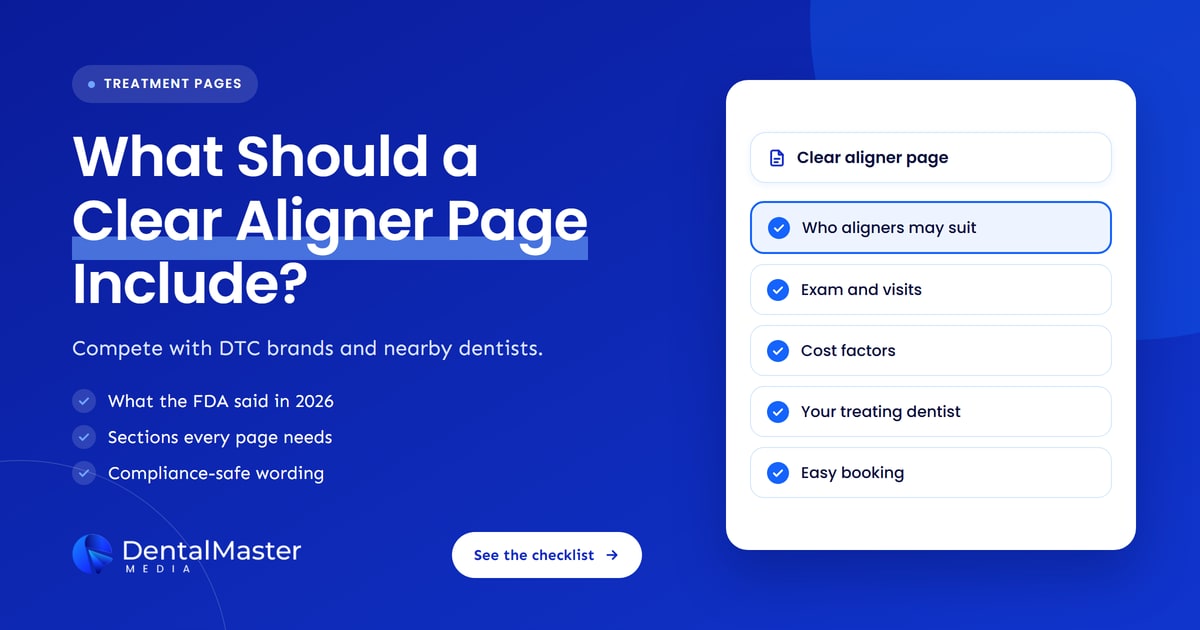
A clear aligner page should include a short answer on who aligners may suit, your consultation and exam process, the number and type of visits, cost factors and payment options, the dentist who plans treatment, honest alternatives, real patient questions and a low-effort way to book. Each section should answer something a patient would otherwise ask by phone.
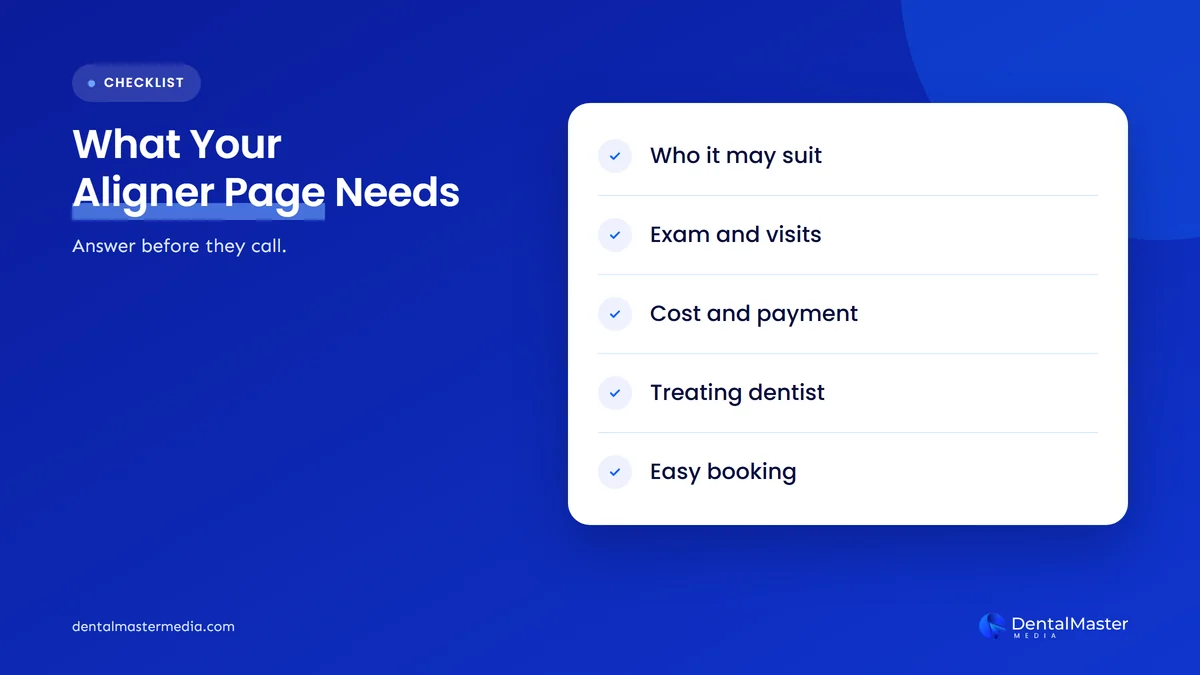
- A clear opening answer. Two or three sentences on what clear aligners are, who they may suit and how to start at your practice. This is the passage search engines and AI tools are most likely to lift.
- Who aligners may suit, and who they may not. Describe common cases in plain words, such as crowding or gaps, and say that a dentist decides suitability after an exam.
- Your process, step by step. Consultation, exam and records, treatment plan, fitting, check-ups and retainers. Patients comparing you with a remote service want to know what happens in the chair.
- Visits and time commitment. Say roughly how often patients come in and why. If you offer remote check-ins between visits, say so.
- Cost factors and payment options. Explain what changes the price and how patients can pay. More on this below.
- The dentist who plans treatment. Name, photo, qualifications and relevant aligner training. Google’s guidance on helpful content encourages clear authorship information, and patients want to know who is treating them.
- Alternatives. Braces, other appointments or a referral to an orthodontist. Showing options reads as honest advice, not a sales pitch.
- FAQs in patient language. Wear time, discomfort, eating, retainers, what happens if a tray is lost.
- An easy next step. A consultation booking link, a phone number that works on mobile and, if you offer it, a scan or smile assessment appointment.
If your page already has these parts but still isn’t bringing in calls, our post on why an Invisalign page isn’t generating new patient calls covers the conversion fixes in more detail.
How should a clear aligner page talk about price?
A clear aligner page should talk about price openly, because DTC brands publish prices and patients compare. You don’t need a single fixed fee. Explain what affects the cost, give a range only if your practice can stand behind it, list what the fee includes, and show payment or financing options clearly.
Spell out what is included: the exam and records, the aligners, check-ups, refinements if needed and the first set of retainers. That list is often where in-office care looks better value than a headline price, and it lets patients compare like with like. Keep any price you publish current, and check it against your local advertising rules.
How should you use brand names like Invisalign?
Use aligner brand names only for products you actually provide, spell them correctly and use them to describe the product, not your practice. Invisalign is a brand of Align Technology, and Align asks people not to use its names in online identities such as usernames or handles. If you hold a provider agreement, follow its marketing terms.
A safe pattern is a generic page title such as “Clear Aligners” with a section that names the systems you offer. That page can rank for both generic and branded searches without making your practice look like part of the brand. Avoid brand names in your practice name, domain or social handles unless the brand owner has given written permission.
How do you compete with direct-to-consumer aligner brands without attacking them?
You compete with direct-to-consumer aligner brands by showing what your practice offers that a remote service can’t: an in-person exam, a dentist who plans and monitors treatment, local follow-up and a clear answer when something goes wrong. Keep the tone factual and helpful, and let patients draw their own conclusions.
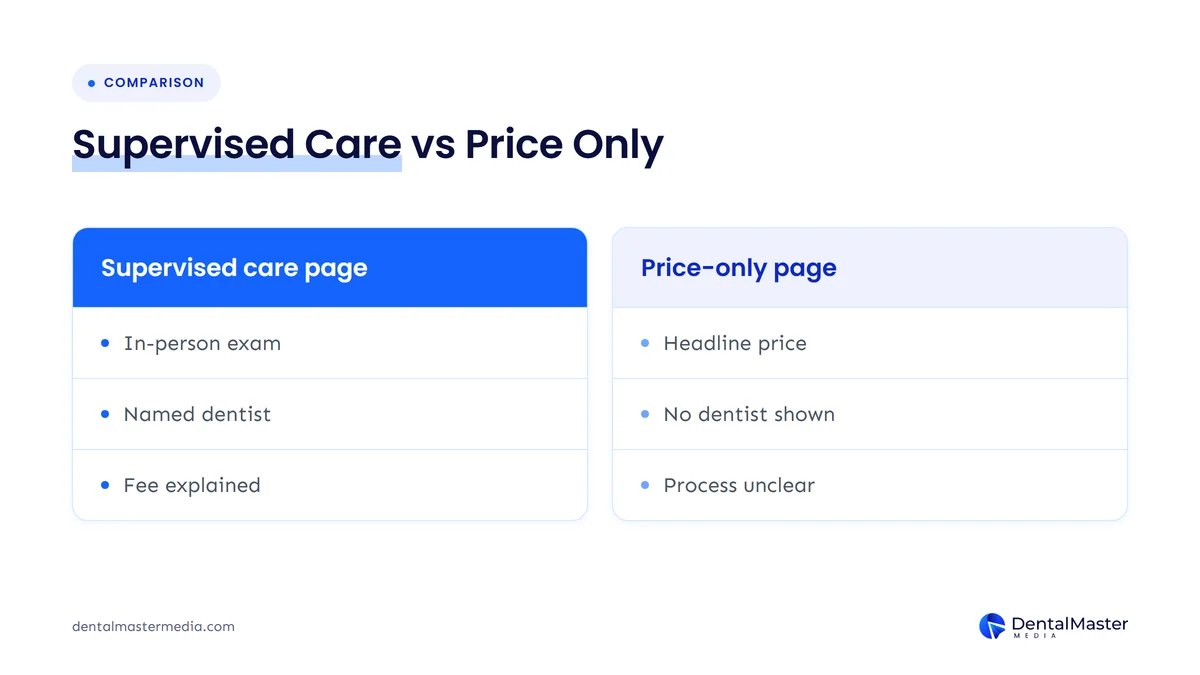
Patients usually weigh three things. Here is how each section of your page can answer them:
| What patients weigh | Why DTC brands appeal | How your page can respond |
|---|---|---|
| Price | Prices are shown up front | Cost factors, what the fee includes, payment options |
| Convenience | Few or no office visits | Number of visits, short appointments, any remote check-ins you offer |
| Trust | Big brand advertising | Named dentist, in-person exam, local reviews, what happens if treatment needs a change |
What to avoid matters as much. Don’t call other providers dangerous, don’t claim your results are better than theirs, and don’t name competing brands. Comparative claims you can’t support with evidence are the kind of statement dental advertising rules and the FTC’s guidance on health claims warn against. Pointing patients to the FDA’s own advice is stronger than any claim you could write yourself.
How do you stand out from other dentists near you?
You stand out from nearby dentists by making your page specific to your practice: who treats patients, how your process works, what your consultation includes, where you are and how fast someone can book. Most local aligner pages read the same, so concrete, practice-only detail is the easiest way to look different.
Practical ways to do that:
- Lead with the treating dentist, not the brand. A short note in the dentist’s own words about how they plan aligner cases is content no competitor can copy.
- Use your own photos of the team, the scanner and the consultation room, not stock images or manufacturer artwork.
- Add local details that help patients decide: parking, opening hours that suit working adults, and which nearby areas you serve.
- Match the page to your Google Business Profile. Add clear aligners as a service, keep the details consistent and link the profile to this page where it fits.
- Show real reviews that mention aligner care, shared with patient permission and without implying everyone gets the same result.
For the keyword and ranking side, including how to target aligner searches in a competitive area, see our guide to ranking for braces and aligner keywords.
How do you build a clear aligner page step by step?
Build a clear aligner page in four steps: research what local patients search and what competing pages offer, write the sections in patient language, add proof and compliance checks, then publish with tracking so you can see calls and bookings. Revisit the page every few months as prices, products and guidance change.
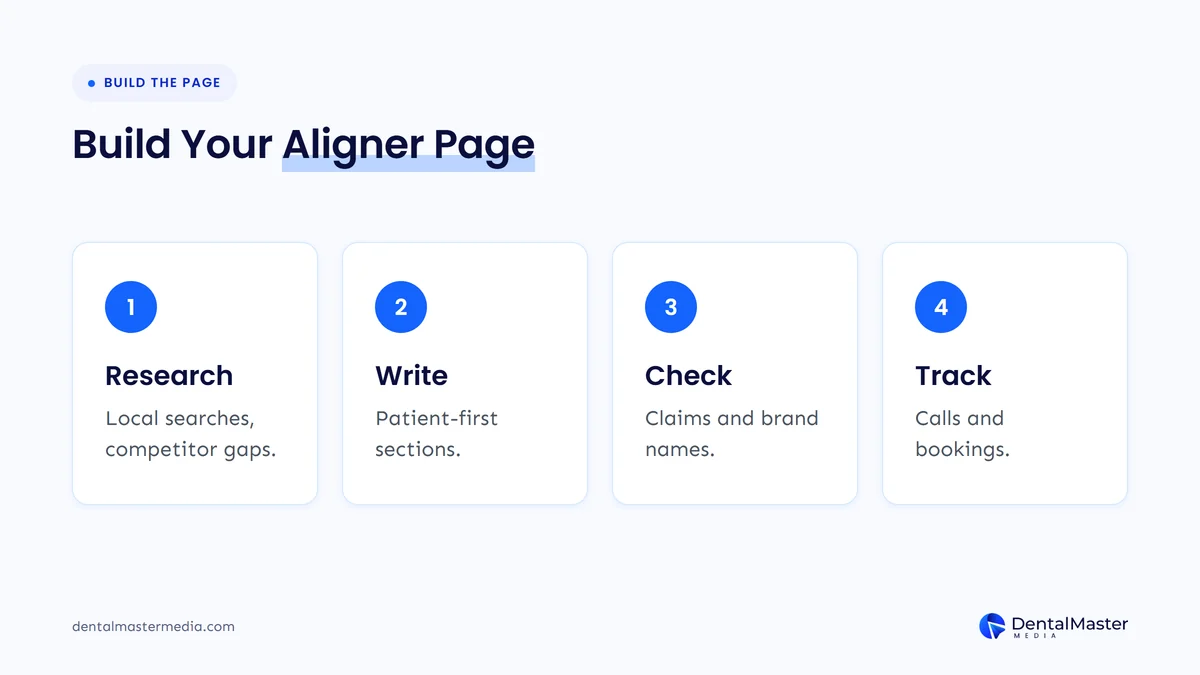
- Research. Search “clear aligners” plus your town as a patient would. Note what the DTC ads promise and what nearby practice pages leave out. Those gaps are your content plan.
- Write. Draft each section from the checklist above. Open every section with a short, direct answer so both patients and AI search tools can lift it on its own.
- Check. Have the dentist review clinical statements. Remove outcome promises, unsupported “best” or “fastest” claims and any testimonial that suggests typical results. Confirm brand names and prices are accurate.
- Track. Add call tracking and form tracking so you know how many consultation requests the page produces, then improve the weakest sections first.
Structure matters for AI search too. Our guide on writing dental service pages that AI search will cite shows how to format answers that tools like Google AI Overviews and ChatGPT can quote.
What compliance mistakes should a clear aligner page avoid?
The most common compliance mistakes on clear aligner pages are promising a specific result or timeframe, claiming to be better than other providers without evidence, using testimonials that imply typical results, publishing out-of-date prices and misusing brand names. Each can mislead patients and may break advertising rules where you practice.
| Risky wording | Safer approach |
|---|---|
| “Perfect smile in six months” | “Treatment time depends on your case. Your dentist will give you an estimate after your exam.” |
| “Better results than mail-order aligners” | “Your treatment starts with an in-person exam and includes check-ups with your dentist.” |
| “The best aligner dentist in town” | Name the dentist, their training and how long they have offered aligner treatment. |
| A testimonial promising fast, dramatic change | Reviews about the experience of care, shared with permission |
The FTC’s Health Products Compliance Guidance says health benefit claims generally need competent and reliable scientific evidence, and that testimonials can’t be used to make claims an advertiser couldn’t make directly. Rules differ by country and state, so check local dental board guidance before you publish.
Frequently asked questions
Should a dental practice list clear aligner prices on its website?
Listing prices is a choice, but explaining cost is not. Patients see published prices from direct-to-consumer brands, so a page with no cost information loses them. At minimum, explain what affects the price, what the fee includes and which payment options you offer. Publish a range only if it is accurate and kept up to date.
Can I use the word Invisalign on my clear aligner page?
You can describe products you actually provide by name, but use the name accurately and follow any provider agreement you hold. Invisalign belongs to Align Technology, which asks people not to use its names in online identities such as usernames. A generic “Clear Aligners” page that names the systems you offer is the safer structure.
Can my page say in-office aligners are safer than direct-to-consumer aligners?
Avoid broad safety or superiority claims. Instead, state facts you can support: the FDA says clear aligners are prescription devices and recommends an in-person evaluation, and your treatment includes an exam and check-ups. Let the facts make the case, and don’t name or criticize other providers.
Should general dentists and orthodontists have different aligner pages?
Yes. Each page should describe the care that practice actually provides. A general dentist’s page can explain which cases it treats and when it refers to an orthodontist. An orthodontist’s page can explain specialist training and complex cases. Both should be honest about who plans and monitors treatment.
How long should a clear aligner page be?
Long enough to answer the questions patients ask before booking, with no padding. For most practices that means a short opening answer, process, visits, costs, the treating dentist, alternatives and FAQs. Short sections with clear headings work better than one long block of text, on mobile and in AI search.
The bottom line on clear aligner pages
A clear aligner page wins patients when it answers the questions that send them to a direct-to-consumer brand or a nearby practice: what it costs, how much time it takes and who is responsible for their care. Show the in-person exam the FDA recommends, name the dentist, explain costs openly and keep every claim factual. The pages that earn bookings feel specific to one practice. If you want help building treatment pages that rank and convert, see our dental SEO services at Dental Master Media.
See how your aligner page stacks up
At Dental Master Media, we review treatment pages the way patients and search engines read them. Our free dental SEO audit shows where your clear aligner page falls short on content, local signals and booking paths, so you know what to fix first.
Sources
- U.S. Food and Drug Administration, “Clear Dental Aligners”, updated September 9, 2026. https://www.fda.gov/medical-devices/dental-devices/clear-dental-aligners
- ADA News, “FDA warns public about unauthorized direct-to-consumer clear aligners”, October 1, 2026. https://adanews.ada.org/ada-news/2026/october/fda-warns-public-about-unauthorized-directtoconsumer-clear-aligners/
- Google Business Profile Help, “Tips to improve your local ranking on Google”, accessed November 13, 2026. https://support.google.com/business/answer/7091
- Google Search Central, “Creating helpful, reliable, people-first content”, accessed November 13, 2026. https://developers.google.com/search/docs/fundamentals/creating-helpful-content
- Federal Trade Commission, “Health Products Compliance Guidance”, December 2022. https://www.ftc.gov/business-guidance/resources/health-products-compliance-guidance
- Align Technology, “Align Social Media Guidelines”, accessed November 13, 2026. https://invisalign.com/social-media-guidelines

Suraj Rana is the owner of Dental Master Media and a leading expert in SEO for dental practices. With a passion for dental marketing, he has successfully helped numerous dental clinics climb the search engine ranks. Suraj’s expertise makes him a go-to resource for effective, results-driven dental marketing.