Quick answer: The 7 main white label SEO red flags are spammy links, an offshore black box, vague reporting, ranking promises, mass-produced content, unclear access and ownership, and no pilot or references. Google’s spam policies name link spam and scaled content abuse as violations, and Google’s hiring page lists secretive plans as a warning sign. Test a provider before it touches a client site.
Key takeaways
- A white label SEO red flag is a provider behavior that puts your agency’s client site, reputation or margin at risk.
- Spammy links come first: Google’s spam policies list bought links, link exchanges and automated links as link spam, and a manual action can lower a client’s rankings.
- Location is not the problem with an offshore team. A black box with no named roles, no change log and no explanation of the work is.
- Vague reporting, ranking promises and mass-produced content each have a fix you can ask for in writing before you sign.
- You can test a white label SEO provider in 5 steps, with a small pilot, before any client site is involved.
- A good provider answers every one of these checks openly, and we invite you to run the same checks on us.
What are white label SEO red flags?
White label SEO red flags are warning signs in a provider’s methods, communication or contract that show it may harm the client sites your agency resells SEO for. A white label SEO provider does the work under your brand, so a flag in its process becomes a risk in your name.
Google’s “Do you need an SEO?” page on Google Search Central lists asking whether an SEO follows Google Search Essentials, and it says you are responsible for the actions of the companies you hire. When you resell SEO, your client holds your agency to that same standard. We are a dental SEO team that also works as a white label provider, and this post lists what we would want to check if we were in your seat. Our own dental SEO services are built to pass these checks.
What are the 7 white label SEO red flags?
The 7 white label SEO red flags are spammy links, an offshore black box, vague reporting, ranking promises, mass-produced content, unclear access and ownership, and no pilot or references. The table below pairs each flag with the Google source behind it and the fix to ask for.
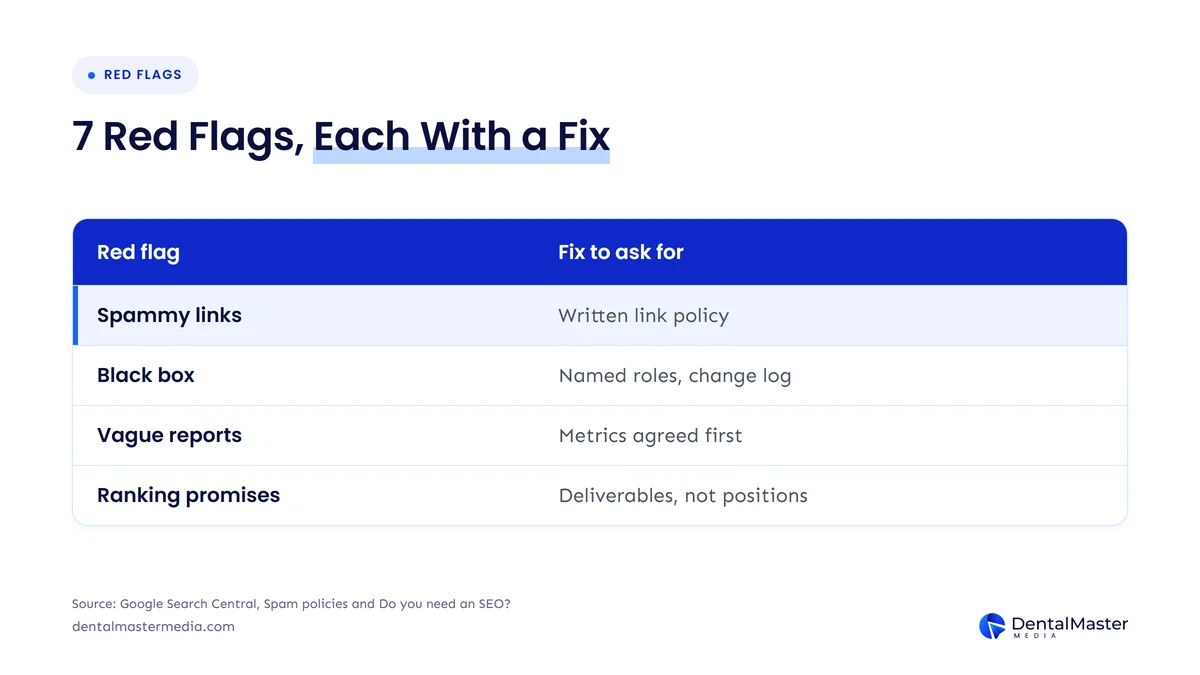
| # | White label SEO red flag | Google guidance behind it | Fix to ask for |
|---|---|---|---|
| 1 | Spammy links | Spam policies for Google web search list link spam | A written link policy and a live-link list |
| 2 | Offshore black box | Hiring page lists secretive or unclear plans | Named roles and a change log |
| 3 | Vague reporting | Hiring page asks for expected results, timeframe and success metrics | Metrics agreed before month 1 |
| 4 | Ranking promises | Nobody can promise a top Google ranking | Deliverables promised, not positions |
| 5 | Mass-produced content | Spam policies list scaled content abuse | Editor name and a source for each claim |
| 6 | Unclear access and ownership | Read-only Search Console access for audits | You own every account |
| 7 | No pilot or references | Hiring page recommends checking references | One pilot client and 2 references |
The table shows that all 7 flags map to published Google guidance, so none of them is only an opinion about taste or price. Google’s page states the guidance for an SEO hired directly, and we apply it to a provider hired by an agency.
Does a white label SEO provider build spammy links?
Yes, some providers do, and spammy links are the most expensive red flag because a client site can lose rankings for them. Google’s spam policies define link spam as links made primarily to manipulate rankings, and list buying or selling links, excessive link exchanges, automated links and low-quality directory links as examples.
Google’s spam policies also list links with optimized anchor text in articles, guest posts or press releases. Paid placements are allowed only when the link carries rel=”sponsored” or rel=”nofollow”, according to Google Search Central’s page on qualifying outbound links. Ask any white label SEO provider to name its link methods in writing and to send a list of live links each month. A provider that will not describe how it earns links has told you something.
Is the provider an offshore black box?
Offshore is not the red flag, a black box is. A black box is a provider that gives you no named roles, no description of the work and no record of changes. Google’s hiring page lists secretive or unclear plans as a warning sign and advises asking whether the SEO will share every change and its reasoning.
A team in another country can do excellent work, and agencies buy from them every day. Check instead who does the work, whether it is subcontracted again and whether you can see a change log for each client site. If a provider has FTP or CMS access, Google’s hiring page says it should explain all changes. Our post on how white label SEO works shows what a transparent workflow looks like from onboarding to delivery.
Does a white label SEO provider send vague reports?
Yes, a vague report is a red flag because it hides whether the work is changing anything. Google’s hiring page says to ask candidates about expected results, timeframe and success metrics, and to ask how they will communicate. A report with only a keyword list and a traffic screenshot answers none of those.
A usable monthly report states the metrics agreed in advance, the work completed that month and the plan for the next month. Branding matters too, because your client sees only your name, and our guide to white label SEO reports covers that side. Ask for a sample report before you sign and check that every number has a named source.
Does a white label SEO provider promise rankings?
Yes, some do, and a ranking promise is a red flag. Google Search Central’s hiring page says nobody can promise a top Google ranking and tells you to look elsewhere if a provider does. The page also lists claims of “approved” status by Google, a “special relationship” with Google and “priority submit” offers as red flags.
Ask for promised deliverables instead: pages fixed, links reviewed, content published and reports sent on named dates. Your agency should never repeat a ranking promise to a client either, because the client will hold you to it.
Does a white label SEO provider mass-produce content?
Yes, some providers publish content in bulk, and mass-produced content can trigger scaled content abuse. Google’s spam policies define scaled content abuse as many pages generated mainly to manipulate rankings, with little or no value to users, however the pages are created.
The same policy names mass-generating pages with AI tools, scraping content and spinning it as examples. Ask the provider who edits each article, how claims are checked and where the sources are listed. A provider that quotes a very high article count for a very low fee should explain how each page is reviewed.
Who owns the access and accounts?
You and your client should own every account, and the provider should work from the access you grant. Google’s hiring page advises read-only access to Google Search Console for an audit and no write access at that stage. The same principle works for white label SEO: begin with the least access the task needs.
Set up Google Search Console, Google Analytics and the Google Business Profile under your agency’s or client’s own login, then add the provider as a user. If a provider asks you to hand over a client’s main login, or holds the accounts in its own name, the client cannot leave without losing its data. Our advice is to write account ownership into the contract.
Does the provider refuse a pilot or references?
Yes, a provider that refuses both is a red flag, because you then have no evidence before the first client is exposed. Google’s hiring page lists checking references as one of 6 steps and recommends asking past clients whether the service was useful, easy to work with and effective.
A small pilot gives you evidence of your own. Give the provider one low-risk client site or one project, agree the metrics and review the work against them. We cannot show you invented case studies here, so we suggest the same test for our own white label dental SEO work.
How do you test a white label SEO provider before signing?
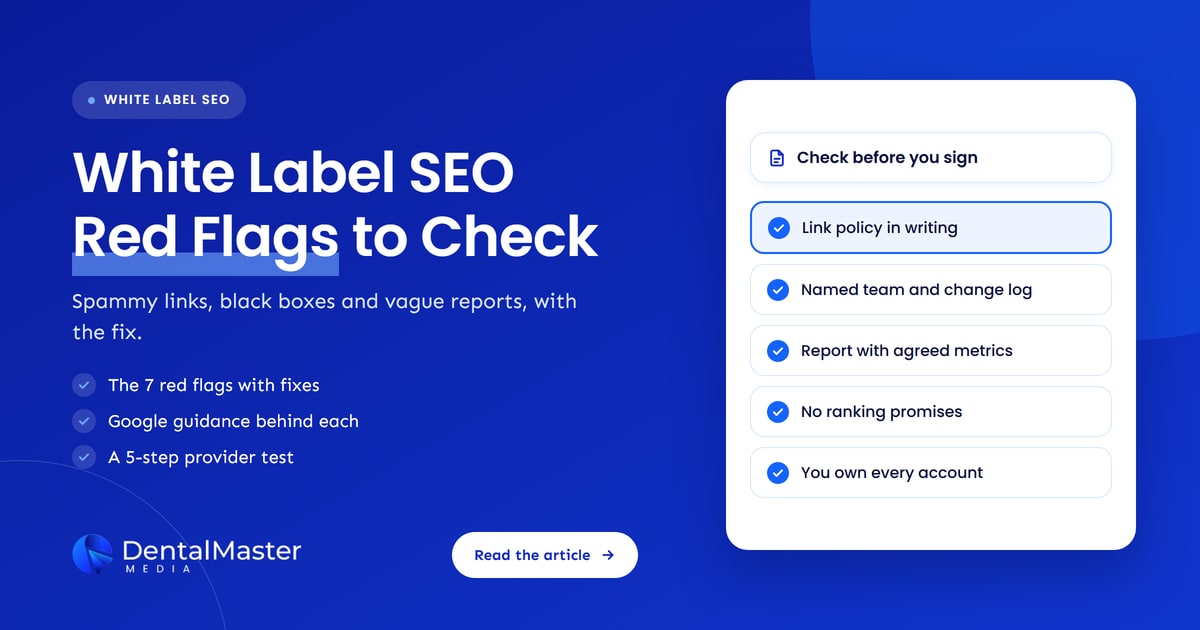
You test a white label SEO provider in 5 steps: ask for the link policy, ask for a sample report, check who does the work, set account ownership, and run a pilot. Each step takes a few days, and none of them involves a client site until the pilot.
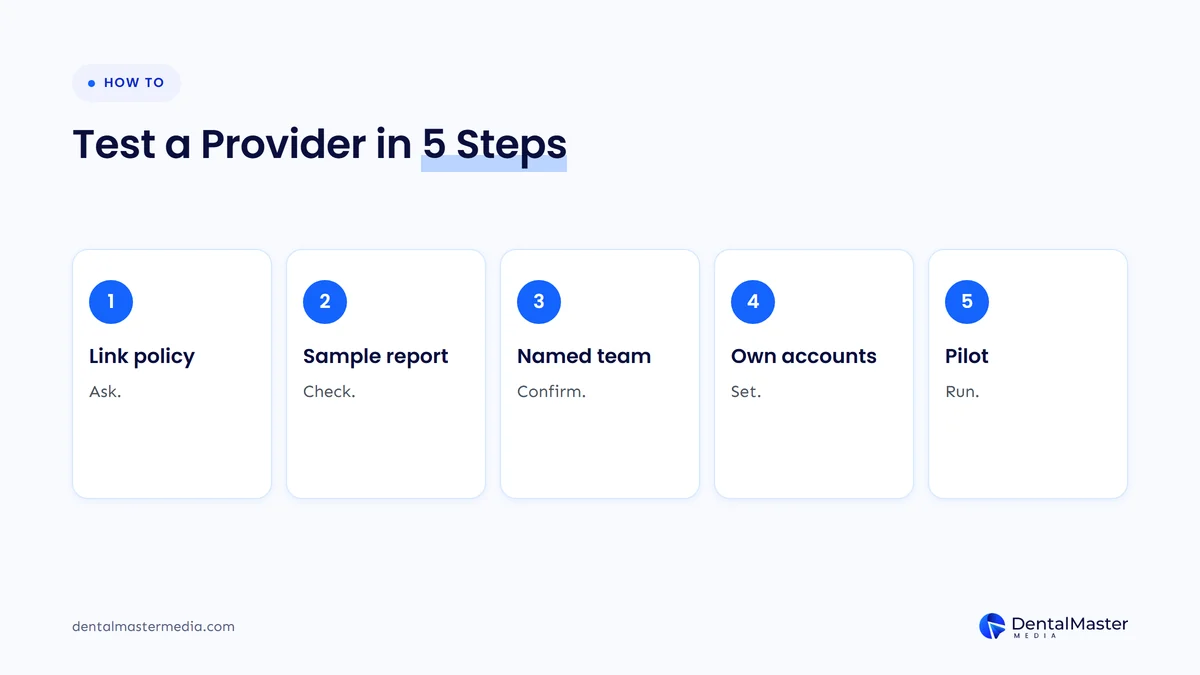
The 5 steps are listed below, and agency owners can run them in any order before a pilot.
- Ask for the link policy: request the written methods a white label SEO provider uses for links, and compare them with Google’s spam policies.
- Request a sample report: check that the monthly report names its metrics, its sources and the work completed.
- Identify who does the work: get named roles, the review process and whether any task is subcontracted.
- Set account ownership: create every account under your or your client’s login and grant the provider only the access it needs.
- Run a pilot: give the provider one small project, agree the metrics and review the results before adding client sites.
Price is a separate check, and it belongs after the steps above. Our post on white label SEO pricing and agency markup shows how to compare a provider’s fee with the work it lists.
What if a white label SEO provider already built spammy links?
If a white label SEO provider already built spammy links, fix them in 3 steps from Google’s Manual actions report help page: remove the links, disavow the ones you cannot remove, and send a reconsideration request. Google says a manual action for unnatural links can affect some or all of a site.
The 3 recovery steps are listed below.
- Remove links: export the links from Google Search Console, find those that break the link spam policy, and ask the site owners to remove them or add nofollow.
- Disavow links: use the Disavow links tool for links you cannot get removed, after a good-faith removal attempt, and never for organic links.
- Request a review: select the review option in the Manual actions report and include records of removed links and an explanation of any you could not remove.
Not every drop in rankings is a manual action. Check the Manual actions report in Google Search Console before you accuse a provider, and then change the contract so the same method cannot return.
What does a good white label SEO provider look like?
A good white label SEO provider does the opposite of each red flag: it states its link methods, names its team, reports agreed metrics, promises deliverables, edits its content, leaves account ownership with you and welcomes a pilot. Red flags tell you what to avoid, and green flags tell you what to buy.
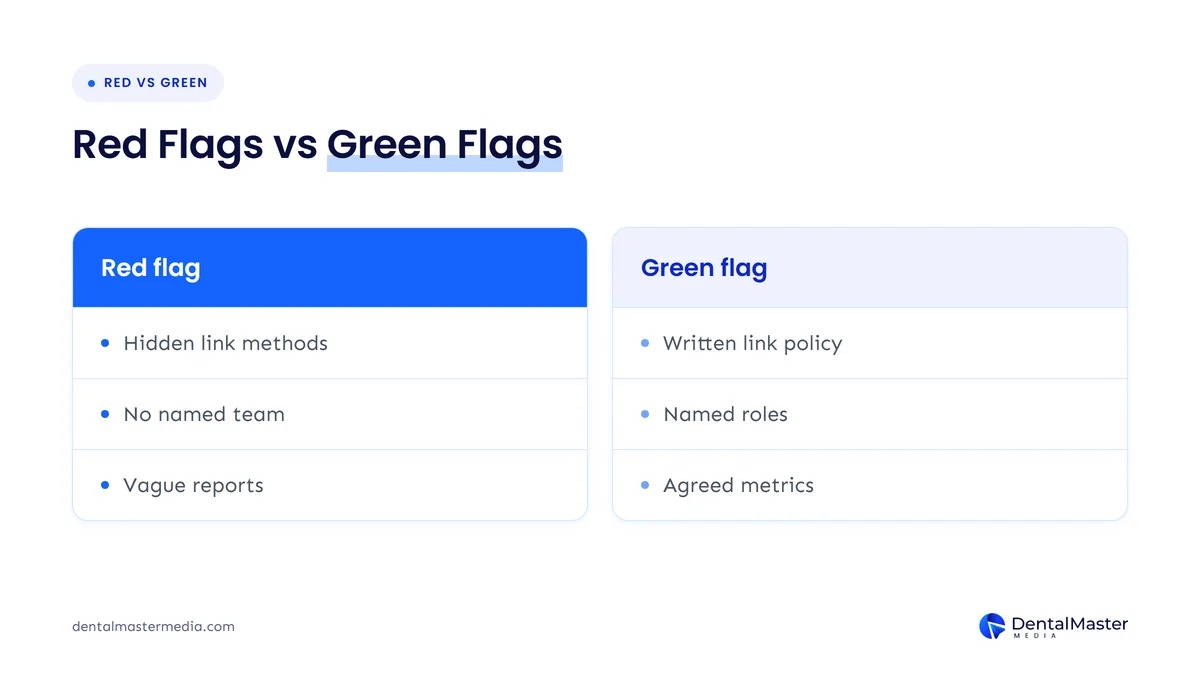
For a full question list, use our guide with 25 questions to ask a white label SEO provider. This post stops at the warning signs, and that guide scores the answers.
Frequently asked questions
How do I spot a bad white label SEO provider?
You spot a bad white label SEO provider by checking 7 things: its link methods, who does the work, its reports, any ranking promise, how it produces content, who owns the accounts and whether it accepts a pilot. Google’s hiring page lists secretive plans and link schemes as warning signs.
Is offshore white label SEO bad?
No, offshore white label SEO is not bad by itself. The risk is a black box, meaning no named team, no change log and no explanation of the work. Judge a provider on transparency and process, not on the country it works from.
Can a white label provider get my client penalized?
Yes, a white label provider can get a client site penalized if it builds links or content that break Google’s spam policies. Google says violating sites may rank lower or not appear in results at all, and that manual actions are reported in Google Search Console.
Should a white label SEO provider promise rankings?
No, a white label SEO provider should not promise rankings. Google’s hiring page says nobody can promise a top Google ranking, and it advises looking elsewhere if a provider does. Ask for deliverables on dated milestones instead.
Can I report an SEO provider that misleads clients?
Yes, Google’s hiring page says US residents can report a misleading SEO company to the Federal Trade Commission online or by calling 1-877-FTC-HELP. Outside the US, the page points to econsumer.gov.
Conclusion
White label SEO red flags come down to 7 checks: links, transparency, reports, promises, content, access and proof. Run them before you resell a provider’s work, because Google’s guidance holds the site owner responsible for the company it hires. Agency owners who run the checks early avoid most of the damage.
Dental Master Media is a dental SEO agency that also supplies white label dental SEO services to agencies, and our team is open to every check in this post. See our core dental SEO services to understand the work behind them, then book a call to run the checks on us.
Run these checks on us
If you resell SEO to dental clients, book a call and ask us for our link policy, a sample report and the names of the roles that do the work. We will answer openly, and you can decide whether we pass.
Sources
- Google Search Central, “Spam policies for Google web search”, accessed November 26, 2026. https://developers.google.com/search/docs/essentials/spam-policies
- Google Search Central, “Do you need an SEO?”, accessed November 26, 2026. https://developers.google.com/search/docs/fundamentals/do-i-need-seo
- Google Search Console Help, “Manual actions report”, accessed November 26, 2026. https://support.google.com/webmasters/answer/9044175
- Google Search Central, “Qualify your outbound links to Google”, accessed November 26, 2026. https://developers.google.com/search/docs/crawling-indexing/qualify-outbound-links

Suraj Rana is the owner of Dental Master Media and a leading expert in SEO for dental practices. With a passion for dental marketing, he has successfully helped numerous dental clinics climb the search engine ranks. Suraj’s expertise makes him a go-to resource for effective, results-driven dental marketing.