Quick answer: Yes, if your practice is in the US and already has a listing in ChatGPT, claim it now. OpenAI launched Business Hub in beta on November 10, 2026. Claiming lets you correct your details and see mentions and website clicks. Verify by phone, email or DNS, then pass an ID check. Claiming does not raise your visibility.
Key takeaways
- OpenAI launched Businesses in ChatGPT in beta on November 10, 2026. Business Hub is where you claim your business, manage its details and see insights.
- OpenAI’s help page says local stores and restaurants can currently claim only an existing US listing. OpenAI does not name dental practices, so practices outside the US should treat access as not yet available.
- You verify the claim by text or automated call to the business phone, a code to the business email, a DNS record on your website domain or Shopify, then complete an identity check with Persona.
- Insights cover the past 28 days: mentions, website clicks and discovery topics. A click does not confirm a website visit or a booking.
- OpenAI says claiming does not by itself make ChatGPT show you more often. Business Agents, the new chat feature, are limited to US ecommerce and online service businesses for now.
What changed?
On November 10, 2026, OpenAI launched Businesses in ChatGPT in beta. Through a new Business Hub, businesses can claim their profile in ChatGPT, keep their information current and see aggregated insights on how people engage with them. Search Engine Roundtable had earlier reported that the feature was coming. This is the live launch.
The OpenAI announcement lists three parts:
- Claim your business. Once verified, a business can update key details. Retailers can also add product feeds with prices and availability.
- Insights. Business Hub shows the number of mentions and website clicks a business receives, plus “discovery topics”, which are common themes in conversations where its website is cited.
- Business Agents. A business can build a chat agent that answers questions about its offerings, starting with eligible ecommerce and online service businesses in the US.
OpenAI says it built the insights to protect user privacy. Businesses don’t see users’ conversations, and insights only appear once activity passes certain thresholds. OpenAI also says it plans to expand to more markets and business categories over time, without giving dates.
Search engine reporters noticed the data straight away. Barry Schwartz, who covered the launch for Search Engine Roundtable, summed it up on X:
“ChatGPT Business Hub with click data, mentions, query’ish data and more is live now”
Barry Schwartz (@rustybrick) on X, November 10, 2026 (source)
What is ChatGPT Business Hub?
ChatGPT Business Hub is the area inside ChatGPT where a business owner, or someone authorized to represent the business, claims its profile. After verification, the owner can update the profile’s details, view insights about mentions and clicks, and, if eligible, build a Business Agent. You open it from the ChatGPT sidebar.
Think of it as a first step toward what Google Business Profile does for Google Search and Maps, though much smaller for now. OpenAI’s help page lists the details you can change: website, business description, product or service category, logo, delivery and return policies, a cover photo and other optional details. OpenAI reviews every change before it goes live, and ChatGPT may still use other sources when it answers questions about your practice.
Can dental practices claim a listing in ChatGPT?
US dental practices that already have a listing in ChatGPT look eligible. OpenAI’s help page says local stores and restaurants can currently claim only an existing US listing, and that availability depends on a business’s location and type. Dental practices are not named, so a practice without a listing, or outside the US, may not be able to claim yet.
Here is how the eligibility rules read for a typical practice, based on OpenAI’s help page:
| Feature | What it does | Open to a US dental practice? |
|---|---|---|
| Claim an existing listing | Takes ownership of your profile in ChatGPT | Appears so, as a local business with an existing US listing |
| Add a new listing | Creates a profile that doesn’t exist yet | Offered to eligible online businesses; local businesses are limited to existing listings |
| Update business details | Website, description, category, logo, cover photo | Yes, after the claim and Persona check are approved |
| Insights | Mentions, website clicks and discovery topics over 28 days | Yes, after Persona approval and once activity passes reporting thresholds |
| Business Agent | A chat that answers questions about your offerings | Not yet; limited to US ecommerce and online service businesses with a website |
Source: OpenAI Help Center, “Setting up your business on ChatGPT”, November 2026.
For practices in Australia, the UK, Canada, New Zealand or Singapore, OpenAI’s announcement says any eligible business located where ChatGPT is available can claim, but the help page limits local businesses to existing US listings for now. Until OpenAI updates its help page, we would not count on access outside the US.
Who is affected?
Every dental practice that patients might find through ChatGPT is affected, because anyone authorized to represent a business can now claim its profile. US practices with an existing listing can act today. Multi-location groups have extra work, since OpenAI says claiming the main brand doesn’t claim its locations.
Three groups should pay the most attention:
- US practices with an existing listing. You can claim now, check your details and start seeing data once it passes OpenAI’s thresholds.
- Group practices and DSOs. OpenAI’s help page says each brand is managed separately and central management across a parent company’s brands and locations isn’t available yet.
- Practices that rely on an agency. The admin who claims the business can add teammates and grant an agency access. Who claims first matters, as we explain below.
There is also a risk if you wait. Barry Schwartz wrote in his Search Engine Roundtable report that he was concerned about businesses being hijacked on the platform and hoped OpenAI would address it. OpenAI’s help page does offer a “Dispute ownership” option for profiles someone else has already claimed, but it’s simpler to claim your own first.
How do you claim your dental practice in ChatGPT?
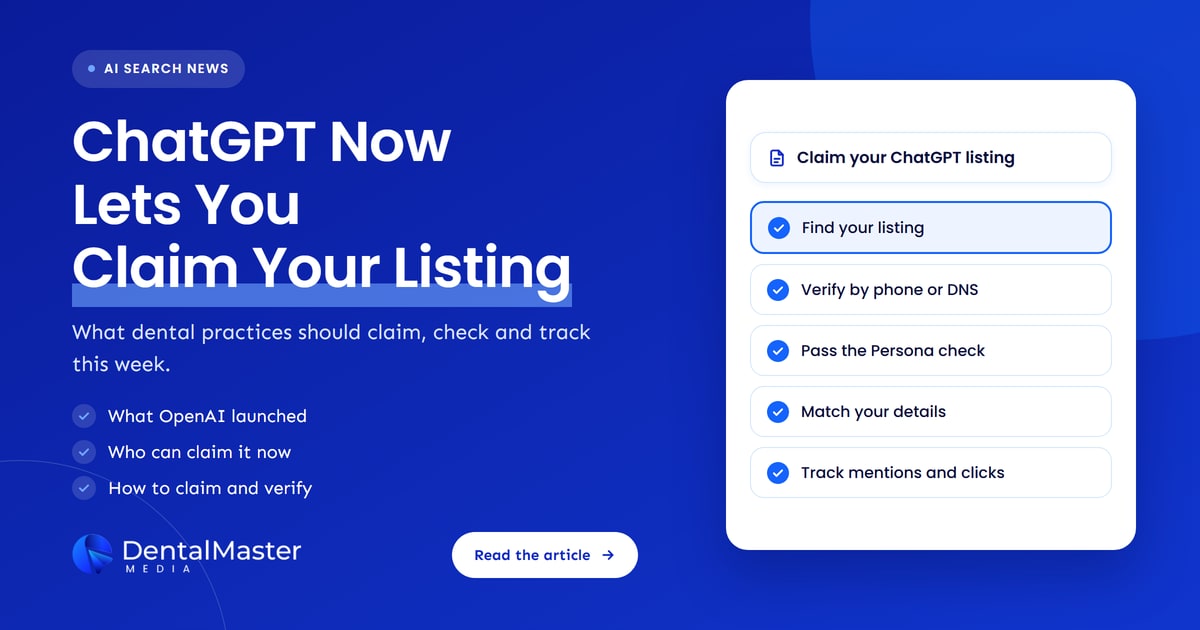
Sign in to ChatGPT, open Business Hub from the sidebar and search for your practice by name. Select the matching listing, choose a verification method and enter the code. OpenAI then reviews the claim by email. After approval, complete Persona identity verification to edit details and see insights.
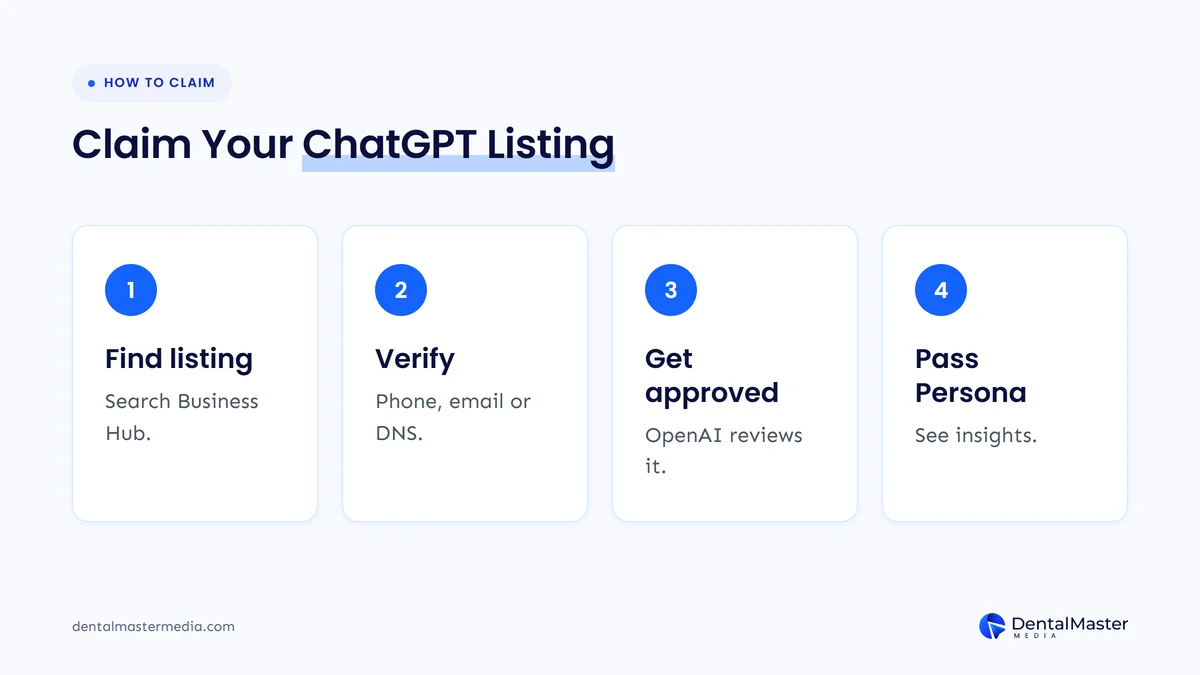
- Use the right ChatGPT account. Sign in with an account the practice controls, not a staff member’s personal login or an agency’s account. OpenAI asks you to confirm which account will manage the listing.
- Find your listing. Open Business Hub from the sidebar and search for your practice name. If your name has changed, also try the old one.
- Pick a verification method. OpenAI’s help page lists business phone (a text message or an automated call), business email, website domain (a DNS TXT record) and Shopify. Only the methods offered for your listing appear.
- Wait for approval. OpenAI reviews the claim and emails its decision or asks for more information.
- Complete Persona verification. You need this before you can publish changes or view insights. Have a government-issued ID, business registration details and proof that you can represent the practice ready.
A few practical points from the verification options:
- Phone verification goes to the number on the listing. Check which number that is before you start. If it’s a call tracking number or routes through a phone menu, make sure someone can receive the text or answer the automated call.
- DNS verification needs your domain login. If your web developer manages your domain, ask them to add the TXT record exactly as shown. OpenAI notes DNS changes can take time to appear.
- The blue check comes later. OpenAI says claiming alone doesn’t add a verified badge. The blue check appears after Persona verification is approved.
If you see “Contact support” instead of a claim option, OpenAI says the listing is locked and you should request help through that button.
What do the Business Hub insights show?
Business Hub insights show aggregated activity for the past 28 days: mentions, website clicks and discovery topics. For a local business, OpenAI counts a mention whenever ChatGPT shows a result for that location, even if nobody opens it. The insights never show individual prompts or patient conversations, and a blank number does not mean zero.
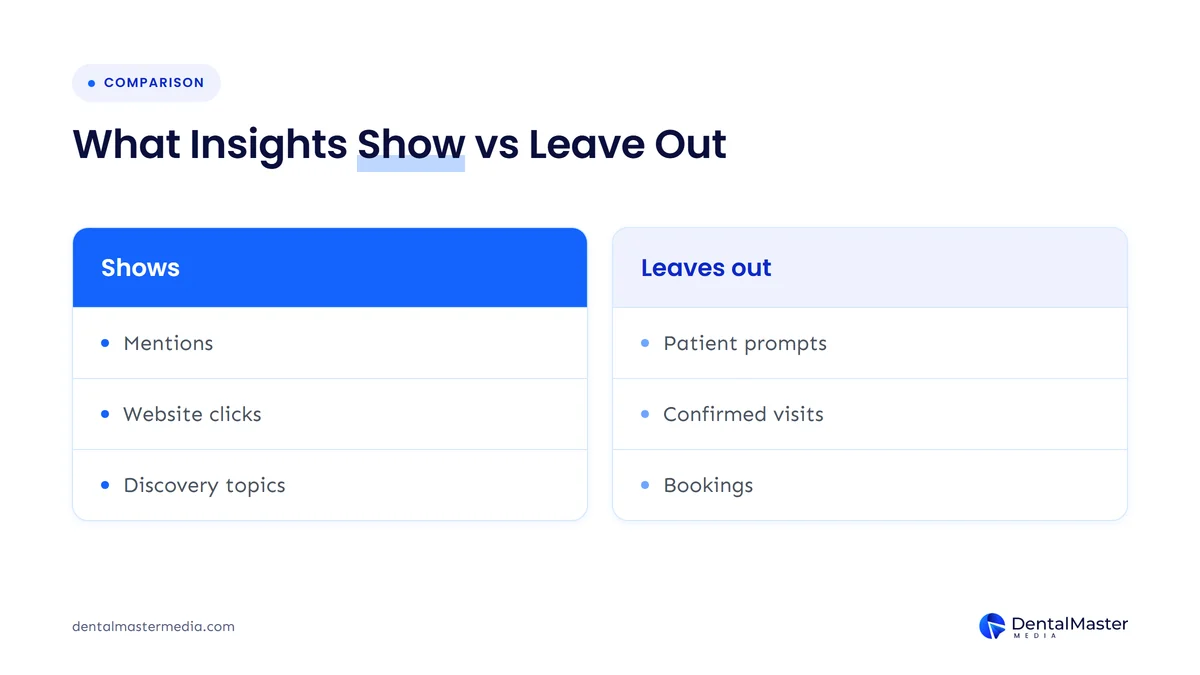
Here is what each metric means, according to OpenAI’s help page:
- Mentions. For a local business, a mention counts when ChatGPT shows a result for that location. For an online business, it counts when ChatGPT references the website; the brand name alone doesn’t count.
- Website clicks. How often people click through to your website from ChatGPT.
- Discovery topics. Common themes in ChatGPT answers that mentioned or cited your business. OpenAI says these don’t reveal individual prompts or directly measure customer intent.
Read the click number with care. Search Engine Roundtable reported that the help tooltip in Business Hub says clicks “don’t confirm website visits or conversions.” A click is not a booked appointment, so you still need your own analytics and call tracking. Our guide on how to track calls and bookings from your dental website covers the set-up.
Data may also be thin at first. OpenAI says a blank metric can mean activity hasn’t reached the reporting threshold, data is still being collected or reporting is unavailable. Schwartz reported that his own claim, made through DNS verification, showed as pending with no data at first.
Does claiming your listing help ChatGPT recommend you?
No, not directly. OpenAI’s help page says claiming lets you manage the information you provide, but it won’t necessarily make you more visible and doesn’t give you control over ChatGPT’s independent recommendations. Claiming or disputing a profile doesn’t change its visibility either. The value is accurate details, a verified owner and data you didn’t have before.
What ChatGPT says about your practice still depends on what it finds about you across the web: your website, your reviews and the directories that list you. If those sources disagree about your name, address, phone number or services, a claimed profile won’t fix that on its own. Our post on why ChatGPT may recommend another dentist instead of your practice explains the factors that shape those answers.
OpenAI also says advertising doesn’t influence ChatGPT’s independent answers. Businesses can sponsor a Business Agent as the destination for ChatGPT Ads, but sponsored placements are labeled and kept separate.
What should you do now?
If you run a US practice, claim your ChatGPT listing this week from an account the practice controls, then complete the Persona check. Make your ChatGPT details match your Google Business Profile and website exactly. Add your agency as a teammate rather than letting it claim for you, and track bookings separately.
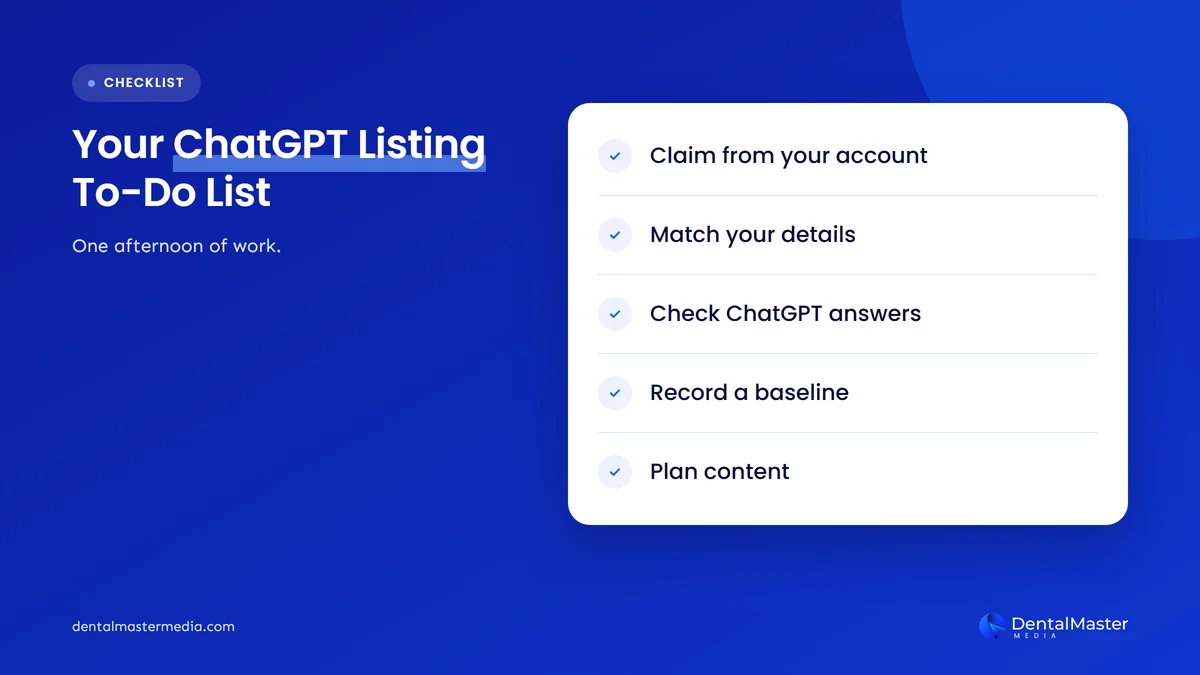
Claim it from a practice-owned account
Treat your ChatGPT profile like your Google Business Profile: the practice should own it. OpenAI’s help page says the admin who claimed the business can add teammates and give an agency access, and that each person should use their own ChatGPT account. If a former employee or agency claims it under their login, getting control back means a dispute.
Match your details everywhere
Use the same practice name, website, description and category that appear on your Google Business Profile and website. ChatGPT can draw on other sources as well as your profile, so consistent details across the web matter more than any single field.
Our guide to cross-platform consistency for dental practices shows where mismatches usually hide.
Check what ChatGPT says about you
Ask ChatGPT the questions patients ask, such as which dentist near you offers implants or emergency appointments, and note whether your practice appears and how it is described. Write down anything wrong. If the error comes from your website or a directory, fix it at the source, as well as in Business Hub.
Record a baseline for mentions and clicks
Once insights appear, note your 28-day mentions, website clicks and discovery topics each month. Compare them with the referral visits from ChatGPT in your own website analytics. Look for trends over several months rather than reacting to one reading, since the beta numbers may be incomplete and OpenAI may change how they are counted.
Use discovery topics to plan content
Discovery topics show the themes of answers where your practice was mentioned or cited. If those themes are all general dentistry and none touch the treatments you most want to grow, that is a sign your treatment pages need work.
Our guide on getting your dental clinic cited by ChatGPT and AI search covers what to publish.
What’s likely next?
This section is our view, not OpenAI’s. Business Hub is a beta, and OpenAI says it plans to expand to more markets and business categories. Local businesses outside the US and service businesses such as dental practices may get more features later, but no dates have been given. Expect the insights and claim process to change.
Search marketers are taking it seriously. Kevin Indig, a search and growth advisor, wrote on X:
“This is one of the most impactful developments for AI Search”
Kevin Indig (@Kevin_Indig) on X, November 10, 2026 (source)
We agree it’s a meaningful change, mainly because it gives practices their first official data on how often ChatGPT shows them. At Dental Master Media, we expect claiming your ChatGPT profile to become as routine as claiming a Google Business Profile, and we’d rather practices do it early, from their own account, than sort out ownership later.
Frequently asked questions
Is it free to claim a business in ChatGPT?
OpenAI’s materials don’t mention a fee for claiming. Its help page says you don’t need an Ads account or a ChatGPT Enterprise agreement to claim an eligible business, and that claiming, publishing an agent and advertising are separate. You do need a ChatGPT account and must pass verification.
Can my dental practice claim a listing outside the US?
Probably not yet. OpenAI’s help page says local stores and restaurants can currently claim only an existing US listing, and that availability depends on location and business type. OpenAI says it plans to expand to more markets, but it hasn’t given dates. Check Business Hub again over the coming months.
Can my agency claim the listing for my practice?
It’s better if the practice claims it and then gives the agency access. OpenAI’s help page says the admin who claimed the business can add teammates and grant an agency access to manage it, with each person using their own ChatGPT account. That keeps ownership with the practice if you ever change agencies.
Can a Business Agent book appointments for my practice?
No. OpenAI’s help page says Business Agents can explain products and policies and link to your website, but cannot complete purchases, make bookings or check orders. Agents are also limited to US ecommerce and online service businesses for now, so most dental practices can’t create one yet.
Does a click in Business Hub mean a patient visited my website?
Not necessarily. Search Engine Roundtable reported that Business Hub’s own tooltip says clicks don’t confirm website visits or conversions. Use your website analytics and call tracking to see whether people from ChatGPT actually reach your site, call or book.
What if someone else has already claimed my practice?
Open the profile in ChatGPT, select the more options menu and choose Dispute ownership. OpenAI’s help page says you then verify with Persona that you’re authorized to represent the business. Keep your business registration documents ready, since the details must match your official records.
The bottom line
ChatGPT now lets businesses claim their listing, and US dental practices with an existing listing appear able to do it today. Claim it from an account the practice owns, complete the Persona check, match your details to your Google Business Profile and website, and record your mentions and clicks. It won’t raise your visibility on its own, but it gives you control and data. To see how we build AI search visibility into our dental SEO services, visit Dental Master Media.
Want to know how ChatGPT sees your practice?
At Dental Master Media, our free dental SEO audit checks how your practice appears in Google and AI search, whether your details match across the web, and which treatment pages need work. You get a clear list of what to fix first.
Sources
- OpenAI, “Introducing Businesses in ChatGPT”, November 10, 2026. https://openai.com/index/introducing-businesses-chatgpt/
- OpenAI Help Center, “Setting up your business on ChatGPT”, updated November 11, 2026. https://help.openai.com/en/articles/20001635-setting-up-your-business-on-chatgpt
- Search Engine Roundtable (Barry Schwartz), “Businesses in ChatGPT Business Hub Live With Click Data”, November 10, 2026. https://www.seroundtable.com/chatgpt-business-hub-42505.html
- Kevin Indig (@Kevin_Indig) on X, post on Businesses in ChatGPT, November 10, 2026. https://x.com/Kevin_Indig/status/2120235080929169467
- Barry Schwartz (@rustybrick) on X, post on ChatGPT Business Hub, November 10, 2026. https://x.com/rustybrick/status/2120227073528607123

Suraj Rana is the owner of Dental Master Media and a leading expert in SEO for dental practices. With a passion for dental marketing, he has successfully helped numerous dental clinics climb the search engine ranks. Suraj’s expertise makes him a go-to resource for effective, results-driven dental marketing.