Quick answer: Google Ads Journey-Aware Bidding is a beta feature that lets Search campaigns using Target CPA learn from earlier conversion actions, such as phone calls and form submissions, not only the action being bid on. A dental practice should check its conversion tracking now and keep patient health information out of ad platforms.
Key takeaways
- Google Ads Journey-Aware Bidding lets Search campaigns learn from the full lead-to-sale journey, including phone calls and form submissions, according to Google’s May 7, 2026 announcement.
- Google still describes Journey-Aware Bidding as a beta and has given no general availability date.
- It works with Search campaigns that use Target CPA. Google’s business page also names Maximize conversions.
- Journey-Aware Bidding learns from conversion actions you import, so a clean setup for phone calls, form leads and booked appointments comes first.
- A dental practice should check its bid strategy, conversion actions and privacy settings before it asks Google for access.
- Dental SEO complements Search ads, because organic and map listings bring the same patients through the same tracked phone calls and forms.
What is Google Ads Journey-Aware Bidding?
Google Ads Journey-Aware Bidding is a bidding upgrade for lead generation that shares your lead-to-sale journey data with Google’s AI so that Search campaigns learn from every conversion goal, whether the goal is biddable or not. Google lists it under “New for 2026” and describes it as a backend change, not a new campaign type.
Journey-Aware Bidding changes how Google Ads sets bids, and it has no effect on organic rankings or Google Business Profile visibility. The organic side belongs to dental SEO services, while this post covers only the ads side. Search Engine Land also covered how the feature works on November 19, 2026.
What changed with Journey-Aware Bidding, and when?
Google announced Journey-Aware Bidding on May 7, 2026, in a Google Ads blog post by Josh Braverman, Group Product Manager at Google Ads, and the feature is still in beta. PPC Land reports that Google first disclosed the idea at Think Week in September 2025, and Search Engine Roundtable reported on it on November 17, 2025.
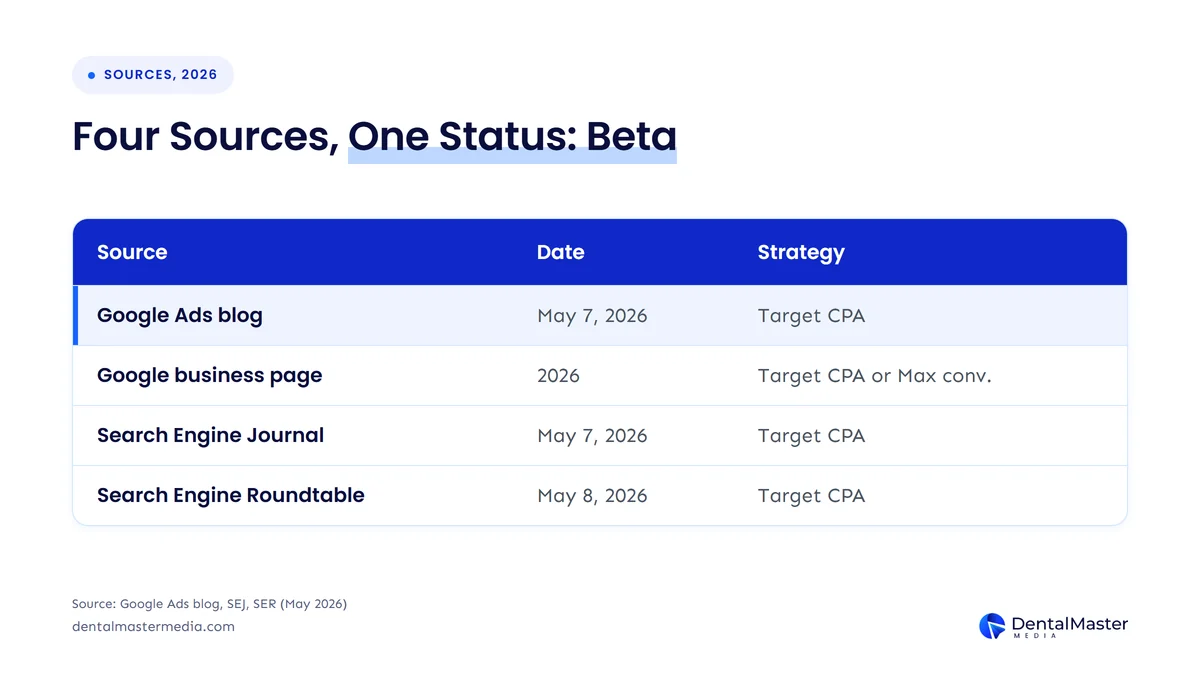
| Source | Published | Bid strategy named | Status |
|---|---|---|---|
| Google Ads blog (Josh Braverman) | May 7, 2026 | Target CPA on Search | Currently in beta |
| Google business page | 2026 | Target CPA or Maximize conversions on Search | Now available in beta |
| Search Engine Journal (Brooke Osmundson) | May 7, 2026 | Target CPA on Search | Still in beta |
| Search Engine Roundtable (Barry Schwartz) | May 8, 2026 | Target CPA on Search | Beta, “Ideal for complex lead gen sales cycles” |
The table shows that all 4 sources agree on the beta status and that only Google’s business page adds Maximize conversions next to Target CPA. Google’s help page adds that from June 2026 “Maximize conversions with a Target CPA” is renamed “Target CPA”, so check which label your Search campaigns show.
How does Journey-Aware Bidding use earlier conversion actions?
Journey-Aware Bidding lets Search campaigns using Target CPA learn from both biddable and non-biddable conversion goals, so earlier steps such as phone calls, form submissions and newsletter signups help Google AI predict which clicks lead to a sale. Google’s blog says tracking the full journey gives Google AI “the whole picture”.
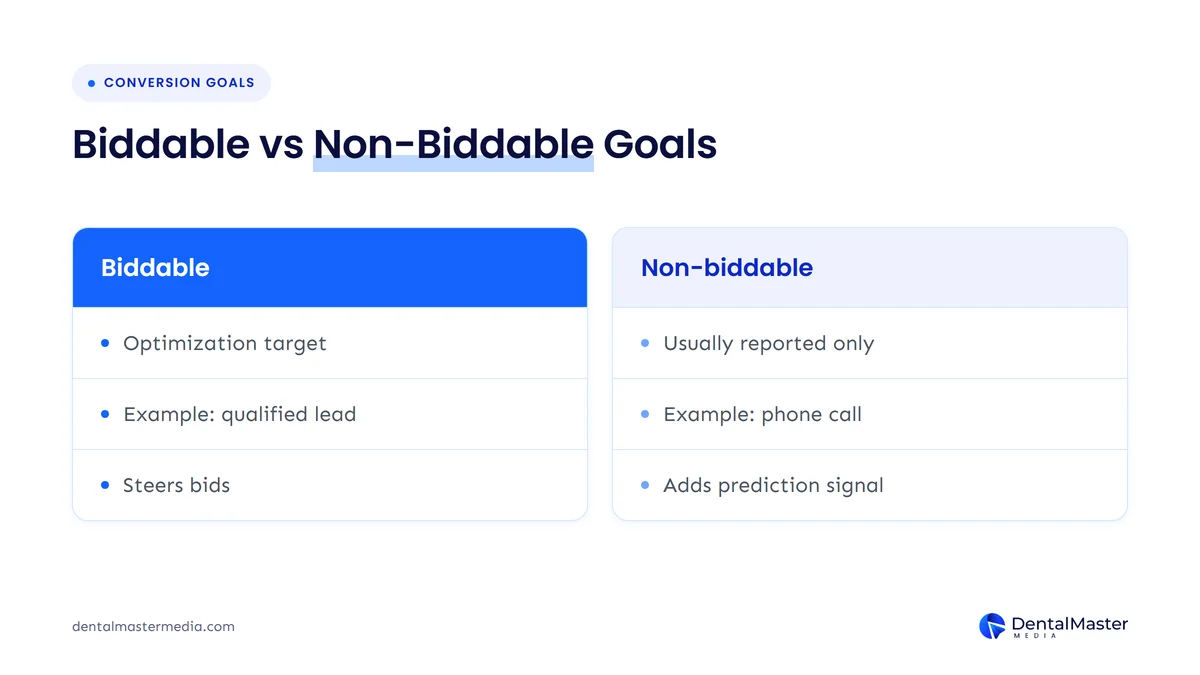
PPC Land explains the difference: a biddable conversion is part of the campaign’s optimization target, such as a qualified lead form submission, while a non-biddable conversion, such as a phone call, is usually reported but does not steer bidding on its own. Search Engine Roundtable described the idea in November 2025 as a way for secondary conversion actions to shape bidding without counting as conversions.
Google’s business page says you must give Google AI “enough visibility into your lead journey by importing the necessary conversion actions”. Search Engine Roundtable’s 2025 report adds that advertisers would import the full funnel and categorize each action accurately. Neither Google page lists the exact steps for importing or categorizing, so follow the setup screens in your own account.
Google Ads separates primary conversion actions, which are used for bidding, from secondary conversion actions, which are used for reporting in the “All conversions” column. A primary conversion action is what your Target CPA aims at, so choose it deliberately.
Does Journey-Aware Bidding apply to a dental practice?
Yes, Journey-Aware Bidding applies to a dental practice that runs Google Search campaigns with a Target CPA strategy, and it does not apply to practices that run no Search ads. Search Engine Journal says the feature appears designed for advertisers with longer sales cycles and names healthcare among the likely fits, alongside B2B, higher education and financial services.
Three limits matter for a practice. Journey-Aware Bidding is a beta with no general availability date. It is described for Search campaigns only, so a practice running Performance Max or Local Services Ads should not expect it there. And Target CPA itself needs working conversion tracking, and Google Ads Help suggests at least 30 conversions in the last 30 days when you evaluate a Target CPA strategy.
Search Engine Journal adds that the feature may be most useful for advertisers who already import offline conversions and CRM data into Google Ads. A practice that books appointments by phone and records them in a practice management system fits that pattern only if those bookings are sent back to Google Ads. Our earlier post on Google AI Mode showing up to four ads covers the other change that affects Search ad budgets this month.
What should a dental practice check before using Journey-Aware Bidding?
A dental practice should check 5 things before it uses Journey-Aware Bidding: the bid strategy, the conversion actions, the primary conversion, the conversion volume and the privacy settings. Doing this work first costs nothing and also improves the Target CPA bidding you run today.
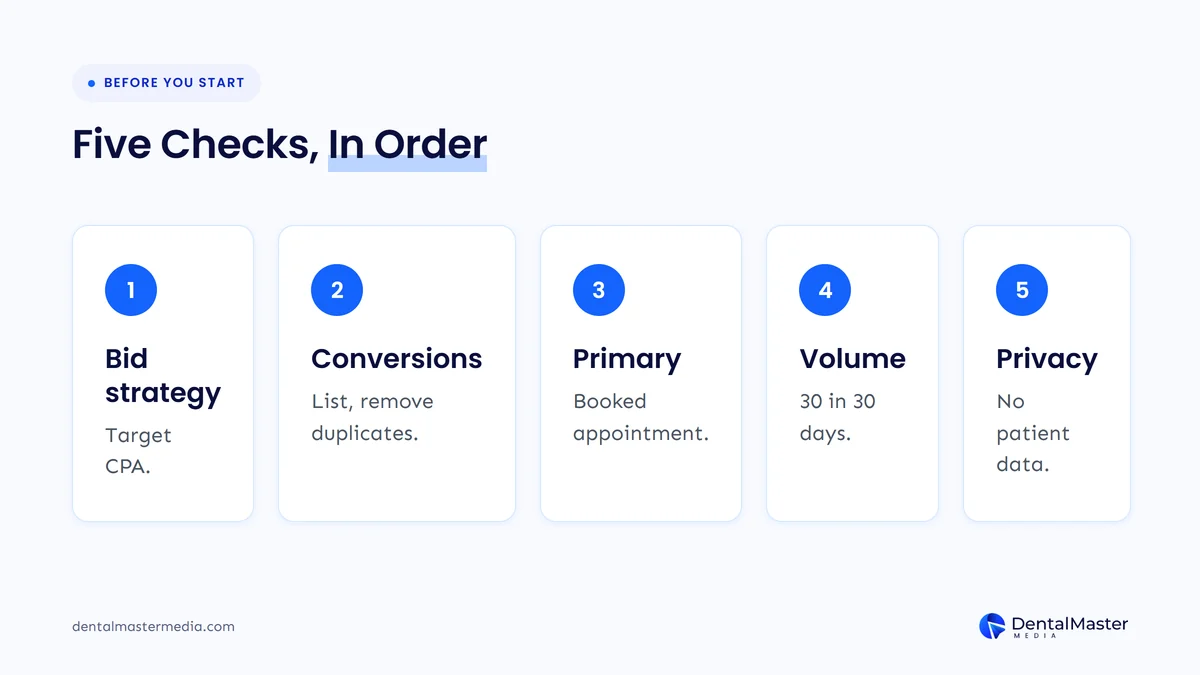
The 5 checks for a dental practice are listed below, in the order to do them.
- Open your Search campaigns and note which ones use Target CPA, since Journey-Aware Bidding is described for Search campaigns with that strategy.
- List every conversion action in your Google Ads account and delete or pause any duplicate that counts the same phone call or form lead twice.
- Set one primary conversion action for the outcome you pay for, such as a booked appointment, and keep earlier steps as separate conversion actions.
- Count your conversions for the last 30 days and compare the total with the 30 conversions Google Ads Help mentions for evaluating Target CPA.
- Review your tracking and privacy settings so that no patient health information reaches Google Ads.
Which dental conversion actions should you track?
You should track phone calls, online booking requests, contact form leads and booked appointments as separate conversion actions, because each marks a different step in the lead-to-sale journey. Google’s blog names phone calls and form submissions as examples of the steps Journey-Aware Bidding can learn from.
The 4 dental conversion actions to set up are listed below.
- Phone calls from your website: use website call conversion tracking, which counts a call when it lasts longer than a minimum length you set, according to Google Ads Help.
- Online booking requests: track the thank-you page or button click that follows a booking request.
- Contact form submissions: track each form submission once, and test it with a real submission.
- Booked appointments: import the appointments your front desk confirms, as Search Engine Journal describes for offline conversions, so Google Ads sees the outcome and not only the click.
A booked-appointment conversion is the one most closely tied to revenue, so it is the first candidate for your primary conversion. Our guide to turning dental website visitors into booked appointments covers the website side of the same journey.
Which patient information should stay out of Google Ads?
Patient health information should stay out of Google Ads conversion data, audience lists and URLs, because the HHS Office for Civil Rights has published HIPAA guidance on online tracking technologies, and Google restricts targeting in health categories. Send an event such as “booking form submitted”, not a patient name, a diagnosis or a treatment note.
The HHS Office for Civil Rights issued its bulletin “Use of Online Tracking Technologies by HIPAA Covered Entities and Business Associates” on December 1, 2022 and revised it on March 18, 2024. A federal court in the Northern District of Texas vacated part of that guidance on June 20, 2024, according to law firm Holland & Knight, and the rest remains in effect.
Google’s “Restricted targeting in Personalized advertising” policy lists Health among its sensitive interest categories, and advertisers in those categories are unable to use advertiser-curated audiences. Read that policy against your own ads, and ask your privacy counsel or compliance lead whether your practice is a HIPAA covered entity before you import any appointment data.
When does dental SEO complement Journey-Aware Bidding?
Dental SEO complements Journey-Aware Bidding when the same patients reach your practice through both paid and organic results, because clean tracking of phone calls and booked appointments shows which source brings each patient. Journey-Aware Bidding only improves paid bids, and it does not change what Google shows in organic results or in the map pack.
Three situations call for both channels. A practice that pays for clicks on a term where it also ranks organically should check whether the paid click is needed. A practice with a new service page needs organic work, since ads stop bringing patients the day the budget stops. And a practice whose Google Business Profile drives most calls should keep that listing accurate, which our post on why some dental practices spend $10,000 a month on ads but still struggle to grow explains from the ad side. Google’s AI features also change how local results look, which we cover in how Google AI Mode is reshaping local search for dental practices.
Frequently asked questions
Is Journey-Aware Bidding available to every Google Ads account?
No, Google describes Journey-Aware Bidding as a beta, and none of the sources we read gives a general availability date. Check your account for the feature or ask your Google Ads representative, because access in a beta can differ between accounts.
Does Journey-Aware Bidding work with Performance Max or Local Services Ads?
No, the sources we read describe Journey-Aware Bidding for Search campaigns only, using Target CPA, and Google’s business page also names Maximize conversions. None of them mentions Performance Max or Local Services Ads for this feature.
Can a dental practice send patient names or treatment details to Google Ads as conversion data?
No, a practice should not send patient names, diagnoses or treatment notes to Google Ads. Send a simple event such as a booked appointment, and ask your privacy counsel about HIPAA before you import appointment data, because the HHS Office for Civil Rights has published guidance on online tracking technologies.
Will Journey-Aware Bidding lower my cost per new patient?
No source we read promises a lower cost per patient. Google’s business page says the feature aims to sharpen predictions and boost performance, but it gives no performance figures, so test it against your current results before you change budgets.
Does Journey-Aware Bidding replace dental SEO?
No, Journey-Aware Bidding changes only how Google Ads bids on Search clicks. Organic rankings, map results and AI answers depend on your website and Google Business Profile, not on your ad bidding.
Journey-Aware Bidding is a tracking upgrade, not a switch to flip
Google Ads Journey-Aware Bidding is a beta for Search campaigns using Target CPA that learns from earlier conversion actions such as phone calls and form submissions. A dental practice gets the most from it with one primary conversion, clean tracking of phone calls and booked appointments, no patient health information in ad data and organic visibility working alongside the ads.
That tracking and organic work is what we do at Dental Master Media, and our dental SEO services cover the organic side. If you want a second opinion on how your ads and organic results work together, book a call.
Want a second opinion on your tracking and visibility?
Book a free strategy call and we will walk through your conversion tracking, your Google Business Profile and where organic visibility can support your ads.
Sources
- Google Ads & Commerce Blog (Josh Braverman), “New AI-powered bidding and budgeting innovations in Search and Shopping”, May 7, 2026. https://blog.google/products/ads-commerce/bidding-budgeting-google-marketing-live-2026/
- Google for Business, “Journey-aware bidding”, 2026. https://business.google.com/us/accelerate/announcements/journey-aware-bidding/
- Google Ads Help, “About Target CPA bidding”, accessed November 23, 2026. https://support.google.com/google-ads/answer/6268632
- Google Ads Help, “About primary and secondary conversion actions”, accessed November 23, 2026. https://support.google.com/google-ads/answer/11461796
- Google Ads Help, “Set up tracking calls to a phone number on a website”, accessed November 23, 2026. https://support.google.com/google-ads/answer/6095883
- Google Ads Policy Help, “Restricted targeting in Personalized advertising”, accessed November 23, 2026. https://support.google.com/adspolicy/answer/143465
- Search Engine Land, “Google Ads Journey-Aware Bidding: How it works and what to know”, November 19, 2026. https://searchengineland.com/google-ads-journey-aware-bidding-502255
- Search Engine Journal (Brooke Osmundson), “Google Ads Introduces Journey-Aware Bidding And New Budget Pacing Updates”, May 7, 2026. https://www.searchenginejournal.com/google-ads-introduces-journey-aware-bidding-and-new-budget-pacing-updates/574141/
- Search Engine Roundtable (Barry Schwartz), “Google Ads Journey-Aware Bidding, Expands Smart Bidding Exploration & Budget Pacing”, May 8, 2026. https://www.seroundtable.com/google-ads-smart-bidding-exploration-budget-pacing-41288.html
- Search Engine Roundtable (Barry Schwartz), “Google Ads Journey Aware Bidding Coming In 2026”, November 17, 2025. https://www.seroundtable.com/google-ads-journey-aware-bidding-40446.html
- PPC Land, “Google targets hidden conversions with new bidding and budgeting tools”, May 2026. https://ppc.land/google-targets-hidden-conversions-with-new-bidding-and-budgeting-tools/
- U.S. Department of Health and Human Services, Office for Civil Rights, “Use of Online Tracking Technologies by HIPAA Covered Entities and Business Associates”, December 1, 2022, revised March 18, 2024. https://www.hhs.gov/hipaa/for-professionals/privacy/guidance/hipaa-online-tracking/index.html
- Holland & Knight, “American Hospital Assn. v. Becerra: Are Tracking Tools OK Again? Court Dials Back OCR Bulletin”, June 2024. https://www.hklaw.com/en/insights/publications/2024/06/american-hospital-assn-v-becerra-are-tracking-tools-ok-again

Suraj Rana is the owner of Dental Master Media and a leading expert in SEO for dental practices. With a passion for dental marketing, he has successfully helped numerous dental clinics climb the search engine ranks. Suraj’s expertise makes him a go-to resource for effective, results-driven dental marketing.