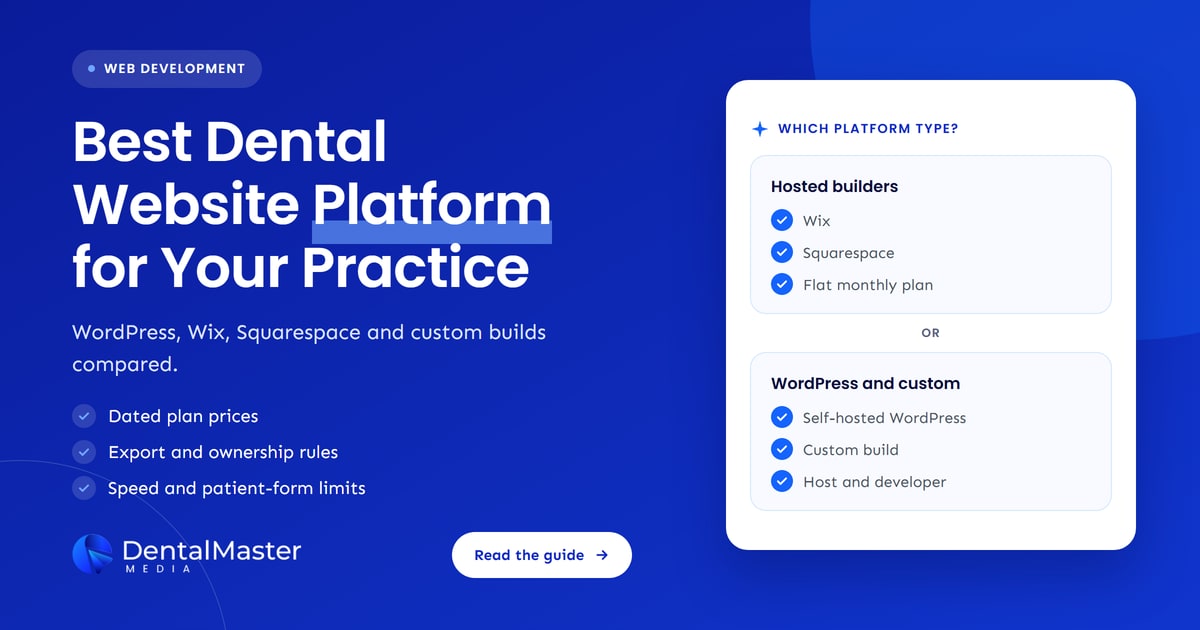
Quick answer: The best dental website platform for most practices is self-hosted WordPress built by a developer, because it has no platform ceiling. Wix and Squarespace suit a small practice that edits its own site on a flat plan of $17 to $49 a month. Google says the platform alone does not change rankings.
Key takeaways
- A dental website platform is the system that builds, hosts and serves a practice’s website, and the 4 common choices are WordPress, Wix, Squarespace and a custom build.
- Self-hosted WordPress fits a practice with 10 or more pages, online booking and growth plans. Wix and Squarespace fit a one-dentist practice that wants to edit pages itself.
- Hosted plans cost $4 to $159 a month on annual billing, checked on November 24, 2026. Self-hosted WordPress and custom builds have no list price.
- WordPress is open source, Squarespace exports part of a site in WordPress format, and Wix says blog posts cannot be exported to other platforms.
- Google’s SEO Office Hours said the backend generally has no bearing on ranking. Server speed does, and mobile Core Web Vitals pass rates differ by platform.
- Patient forms need a business associate agreement from the platform, host or form tool, and Wix and Squarespace limit this to specific plans or features.
What is a dental website platform?
A dental website platform is the software and hosting system that builds, stores and serves the pages of a dental practice’s website. The 4 common choices are WordPress, Wix, Squarespace and a custom build, and they differ in who hosts the site, who can edit it and who can move it elsewhere.
WordPress is open source software licensed under GPLv2 or later, according to WordPress.org, and it runs either on a host the practice picks or on a WordPress.com plan. Wix and Squarespace are hosted website builders: the company owns the editor, the hosting and the templates, and bills a monthly plan. A custom build is a site coded for one practice, usually by a developer, with no template platform behind it.
What each page should contain is covered in our dental website design guide. This post covers only the platform choice.
Which dental website platform is best for a dental practice?
Self-hosted WordPress is the best dental website platform for a practice that wants 10 or more pages, online booking and room to grow, while Wix and Squarespace are the better fit for a small dental practice that wants to edit its own site on a flat monthly plan.
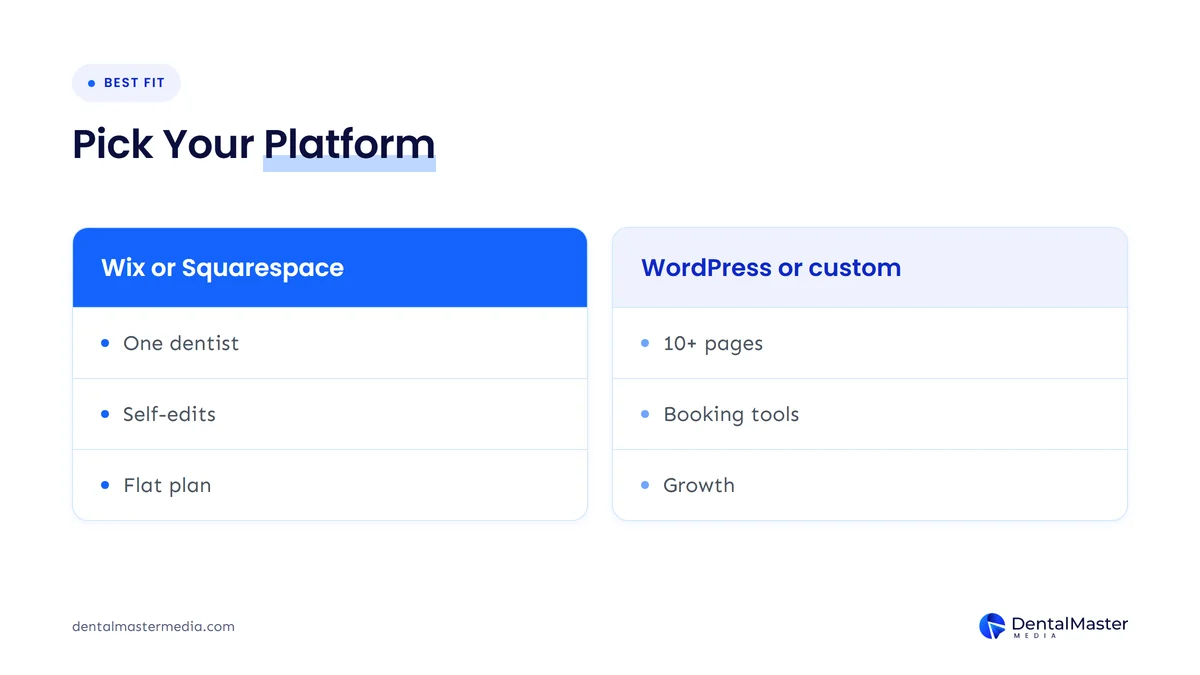
The best dental website platform by practice situation is listed below.
- One dentist who edits the dental website personally: Squarespace or Wix, because the editor, hosting and SSL sit inside one monthly plan.
- A practice that wants online booking, custom patient forms or other tools: self-hosted WordPress, because a developer can add any tool the practice chooses.
- A practice that wants WordPress without managing hosting: a WordPress.com plan, which starts at $4 a month on annual billing.
- A multi-location group or a practice with unusual integrations: a custom build, because a developer codes exactly what the group needs.
These picks are our judgment from the facts in the sections below, not rules. Staff time and patient-form needs can change the answer. Disclosure: Dental Master Media builds dental websites on WordPress with Elementor Pro, so we have a stake in this comparison. Every platform price below comes from the platform’s own pricing page.
What does each dental website platform cost?
A hosted dental website platform costs $4 to $159 a month on annual billing, depending on the platform and the plan. Self-hosted WordPress and custom builds have no list price, because the host and the developer set the cost.
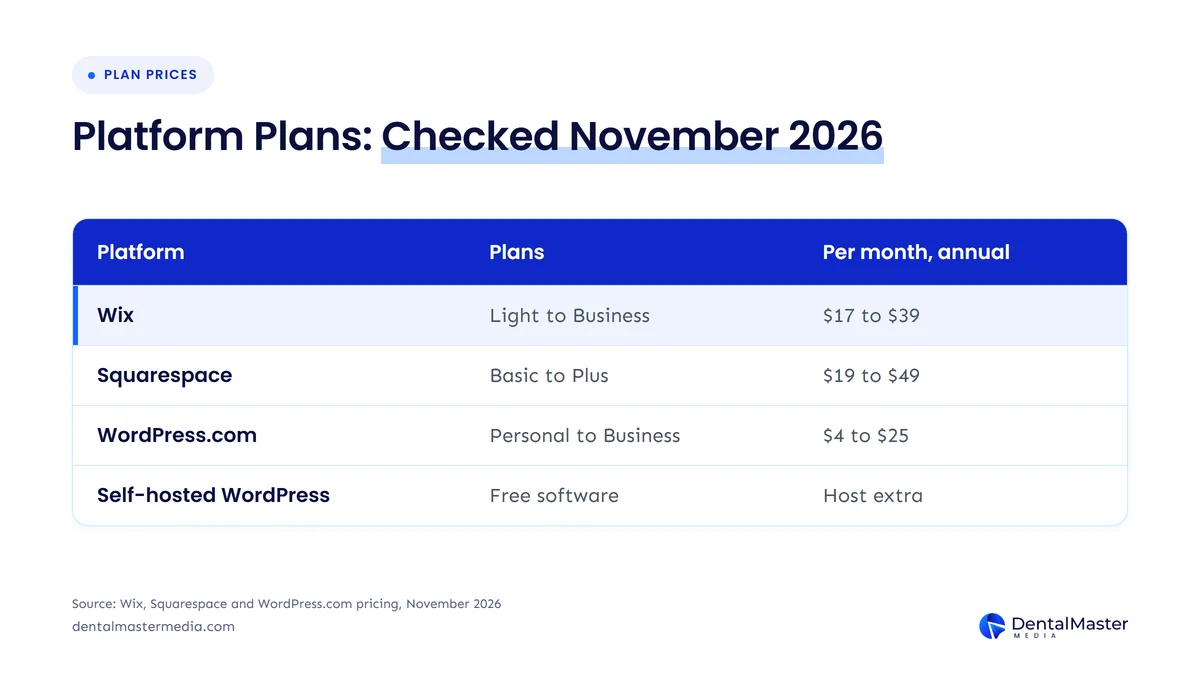
| Platform | Plans and price per month (annual billing) | Price per month (monthly billing) |
|---|---|---|
| Wix | Light $17, Core $29, Business $39, Business Elite $159 | Not compared here |
| Squarespace | Basic $19, Core $29, Plus $49, Advanced $99 | Basic $25, Core $39, Plus $65, Advanced $139 |
| WordPress.com | Personal $4, Premium $8, Business $25, Commerce $45 | Not compared here |
| Self-hosted WordPress | The software is free, so only the host and the developer cost money | No list price |
| Custom build | No list price: a developer quotes the project | No list price |
The table shows that the cheapest hosted plan is $4 a month on WordPress.com and the cheapest builder plan is $17 a month on Wix, both billed annually.
Plan prices are only one cost. Squarespace Basic is $228 a year on annual billing, and that covers the editor and hosting but not the design, copy, photography or the hours someone spends on edits. For comparison, Dental Master Media’s dental web development page states that website development starts at $999 for a 10-page website and a full redesign is $999 for up to 100 pages, with hosting and domain costs staying with the practice. Platform prices change, so check each pricing page before you buy.
Who owns the website on each dental website platform?
On WordPress the practice runs open source software, on Squarespace it can export part of its content in WordPress format, and on Wix it cannot export blog posts, so leaving a builder usually means rebuilding the design. The 3 ownership facts are listed below.
- WordPress: WordPress.org licenses the software under GPLv2 or later and lists the freedom to run it for any purpose, so any developer or host can run a WordPress dental website.
- Squarespace: the Help Center article “Exporting your site”, updated October 9, 2026, says the export file is in WordPress format and excludes style settings, custom CSS, product pages and drafts.
- Wix: the Wix Help Center states, “Currently, it is not possible to export blog posts to other platforms”, in an article updated July 2, 2025.
A practice should register its domain in its own account on any platform and keep its own copies of photos, text and Google Business Profile details. Those 3 items are the ones that take longest to recreate after a move.
Does the dental website platform change Google rankings and speed?
No, the dental website platform does not change Google rankings by itself. In its May 2023 SEO Office Hours, Google said the choice of backend generally has no bearing on ranking, but how the server performs does, and a very slow server can affect rankings.
Google’s John Mueller repeated the point in an October 28, 2025 Reddit comment reported by Search Engine Roundtable: there is no fundamental SEO difference between mainstream CMSs, and WordPress gets no ranking boost. Speed is where platforms differ in the data, as the table below shows.
| Platform | Share of CMS-built sites (W3Techs, November 2026) | Mobile “good” Core Web Vitals pass rate (Web Almanac 2025) |
|---|---|---|
| WordPress | 57.3% | 45% |
| Wix | 6.2% | 74%, up from 55% |
| Squarespace | 3.6% | No overall rate given; 89% good on layout shift and 96% good on interaction |
The table shows that the average Wix site passed mobile Core Web Vitals more often than the average WordPress site in the HTTP Archive Web Almanac 2025 CMS chapter. The WordPress average covers every host, theme and plugin combination, so a fast build can beat it and a slow one can miss it. Our post on dental website speed fixes lists what slows a page on any platform.
Which dental website platform handles patient forms and HIPAA?
A dental website platform handles protected patient health information only when the vendor signs a business associate agreement for that feature, and Wix and Squarespace each limit this to specific plans or features. A practice that is a HIPAA covered entity should confirm its own obligations with counsel.
The 3 platform positions are listed below.
- Wix: its Help Center article, updated October 15, 2026, requires a supported Premium or Studio plan, activated PHI protection and a signed business associate agreement, and warns that protection may disable some features, apps and visitor analytics.
- Squarespace: its Help Center article, updated January 20, 2026, calls Acuity Scheduling the only feature designed for HIPAA obligations, requires an Acuity Powerhouse or Premium plan, and says form blocks cannot be part of a HIPAA-compliant solution.
- WordPress: the answer depends on the host and the form or booking tool, so ask each vendor for a signed business associate agreement before a patient form goes live.
Form and booking design affects how many visitors become appointments, which we cover in dental website conversion.
How do you choose a dental website platform?
To choose a dental website platform, work through 4 steps in order: list the pages and tools the site needs, check patient-data needs, price 3 years of cost and check what you can take with you if you leave.
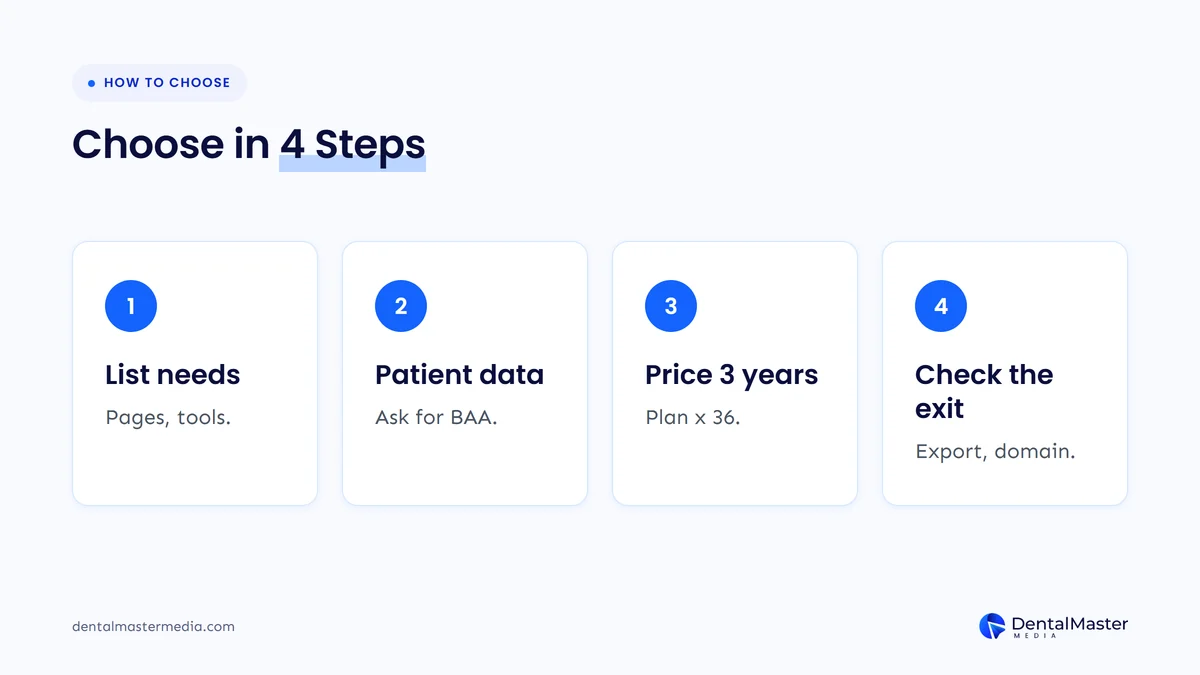
The 4 steps to choose a dental website platform are listed below.
- List the pages, tools and editor: write down the service pages, the online booking tool, the patient forms and the person who edits the site each month.
- Check patient-data needs: ask whether any form or booking tool collects health information, then ask the vendor for a business associate agreement.
- Price 3 years: multiply the monthly plan price by 36 months, so Wix Core at $29 a month is $1,044, WordPress.com Business at $25 a month is $900 and Squarespace Basic at $228 a year is $684, then add design and edit costs.
- Check the exit: read the export steps, confirm the practice owns the domain and ask which content leaves with you.
Accessibility is a fifth test that applies to every platform, and we cover it in dental website accessibility under WCAG and ADA.
When should a practice move to a new dental website platform?
A dental practice should move to a new dental website platform when the current one blocks something the practice needs, such as a booking tool, passing page speed or a content export, not because another practice uses a different platform.
A move is a redesign project, because the design usually has to be rebuilt and every old URL needs a redirect. Our post on when a dental website needs a redesign gives 6 tests with numbers, and a platform move should pass at least one of them.
Frequently asked questions
Is WordPress better than Wix for a dental practice?
No, WordPress is not better than Wix in every case. WordPress offers more control over booking tools and forms, while Wix is simpler to run, and the HTTP Archive Web Almanac 2025 found 74% of Wix sites passed mobile Core Web Vitals against 45% of WordPress sites on average.
Is Squarespace good enough for a dental website?
Yes, Squarespace is good enough for a small dental practice that edits its own pages, with plans from $19 a month on annual billing. Its limits are patient data, because form blocks cannot be part of a HIPAA-compliant solution, and export, because only part of a site leaves in WordPress format.
Can a Wix dental website be HIPAA compliant?
Yes, a Wix dental website can be set up for HIPAA, according to Wix, but only on a supported Premium or Studio plan with PHI protection activated and a business associate agreement signed. Wix says activation may disable some features and apps, so test the booking and form tools first.
What does a custom dental website cost?
A custom dental website has no published price, because a developer quotes each project. Ask any developer for the page count, the build time, the support period and who owns the code. Dental Master Media’s published price for a WordPress website with Elementor Pro is $999 for 10 pages.
Which website platform do most websites use?
WordPress is used by 38.4% of all websites, according to W3Techs on November 23, 2026, which is 57.3% of the websites built on a CMS. Wix is used by 4.2% of all websites and Squarespace by 2.4%.
The best dental website platform depends on who edits the site
The best dental website platform for most practices is self-hosted WordPress built by a developer, and Wix or Squarespace is the better fit for a small practice that edits its own pages. Google says the platform alone does not change rankings, so the deciding facts are cost over 3 years, patient-form needs and what you can export if you leave.
At Dental Master Media, our dental web development service builds dental websites from $999 for 10 pages, with about 30 days to build and 30 days of free post-launch support, and our dental SEO services keep the site found on Google.
Talk through your dental website platform
If you are choosing between WordPress, Wix, Squarespace and a custom build, book a free strategy call. We will look at your pages, booking tools and patient forms, and tell you which platform fits your practice, even if the answer is to keep what you have.
Sources
- Wix, “How much is a Wix website?”, editor’s note: plans and pricing current as of November 2026, accessed November 24, 2026. https://www.wix.com/blog/how-much-is-a-wix-website
- Squarespace, “Pricing” (pricing.txt), updated October 5, 2026, accessed November 24, 2026. https://squarespace.com/assets/pricing.txt
- WordPress.com, “Pricing”, accessed November 24, 2026. https://wordpress.com/pricing/
- WordPress.org, “About WordPress”, accessed November 24, 2026. https://wordpress.org/about/
- Squarespace Help Center, “Exporting your site”, updated October 9, 2026. https://support.squarespace.com/hc/en-us/articles/206566687-Exporting-your-site
- Wix Help Center, “Wix Blog Request: Exporting Blog Posts to Other Platforms”, updated July 2, 2025. https://support.wix.com/en/article/wix-blog-request-exporting-blog-posts-to-other-platforms
- Google Search Central, “May 2023 Google SEO Office Hours Transcript”, May 2023. https://developers.google.com/search/help/office-hours/2023/may
- Search Engine Roundtable, “Google’s John Mueller On Best Content Management Systems For SEO”, October 28, 2025. https://www.seroundtable.com/google-best-cms-for-seo-40329.html
- W3Techs, “Usage statistics of content management systems”, November 23, 2026. https://w3techs.com/technologies/overview/content_management
- HTTP Archive, “Web Almanac 2025: CMS”, published January 15, 2026. https://almanac.httparchive.org/en/2025/cms
- Wix Help Center, “Enabling HIPAA Compliance for Your Wix Site”, updated October 15, 2026. https://support.wix.com/en/article/enabling-hipaa-compliance-for-your-wix-site
- Squarespace Help Center, “Acuity Scheduling and HIPAA”, updated January 20, 2026. https://support.squarespace.com/hc/en-us/articles/360028867231-Acuity-Scheduling-and-HIPAA
- Dental Master Media, “Dental Web Development”, accessed November 24, 2026. https://dentalmastermedia.com/dental-web-development/

Suraj Rana is the owner of Dental Master Media and a leading expert in SEO for dental practices. With a passion for dental marketing, he has successfully helped numerous dental clinics climb the search engine ranks. Suraj’s expertise makes him a go-to resource for effective, results-driven dental marketing.