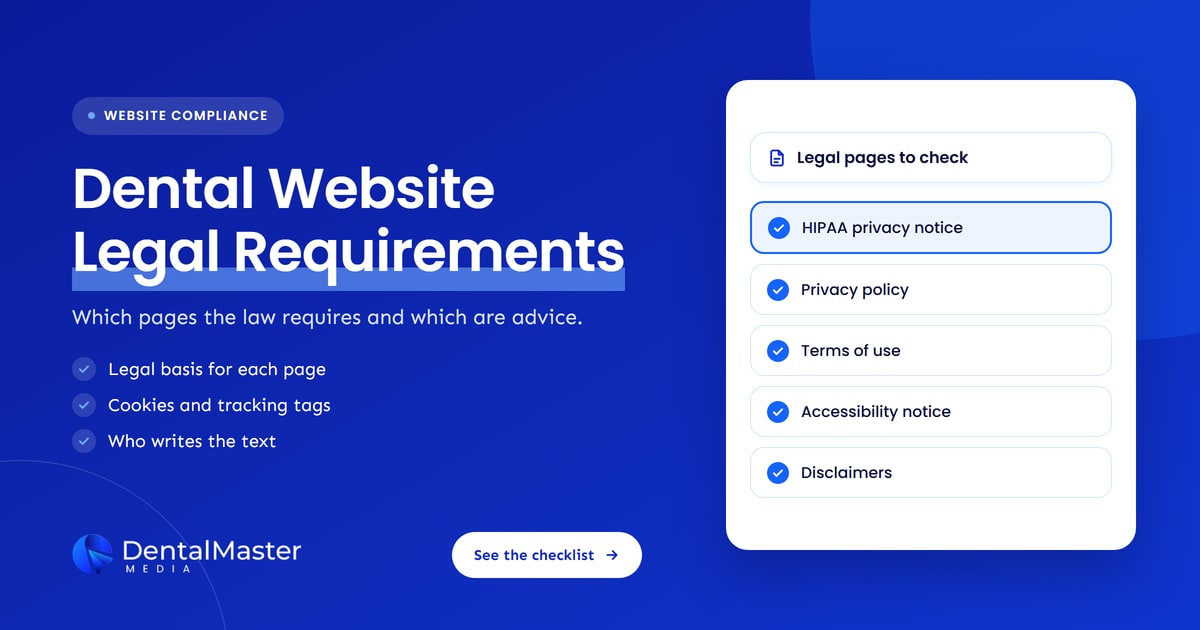
Quick answer: A dental website needs a HIPAA Notice of Privacy Practices, a privacy policy, terms of use, an accessibility and nondiscrimination notice, and clear disclaimers on health and advertising claims. Only the HIPAA notice (45 CFR 164.520) and truthful advertising are written into law for every practice. This guide is not legal advice, so check the final text with a lawyer.
Key takeaways
- The American Dental Association’s website checklist lists 6 legal elements: legal name and contact details, a privacy policy, a HIPAA Notice of Privacy Practices, terms of use, a notice of nondiscrimination and a copyright notice.
- A HIPAA covered dental practice must prominently post its Notice of Privacy Practices on its website, under 45 CFR 164.520(c)(3).
- A privacy policy and the HIPAA notice are 2 different documents. The privacy policy covers what the website itself collects, including cookies and forms.
- No source reviewed for this guide sets a single US cookie banner rule for dental websites. The bigger risk is tracking tags on appointment pages that send protected health information to Google or Meta.
- Disclaimers do not make a false claim legal. Your state dental board, the Federal Trade Commission and the ADA all point to truthful advertising and complete testimonials.
- A web designer builds and links the pages. A lawyer who knows your state writes or approves the text.
What legal pages does a dental website need?
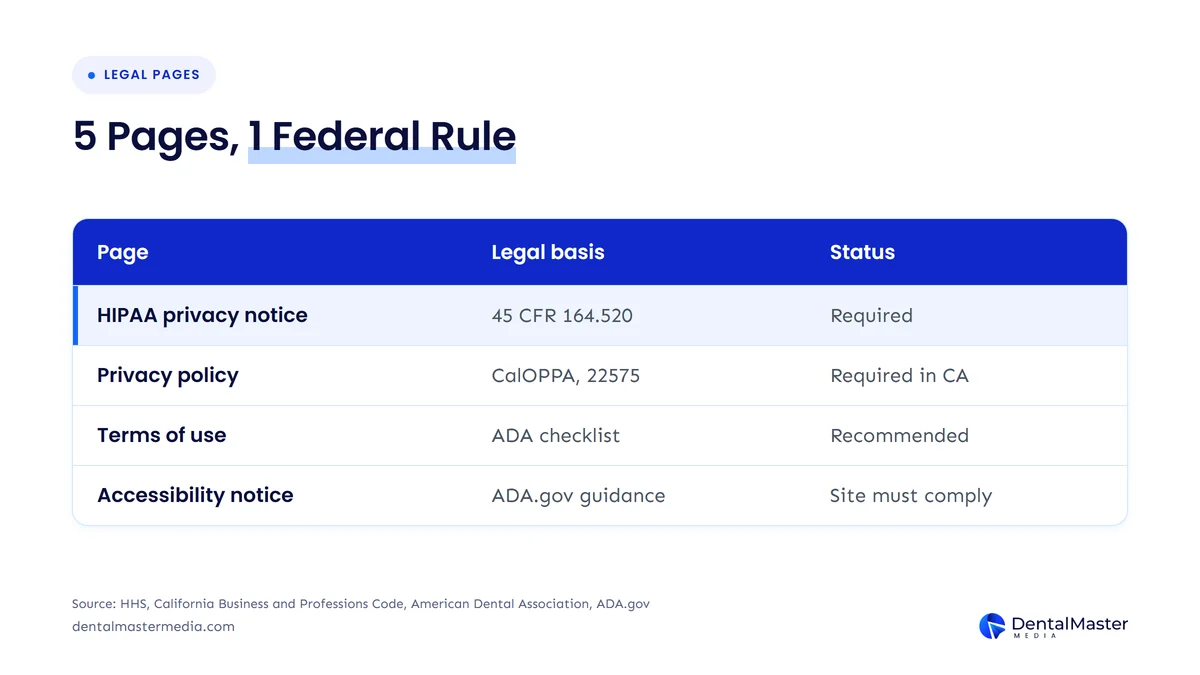
A dental website needs 6 legal elements according to the American Dental Association: the practice’s legal name and contact details, a privacy policy, a HIPAA Notice of Privacy Practices, terms of use, a notice of nondiscrimination and a copyright notice. Only some of these are required by a specific law, so the table below separates the legal basis from the recommendation.
| Legal page | Legal basis | Status | What it does |
|---|---|---|---|
| HIPAA Notice of Privacy Practices | HIPAA Privacy Rule, 45 CFR 164.520(c)(3) | Required for covered practices | Tells patients how their health information is used and disclosed |
| Privacy policy | California Online Privacy Protection Act, Business and Professions Code 22575, for California visitors; listed by the American Dental Association | Required when the site collects personal information from California residents; recommended for every practice | Explains what the website collects through forms, cookies and tags |
| Terms of use | Listed in the American Dental Association website checklist | Recommended | Sets the rules for using the site and its content |
| Accessibility and nondiscrimination notice | ADA.gov web guidance for Title III businesses; Section 1557 as cited by the American Dental Association | Accessible website required; notice listed in the checklist | Commits the practice to equal access and gives a contact for problems |
| Disclaimers and copyright notice | Truthful advertising rules such as California Business and Professions Code 651 | Wording recommended; truthful claims required | Limits what readers assume from general health information |
The table shows that the HIPAA notice is the page with the clearest federal requirement, while the others rest on state law, federal civil rights guidance or professional advice.
Each legal page sits in the footer of every page, so the footer is part of the dental website design guide layout, not an afterthought. The sections below take the pages in the order of the table.
What is a HIPAA Notice of Privacy Practices?
A HIPAA Notice of Privacy Practices is a written notice that tells patients how a practice may use and disclose their health information, what rights they have and how to complain. The HIPAA Privacy Rule requires a covered dental practice that has a website describing its services to prominently post the notice there and make it available electronically.
The rule sits at 45 CFR 164.520. Paragraph (c)(3) covers the website, and paragraph (c)(2)(ii) says a covered provider must make a good faith effort to get a written acknowledgment of receipt from each new patient. ADA News repeated the website requirement for dentists on November 14, 2022. Whether your practice is a HIPAA covered entity depends on how it handles billing and health information, so your attorney or HIPAA officer should confirm your status.
The 4 practical steps for the notice are listed below.
- Use the practice’s own notice text, not a copy of another practice’s text, because the notice must match how your office handles information.
- Post the Notice of Privacy Practices on a page of its own and link it from the footer of every page.
- Offer a downloadable PDF so patients can keep a copy.
- Revise the notice and the page whenever your privacy practices change in a material way.
Our HIPAA compliance guide for dental practices covers the wider rules around patient information.
What is a dental website privacy policy, and how is it different?
A dental website privacy policy is a page that tells visitors what personal information the website collects, how it is used and who it is shared with. It differs from the Notice of Privacy Practices because the privacy policy covers the website, while the HIPAA notice covers the protected health information the practice holds about its patients.
California’s online privacy law, the California Online Privacy Protection Act, requires the operator of a commercial website that collects personal information from California residents to conspicuously post a privacy policy. The operator violates the law only if the policy is still missing 30 days after being notified of noncompliance. The Business and Professions Code, section 22575, lists what the policy must say.
The 6 items a California privacy policy must cover are listed below.
- Categories of information: the categories of personally identifiable information the website collects and the third parties it may share them with.
- Review process: a description of how visitors can review and correct their information, if the site offers that.
- Change notice: how the practice tells visitors about material changes to the policy.
- Effective date: the date the policy took effect.
- Do not track: how the site responds to web browser do not track signals, if it collects information across other sites.
- Third-party collection: whether other parties may collect personal information about visitors’ activity across sites.
The privacy policy has to describe what your website really does. A policy that says you collect nothing, while a chat widget and an ad tag collect data, is worse than a short and accurate one.
Does a dental website need a cookie banner?
A dental website does not need a cookie banner under any single US rule found in the sources reviewed for this guide, but it does need to control what its cookies and tracking technologies send to third parties. The risk sits in tags on appointment, contact and symptom pages, where a visit can reveal protected health information.
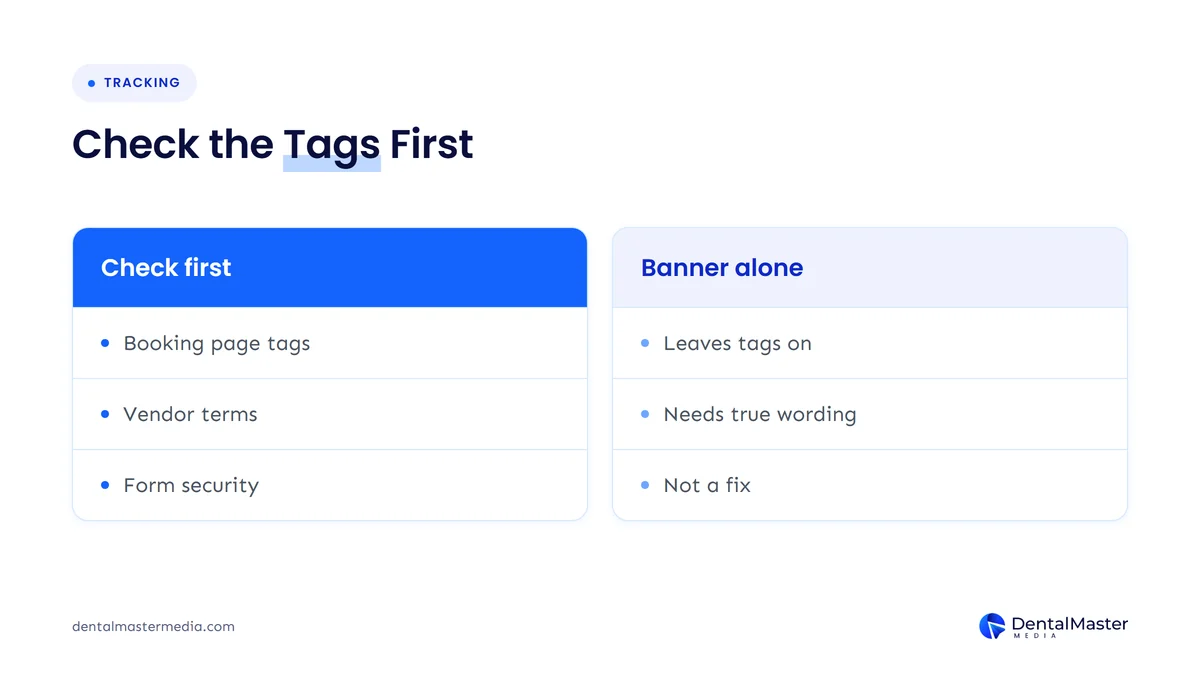
The HHS Office for Civil Rights published a bulletin on online tracking technologies in December 2022 and updated it on March 18, 2024. It says a HIPAA regulated practice needs a business associate agreement with a tracking vendor that handles protected health information, or a patient authorization. On June 20, 2024, a federal judge in Texas, Judge Mark Pittman, vacated the part of the bulletin called the Proscribed Combination, which treated an IP address plus a visit to an unauthenticated health page as protected information. The court did not vacate other parts of the bulletin.
Google’s own guidance is stricter than the law on one point. Google Analytics Help says Google does not offer business associate agreements for Google Analytics and that HIPAA covered customers must refrain from exposing to Google any data that may be considered protected health information. The thresholds below show when California’s consumer privacy law adds a banner or opt-out link on top.
| Rule | Number | What it means for a dental practice |
|---|---|---|
| California Consumer Privacy Act: revenue test | Over $25 million in gross annual revenue | Compare this figure with your practice’s total annual revenue |
| California Consumer Privacy Act: data volume test | 100,000 or more California residents or households | Applies to businesses that buy, sell or share that much personal information |
| California Consumer Privacy Act: revenue share test | 50% or more of annual revenue from selling personal information | Compare it with how your practice earns its revenue |
| California Consumer Privacy Act: response time | Up to 15 business days | Time allowed to respond to an opt-out request |
The California Attorney General states that a business meeting any 1 of the 3 tests must comply, and that the law exempts certain medical information, so a dental group or a multi-state organization should ask a lawyer whether it is covered.
If you add a cookie banner, 3 rules keep it honest: the banner must match what the tags actually do, a refused tag must really stay off, and the banner does not replace removing tags from pages that handle patient information. Visitors from the European Union fall under different rules that are outside this US-focused guide.
What disclaimers does a dental website need?
A dental website needs disclaimers that limit what readers assume from general health information, but no disclaimer makes a false or misleading claim legal. The American Dental Association’s checklist names advertising and endorsements as a risk area and gives “totally painless” as an example of a claim to avoid.
The 4 disclaimers worth writing are listed below.
- Medical disclaimer: says the articles and pages give general information and are not a diagnosis, treatment plan or personal advice, and tells readers to call the practice for care.
- Results disclaimer: says that outcomes differ from patient to patient and that before and after images are of real patients, with permission, if that is the case.
- Emergency notice: tells visitors with a medical emergency to call 911 instead of using a contact form.
- Fees and coverage notice: says fee and coverage information is an estimate that depends on the patient’s plan.
Advertising law sits behind these notices. California Business and Professions Code 651, one example of a state dental board rule, bars a licensee from advertising with a false, fraudulent, misleading or deceptive statement, claim or image, and counts a testimonial that omits material facts. Your own state dental board publishes its version of this rule, so read it before you write claims.
The Federal Trade Commission added a second layer. Its final rule on fake reviews and testimonials, announced on August 14, 2024, bars fake or false reviews, including AI-generated ones, and reviews from insiders who do not disclose their connection to the business. Our patient testimonial rules page explains how that applies to the reviews you show on your site.
What belongs in the terms of use?
The terms of use are a page that sets the rules for using a dental website and protects the practice’s content. The American Dental Association lists terms of use as a website element but does not publish required text, so the contents below are a drafting checklist for your lawyer.
- Information only: a statement that the site gives general information and is not a patient relationship.
- Content ownership: a copyright notice and a rule on reusing text and images.
- Links and third parties: a note that outside sites are not controlled by the practice.
- Changes: the right to update the terms, with a visible date.
Does a dental website need an accessibility statement?
Yes, a dental website needs to be accessible, and an accessibility statement is the page that says so and tells visitors how to report a problem. ADA.gov’s web guidance, dated March 18, 2022, says Title III of the Americans with Disabilities Act applies to businesses open to the public, including what they offer on the web, and points to the Web Content Accessibility Guidelines as helpful technical guidance.
The statement does not make the site accessible. Fixing contrast, alt text, form labels and keyboard use does, and our post on dental website accessibility covers those fixes in detail.
How do you add legal pages to a dental website?
You add legal pages to a dental website by confirming your HIPAA status, getting lawyer-approved text for each page, publishing each page with a footer link and then checking that your tags match what the pages say. The 6 steps below put the work in order.
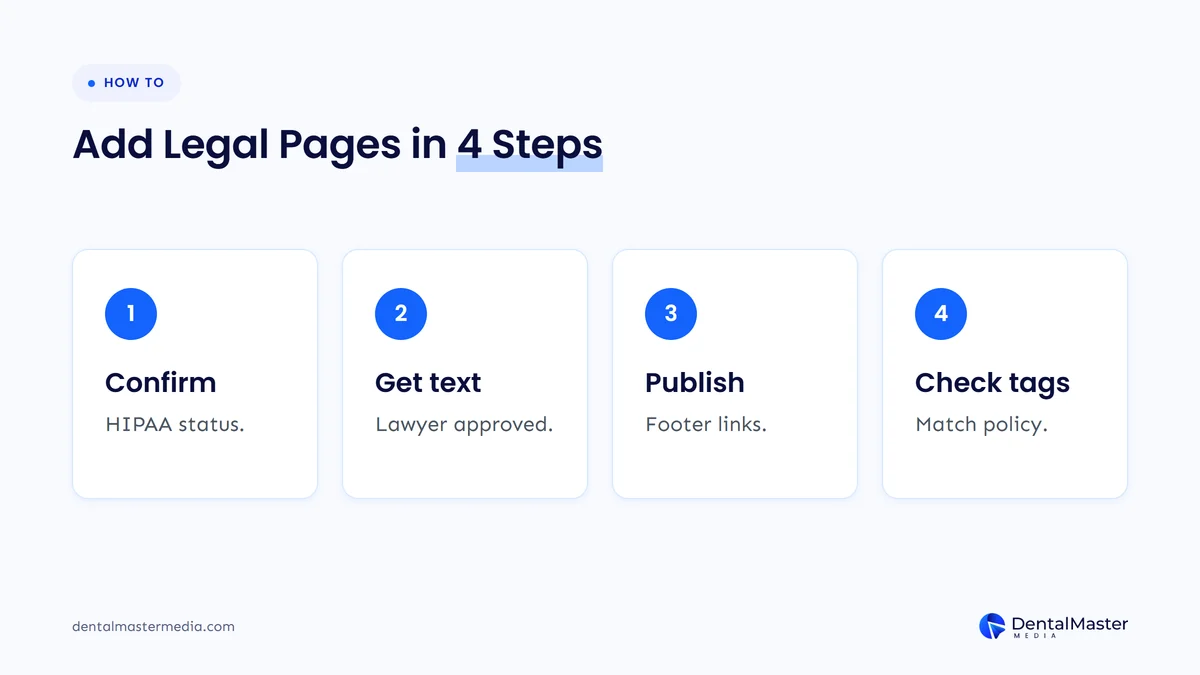
The 6 steps for adding the pages are listed below.
- Confirm whether your dental practice is a HIPAA covered entity and which state laws apply to your patients.
- Collect the text for the Notice of Privacy Practices, privacy policy, terms of use, accessibility statement and disclaimers from your attorney, using the American Dental Association’s HIPAA resources as a starting point.
- Publish each page on its own URL and link all of them from the footer of every page.
- List every form, chat widget, analytics tag and ad pixel on the website, and write the privacy policy from that list.
- Remove or restrict any tag that sends protected health information to a vendor without a business associate agreement.
- Review the pages whenever your tools, forms or practices change, and update the effective date each time.
Who should write the legal pages of a dental website?
A lawyer who knows your state should write or approve the legal pages of a dental website, and your web designer should build them, link them and keep them current. Legal text is a legal product. Page layout, footer links, form setup and tag control are website work.
That split also keeps costs clear. A new Dental Master Media website starts at $999 for 10 pages, takes about 30 days to build and comes with 30 days of support, and legal pages are part of the page plan from the start, not added at the end. A lawyer’s fee for the text is a separate cost with a separate provider.
Templates from dental software or marketing vendors are a fair starting draft. They are not a substitute for a review, because each practice collects different data and each state has different rules.
Frequently asked questions
Does my dental website need a privacy policy?
Yes, your dental website should have a privacy policy, and California law requires one when the site collects personal information from California residents. The California Online Privacy Protection Act requires the policy to be conspicuously posted. The American Dental Association also lists a privacy policy as a standard website element.
Does a dental website have to be HIPAA compliant?
Yes, a dental website must follow HIPAA if the practice is a covered entity and the site transmits, stores or collects protected health information. A covered practice must also post its Notice of Privacy Practices on the website. Web forms that capture patient details should be secure and encrypted, according to ADA News.
Do I need a medical disclaimer on my dental website?
No, none of the laws cited in this guide requires a standalone medical disclaimer, but a short one is good practice. It tells readers that your pages give general information and are not personal advice. It does not excuse a false or misleading claim.
Can I show patient testimonials on my dental website?
Yes, you can show patient testimonials if they are real, complete and not misleading. California Business and Professions Code 651 counts a testimonial that omits material facts as misleading, and the Federal Trade Commission’s 2024 rule bans fake reviews. Check your state dental board’s advertising rule first.
Can I copy a legal page template for my dental website?
Yes, you can use a template as a first draft, but your attorney should review it before it goes live. A copied Notice of Privacy Practices or privacy policy can describe practices that your office does not follow, and that mismatch is the problem, not the borrowed wording.
Dental website legal requirements: the short version
A dental website needs a HIPAA Notice of Privacy Practices, a privacy policy, terms of use, an accessibility and nondiscrimination notice and honest disclaimers. The HIPAA notice has the clearest federal rule behind it, a privacy policy is required in California and is standard everywhere, and a cookie banner matters less than keeping protected health information away from tracking tags. This guide is not legal advice, so have a lawyer review the final text.
At Dental Master Media, our dental website design service builds the pages and footer links for the text your attorney approves, and our dental SEO services keep the site found once it is live.
Get a dental website that is built to be reviewed by your lawyer
Book a free strategy call and we will walk through your current website, the legal pages it has today and the tags and forms that need a second look. You leave with a clear list of what to ask your attorney and what we can build for you.
Sources
- American Dental Association, “Check your website for legal risks”, 2026. https://www.ada.org/resources/practice/legal-and-regulatory/check-your-website-for-legal-risks
- ADA News, “HIPAA compliance includes website compliance”, November 14, 2022. https://adanews.ada.org/ada-news/2022/november/hipaa-compliance-includes-website-compliance/
- US Department of Health and Human Services, 45 CFR 164.520, “Notice of privacy practices for protected health information” (text via Cornell Legal Information Institute). https://www.law.cornell.edu/cfr/text/45/164.520
- HHS Office for Civil Rights, “Use of Online Tracking Technologies by HIPAA Covered Entities and Business Associates”, updated March 18, 2024. https://www.hhs.gov/hipaa/for-professionals/privacy/guidance/hipaa-online-tracking/index.html
- American Hospital Association, “Judge rules in favor of AHA, vacating HHS online tracking bulletin”, June 20, 2024. https://www.aha.org/news/news/2024-06-20-judge-rules-favor-aha-vacating-hhs-online-tracking-bulletin-unlawful-and-beyond-agency-authority
- Google Analytics Help, “HIPAA and Google Analytics”. https://support.google.com/analytics/answer/13297105
- State of California, Business and Professions Code section 22575 (California Online Privacy Protection Act). https://california.public.law/codes/ca_bus_and_prof_code_section_22575
- State of California, Business and Professions Code section 651. https://california.public.law/codes/ca_bus_and_prof_code_section_651
- California Attorney General, “California Consumer Privacy Act (CCPA)”. https://oag.ca.gov/privacy/ccpa
- Federal Trade Commission, “Federal Trade Commission Announces Final Rule Banning Fake Reviews and Testimonials”, August 14, 2024. https://www.ftc.gov/news-events/news/press-releases/2024/08/federal-trade-commission-announces-final-rule-banning-fake-reviews-testimonials
- ADA.gov, “Guidance on Web Accessibility and the ADA”, March 18, 2022. https://www.ada.gov/resources/web-guidance/

Suraj Rana is the owner of Dental Master Media and a leading expert in SEO for dental practices. With a passion for dental marketing, he has successfully helped numerous dental clinics climb the search engine ranks. Suraj’s expertise makes him a go-to resource for effective, results-driven dental marketing.