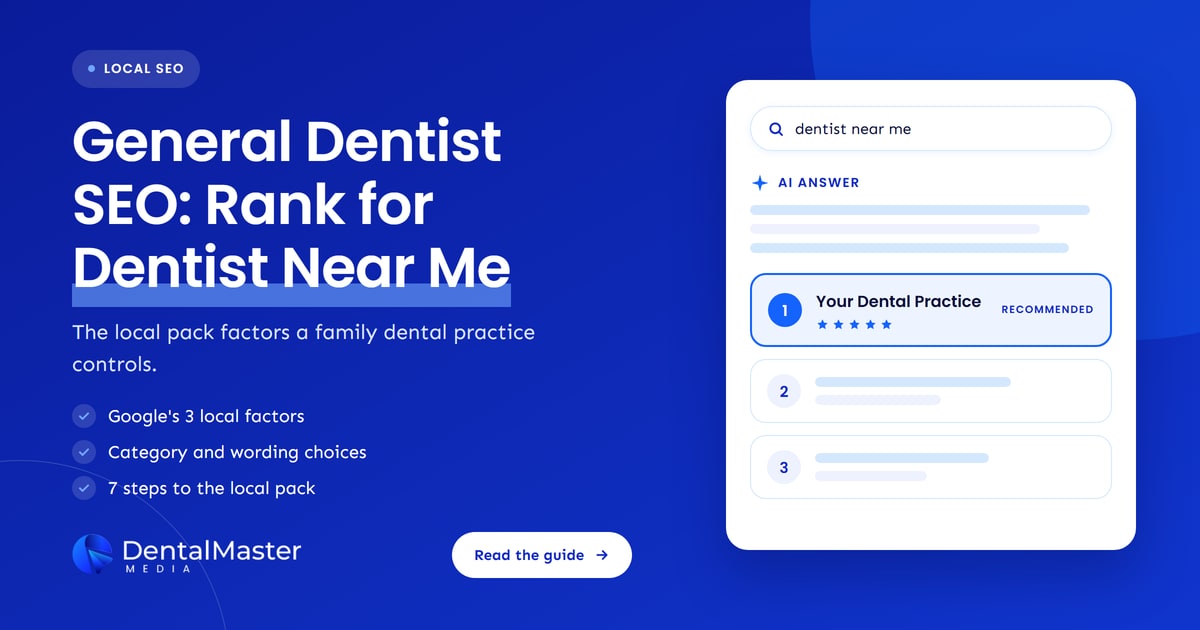
Quick answer: A general dentist ranks for “dentist near me” by winning the Google local pack. Set the right primary category on your Google Business Profile, keep your name, address, phone and business hours identical everywhere, collect recent reviews with text, and build one service page per treatment. Distance is fixed, so these factors decide which nearby practice shows first.
Key takeaways
- General dentist SEO is the work of making a general or family dental practice show up in local search, and “dentist near me” is its biggest head term.
- Google ranks local results on 3 factors: relevance, distance and prominence, and its Help page says there is no way to pay for a better local ranking.
- In Whitespark’s 2026 survey of 47 local SEO experts, the primary Google Business Profile category ranked first and searcher-to-business distance ranked second.
- Distance can’t be changed, but categories, business hours, reviews and the profile’s accuracy can.
- “Family dentist” and “general dentist” are not among the 12 dental specialties the ADA’s national commission recognizes, so use them as plain descriptions, not specialty claims.
- Treatment searches such as dentures and pediatric care build on the head term once the basics are in place.
What is general dentist SEO?
General dentist SEO is the set of changes to a dental practice’s Google Business Profile, website and reviews that helps a general dentist or family dentist appear in Google Maps and the local pack when patients search “dentist near me”. The local pack is the short list of 3 map results that Google shows above the regular results for a nearby search.
“Dentist near me” is one of the largest local search terms in dentistry, but tools disagree on its size. Semrush’s dental SEO article of December 15, 2023 reports about 1.2 million monthly U.S. searches, while SE Ranking’s article of June 11, 2024 reports about 2.2 million. Both figures are estimates, so treat the term as a million-search-a-month opportunity, not an exact number. Our dental SEO services start from the same place: a complete, accurate profile and a website that matches it.
A general dentist competes with every other dental practice near the searcher, so the work is local search work first and keyword work second.
How does Google rank a general dentist for “dentist near me”?
Google ranks a general dentist for “dentist near me” using 3 factors that Google Business Profile Help names: relevance, distance and prominence. The 3 local ranking factors are listed below.
- Relevance: how well the Business Profile of the general dentist matches what the patient searched for, which depends on the primary category and on complete, detailed information.
- Distance: how far the practice is from the person searching, measured when the search happens.
- Prominence: how well known the dental practice is, which Google ties to review count, ratings and the practice’s presence across the web.
Google also states that there is no way to request or pay for a better local ranking, and that businesses with complete and accurate information are more likely to show up in local search results. That makes the profile itself the first thing to fix.
Which local ranking factors matter most for a general dentist?
The primary Google Business Profile category matters most for a general dentist, scoring 227 in Whitespark’s Local Search Ranking Factors 2026, followed by searcher-to-business distance at 225. Whitespark published the 2026 edition on November 6, 2025, based on a survey of 47 local search experts, and the table below lists the factors a dental practice can act on.
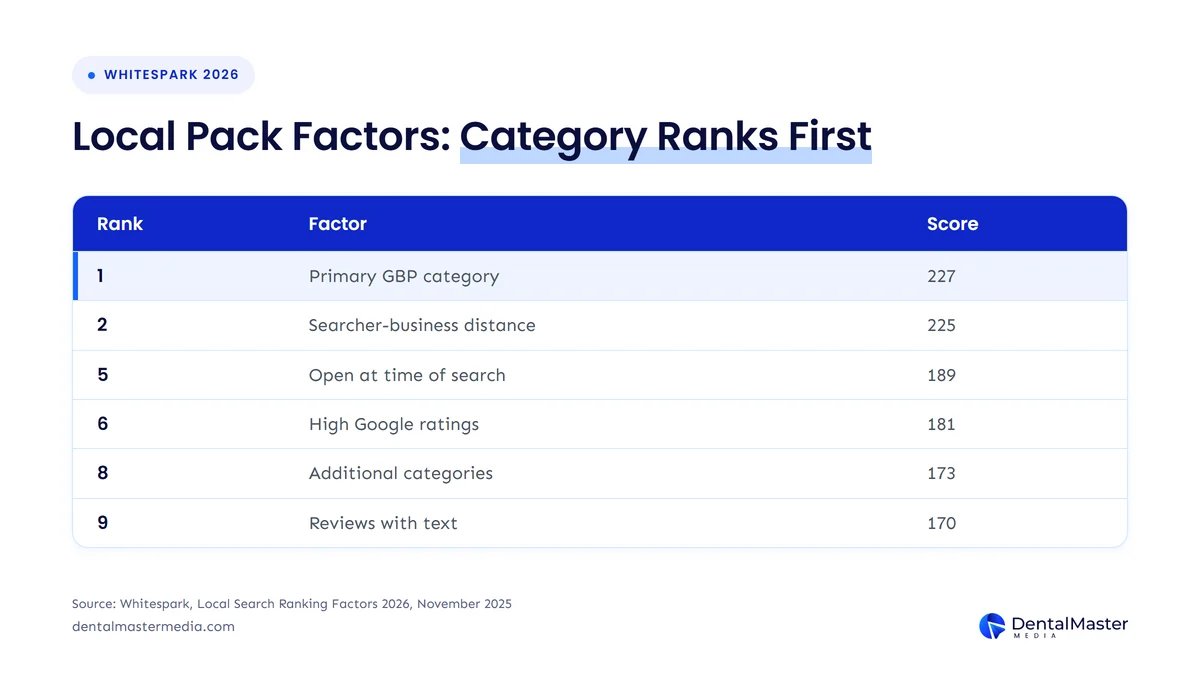
| Rank | Factor (Whitespark 2026) | Survey score | What a general dentist controls |
|---|---|---|---|
| 1 | Primary GBP category | 227 | The primary category in the profile |
| 2 | Searcher-business distance | 225 | Nothing, except an accurate map pin |
| 3 | Keywords in the GBP business title | 223 | Only the real-world name; Google bans extras |
| 4 | Physical address in the city of search | 213 | An accurate, real street address |
| 5 | Business is open at time of search | 189 | Accurate business hours, including late and weekend hours |
| 6 | High numerical Google ratings (4 to 5) | 181 | Patient experience and review requests |
| 8 | Additional GBP categories | 173 | Extra categories that describe real services |
| 9 | Quantity of native Google reviews with text | 170 | A steady flow of written reviews |
The table shows that the 2 highest local ranking factors are a category choice the practice makes in minutes and a distance it cannot change.
Review recency ranked 11th in the same survey with a score of 164, which is why one burst of reviews followed by silence works less well than a steady flow.
Why does a general dentist rank in one area and not another?
A general dentist ranks in one area and not another because Google weighs distance from the searcher, so a practice usually appears first for patients closest to it. Whitespark’s 2026 survey scored searcher-to-business distance at 225, second only to the primary category, and scored proximity to the city centroid lower at 157, 12th.
A practice cannot move closer to every neighborhood, and Google’s guidelines rule out the shortcuts. Google requires a precise, accurate address, says P.O. boxes and remote mailboxes are not acceptable, and says virtual offices are not eligible for a Business Profile. A second profile for the same location also breaks the rule of one profile per location.
The practical response is to win the factors that stretch a practice’s reach: stronger relevance and stronger prominence let a general dentist appear for searches slightly further away than a competitor with a thinner profile. To see how far your reach really goes, search “dentist near me” from the practice and from 2 other neighborhoods you serve, and note where the practice drops out of the local pack.
Which Google Business Profile categories should a general dentist choose?
A general dentist should choose the most specific category that still represents the main business, and add additional categories only for services the practice really provides. Google’s guidance is to use the fewest categories that describe your overall core business, as specific as possible, and to pick a more general category if no specific one fits.
The primary category is the first factor in Whitespark’s 2026 list, so it deserves the most attention. For a practice that offers routine care to all patients, the plain Dentist category is the general choice, and the category list in your profile shows the current options. We cover the other profile fields that often go wrong in 7 Google Business Profile settings dental practices often get wrong.
Additional categories rank 8th in Whitespark’s survey at 173, but the evidence for dentists is weaker than for other industries. BrightLocal’s study of June 20, 2023 covered 1,050 business locations across 7 industries and found that businesses with 4 additional categories had the best average map ranking overall, 5.9, against 7.6 for businesses with none. For dentists, it found no clear pattern: the best group averaged 7.3 with 1 additional category. Add categories that match real services, such as cosmetic or emergency care, and don’t expect a ranking jump from the count alone.
Keep the business name plain. Keywords in the profile title ranked 3rd in Whitespark’s survey at 223, but Google’s guidelines say the name should reflect the real-world name and that service or location details in the name are not permitted, which can lead to suspension.
Family dentist or general dentist: which wording should the practice use?
A practice should use the wording its patients search and the wording that is true for the practice: “family dentist” fits a practice that treats children and adults, and “general dentist” fits a practice that provides routine care without a specialty. The American Dental Association’s National Commission on Recognition of Dental Specialties and Certifying Boards recognizes 12 dental specialties, and neither label is one of them.
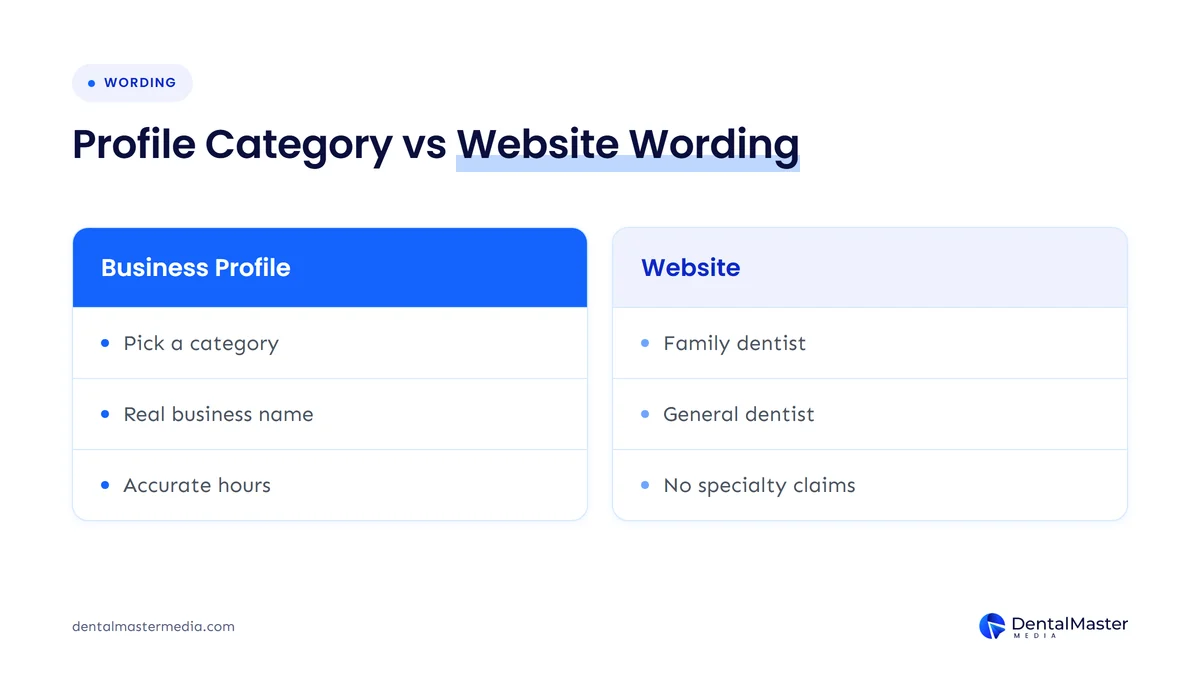
The category and the website wording do different jobs, and the 2 items below show where each term belongs.
- In the Google Business Profile: choose a category from Google’s list, because the profile category carries the weight and free-text wording does not replace it.
- On the website: use “general dentist” and “family dentist” in the homepage heading, service pages and location details, in the words your patients use.
Because neither label is a recognized specialty, avoid wording that suggests specialist training you do not hold, and check your state dental board’s advertising rules before you publish. Practices that see many children can also read our guide on how to attract more pediatric dental patients online.
How do you rank a general dentist practice for “dentist near me”?
You rank a general dentist practice for “dentist near me” by completing 7 steps in order: fix the profile, align every listing, then build the website and reviews that raise prominence.
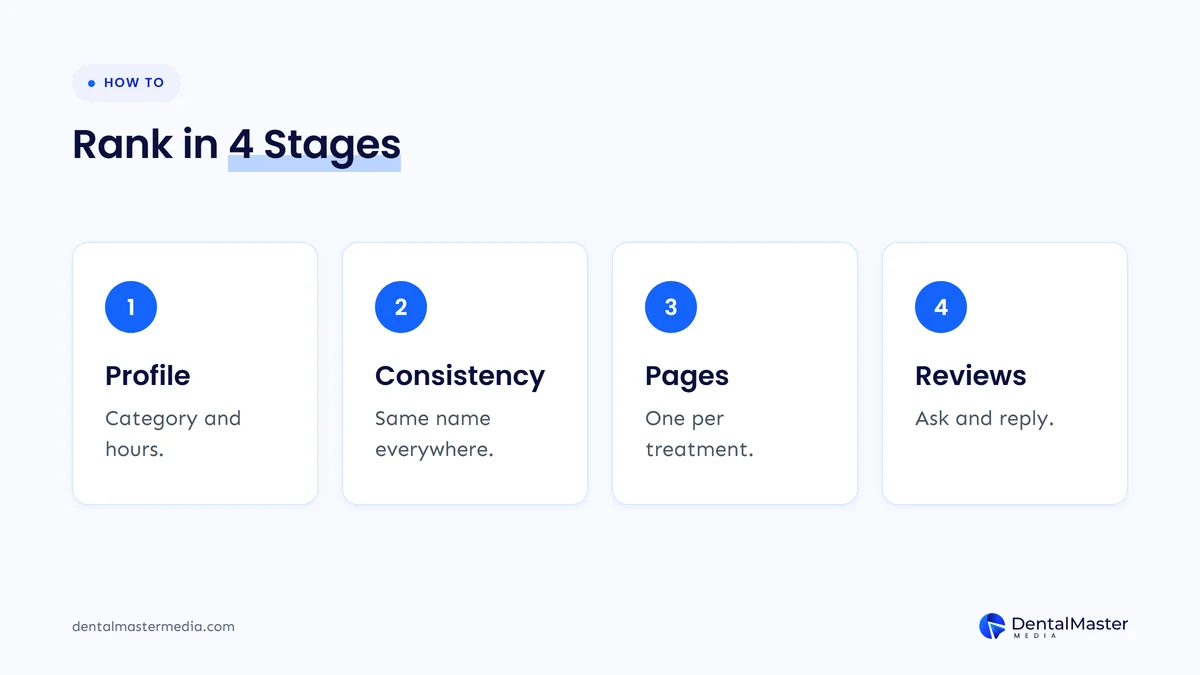
The 7 steps for a general dentist practice are listed below, each with one outcome.
- Verify the Google Business Profile and complete every field, because Google says complete and accurate information makes a business more likely to appear.
- Set the primary category to the most specific category that represents the practice, then add additional categories for real services.
- Match the name, address and phone number on the website, the profile and other listings, and remove duplicates, as covered in our guide to fixing duplicate or wrong Google listings.
- Enter accurate business hours for the days and times patients can really book, because being open at the time of search ranked 5th in Whitespark’s survey at 189.
- Build one service page per treatment, with the treatment, the city and the booking link on the page; the layouts in dental service page design show how.
- Ask every patient for a Google review with text, and reply to each one, since Google says replies show you value feedback and more reviews and positive ratings can help local ranking.
- Test your local pack position from the practice and from 2 nearby neighborhoods each month, and use Google Search Console for the website pages that bring searchers to the practice.
Booking should be one tap away once a patient finds the practice, so check that the profile links to a working appointment page.
How do treatment searches build on general dentist rankings?
Treatment searches build on general dentist rankings because a practice that already appears for “dentist near me” has the profile, reviews and pages that treatment searches also need. A patient looking for dentures, veneers or a children’s dentist usually searches a treatment name plus a location, and each of those searches is won by a dedicated service page.
That is the border between this guide and the next one: this page covers the head term, and each treatment has its own page and its own questions. Denture searches are a good example, and we cover them in Denture SEO: getting found for dentures, partials and relines.
Frequently asked questions
Does a general dentist need a different SEO strategy from a specialist?
Yes, a general dentist needs a broader strategy than a specialist, because a general practice competes for the head term “dentist near me” and for many treatment searches, while a specialist competes in one treatment. The 3 Google local factors of relevance, distance and prominence apply to both.
Can I pay Google to rank for “dentist near me”?
No, you cannot pay Google for a better local ranking. Google Business Profile Help states that there is no way to request or pay for a better local ranking, so ranking comes from relevance, distance and prominence.
Should I put “family dentist” in my Google Business Profile name?
No, you should not add “family dentist” or other keywords to your business name. Google’s guidelines say the name should reflect your real-world name and that service or location details in the name are not permitted, so keywords in the name risk a suspension.
How many Google categories should my dental practice use?
A dental practice should use the fewest categories that describe its core business, and Google says to pick them as specific as possible. BrightLocal’s 2023 study of 1,050 locations found no clear category-count pattern for dentists, so add categories only for services you really provide.
How long does it take to rank for “dentist near me”?
Ranking for “dentist near me” can take months, depending on the competition near the practice. Semrush’s dental SEO article of December 15, 2023 says results are typically seen in 4 to 12 months, and it gives that as an estimate, not a promise.
Conclusion
A general dentist wins “dentist near me” by controlling the factors Google lets a practice control: the primary category, accurate business hours, a profile that matches the website, steady written reviews and a service page for every treatment. Distance sets the starting position, and the rest decides how far the practice’s reach extends.
If you want a specialist team to run this for you, Dental Master Media offers dental SEO services built around the Google Business Profile and local pack, or you can book a free dental SEO strategy call to talk through your practice.
Want to rank for “dentist near me”?
Book a free strategy call and we will review your Google Business Profile, categories and local pack position with you.
Sources
- Google Business Profile Help, “Tips to improve your local ranking on Google”, accessed November 27, 2026. https://support.google.com/business/answer/7091
- Google Business Profile Help, “Guidelines for representing your business on Google”, accessed November 27, 2026. https://support.google.com/business/answer/3038177
- Whitespark, “Local Search Ranking Factors 2026”, published November 6, 2025 (47 local search experts). https://whitespark.ca/local-search-ranking-factors/
- BrightLocal, “Study: Do Additional GBP Categories Boost Local Rankings?”, June 20, 2023. https://brightlocal.com/research/study-do-additional-gbp-categories-boost-local-rankings/
- Semrush, “Dental SEO”, December 15, 2023. https://www.semrush.com/blog/dental-seo/
- SE Ranking, “SEO for dentists: A step-by-step guide”, June 11, 2024. https://seranking.com/blog/seo-for-dentists/
- American Dental Association, National Commission on Recognition of Dental Specialties and Certifying Boards, “Recognized Dental Specialties”, accessed November 27, 2026. https://ncrdscb.ada.org/recognized-dental-specialties

Suraj Rana is the owner of Dental Master Media and a leading expert in SEO for dental practices. With a passion for dental marketing, he has successfully helped numerous dental clinics climb the search engine ranks. Suraj’s expertise makes him a go-to resource for effective, results-driven dental marketing.